Seamless vs ZoomInfo: Best for B2B Leads 2026

Seamless vs ZoomInfo: Best for B2B Leads 2026

Choosing between Seamless.AI and ZoomInfo isn’t some small database decision, because it directly shapes how your team builds lead lists, prioritizes accounts, enriches CRM records, and eventually turns all that data into personalized outreach.

Both platforms help sales teams find targeted leads, pick up intent signals, and feed your entire tech stack actionable data and sales intelligence. 

But the right fit will depend on how your team works in practice, whether you mainly need quick contact discovery, richer account intelligence, buyer intent data, or a more complete outbound execution system that takes leads all the way into conversations and booked meetings.

What are Seamless.AI and ZoomInfo?

Seamless.ai and ZoomInfo are both B2B lead generation and sales intelligence platforms that help sales teams find potential buyers, uncover their emails, phone numbers, company details, job titles, and other account-level context, prioritize leads, and build prospecting GMT workflows. 

The difference is how each tool gets the job done.

What is Seamless? 

Seamless is positioned as an AI-powered prospecting tool and B2B contact database for teams that want to find decision-makers quickly, build lead lists, enrich records, and start outreach with little to no friction. 

Its core product experience is built around real-time search, contact discovery, enrichment, buyer intent signals, job change tracking, and now more engagement features through tools like Connect, Emailing, Calling, Social Selling, and AI Assistant.
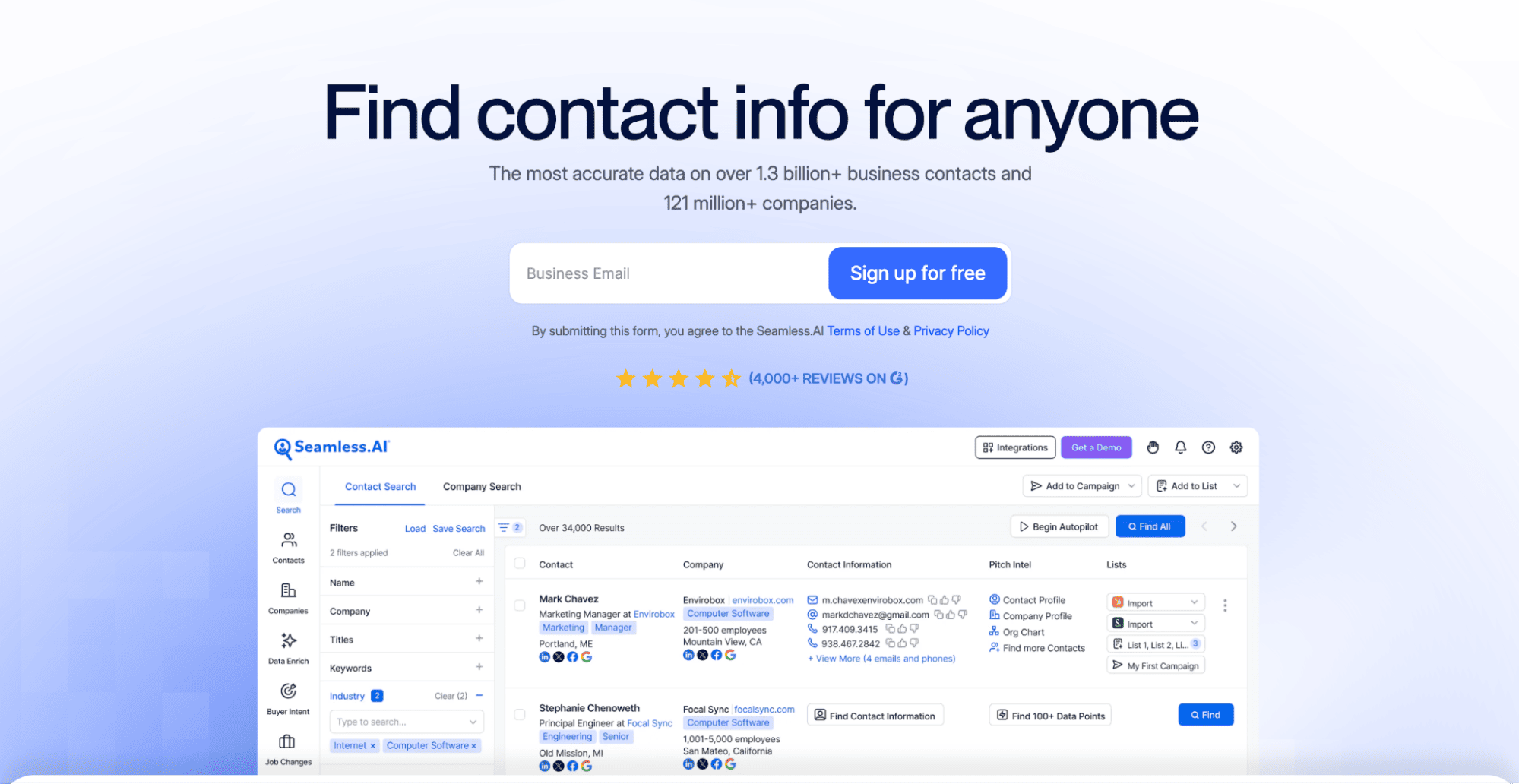
Seamless.ai, one of the prospecting tools for sales

Unlike traditional databases that mainly return stored contact records, Seamless searches and validates prospect data in real time, which is its main product differentiator. Its Buyer Intent product covers more than 10,000 topics across 170+ categories, while the Job Changes feature tracks promotions and company moves that can signal fresh buying authority. 

Its Connect feature then lets teams act on those signals inside the same platform by building simple multi-step sequences, automating follow-ups, and tracking engagement without exporting leads into a separate tool (unless you’re generating leads at scale, but more on that later). 

All this makes Seamless a strong fit for sales teams, founders, recruiters, and agencies that care about speed of execution. You search for a specific ICP, pull emails and direct dials, enrich the missing fields, and move those prospects into the next outreach step.

What is ZoomInfo? 

ZoomInfo is an enterprise sales intelligence platform for companies that need much more than a basic list of emails and phone numbers. It brings together company and contact data with buying signals, technographics, org charts, CRM enrichment, website visitor intelligence, and workflow automation, giving GtM teams more context to identify, prioritize, and engage the accounts that are most likely to convert.
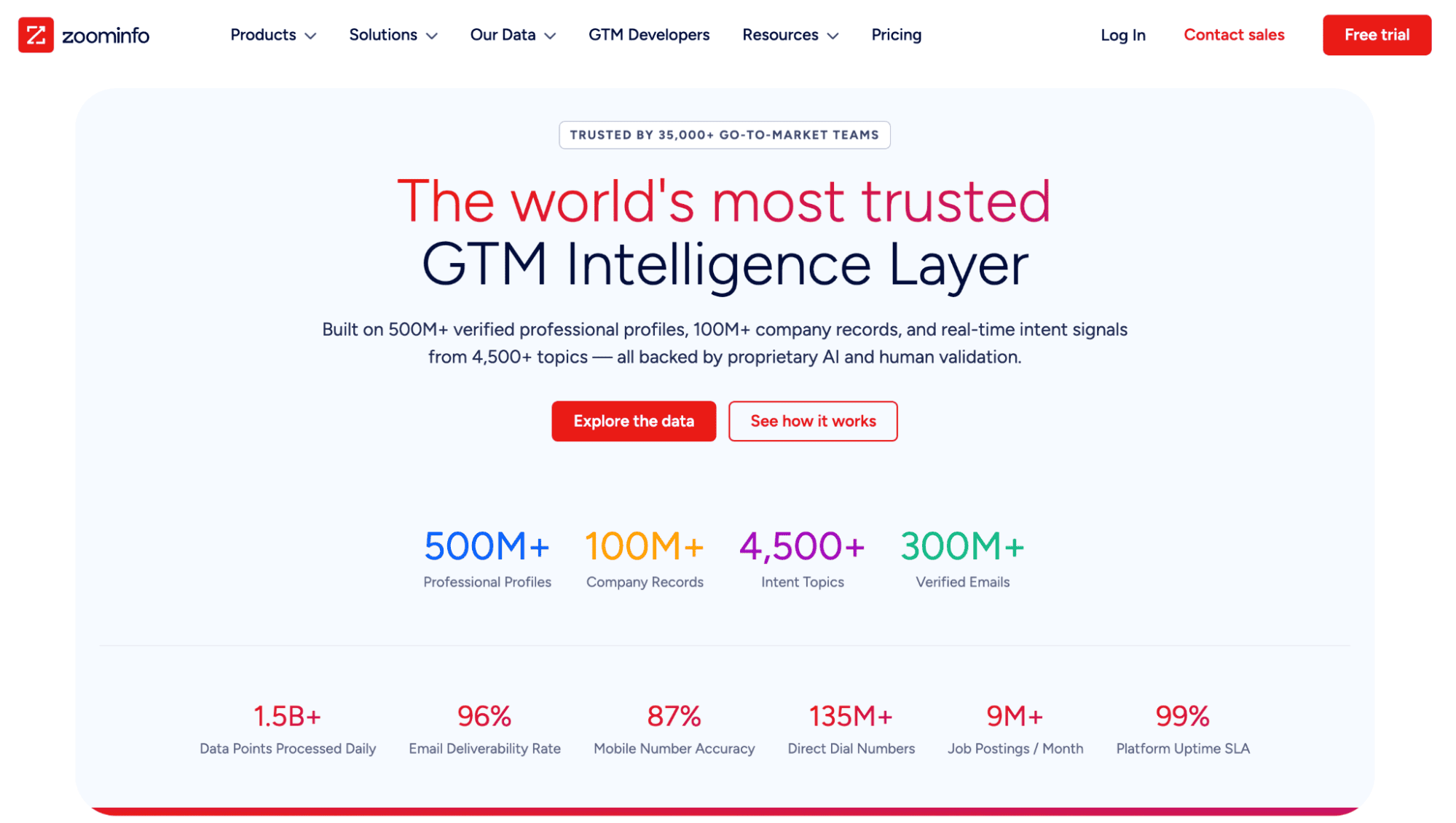
Hero section promoting GTM Intelligence Layer with headline “The world's most trusted GTM Intelligence Layer” and action buttons “Explore the data” and “See how it works.”

Its biggest strength is account intelligence depth. Sales teams can see a company’s tech stack, map buying committees through org charts, track hiring trends and executive changes, spot accounts researching relevant topics through intent data, and keep CRM records updated automatically through enrichment.

All this makes ZoomInfo especially useful for enterprise sales, account-based selling (ABS), and RevOps teams managing large territories, long buying cycles, and several stakeholders at once.

Rather than simply helping reps find prospects, ZoomInfo is built to help GTM teams decide which accounts to prioritize, when to engage them, and why, which makes it one of the most comprehensive sales intelligence platforms for mid-market and enterprise organizations on the market. 

Seamless vs ZoomInfo: quick verdict

For those in a rush and simply wanting a brief overview of when Seamless vs ZoomInfo is the right pick, the right answer comes down to what your sales/GTM motion needs the most:

Category Better fit
Fast B2B contact discovery Seamless
Enterprise sales intelligence ZoomInfo
Buyer intent and account context ZoomInfo
Simpler adoption for smaller teams Seamless
CRM enrichment and GTM operations ZoomInfo
Turning leads into AI outreach & meetings Reply.io 

In short, choose Seamless if your team needs a prospecting tool that helps reps quickly find emails and phone numbers, company records, and intent signals, and launch simple yet fully automated outreach sequences. Choose ZoomInfo if you need a deeper sales intelligence platform with deeper account data, org charts, and enterprise-grade GTM workflows.

Choose Reply.io if your main bottleneck is not finding leads, but turning those leads into personalized multichannel outreach, replies, and booked meetings. In practice, whether you go with Seamless or Zoominfo, you’d still want to connect it to an AI outreach platform like Reply to turn all the uncovered sales intelligence into tailored and coordinated outreach campaigns at scale. 
Seamless.AI vs ZoomInfo: feature-by-feature comparison

While both platforms help sales teams find B2B leads, they take noticeably different approaches to prospecting and sales intelligence. Below, we’ll compare Seamless vs ZoomInfo across the features that have the biggest impact on outbound performance and overall ROI.

B2B lead database and data accuracy

Both platforms are primarily built for B2B contact data, but they position that data differently, and they come with different secondary features to make full use of that data down the line. 

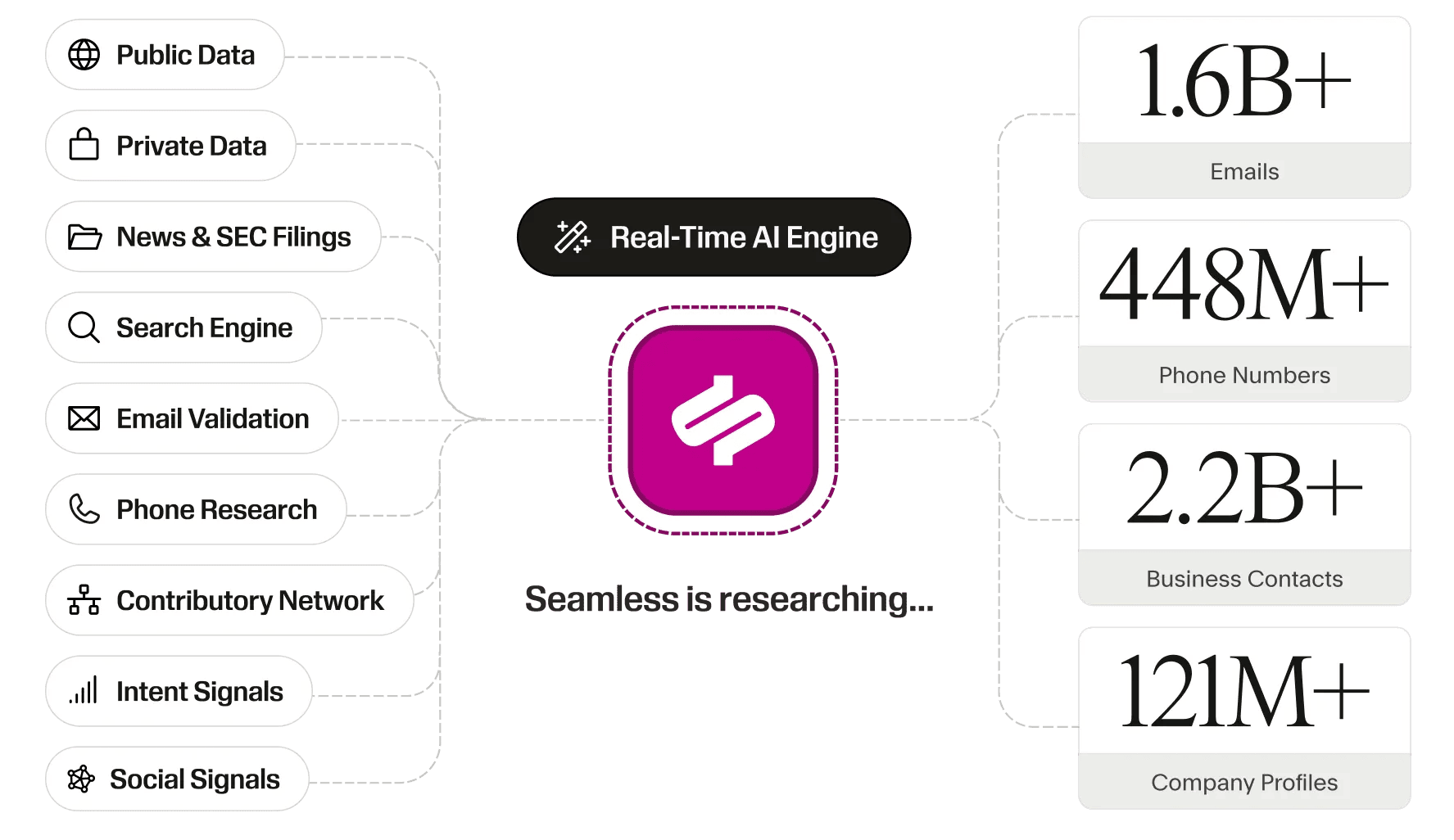
Seamless puts the focus on live contact discovery instead of pulling data from static stored records, offering coverage of 1.3B+ verified contacts and 414M+ verified mobile numbers. Its Prospector searches and validates data when a user runs a query, covering business emails, direct dials, mobile numbers, employment history, company details, and 100+ profile-level data points. 

Reps can also use the Chrome extension on LinkedIn, Sales Navigator, Salesforce, Gmail, or company websites, then save researched contacts into lists or push them into their CRM. 

Data-sources feeding a Real-Time AI Engine: left-column data types, center AI icon, right-column counts of emails, numbers, and profiles.

ZoomInfo uses a multi-source database approach and adds a much deeper account layer around each contact. Alongside emails and phone numbers, records can include corporate hierarchies, department structures, reporting lines, company locations, revenue and headcount, installed technologies, hiring activity, executive changes, and intent signals. 

According to ZoomInfo, its database spans 500M+ professional contacts and 100M+ company profiles. That depth is especially useful in enterprise outbound, where teams need to map several stakeholders, focus on the right account location, verify reporting lines, and enrich messy CRM records before deciding who should enter a campaign.

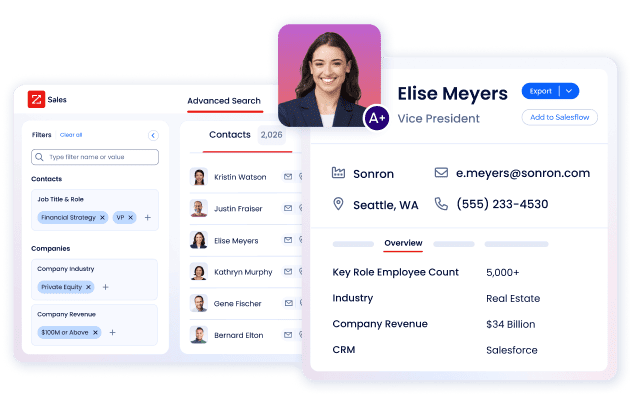
zoominfo as one of the prospecting tools that integrate with salesforce

The expert point here is simple — database size should not decide the purchase. For outbound, the useful metric is how many records are accurate, relevant, verified, ICP-matched, and safe to use in campaigns.

A 10,000-contact export with weak segmentation can burn domains and waste SDR time. A smaller list of 1,500 verified buyers segmented by role, account fit, tech stack, and intent will usually perform much better.

Search filters, enrichment, and ICP list building

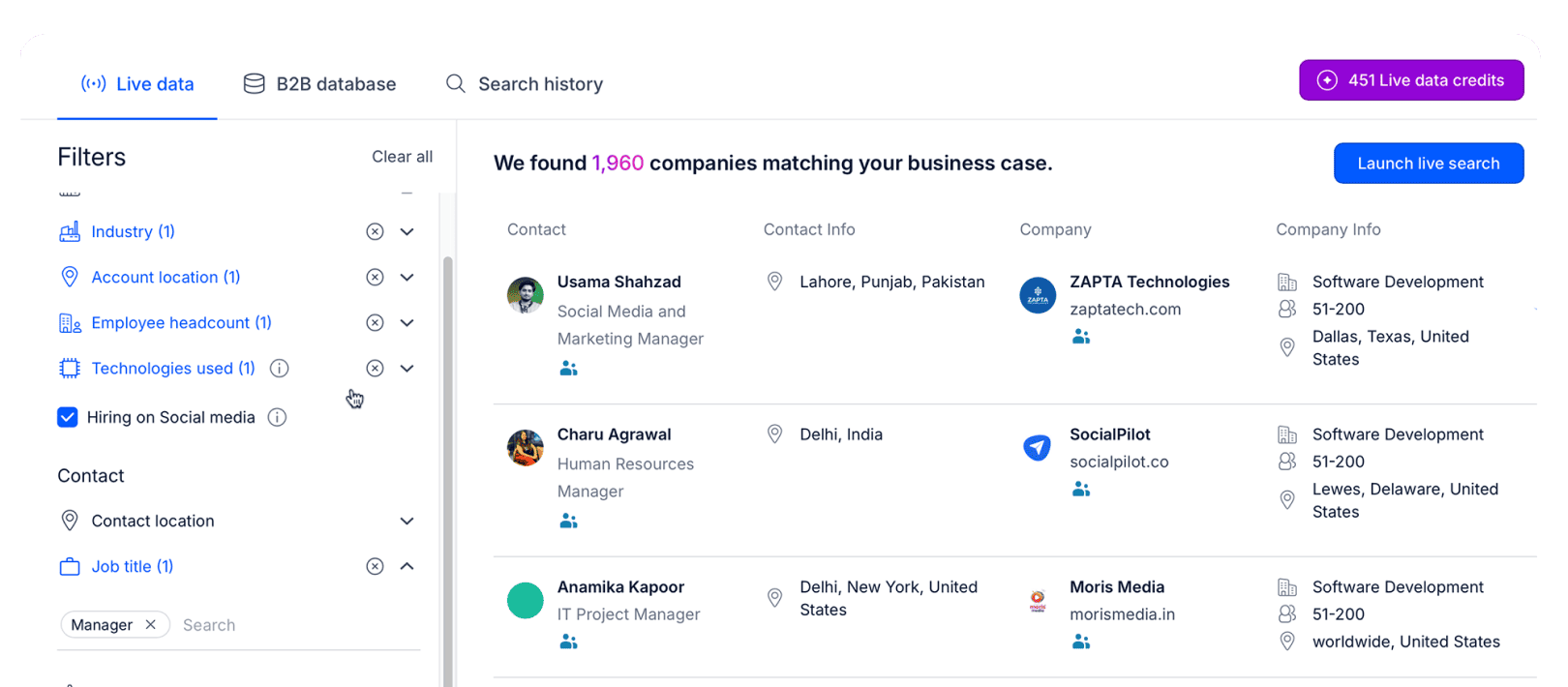
Seamless keeps lead search fairly straightforward, but the filters cover what most GTM teams use day to day, including job title, seniority, department, industry, employee count, revenue, location, and technology usage. 

Its enrichment layer can fill missing emails, mobile numbers, direct dials, company details, employment history, and social profiles into existing records, either one by one or in bulk. The real advantage is speed, since teams can take a broad ICP, narrow it into a usable segment, clean up incomplete records, and export or sync the finished list without building a separate enrichment process around it.

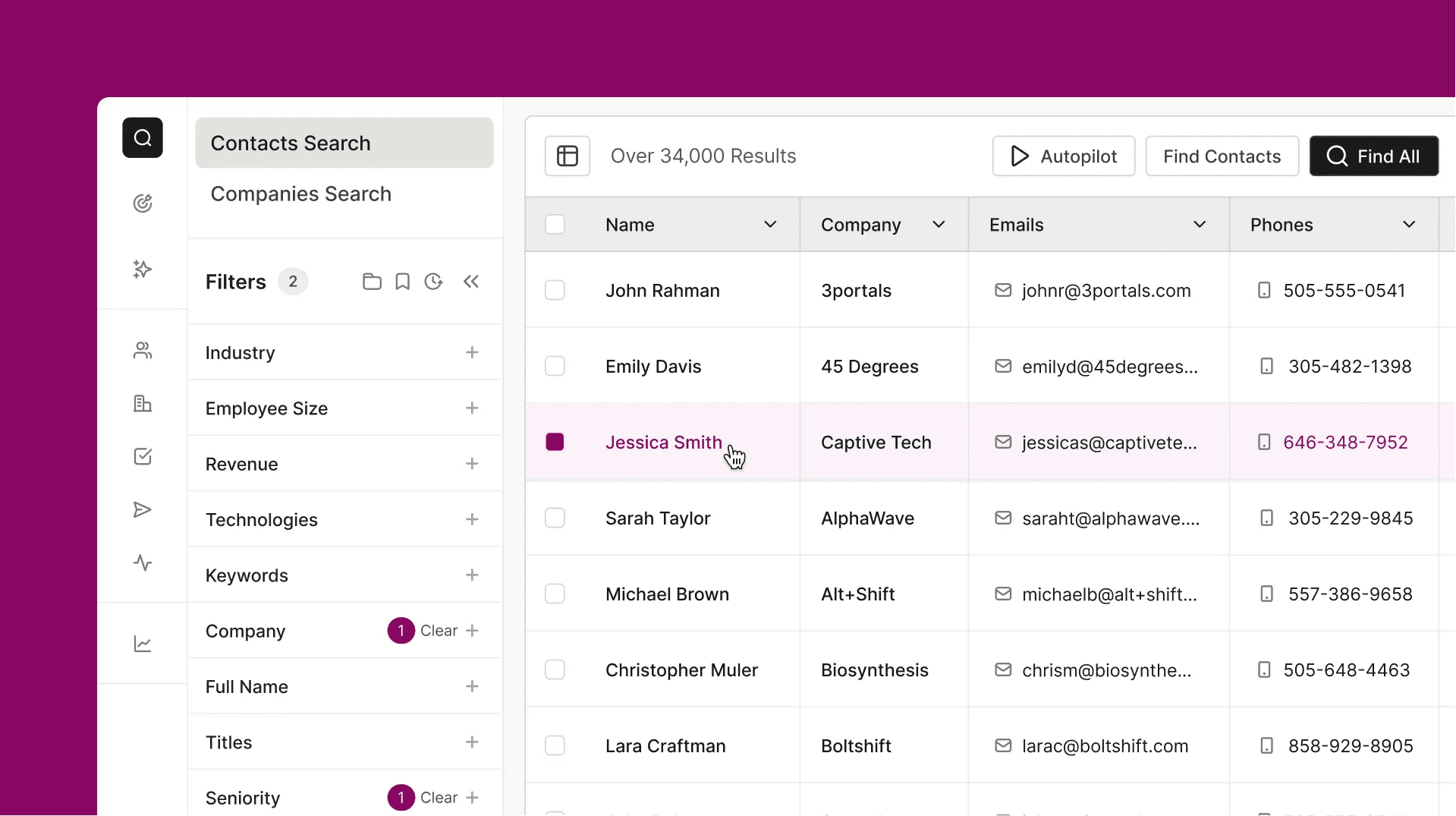
Screenshot of a CRM-style Contacts dashboard: left filters panel and a table with Name, Company, Emails, and Phones; Jessica Smith highlighted in pink.

That makes it useful for straightforward segments such as:

  • VP Sales at SaaS companies with 50-500 employees
  • HR leaders at US healthcare companies
  • RevOps leaders using Salesforce or HubSpot
  • recently promoted decision-makers in a target industry

ZoomInfo gives teams much more control when the ICP depends on account-level criteria, not just a few contact filters. SalesOS offers 300+ company attributes and lets teams combine firmographics, technographics, funding, department structure, location, buyer intent, CRM data, and marketing engagement. Teams can also save searches, get alerts when new companies or contacts match their criteria, map department org charts, and export complete buying groups instead of isolated leads.

Its enrichment layer is more operational, as ZoomInfo can fill missing CRM fields, refresh outdated employment and company data, assign the right account location, and route records based on territory, account fit, or buying stage. Teams can therefore define the target account, identify the economic buyer, champion, technical evaluator, and end users, and then tailor the outreach strategy by stakeholder using the real-time intent and company signals.

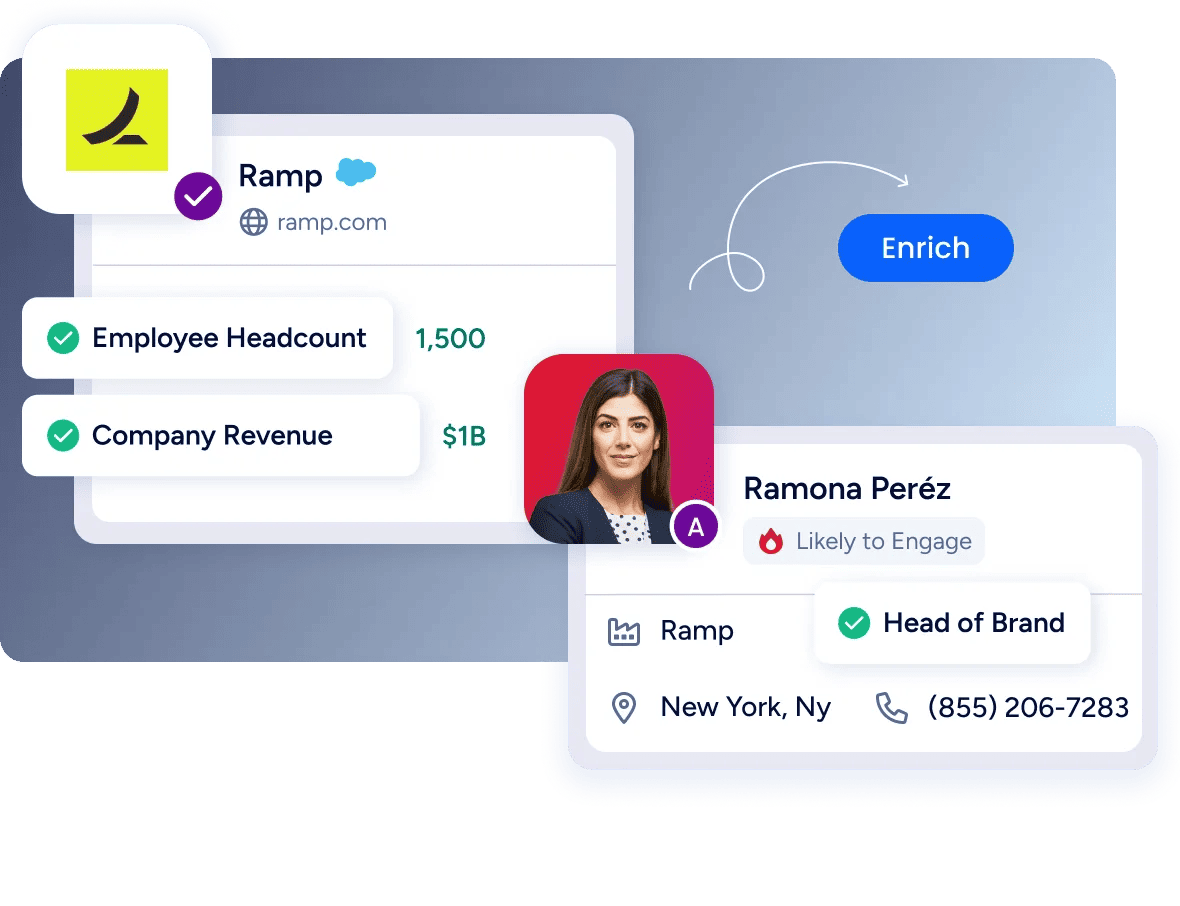
Dashboard-style profile collage showing Ramp with metrics: Employee Headcount 1,500 and Company Revenue $1B, plus Ramona Pérez as Head of Brand with Likely to Engage tag and Enrich button.Strong B2B lists usually come down to three layers:

  • Fit: industry, size, geography, revenue, and technology stack
  • Role: title, seniority, department, reporting line, and buying-group function
  • Timing: intent activity, hiring, funding, job changes, website visits, or executive moves

Seamless gets reps from search to ready-for-outreach contact lists faster, while ZoomInfo gives revenue teams more control over account selection, buying-group coverage, and routing once the list is built.

Buyer intent, triggers, and account intelligence

This is where ZoomInfo usually has the advantage compared to most other B2B data and prospecting tools on the market. 

Seamless offers Buyer Intent to help sales teams prioritize accounts that are actively researching relevant topics instead of working from static prospect lists. It tracks intent across more than 10,000 topics and 170+ business categories, while Job Changes surfaces prospects who have recently changed roles or been promoted — a trigger that often creates new B2B buying opportunities. Combined, these signals help reps decide not only who fits the ICP, but who is worth contacting right now.

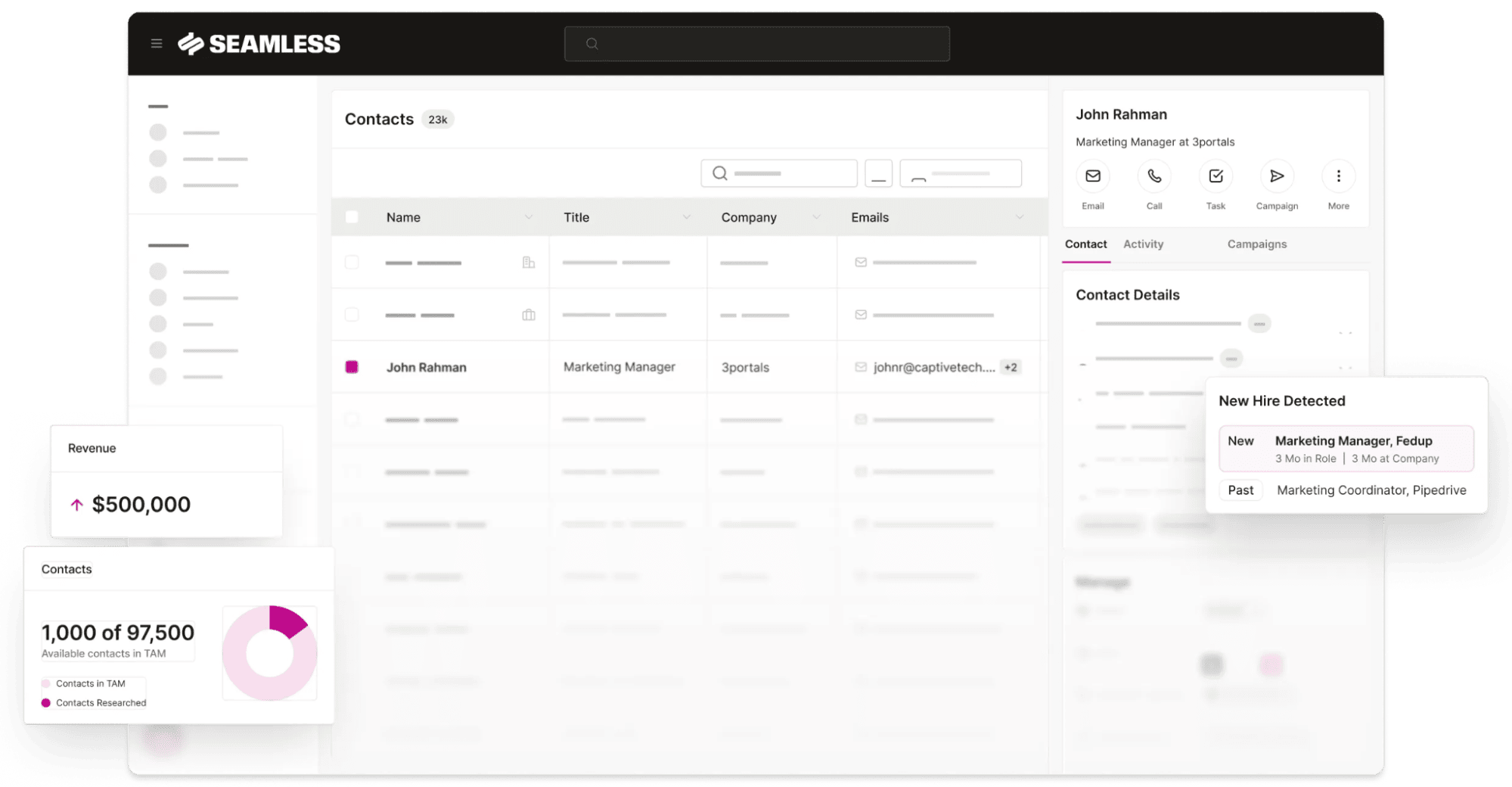
CRM dashboard: center "Contacts" table with John Rahman selected, left navigation, and right profile panel

ZoomInfo’s intent engine is considerably broader, combining third-party intent, first-party website visitor identification (WebSights), technographics, hiring trends, funding events, executive changes, CRM activity, and buying-group intelligence into a single account view. Rather than showing one isolated signal, ZoomInfo scores accounts based on multiple buying indicators, helping teams identify which companies are entering an active buying cycle and which stakeholders are most likely to influence the decision.

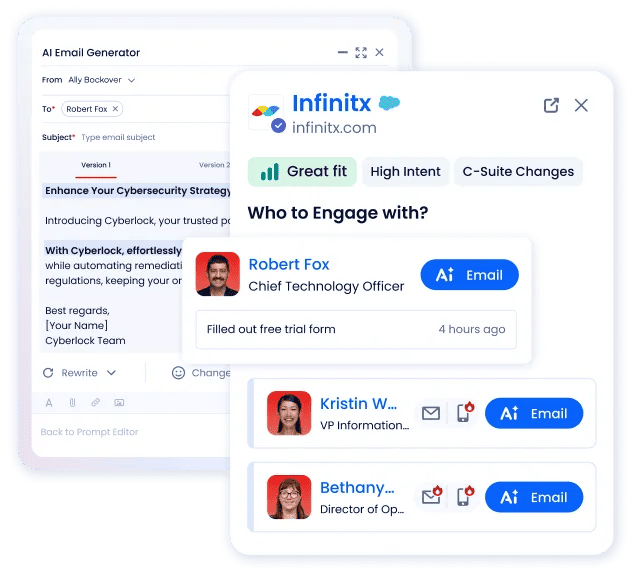
UI of Infinix AI Email Generator showing contact cards with names, titles, and an Email button for each contact.

For example, a cybersecurity provider could identify a mid-market company researching ransomware protection, see that it recently opened several security engineering roles, confirm it uses Microsoft 365 and CrowdStrike, map the CISO, IT director, and security operations lead through org charts, and prioritize outreach while the buying signals are still active. That level of context is exactly what turns intent data from an interesting signal into a practical prioritization system for sales, marketing, and GTM teams.

Outreach workflow, automation, and integrations

Seamless now covers a huge chunk of the execution layer through Connect and its dedicated AI assistant, so reps can move from a researched contact into email, calling, social, or custom tasks without leaving the platform. 

Its email product supports templates, dynamic variables, AI-assisted writing, sequencing, and engagement tracking, while Calling adds verified direct dials, click-to-call, power or parallel dialing, voicemail drops, call recording, notes, and CRM logging. Seamless also connects with 6,000+ tools, which makes it easier to push contact data into the existing sales workflow instead of relying on CSV exports every time.

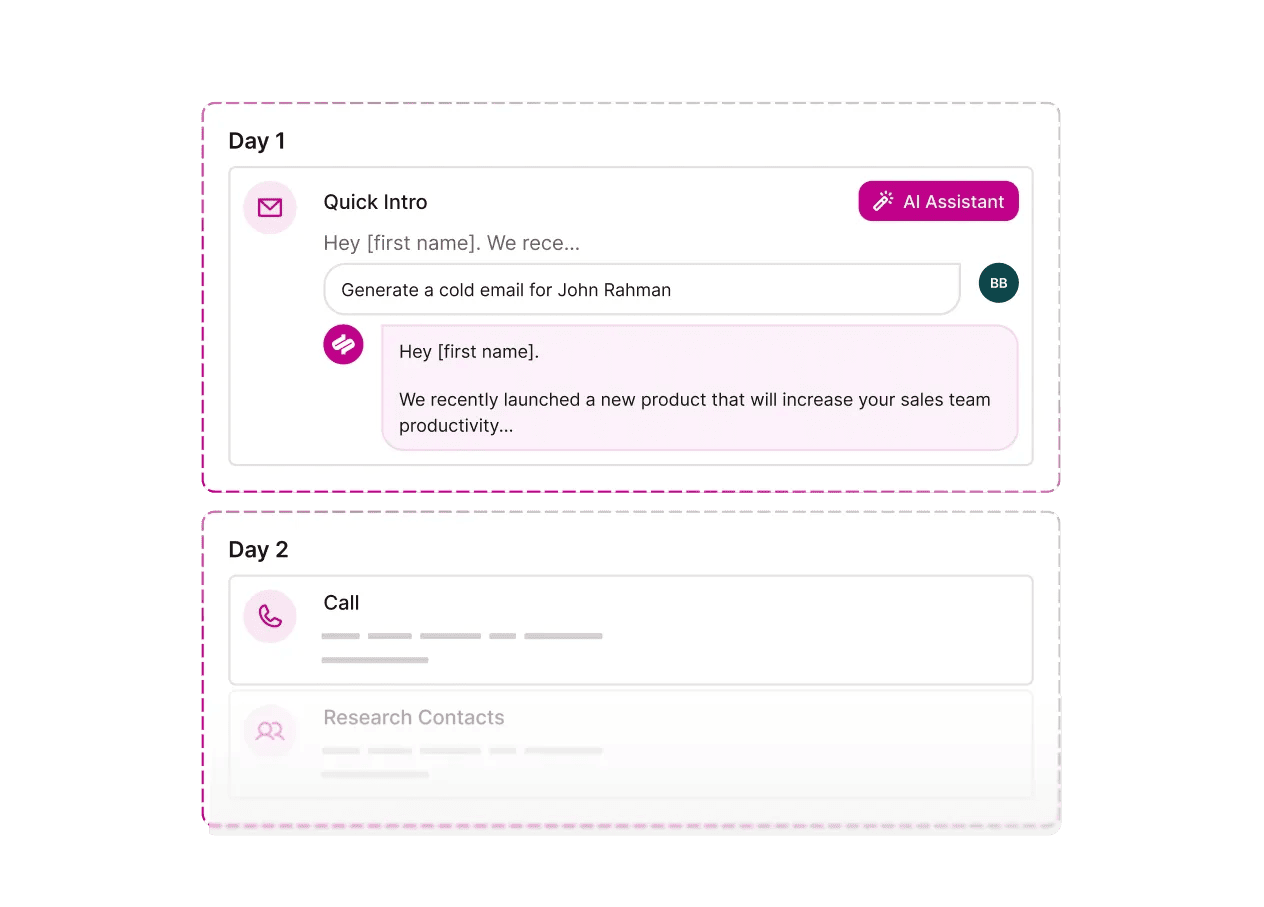
Day 1 panel with Quick Intro chat, AI Assistant badge, and an email draft field and pink chat reply sample.

ZoomInfo handles execution through GTM Workspace and Copilot. It pulls CRM records, ZoomInfo data, buying signals, account activity, and AI assistance into one seller workspace, then helps reps understand which accounts need attention and what to do next. 

Reps can research companies, review contacts and opportunities, generate account briefs, prepare outreach, and act on buying signals, while integrations with Salesforce, sales engagement platforms, and other GTM tools keep records and actions connected across the stack. 

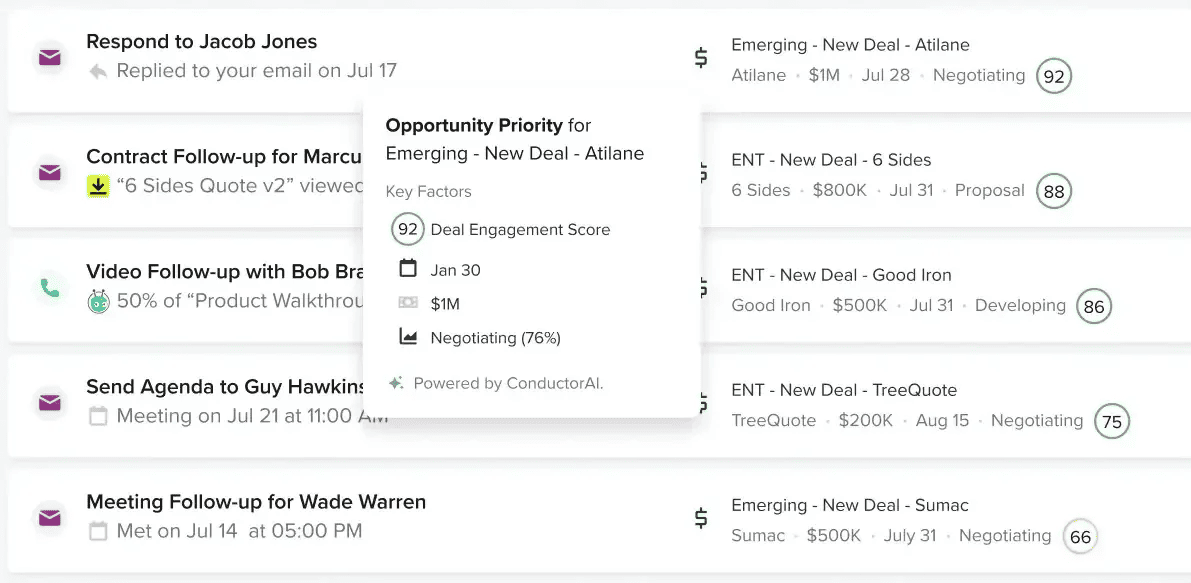
A sales dashboard with a floating card titled 'Opportunity Priority' showing key factors (92 Deal Engagement Score, Jan 30, $1M, Negotiating 76%), powered by ConductorAI, over a list of email/task rows on the left and deal items on the right.

Neither platform fully handles the entire outbound process, which includes:

  • Building and segmenting targeted account lists
  • Finding, verifying, and enriching the right contacts within those accounts
  • Launching coordinated email, LinkedIn, call, and follow-up steps with AI personalization
  • Conditional outreach, which adjusts each message, channel, and timing in real time 
  • Providing an email deliverability suite with domain warm-up, spam monitoring, and more
  • Feed campaign results back into targeting

Finding the right contacts is only the first step. In reality, revenue comes from turning that contact into a qualified conversation, and while both Seamless and Zoominfo can now handle much of that workflow natively, most businesses will still need a dedicated sales engagement platform like Reply.io on top.

Reply comes with its own B2B database, built-in enrichment and email verification, conditional outreach sequences across email, LinkedIn, calls, SMS, and WhatsApp, deep AI personalization, analytics, and premium deliverability. With this stack in place, you can fully automate the entire process from contact discovery to outreach to booked meetings.


Seamless.AI vs ZoomInfo pricing

Seamless pricing is more accessible and easier to understand at the starting point. The platform offers Free, Pro, and Enterprise plans:

  • Free includes 1 user, 50 credits, email addresses, cell phones, real-time search, export downloads, Pitch Intelligence, Connect, and job change filters. 
  • Pro is priced per user and adds unlimited exports, annual credit packages starting at 10,000 credits, premium integrations, advanced org management, priority support, live chat, and Buyer Intent. 
  • Enterprise is built for larger teams and adds unlimited users, custom packages, customer success, enterprise support, phone support, and dedicated success management.

ZoomInfo pricing is much heavier and usually comes through SalesOS packages like Professional, Advanced, and Elite:

  • Professional starts around $15,000/year (estimate from public info) and includes database access, targeted prospect lists, 5,000 bulk credits, basic email/call outreach, list customization, and basic intent notifications. 
  • Advanced is usually around $25,000-$30,000/year (estimate from public info) and adds 10,000 bulk credits, org charts, technographics, stronger intent data, CRM integrations, and website visitor tracking. 
  • Elite starts around $40,000+/year (estimate from public info) and adds real-time buying signals, AI-generated customer profiles, analytics, pipeline management, and conversational intelligence.

The practical takeaway is pretty straightforward — Seamless is the lighter and cheaper option for contact discovery, list building, and lightweight outreach, while ZoomInfo costs significantly more because it goes deeper into sales intelligence, intent, enrichment, and operational sales features for larger GTM teams.

Which should you choose: Seamless.AI or ZoomInfo?

Choose Seamless.AI if:

  • you need fast B2B lead generation and contact discovery
  • your team is small or mid-sized
  • reps need emails, cell phones, and direct dials quickly
  • you want a lower-friction prospecting workflow
  • you do not need complex GTM operations or enterprise data governance

Choose ZoomInfo if:

  • you sell into mid-market or enterprise accounts
  • you need deeper sales intelligence and account context
  • RevOps needs CRM enrichment and data governance
  • your team uses buyer intent, technographics, and org charts
  • sales and marketing need one GTM intelligence source

Choose neither as your only tool if:

  • Your bottleneck is outbound execution
  • You already have enough lead data but low reply rates
  • Your emails are landing in spam
  • Your team lacks coordination across email and LinkedIn outreach
  • You need meaningful personalization at scale
  • Your campaigns are not converting contacts into meetings

Seamless and ZoomInfo can help you find and understand buyers, but you still need a system in place to reach them, personalize emails, follow-ups, and LinkedIn messages, manage deliverability, handle replies, and book meetings.

Reply.io: the best Seamless and ZoomInfo alternative for AI lead gen and outbound

Reply.io is one of the best Seamless and ZoomInfo alternatives for teams that want B2B contact data and AI-powered outbound under one roof. 

Reply is an AI sales engagement and lead generation platform that offers a native lead database with over 1 billion live contacts and accounts, enrichment, email verification, and intent signals like hiring, technographics, and more, to help you find and prioritize targeted leads.

data in Reply.io as an extra to your personal CRM

With just a few clicks, you can send those leads into coordinated outreach campaigns with automated emails, follow-ups, LinkedIn touchpoints (connection requests, messages, etc.), SMS, calls, and WhatsApp. These sequences follow conditional logic, so Reply’s AI engine will adjust the channel mix, messaging, and timing in real time based on each lead’s engagement behavior. 

So for instance, if your initial email goes unopened for 4 days, Reply launches an automated LinkedIn connection request. Once accepted, it will cancel the scheduled email follow-up and write up a tailored LinkedIn message, and so on. 

how to send a second follow up email after no response with conditional sequences

Each message is personalized with Reply’s AI engine based on all the available lead/company data, be it from Reply’s own database or from Seamless/ZoomInfo integrations, and teams can also use its AI variables feature to create their own custom templates, and Reply will research each lead/account to fill in those gaps.

Seamless and ZoomInfo help you find and understand targeted accounts, while Reply.io helps you run the AI-powered outbound engine that turns those leads into conversations, and eventually, booked meetings. 

Jason AI: when you want an AI sales agent to run the execution

Jason AI is Reply’s very own AI SDR agent that joins your team as a full-time sales rep, learns everything about your product, ICP, and sales strategy, and then starts finding relevant prospects, building targeted lists, launching multichannel sequences, personalizing messages, and even handling replies and booking meetings on your behalf. 

That is especially useful for lean sales teams, founders, agencies, and companies that want to scale outbound without immediately hiring more SDRs or stitching together five different tools.

That doesn’t make Seamless or ZoomInfo irrelevant — both can still be incredibly useful sources of lead/account data and sales intelligence. But if the goal is meetings and pipeline at scale, lead generation and outreach execution is usually where the biggest results come from.

Final thoughts

Seamless is the better choice for teams that need fast and accessible B2B contact discovery, intent signals, and AI assistants helping with outreach, while ZoomInfo is the stronger option for companies that need deeper sales intelligence and enterprise GTM workflows.

But B2B leads do not create booked meetings on their own, so if one of your team’s main challenges is automating the process of turning data into AI outreach and nurturing, and eventually closed deals, integrating Seamless or ZoomInfo with Reply.io is the most practical next step. 

Start by locking in the mechanism to finding the right leads, and then leverage AI-powered outbound execution to turn them into real opportunities.

FAQ

Is Seamless better than ZoomInfo?

Seamless is better for fast prospecting, simple contact discovery, and lean outbound teams, while ZoomInfo is the better choice for larger teams that need deeper sales intelligence, org charts, more precise technographics, and full-scale GTM workflows.

Which has better data accuracy, Seamless or ZoomInfo?

ZoomInfo is generally stronger for enterprise-grade data coverage and account intelligence, though Seamless is very strong for real-time contact discovery. In any case, teams should still always verify emails before outreach as no B2B database is accurate enough to skip validation completely.

Is ZoomInfo worth it for small sales teams?

ZoomInfo can be too expensive for small teams that only need lightweight data such as contact emails and direct dials, simple intent signals, and so on. It becomes more valuable in terms of ROI when multiple teams use it for sales intelligence, buyer intent, CRM enrichment, territory planning, and account-based selling.

Does Seamless include buyer intent data?

Yes, Seamless offers buyer intent to help sales teams find prospects and accounts showing research activity around relevant topics, picked up from multiple sources like company websites, news, LinkedIn, and more. The real value is how well your team uses those signals for segmentation, messaging, and outreach timing.

What is the best ZoomInfo alternative for outbound sales?

If you need a Seamless alternative or a ZoomInfo alternative that both offers lead data and outbound execution, Reply.io is one of the strongest choice on the market, combining a native lead database, multichannel outreach, AI personalization, deliverability, analytics, and an AI sales agent For many sales teams, that makes it the best ZoomInfo alternative when the real goal is to create a coordinated lead generation and outbound engine.

Subscribe to our blog to receive the latest updates from the world of sales and marketing.
Stay up to date.

Related Articles

10+ Best Personal CRM Tools for Sales in 2026

10+ Best Personal CRM Tools for Sales in 2026

10+ Best Personal CRM Tools for Sales in 2026
How to Build a Simple GTM Process That Just Works in 2026

How to Build a Simple GTM Process That Just Works in 2026

How to Build a Simple GTM Process That Just Works in 2026
How to Build a GTM Strategy with AI for Growth in 2026

How to Build a GTM Strategy with AI for Growth in 2026

How to Build a GTM Strategy with AI for Growth in 2026