
Most B2B buyers have shortlisted their top picks before your first email ever reaches their inbox. For sales teams, that creates a serious new challenge, especially given that one 2025 report found that 94% of buying groups rank their preferred vendor before they first contact sellers, and that vendor goes on to win 80% of deals. A broad list and a generic pitch can’t earn that spot, no matter how many emails you send.
Market segmentation is how you decide which buyers are worth reaching to and investing time on research, and what each of those groups should hear from you. In this guide, we’ll cover the main types of market segmentation, a 6-step process for B2B teams, worked examples, and the mistakes that quietly drag segment performance down.
What is market segmentation?
Market segmentation is the process of dividing a market into smaller groups of buyers who share similar needs and buying behavior, so each group can get its own, more specialized offer and messaging strategy. In B2B, those groups are usually defined by company traits like industry, size, and tech stack, and by the problem the buyer is trying to solve.
The test for a good segment is simple — one message should work for everyone in it. If a 20-person agency and a 2,000-person enterprise land in the same segment, you’ll end up writing for neither of them, because their budgets and buying processes have almost nothing in common.
Segmentation often gets mixed up with two related terms, so here’s how they differ:
| Term | What it covers | When you use it |
| Market segmentation | The whole market, including companies that have never heard of you | Deciding where to sell, which segments to enter, and how to position your offer |
| Customer segmentation | Your existing customers and users | Retention, upsells, onboarding, and pricing |
| Target market | The one or few segments you choose to pursue | Building lists, campaigns, and sales plays |
Together, they form the classic segmentation, targeting, and positioning (STP) model. You segment the market first, choose your target segments next, and then position your offer for each one. Market segmentation vs customer segmentation is mostly a question of scope, and the two feed each other, since your best current customers are usually the clearest pointer to which market segments to go after, and how.
Why market segmentation in B2B matters more than ever
B2B buyers are giving sellers fewer chances to make an impression. Gartner’s 2026 sales survey of 646 B2B buyers found that 67% prefer a completely rep-free experience, which means they would happily do all the research, comparisons, and even purchase without talking to a salesperson. When conversations are that rare, every email, LinkedIn message, or call you do get has to feel like it was written for that specific buyer.
At the same time, there are more people to convince inside each account. According to Forrester, a typical B2B purchase decision now involves 13 internal stakeholders and nine external influencers. That turns B2B market segmentation into a two-level job, where sales teams have to segment companies first, and then do the same for the roles inside them.
Done well, the benefits of market segmentation show up across the whole funnel:
- Higher reply rates per touch, because the message matches the pain the reader actually has.
- Less wasted time and effort on audience research and outreach, since you stop contacting accounts that were never a fit to begin with.
- Sharper positioning, with one clear value proposition per segment instead of a vague one for everyone.
- Cleaner product feedback, as objections and feature requests start to cluster by segment.
- Pipeline you can forecast, because each segment builds up its own conversion rates you can plan around.
The 5 types of market segmentation and when to use each
The four classic types of market segmentation are demographic, geographic, psychographic, and behavioral. B2B teams add a fifth, firmographic segmentation, which groups companies the way demographics group people, and nowadays, it’s usually where B2B segmentation starts.
| Type | Groups buyers by | B2B example | Where the data comes from |
| Firmographic | Industry, headcount, revenue, location, funding stage | SaaS companies with 50 to 200 employees in North America | Lead databases, LinkedIn, company websites |
| Demographic | Role, seniority, department, time in role | VPs of Sales and Heads of RevOps | Lead databases, LinkedIn profiles |
| Geographic | Country, region, time zone, language | DACH companies that expect German-language outreach | CRM, lead databases |
| Behavioral | Actions and buying signals | Accounts that visited your pricing page twice this week | Website tracking, product usage, email and LinkedIn engagement |
| Psychographic | Priorities, values, attitude toward risk and change | Teams that want to scale output without adding headcount | Discovery calls, surveys, reviews, job posts |
Depending on your product, B2B market segmentation may also include technographic segmentation that groups companies by the tools they use, which is useful when your product replaces or integrates with a specific stack.
If you sell a HubSpot add-on, for example, companies already on HubSpot are your ideal market, and most lead databases and technographic data APIs can show you who they are.
On top of that, needs-based segmentation groups buyers by the problem they’re trying to solve, and it’s often the most useful layer for messaging, since two companies with identical firmographics can be buying for completely different reasons.
In practice, you rarely end up using just one type on its own. A simple way to combine them is to let firmographic and technographic data define fit, behavioral signals decide timing, and psychographic or needs-based insight shape the message.
How to use market segmentation to reach the right buyers in 6 steps
The market segmentation process below is built for teams that sell directly to their buyers through outbound, ABM, or sales-led campaigns.
1. Start from your best customers, not the whole market
By far the fastest way to find good segments is to take a close look at your existing customers. Pull your last 20 to 50 closed-won deals from the CRM, group them by the problem the customer was trying to solve when they bought, analyze what messaging, channel, and even timing you used to engage them, and then check which firmographic traits repeat inside each group. You’ll often find two or three distinct clusters that look nothing like the single ICP on your sales deck.
Closed-lost deals matter just as much, since if deals with companies under 20 employees keep stalling on budget, or one industry always gets stuck in security review, that’s a segment to exclude or push down the list.
2. Define 3 to 5 segments you can actually build a list from
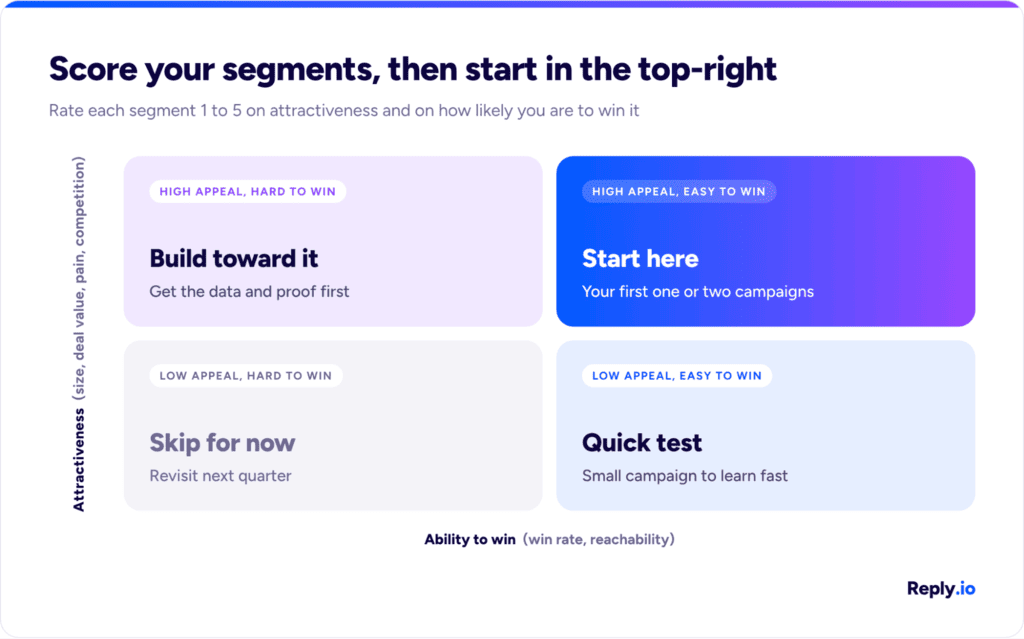
Every segment needs a definition that turns into search filters, such as industry, headcount, location, tech stack, department, role, and seniority. If you can’t filter on it, you can’t turn it into a list or track how it performs.
Here’s how one ICP can split into two segments with very different pains:
- Segment A: B2B marketing and lead gen agencies with 10 to 50 employees, targeting founders and heads of sales. Their main pain is running effective cross-channel outreach for several clients without hiring more people.
- Segment B: Series B SaaS companies with 100 to 500 employees and an in-house SDR team, targeting VPs of Sales and RevOps leads. Their main pain is rep productivity and pipeline per rep.
Both groups may end up buying the same product, but the message and even the channel mix to make that happen are completely different. Three to five segments is a sensible ceiling for most teams, since each one needs its own list and copy.
Once the segments are clearly set, building the lists becomes much easier with a reliable data source, especially with a reputable B2B database. For instance, Reply Data gives you over 1B contacts and accounts across 150+ countries, with advanced search filters that match these segment definitions one-to-one. You can run each segment as its own search and pull fresh, verified contacts every time you launch a new campaign.
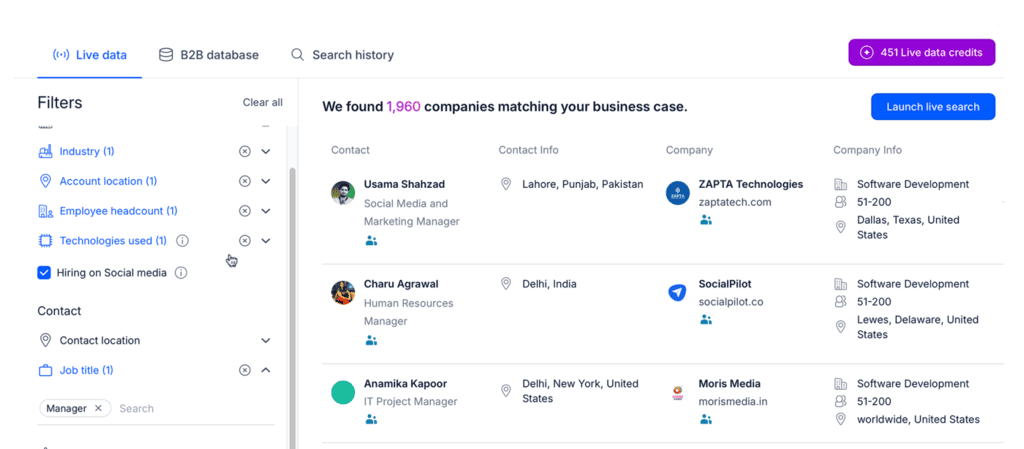
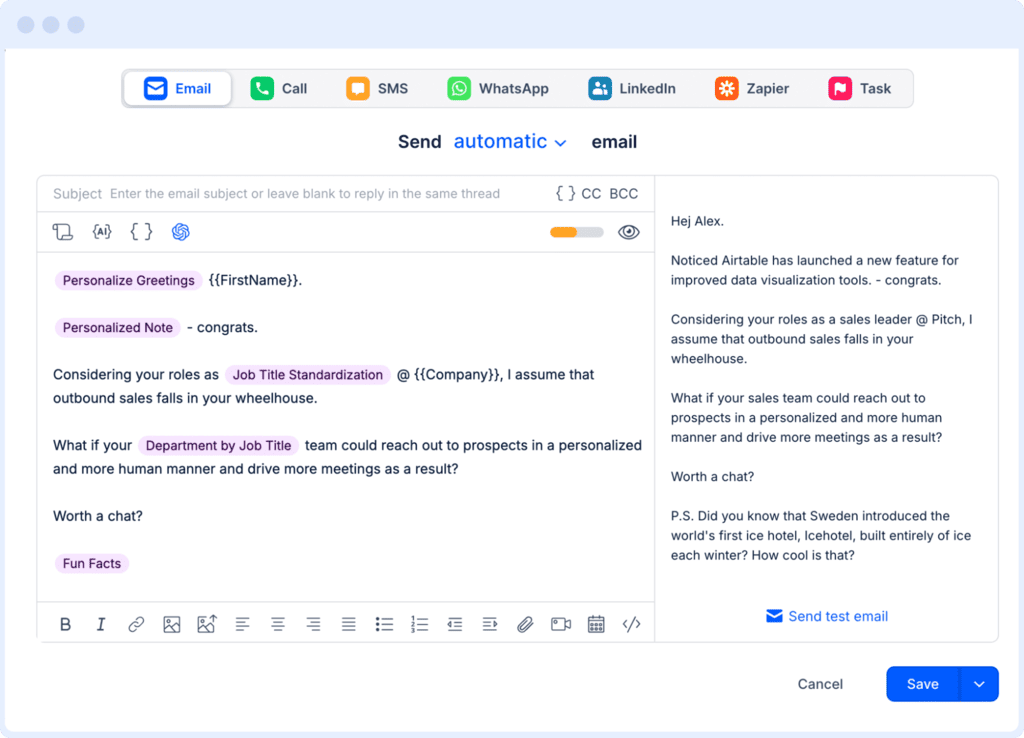
On top of that, Reply Data comes with technographic filters and intent signals, such as “Hiring on Social Media” for even more precise targeting. The best part is that once you’ve got your lists ready, along with the verified email addresses and additional prospect and company research, you simply add them to Reply.io’s multichannel outreach sequences, and its AI handles the rest. It uses that data to craft tailored emails, follow-ups, and LinkedIn messages for each lead, while adjusting the messaging, channel mix, and timing based on each lead’s engagement in real time.