
12 Best Company Enrichment APIs in 2026 for Prospecting

12 Best Company Enrichment APIs in 2026 for Prospecting

Key takeaways:

  • A company enrichment API turns a domain or company name into firmographics: headcount, industry, location, funding, tech stack and social profiles.
  • Free company data APIs do exist and are genuinely usable. Abstract API allows 100 requests at no cost and Diffbot gives 10,000 credits a month on a free-forever plan.
  • LinkedIn company data comes through licensed dataset providers such as Bright Data and Coresignal rather than from LinkedIn directly, which carries compliance obligations you should read before building.
  • Our own strength is company data for prospect targeting, not domain-level firmographic lookup, and we say exactly where that line falls in our entry below.

Company data is where prospecting becomes precise or quietly falls apart. Knowing a domain belongs to a 40-person logistics company in Rotterdam that raised a Series A last quarter changes the email you send. Not knowing means you send the same email to everyone.

The problem is that firmographics rot faster than most teams assume. Companies get acquired, rebrand, move headquarters, double headcount, or stop trading. Gartner puts the cost of poor data quality at an average of $12.9 million per organization per year, and stale company records are a large part of that bill.

A company data enrichment API solves it by making the lookup live, which is why marketing data providers have shifted from selling files to selling endpoints. You send a domain, you get current firmographics back, and never maintain a company table again.

This guide ranks the 12 company enrichment APIs worth building against in 2026. We are one of the entries and placed ourselves first, so read our section knowing that. We have also been specific about the one thing we do not do, which matters more than usual here.

What a Company Enrichment API Returns

The core operation is simple. You pass a domain, sometimes a company name or LinkedIn company URL, and the response contains a structured company record.

Most providers return legal and trading name, domain, industry classification, employee count or headcount band, founding year, headquarters location, and social profile links. Better ones add revenue estimates, funding history, technology stack, parent and subsidiary relationships, and recent hiring activity.

Three source models exist and they behave differently. Licensed database providers such as People Data Labs and Coresignal assemble large stores and match on domain. Crawl-and-infer providers such as Diffbot build a knowledge graph from the public web, reaching companies no list vendor has bothered to catalog.

Signal providers such as Crustdata focus less on static attributes and more on what changed: hiring, funding, headcount movement. They overlap with intent data providers in practice.

Which one you need depends entirely on whether you are describing a company or watching it.

How We Evaluated These Company Data APIs

We required verifiable pricing and a company-level endpoint a developer can call. Several well-known names failed one or the other.

We checked each pricing page live rather than repeating figures from other roundups, because this category reprices often. Where a vendor is quote-only we say so instead of inventing a range, and where a third party published a figure the vendor has not, we attribute it.

We gave weight to three practical questions:

  • Does a failed match still consume a credit
  • Is there a genuine free tier you can evaluate with, or just a demo
  • Are rate limits published, because a 50 requests per second ceiling and a 5 calls per minute ceiling are different products

ZoomInfo is discussed here but is not a ranked entry. Its pricing is quote-only, its site blocks automated inspection, and its API is reported at roughly $50,000 a year through third-party procurement data rather than published rates. We could not verify it to the standard the other entries meet.

The 12 Best Company Enrichment APIs Compared

Pricing below is the cheapest tier that includes API access.

Tool Best for Key features Main limitation Pricing (from) Rating
Reply.io Targeting companies you will then contact 60M+ accounts, Live Data ICP filters, one API for data and sending No domain-to-firmographics endpoint $49/month ★★★★★
CompanyEnrich Best value at scale Full API on every plan, credit rollover, batch API Newer vendor, smaller brand footprint $49/month ★★★★☆
The Companies API High request-rate lookups ~50M companies, 50 to 1,000 req/sec, flat credits Company data only, no contacts $95/month ★★★★☆
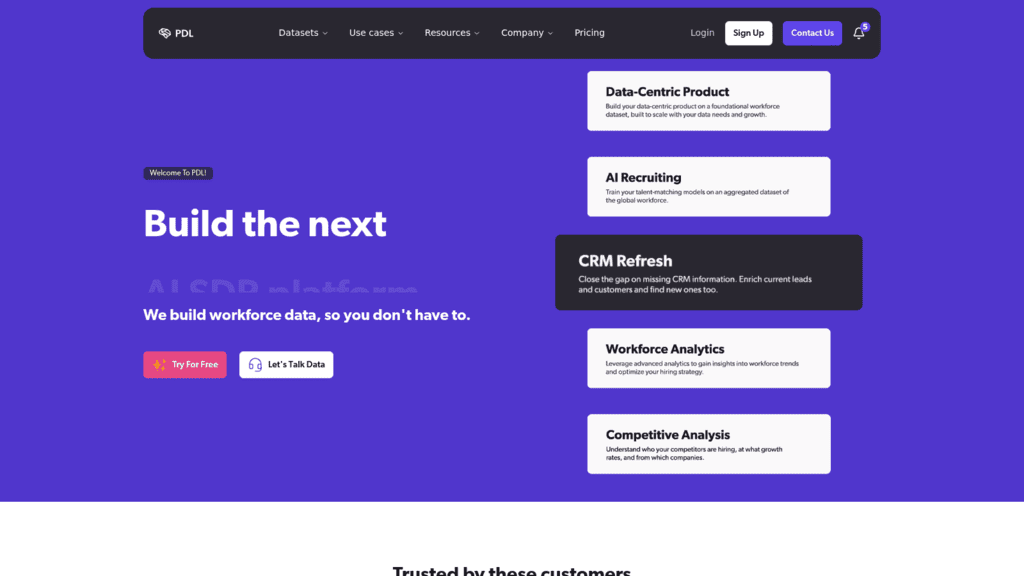
People Data Labs Combined person and company records 200M+ company records, strong SDKs Free tier obfuscates contact fields $98/month ★★★★☆
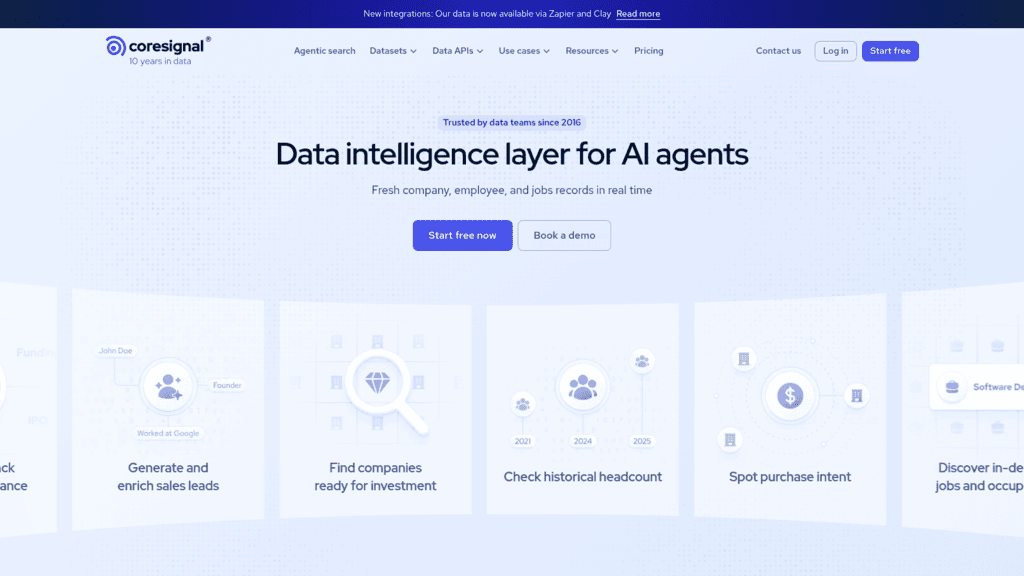
Coresignal LinkedIn-derived employment depth 70M+ companies, historical headcount API Search and Collect credits billed apart $49/month ★★★★☆
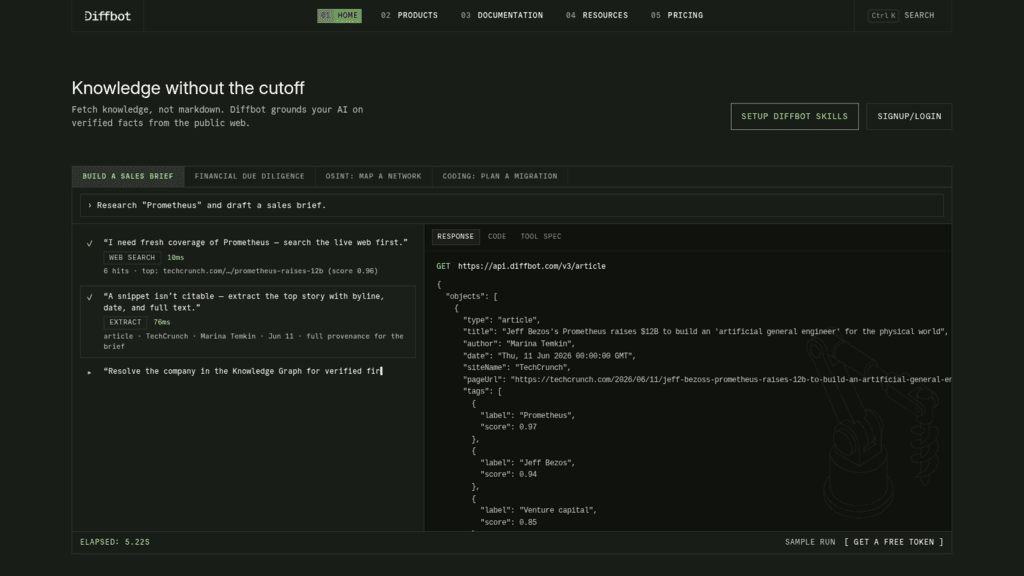
Diffbot Coverage beyond curated lists Knowledge Graph, 10,000 free credits monthly Credits, not records, so cost varies Free (10,000 credits) ★★★★☆
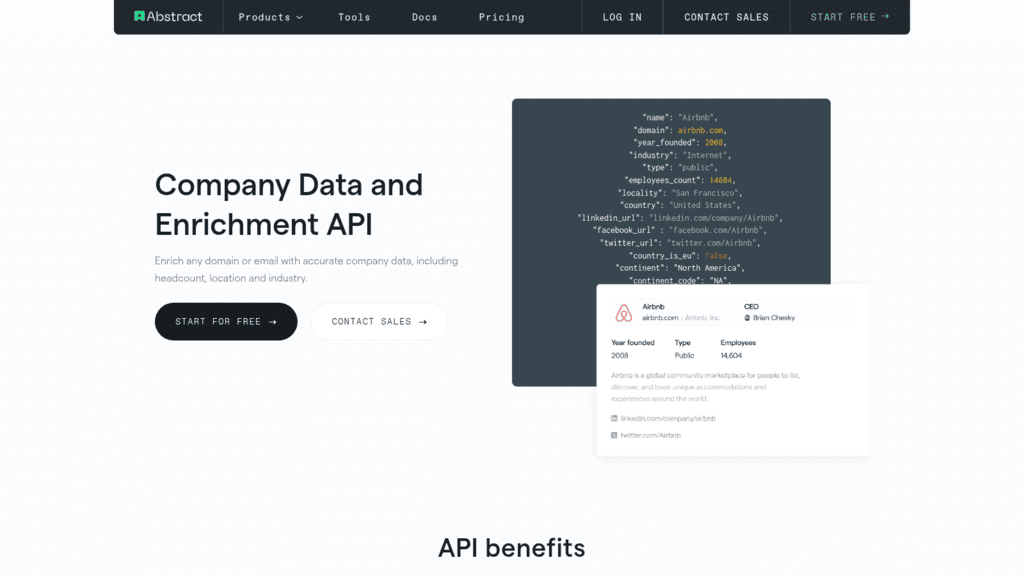
Abstract API A genuinely free company data API 100 free requests, clean domain lookup 1 req/sec on free, thin field set Free (100 requests) ★★★★☆
Explorium Agent-driven data workflows Agent-native positioning, credit packages Credits expire after 12 months $84.99 (2,500 credits) ★★★☆☆
Crustdata Real-time company signals Hiring, funding and headcount events, MCP server No public pricing at all Quote only ★★★☆☆
Bright Data Bulk LinkedIn company datasets LinkedIn company and jobs datasets at volume Per-tier prices not published $2.50/1,000 records ★★★☆☆
Datagma Company data alongside contacts Person and company in one call, API on free tier Smaller company coverage Free (90 emails) ★★★☆☆
Cognism Enterprise compliance requirements Phone-verified data, GDPR notified Quote-only, five-figure annual contracts Quote only ★★★☆☆

Star ratings reflect company-enrichment API fit, so a quote-only enterprise vendor scores lower than in a general sales-intelligence comparison. Details follow.

1. Reply.io
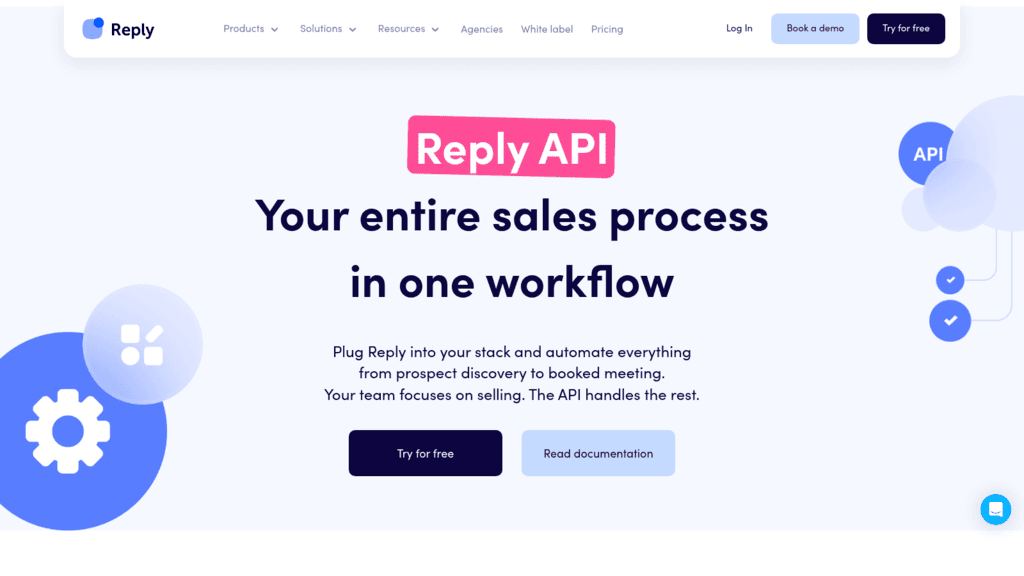
Reply.io as one of the best company enrichment apis

Best for: Targeting companies you will then contact

Overview: We should be precise about what we are and are not, because this category has a specific technical meaning and we only meet part of it.

Our database covers 60+ million accounts and 15+ million US company profiles, and our Live Data search lets you filter that universe by industry, location, headcount signals and seniority to build a target list. That is company data used for targeting, and it is genuinely strong.

What we do not have is a domain-in, firmographics-out endpoint. If your requirement is to POST stripe.com and receive a company record, we cannot serve that today, and no such endpoint is on our published roadmap.

Where we earn the top spot is the step after targeting, and the full feature set shows how wide that surface runs. Company data, contact enrichment, sequencing and deliverability sit behind one API key, so the account you identified becomes a running campaign without a second vendor.

Key features:

  • Live Data search across 60+ million accounts, filtered by industry, location, department and seniority
  • Company-level targeting that resolves straight into contactable people rather than a static firmographic record
  • 220+ million US contacts and 15+ million US company profiles inside the same B2B database
  • Contact enrichment endpoints by email and LinkedIn URL, arriving late August 2026
  • Async email validation, so a built list is screened before it touches a sending domain
  • An MCP server connecting the platform to Claude, Cursor and other MCP clients

Pricing: we bill by active contact, not by seat. The entry tier holds 1,000 active contacts for $49 a month on annual billing, $59 monthly, and the ladder runs to $899 at 100,000. Adding teammates costs nothing; outgrowing your contact tier is what moves you a step up. Fifty live data credits ship with the base plan, and further packages start at $20 a month.

Pros: company targeting and outreach behind one API, 60+ million accounts with deep US coverage, plan-level rather than per-seat pricing, documented rate limits at 100 requests per minute, MCP server for agent-driven workflows

Cons: we have no domain-to-firmographics endpoint, so a pure company-lookup use case is not served, and our company data is bundled inside the platform rather than sold as a standalone data product, which makes us the wrong fit if you want firmographics without a sending tool

How to start using it:

  1. Open a 14-day trial, then create your key at Settings > API Key.
  2. Check it resolves by calling https://api.reply.io/v3/whoami.
  3. Call the Live Data endpoints with your ICP filters and preview the result set before spending credits.
  4. Compare the account coverage against 100 known target companies to judge fit on your segment.
  5. Push the resulting contacts into a sequence through the same API, with no export step.

Why it’s a good company enrichment API: the company record is not the deliverable for most sales teams; a booked meeting is. Holding targeting and outreach behind one key removes the integration that usually sits between them.

Final verdict: the strongest option when company data feeds outbound you are already running, and the wrong option if you need firmographic lookup as a standalone service. That distinction is worth checking against your actual requirement before you trial anything, and if it is the latter, CompanyEnrich or The Companies API below will serve you better.
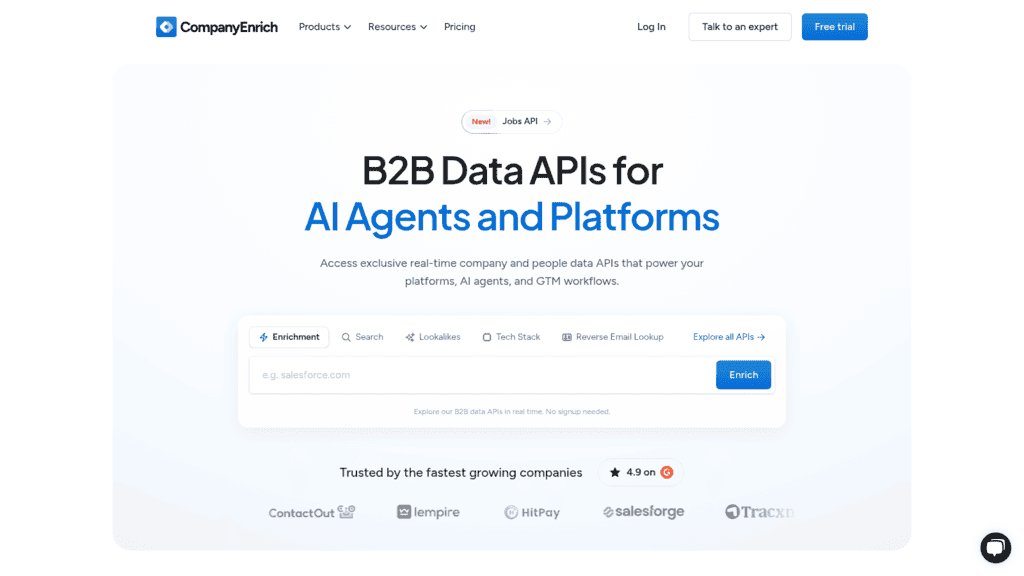
2. CompanyEnrich

CompanyEnrich as one of the best company enrichment apis

Overview: CompanyEnrich does one thing and prices it aggressively. Full API access to company and people data sits on every plan including the cheapest, which is rarer here than it should be.

Key features:

  • Domain-based company enrichment with a documented credit cost per endpoint
  • Credit rollover on Pro and above, so unused spend is not lost monthly
  • Batch API and async endpoints on the Scale tier for high-volume jobs

Pricing: a free trial gives 500 credits with no subscription. Starter is $49 per month for 5,000 credits at $0.0098 each with a 60 requests per minute limit. Pro is $149 for 50,000 credits at $0.0030 and 120 requests per minute. Scale is $549 for 500,000 credits at $0.0011 and 600 requests per minute.

Pros: per-credit cost drops roughly nine-fold from Starter to Scale, full API on every tier, published rate limits at each level

Cons: a newer and smaller vendor than the licensed data majors, some endpoints cost far more than one credit with mobile lookup at 30, and there is no published independent accuracy benchmark

Why it’s a good company enrichment API: the pricing curve rewards volume more steeply than almost anything else here, and nothing important is gated behind an enterprise conversation.

Final verdict: the best value pick for teams enriching company records at real scale.

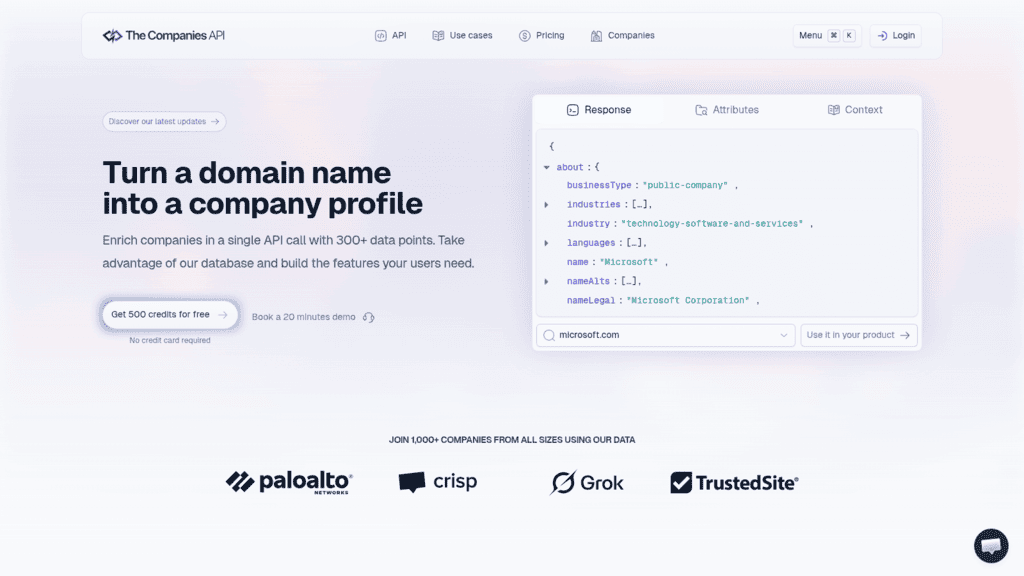
3. The Companies API

The Companies API as one of the best company enrichment apis

Overview: As the name suggests, this is a company data API and nothing else. Its distinguishing feature is throughput: request-rate ceilings run far above most competitors.

Key features:

  • Domain-to-company enrichment across a database of roughly 50 million companies
  • Rate limits from 50 to 1,000 requests per second depending on tier
  • Every API feature and the full database available on all plans

Pricing: Startup is $95 per month for 50,000 credits with extra credits at $2.50 per 1,000 and a 50 requests per second limit. Scaleup is $295 for 250,000 credits at $1.75 per 1,000 and 250 requests per second. Enterprise is $595 for 500,000 credits at $1.50 per 1,000 and 1,000 requests per second. Annual billing includes two months free.

Pros: exceptional request-rate ceilings, no feature gating between tiers, predictable flat credit pricing

Cons: company data only so you still need a contact provider, the $95 entry is higher than several rivals, and 50 million companies is a smaller universe than crawl-based competitors reach

Why it’s a good company enrichment API: if you are enriching a large table in a single job rather than trickling lookups, the throughput ceiling is the specification that matters and this is the best of them.

Final verdict: the pick for high-throughput batch enrichment where latency budgets are tight.

4. People Data Labs

People Data Labs as one of the best company enrichment apis

Overview: People Data Labs sells person and company data as separate products with separate pricing, suiting teams that need both sides of the graph from one contract and SDK.

Key features:

  • Company enrichment and company search endpoints alongside the person dataset
  • Bulk enrichment for batch jobs rather than per-record calls
  • A strong OpenAPI spec and maintained SDKs across major languages

Pricing: a free tier covers up to 100 records per month. Pro starts at $98 per month from 350 monthly records with volume discounts as usage grows, and annual commitment saves 20%. Enterprise moves to custom pricing with data-license feeds.

Pros: person and company data from one vendor, excellent developer tooling, ISO and SOC 2 Type 2 certified

Cons: the free tier obfuscates contact fields which limits evaluation, coverage claims of 200M+ company records are vendor-published rather than audited, and Person and Company are priced separately so a combined workload costs more than the headline

Why it’s a good company enrichment API: it is the most complete single source when you need to move between company records and the people inside them without joining two vendors.

Final verdict: the strongest all-round data foundation for engineering-led teams.

5. Coresignal

Coresignal as one of the best company enrichment apis

Overview: Coresignal is the most direct LinkedIn company data API here, aggregating employee, company and job-posting records from 15+ web sources with the employment graph at its center.

Key features:

  • 70M+ company records and 895M+ employee records from public web sources
  • A historical headcount API and employee webhooks on the Premium tier
  • Bulk datasets in JSON, CSV or JSONL as an alternative to per-record calls

Pricing: the API has a free tier with 200 Collect and 400 Search credits valid for 7 days. Starter is $49 per month, Pro $800 and Premium $1,500, with per-record costs falling from roughly $0.196 to as little as $0.005 at the top tier. Bulk datasets start from $1,000 per month with no free option. Paying yearly upfront saves 20%.

Pros: unmatched headcount and hiring history, per-record cost falls dramatically at volume, genuine free tier for evaluation

Cons: Collect and Search credits are billed separately so query-heavy workloads cost more than the per-record rate implies, multi-source company data costs double, and the leap from $49 to $800 leaves no middle tier

Why it’s a good company enrichment API: headcount trajectory is one of the few firmographic signals that reliably predicts buying, and almost nobody else exposes it historically.

Final verdict: the specialist choice when growth signals matter more than static attributes.

6. Diffbot

Diffbot as one of the best company enrichment apis

Overview: Diffbot builds its Knowledge Graph by crawling and parsing the public web with machine learning rather than licensing lists. That reaches companies no curated database has cataloged, which is the whole reason to choose it.

Key features:

  • Knowledge Graph search and enhance endpoints for company records
  • Extract, Bulk Extract and Crawl on every tier including free
  • Natural language processing over the crawled corpus

Pricing: the free tier gives 10,000 credits per month, free forever with no card, at 5 calls per minute. Startup is $299 per month for 250,000 credits at $0.001 each and 5 calls per second. Plus is $899 for 1 million credits at $0.0009, 25 calls per second and 3 seats. Enterprise is custom.

Pros: the most generous free tier in this list at 10,000 monthly credits, coverage of long-tail and private companies, no long-term contract

Cons: billing is by credit rather than by record so a complex query costs more than a simple one, the free tier’s 5 calls per minute is restrictive, and crawled data can lag official sources on very recent changes

Why it’s a good company enrichment API: when your target list includes companies too small or too obscure for licensed databases, crawling is the only method that finds them.

Final verdict: the best coverage of companies the list vendors have missed, with a free tier worth using.

7. Abstract API

Abstract API as one of the best company enrichment apis

Overview: Abstract API is the cleanest answer for anyone wanting a company data API free of charge. It does a narrow job simply and gets out of the way.

Key features:

  • Domain input returning company name, founding year, employee count, industry and location
  • Social profile URLs for LinkedIn, Facebook and X
  • Coverage across 175+ countries with weekly updates

Pricing: the free tier includes 100 requests at 1 request per second with no card required. Standard is $99 per month billed annually for 60,000 requests per month at 3 requests per second. Enterprise is custom and adds a 99.99% uptime SLA, SSO and a commercial license.

Pros: the simplest free company data endpoint available, no card required to start, wide country coverage

Cons: the field set is thinner than dedicated firmographic vendors, 1 request per second on free and 3 on Standard are low ceilings, and there is no company search, only lookup by domain

Why it’s a good company enrichment API: for adding basic firmographics to a signup form or a lead router, it is enough, free to try, and takes about ten minutes to integrate.

Final verdict: the right pick for lightweight enrichment and the best genuinely free option here.

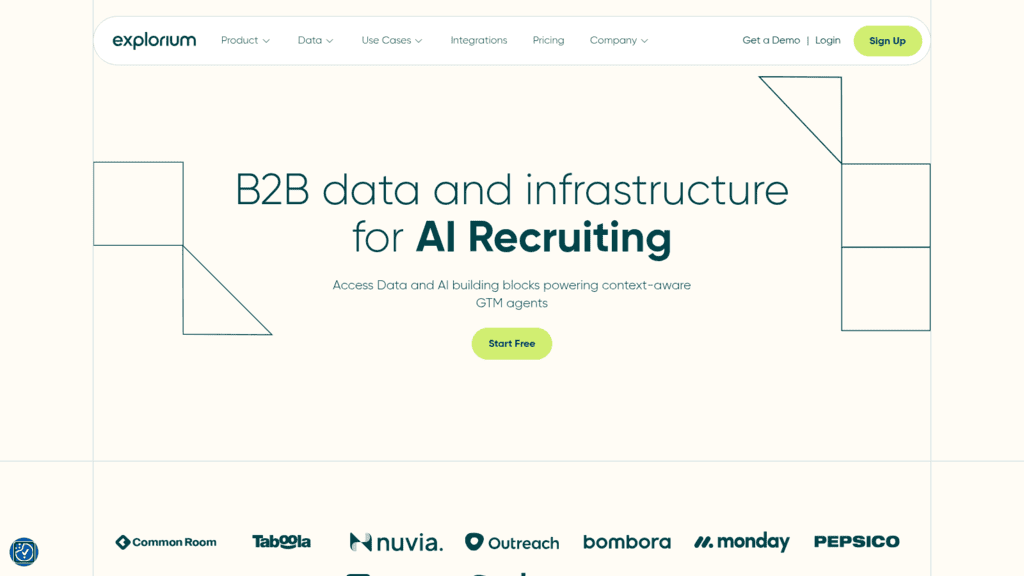
8. Explorium

Explorium as one of the best company enrichment apis

Overview: Explorium positions itself for agent workloads, describing itself as a B2B data layer for building GTM agents. Its commercial model is credit packages rather than subscriptions, which cuts both ways.

Key features:

  • Company and contact data exposed for agent-driven retrieval
  • Credit packages with no monthly commitment
  • Volume discounts and resale rights on enterprise agreements

Pricing: a free trial gives 100 credits valid for 90 days and does not renew. Starter is $84.99 for 2,500 credits, Growth $599.99 for 25,000, and Scale $5,624 for 500,000. Enterprise is custom. Different operations consume between 1 and 5 credits.

Pros: no subscription commitment, clear agent-oriented positioning, steep volume discounts at the top

Cons: credits expire after 12 months and cannot be carried over, packages are non-refundable and non-renewing so you must actively re-buy, and per-operation credit costs vary between 1 and 5 which complicates forecasting

Why it’s a good company enrichment API: buying credits outright suits spiky, project-based enrichment better than a monthly subscription you underuse.

Final verdict: worth considering for burst workloads, provided the 12-month expiry fits your usage.

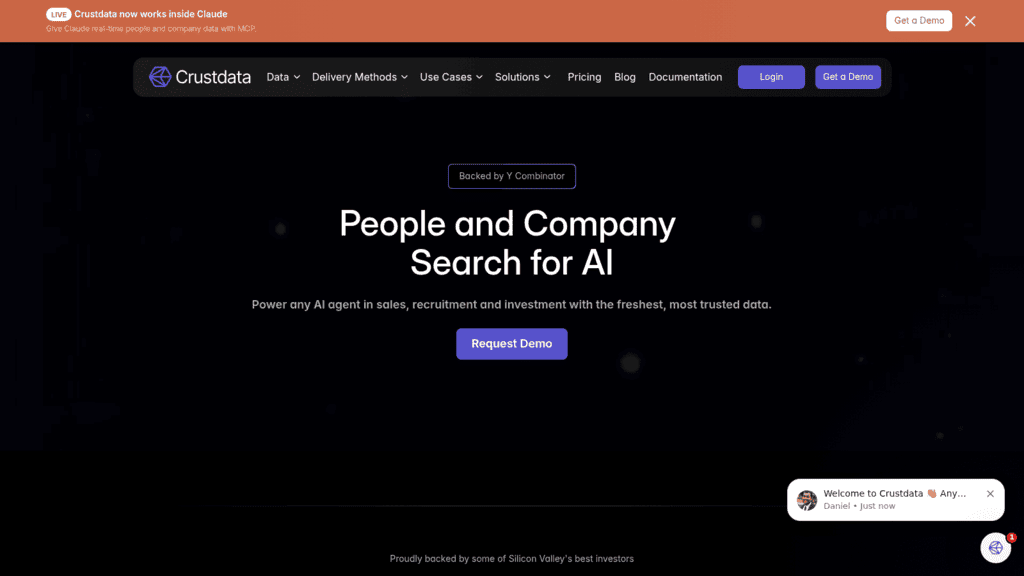
9. Crustdata

Crustdata as one of the best company enrichment apis

Overview: Crustdata is a real-time signals provider rather than a static firmographic store. Its focus is what changed recently: hiring, funding, headcount movement and other events.

Key features:

  • Real-time hiring, funding and company-event signals
  • An MCP server, so an agent can pull live company data directly
  • Flat-file datasets unified from 11+ sources as an alternative delivery method

Pricing: there is no public pricing. Crustdata operates two models, a real-time API on credit-based usage tiers billed monthly or annually, and flat-file datasets refreshed monthly. Both require a sales conversation.

Pros: genuinely real-time signals rather than periodic refreshes, ships an MCP server which few data vendors do, unified across many upstream sources

Cons: no published pricing at all so you cannot budget without a call, quote-only models tend to price out smaller teams, and the signals focus means it is a poor fit for plain firmographic lookup

Why it’s a good company enrichment API: timing beats attributes in outbound, and a company that just posted twelve engineering roles is a better prospect than one that merely matches your headcount filter.

Final verdict: excellent for event-driven prospecting, frustrating if you need a price before a meeting.

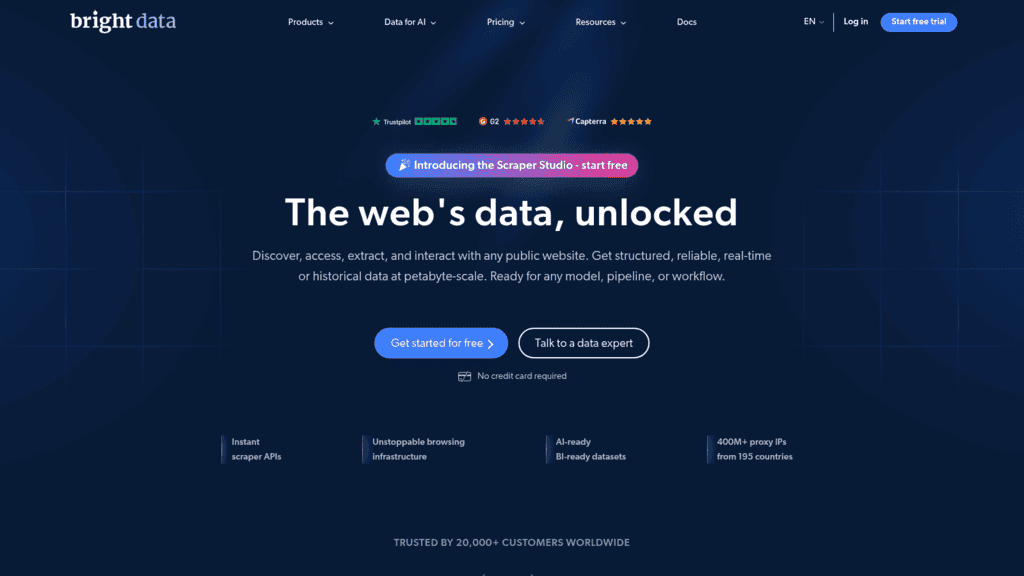
10. Bright Data

Bright Data as one of the best company enrichment apis

Overview: Bright Data is infrastructure rather than a plug-in endpoint. Its dataset marketplace is the most direct route to LinkedIn company data at volume, with the compliance weight that implies.

Key features:

  • LinkedIn Company Information, People Profiles and Job Listings datasets
  • Additional B2B datasets including Crunchbase, Google Maps and Glassdoor
  • Refresh-rate options from one-time to monthly

Pricing: the dataset marketplace base rate is $2.50 per 1,000 records, with volume tiers from 100,000 records up to full datasets of around 3TB. Refresh discounts apply: 25% for biannual, 50% for quarterly and 80% for monthly. A minimum monthly commitment is billed at the start of each month, and exact per-tier totals are not published.

Pros: the most direct access to LinkedIn company datasets at scale, steep refresh discounts, mature infrastructure

Cons: per-tier dollar amounts are not published so you cannot model total cost from the site, it is heavier to implement than a REST enrichment call, and bulk web data carries compliance obligations you must assess yourself

Why it’s a good company enrichment API: for building your own company graph rather than querying someone else’s, buying the underlying dataset is cheaper per record than any per-call API here.

Final verdict: the right layer if you are building infrastructure, overkill if you just need lookups.

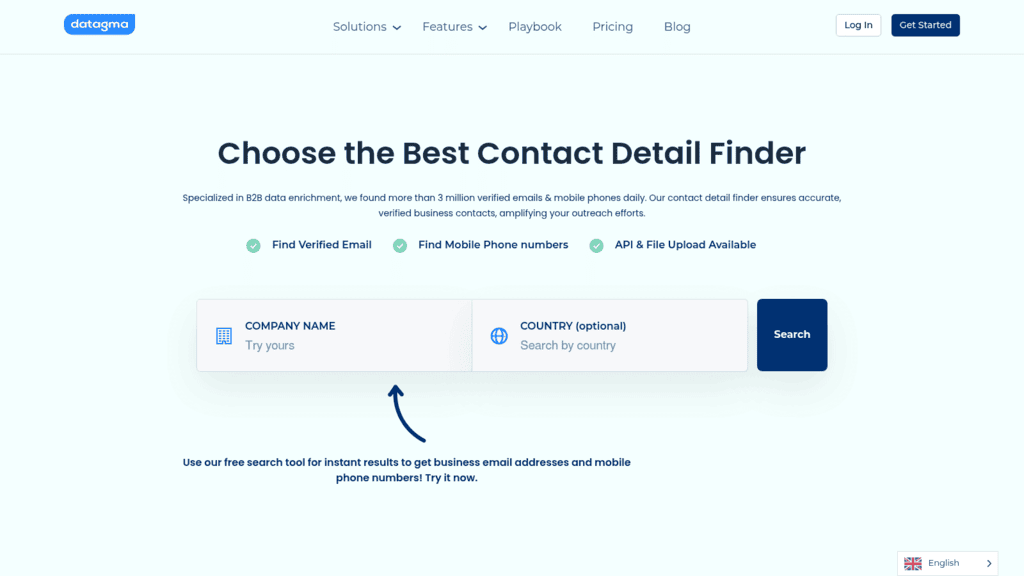
11. Datagma

Datagma as one of the best company enrichment apis

Overview: Datagma returns company attributes alongside contact data in a single call, and puts API access on every tier including the free one. That combination makes it a cheap way to prototype.

Key features:

  • Combined person and company enrichment from one lookup
  • API access on all tiers including free
  • Phone and email enrichment alongside firmographics

Pricing: the free tier covers 3 mobile numbers and 90 emails. Regular is $49 per month ($39 annually), Popular $99 ($79) and Expert $249 ($209), with an enterprise tier above. One credit buys an email and a mobile number costs 30.

Pros: API on the free tier, company and contact data from one endpoint, 20% annual discount

Cons: company coverage is narrower than dedicated firmographic vendors, 30 credits per mobile is steep, and the free allowance is too small for real evaluation

Why it’s a good company enrichment API: it answers the company question and the contact question in one request, which keeps simple enrichment pipelines simple.

Final verdict: a convenient combined option for small-scale work rather than a firmographic specialist.

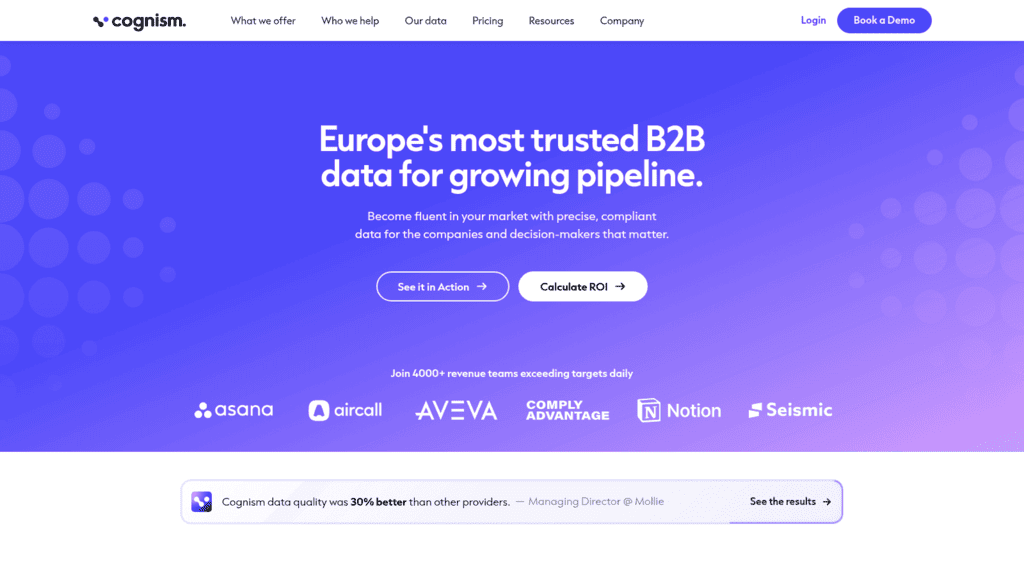
12. Cognism

Cognism as one of the best company enrichment apis

Overview: Cognism sells to enterprise buyers with compliance requirements, offering phone-verified contact data and notified GDPR coverage across Europe. Its API sits in a Data-as-a-Service add-on, not the core platform.

Key features:

  • CRM enrichment and Data-as-a-Service API delivery
  • Phone-verified mobile data, sold as a distinct quality tier
  • Notified GDPR coverage across European markets

Pricing: quote-only. Cognism charges an annual platform fee plus per-seat licenses, prepaid, with no monthly billing and no free plan beyond a 25-lead sample. Third-party procurement sources report roughly $15,000 platform plus $1,500 per user annually at the entry tier, rising steeply. API pricing sits inside the Data-as-a-Service add-on and is quoted by volume. These figures come from third parties, not from Cognism.

Pros: strong European coverage with a clear compliance position, phone-verified data reduces dial waste, mature enterprise support

Cons: quote-only with five-figure annual commitments, API access is an add-on rather than included, and there is no self-serve path or free tier to evaluate with

Why it’s a good company enrichment API: when procurement and legal are as involved as engineering, a notified GDPR position and a signed DPA matter more than a pricing page.

Final verdict: an enterprise purchase, appropriate when compliance drives the decision and budget is not the constraint.

What Separates a Good Company Data API From a Cheap One

Three questions change the answer.

Coverage of Your Segment, Not Their Total

A 200 million company database sounds comprehensive until you find it thin on the 40-person manufacturers you actually sell to. Coverage is not uniform, and vendors report the total rather than the distribution.

Take 200 domains from your customer base and run them through each candidate, using the discipline you would apply to find B2B leads anywhere. Differences on long-tail companies are much larger than on well-known ones, and the long tail is where most B2B pipelines live.

Diffbot tends to win this test on obscure companies precisely because it crawls rather than licenses.

Which Fields Are Actually Populated

A response with 40 possible fields is not one with 40 populated fields. Employee counts, revenue estimates and tech stack are often null even when the record exists, and vendors rarely publish fill rates.

Measure fill rate on the three or four fields your workflow depends on and ignore the rest of the schema. A provider that reliably returns headcount and industry beats one returning twenty sparse fields.

Ask whether estimates are labeled as estimates, because a modeled revenue figure presented as fact will eventually embarrass someone on a call.

Refresh Cadence and Legal Basis

Real-time company data APIs are not all real time. Some query a live index, others a cache refreshed weekly or monthly, and the difference shows on companies that recently moved, rebranded or were acquired.

The compliance question runs alongside it. Company records naming employees are personal data under GDPR, and the penalties are not theoretical: Article 83 allows fines up to EUR20 million or 4% of worldwide annual turnover, whichever is higher.

If you pull LinkedIn-derived data through a dataset provider, confirm the legal basis in writing before it reaches production.

What Company Enrichment Costs in Practice

Company data costs less per record than contact data: there are fewer companies than people, and firmographics change less often than jobs.

Use case Monthly volume Realistic cost Best-fit picks
Enriching signup forms Under 1,000 Free to $99 Abstract API, Diffbot free tier
Scoring inbound leads 5,000 to 50,000 $49 to $149 CompanyEnrich, The Companies API
Building a target account list 50,000 to 250,000 $149 to $595 CompanyEnrich Scale, The Companies API
Maintaining a company table 500,000+ $549 to $1,500+ CompanyEnrich, Coresignal, Bright Data
Event-driven prospecting Any Quote only Crustdata

Those bands assume standard lookups. Premium fields change the picture: multi-source company data costs double at Coresignal, and Datagma charges 30 credits for a mobile against 1 for an email.

The free options deserve a look before you spend anything. Between Abstract API’s 100 requests and Diffbot’s 10,000 monthly credits, most teams can validate their integration and measure fill rates without a purchase order.

Choosing the Right Company Enrichment API

The decision usually comes down to what you are doing with the record, and how it feeds your outbound prospecting.

If you need firmographics attached to a domain cheaply and at volume, go with CompanyEnrich for value or The Companies API for throughput. If you need company data alongside the people inside, People Data Labs covers both sides properly.

If your prospects are small, private or absent from curated lists, Diffbot finds them when others return nulls. If you are watching for growth signals rather than describing companies, Crustdata and Coresignal are the specialists.

If you want LinkedIn company data at dataset scale, Bright Data is the honest answer, with the compliance work that entails. If you just need a free company data API for a form, Abstract API takes ten minutes.

Choose Reply.io if your company targeting exists to feed outbound, and you would rather run targeting, enrichment and sequencing through one key than stitch three vendors together. If what you need is domain-level firmographic lookup on its own, one of the specialists above is the better buy, and we would rather say so here than have you discover it mid-integration.

The frustration here is well documented. In a thread on r/agency, an agency founder running outreach for multiple clients described the pattern anecdotally: every list provider promises 90% accuracy, but once sending starts, bounces climb and titles turn out to be outdated. That is the practical case for enriching live rather than trusting a stored list, whichever vendor you pick.

Frequently asked questions

What is a company enrichment API?

It is an endpoint that takes a company identifier, usually a domain, and returns structured firmographics: legal name, industry, employee count, headquarters location, founding year and social profiles. It replaces maintaining your own company table, because you request current attributes at the point of use instead of storing a snapshot that ages.

Is there a genuinely free company data API?

Yes. Abstract API provides 100 free requests with no card, and Diffbot offers 10,000 credits a month on a free-forever plan, the most generous allowance here. Coresignal and People Data Labs also have limited free tiers, though People Data Labs obfuscates contact fields.

How do I get LinkedIn company data through an API?

Not from LinkedIn directly, because no public LinkedIn API company data feed exists for this purpose. Licensed providers such as Bright Data and Coresignal aggregate LinkedIn company information and expose it through datasets or APIs, from $2.50 per 1,000 records at Bright Data. Confirm the legal basis in writing, since LinkedIn-derived records naming employees are personal data under GDPR.

What is the difference between a company data API and a real-time company data API?

A standard company data API serves records from a cache refreshed weekly or monthly. A real-time company data API queries a live index or event stream, so funding rounds, hiring surges and acquisitions appear immediately. Crustdata sits at the real-time end; most database providers serve periodically refreshed records.

Why do so many company enrichment APIs hide their pricing?

Because they sell to enterprise buyers where price varies by volume, contract length and licensing terms, and publishing a rate card weakens negotiating position. Crustdata, Cognism and ZoomInfo all operate this way. The trade-off is a sales cycle before evaluation, which is why self-serve options with published credit costs are faster to test.

Subscribe to our blog to receive the latest updates from the world of sales and marketing.
Stay up to date.

Related Articles

How to Run Deal Sourcing Outreach With udu and Reply.io

How to Run Deal Sourcing Outreach With udu and Reply.io

How to Run Deal Sourcing Outreach With udu and Reply.io
What’s New in Reply: Jason Gets Smarter, Your Inbox Goes Mobile, and More

What’s New in Reply: Jason Gets Smarter, Your Inbox Goes Mobile, and More

What’s New in Reply: Jason Gets Smarter, Your Inbox Goes Mobile, and More
11 Best Intent Data APIs in 2026 to Find Ready-to-Buy Leads

11 Best Intent Data APIs in 2026 to Find Ready-to-Buy Leads

11 Best Intent Data APIs in 2026 to Find Ready-to-Buy Leads