
Key takeaways:
- A company lookup API answers an identity question: given a domain, a name or a LinkedIn URL, which company is this and what is its canonical record?
- Resolution is the hard part. Acme Corp, acme.com, Acme Holdings Ltd and a LinkedIn slug may all be one entity or four, and vendors disagree constantly.
- Company records decay faster than most teams assume, since only about half of new US businesses survive five years, so yesterday’s resolved record may point at nothing.
- We are direct below about the boundary: we hold 60+ million accounts for targeting, but we have no endpoint that takes a domain and hands back a company record.
Every system that touches company data eventually hits the same problem. A form fill says “Acme”. A CRM record says “Acme Corporation”. A signup says acme.co.uk. An enrichment vendor returns “ACME Holdings Limited”. Are these one customer or four?
That is identity resolution, and a company lookup API is the tool built for it, sitting upstream of the marketing data providers that append attributes later. You send whatever identifier you happen to hold, and you get back a canonical record with a stable ID you can join everything else to.
It matters more than it sounds, because the underlying reality keeps moving. US Bureau of Labor Statistics Business Employment Dynamics data shows roughly half of new establishments survive five years, so a meaningful share of any company table older than a couple of years describes businesses that no longer trade under that name.
This guide ranks the 11 company lookup APIs worth building against in 2026, with pricing verified live. We are listed first, and our entry is specific about which half of this problem we solve.
Lookup Is Not the Same as Enrichment
The distinction decides which vendor you should buy, and the marketing pages blur it deliberately.
Enrichment assumes you already know which company you mean and appends attributes: headcount, industry, revenue band, tech stack. The question is “tell me more about this company.”
Lookup is the step before that. The question is “which company is this, and what is its canonical identity?” You may be starting from a messy string a human typed, a domain that redirects somewhere else, a LinkedIn slug, or an email address.
Four directions come up repeatedly, and no vendor is equally good at all of them: a company domain lookup API call resolving domain to company name, the reverse from company name to domain, LinkedIn URL to company, and email address to company.
The failure modes are specific too. Subsidiaries resolving to parents, or not. Rebrands where the old domain still redirects. Holding companies with no web presence. Franchises sharing one brand across hundreds of legal entities. A vendor that nails domain-to-name can still be useless at reconciling a franchise network.
How We Assessed These Company Lookup APIs
We required a callable API, pricing we could verify live or an explicit statement that pricing is quote-only, and genuine resolution capability rather than an enrichment endpoint with a domain parameter.
We fetched every price rather than repeating figures from elsewhere, which mattered because this category reprices and repositions often. Where a vendor publishes credit costs but not tier prices, we say so rather than inventing a tier.
We weighted three things specific to resolution work:
- Whether autocomplete or fuzzy name matching exists, since real inputs are messy
- Whether the vendor returns a stable identifier you can store and rejoin later
- Whether published rate limits support interactive use, because lookup is often user-facing
ZoomInfo is discussed in this space but is not ranked here. It publishes no pricing, blocks automated inspection, and its API is reported through third-party procurement sources rather than a rate card, which is not a standard we can hold the other entries to.
The 11 Best Company Lookup APIs Compared
Pricing is the cheapest tier that includes API access.
| Tool | Best for | Key features | Main limitation | Pricing (from) | Rating |
| Reply.io | Turning a resolved account into outreach | 60M+ accounts, ICP filters, sequencing in one API | No domain-to-record lookup endpoint | $49/month | ★★★★★ |
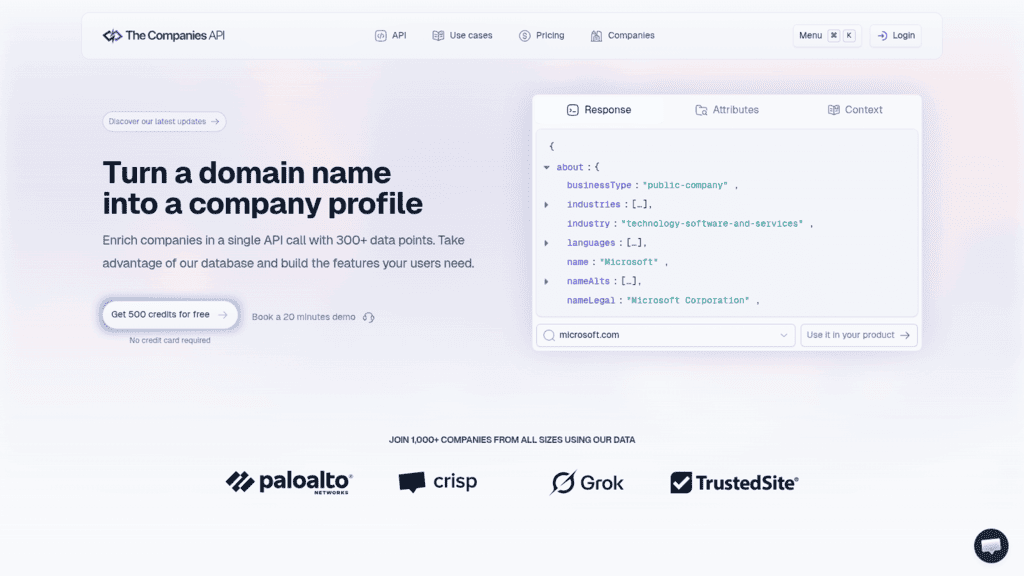
| The Companies API | High-throughput domain resolution | ~50M companies, 50 to 1,000 req/sec | Company data only, no contacts | $95/month | ★★★★★ |
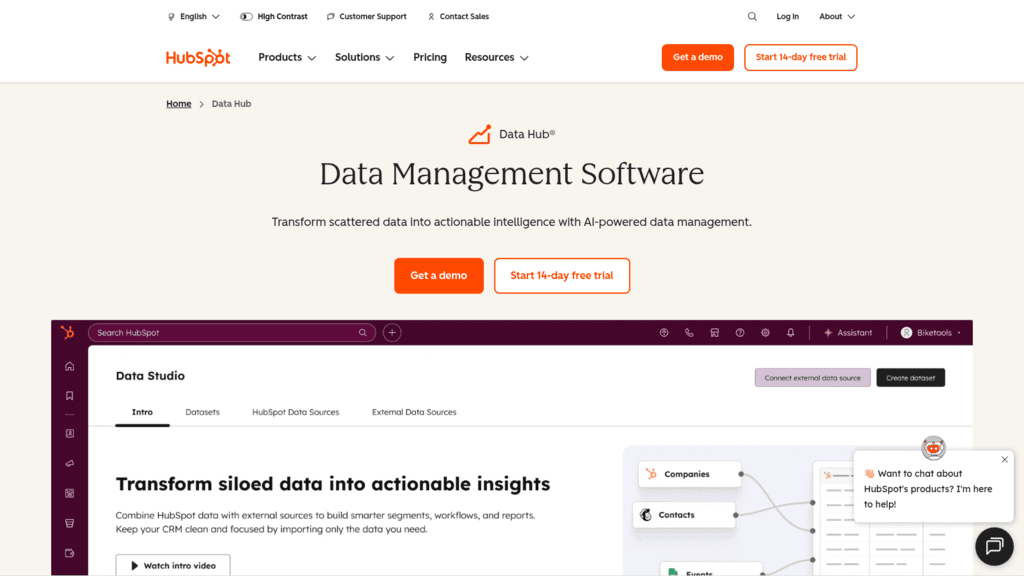
| HubSpot Data Hub | Name and domain autocomplete | Clearbit lineage, CRM-native resolution | Best value only inside HubSpot | Free tier | ★★★★☆ |
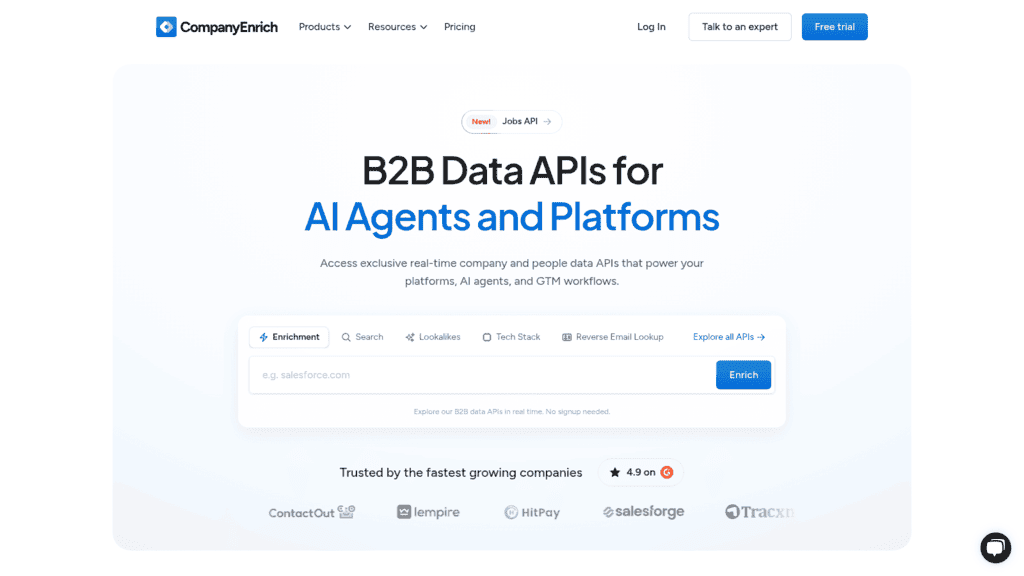
| CompanyEnrich | Value at volume | Full API on every tier, credit rollover | Newer vendor, smaller footprint | $49/month | ★★★★☆ |
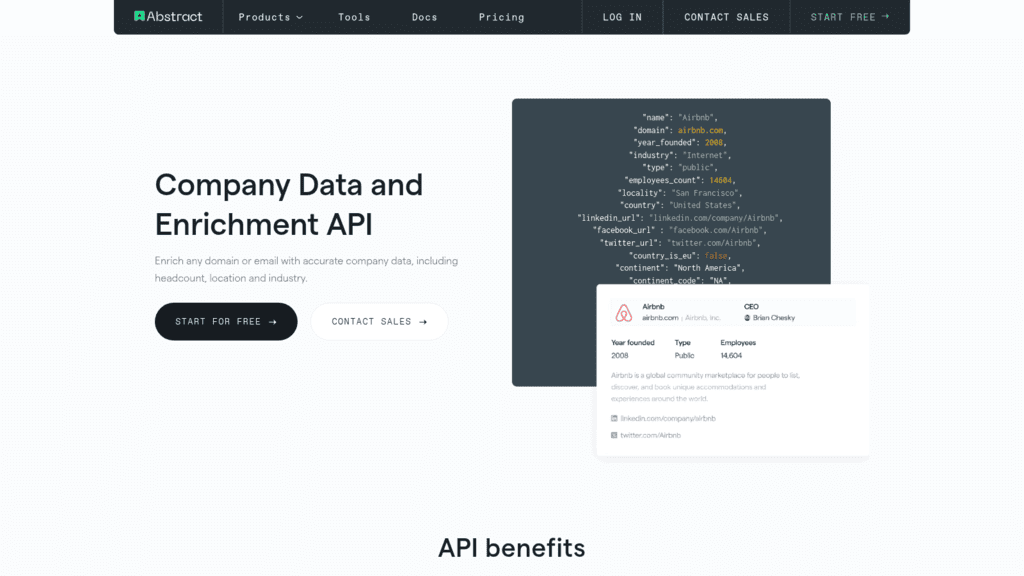
| Abstract API | The simplest free lookup | Domain in, clean company record out | 1 request per second on free | Free (100 requests) | ★★★★☆ |
| Harmonic | Startups and private companies | 35M companies, 195M people, weekly refresh | Quote-only across every product | Quote only | ★★★★☆ |
| Generect | Pay-per-result resolution | Company API, unlimited free search | Thin published tier documentation | Free searches | ★★★★☆ |
| Ocean.io | Finding the companies next to this one | Lookalike expansion, clear credit costs | Tier prices sit behind a calculator | ~$99/month | ★★★☆☆ |
| Sumble | Resolving companies to named people | Org and reporting hierarchy, MCP server | Signal-oriented rather than registry-like | Free (500 credits) | ★★★☆☆ |
| PredictLeads | Monitoring resolved companies over time | 1 credit per month to follow a company | Credits do not roll over | Free (100 calls) | ★★★☆☆ |
| Bright Data | Building your own company graph | LinkedIn company datasets at $2.50/1,000 | Per-tier totals not published | $2.50/1,000 records | ★★★☆☆ |
Ratings reflect resolution quality and throughput rather than attribute depth, which is why a narrow fast vendor can outrank a broader one here.
1. Reply.io
Best for: Turning a resolved account into outreach
Overview: Let us be exact about the boundary, because this category has a technical meaning and we sit on one side of it.
We hold 60+ million accounts and 15+ million US company profiles, and our Live Data endpoints let you search that universe by industry, location, headcount signals and seniority. That is discovery: describe a company profile and receive matching accounts, resolved into contactable people.
What we do not offer is resolution in the other direction. There is no endpoint that accepts acme.com and returns Acme’s canonical record, and none is published on our roadmap. If your problem is deduplicating a CRM or normalizing messy form input, buy one of the specialists below.
Our claim to the top spot is what happens after resolution, and the full feature set shows how much of that sits in one place. Once you know which accounts matter, sequencing them across email, LinkedIn, SMS and calls runs through the same credential, with no export between systems.
Key features:
- Live Data search across 60+ million accounts by industry, location, department and seniority
- Account-to-people resolution, so a target company becomes named contacts rather than a firmographic row
- 220+ million US contacts and 15+ million US company profiles in the same B2B database
- Async email validation with background-job handling before anything sends
- Multichannel sequence endpoints so a resolved account becomes an active campaign
- Rate limiting documented at 100 calls a minute and 3,000 an hour for each user
Pricing: the meter is active contacts rather than seats. The first tier holds 1,000 active contacts for $49 monthly on annual billing, $59 if you pay month to month, and the ladder ends at $899 for 100,000. Fifty live data credits are bundled in; more start at $20.
Pros: account discovery resolves straight into contactable people, one API key covers targeting through to sending, no per-seat charge as headcount grows, published rate limits, deliverability tooling included
Cons: we have no domain-to-company lookup endpoint, so we cannot answer “which company is this” from an identifier, our Live Data search is in beta with response shapes that may change, and the account data is bundled inside a sending platform rather than sold as a resolution service
How to start using it:
- Take a 14-day trial and generate an API key at Settings > API Key.
- Verify the credential with
https://api.reply.io/v3/whoami. - Run a Live Data preview against your ICP filters before spending credits.
- Check how many of your 100 known target accounts appear in the result set.
- Sequence the resolved contacts through the same API rather than exporting them.
Why it’s a good company lookup API: resolving a company is a means, not an end. We cover the part where a resolved account turns into a conversation, which none of the pure data vendors here attempt.
Final verdict: the right choice when you already know your target profile and need it worked, and the wrong one when you need identity resolution itself. For that, The Companies API or HubSpot Data Hub below are built for the job and we are not.