
11 Best Contact Enrichment APIs in 2026 for Sales Outreach

11 Best Contact Enrichment APIs in 2026 for Sales Outreach

Key takeaways:

  • A contact enrichment API takes an identifier you already hold, an email or a LinkedIn URL, and returns the missing fields: job title, employer, seniority, direct dial, verified address.
  • Price per credit tells you almost nothing. What matters is the match rate on your list and whether the vendor bills you for a miss, which is why pay-on-success providers like FullEnrich and BetterContact often beat cheaper per-credit tiers.
  • API access is gated behind a top tier at several vendors. Wiza opens it only on Email + Phone, and Coresignal splits API and bulk datasets into separate products.
  • Our own enrichment runs inside the platform today, and the endpoints land in late August 2026, so check the timing against your build schedule before you commit.

Enriching a contact list is the least glamorous part of outbound and quietly decides whether a campaign works. You can write a great sequence and still send it to a director who left fourteen months ago.

That decay is not a rounding error. The Bureau of Labor Statistics puts median employee tenure at 3.9 years, and 3.5 years in the private sector, with roughly 22% at their employer a year or less. A list you bought last spring is already wrong in ways a spreadsheet cannot show you.

A contact enrichment API is the fix. Instead of re-buying a static file, you call an endpoint with what you already know and get back what you are missing, at the moment you need it. That turns B2B list building from a purchase into a process.

This guide ranks the 11 contact enrichment APIs worth a developer’s time in 2026. We built one of them and put ours first, so read our entry with that in mind. We have also stated plainly where our product is not ready yet.

What a Contact Enrichment API Actually Does

A contact enrichment API accepts a partial record and returns a fuller one. It is the programmatic form of data enrichment: you send an anchor, most often a work email or a LinkedIn profile URL, and the response comes back with the fields you were missing.

The useful ones return some combination of full name, job title, seniority, department, employer and domain, location, a verified work email, a personal email, and a direct dial.

Two architectures dominate. Database providers license or assemble a large store of records and match your anchor against it, which is fast and cheap but only as fresh as the last refresh. Waterfall providers hold no database and query several upstream vendors in sequence until one returns a verified hit, which costs more per call but lifts the match rate.

A third, smaller group works algorithmically. Dropcontact holds no contact database and derives addresses from patterns and public signals, which is slower on coverage but much simpler under GDPR.

The distinction matters more than any pricing page, because it decides what happens when a provider does not know your prospect.

How We Picked These Contact Enrichment APIs

We required a live pricing page and a working endpoint. Both knocked out candidates.

Every tool here publishes enough pricing detail to work out a real cost per enriched contact, or is explicit that it does not. We dropped vendors we could not verify rather than repeat a number from someone else’s roundup. Lusha and RocketReach both came out: Lusha gates API access off its self-serve tiers, and RocketReach served us regional pricing we could not state in dollars.

We also weighted three things a buyer notices only after signing:

  • Whether the API is available on the entry plan or gated behind an enterprise tier
  • Whether a failed lookup consumes a credit
  • Whether credits expire, roll over, or reset to zero every month

Ratings reflect fit for programmatic contact enrichment, not the vendor’s whole product. A tool can be excellent at list building and mediocre as an API.

The 11 Best Contact Enrichment APIs Compared

Pricing below is the cheapest tier that actually includes API access, which is not always the cheapest tier the vendor advertises.

Tool Best for Key features Main limitation Pricing (from) Rating
Reply.io Enriching contacts you will then sequence Enrich by email or LinkedIn URL, Live Data prospect search, email validation Enrichment endpoints ship late August 2026 $49/month ★★★★★
People Data Labs Raw person data at engineering scale 1.5B+ person records, clean JSON, strong SDKs Free tier obfuscates contact data $98/month ★★★★☆
FullEnrich Lifting match rate on a hard list 25+ source waterfall, pay per verified result Credit costs vary sharply by field Free (1,000 credits) ★★★★☆
BetterContact Cheapest waterfall per valid email 20+ providers, only billed when valid Small starter credit pool $15/month ★★★★☆
LeadMagic Teams wiring enrichment into agents API, CLI and MCP server on every plan Basic plan credits do not roll over $49/month ★★★★☆
Prospeo Predictable per-credit budgeting Flat credit model, generous free tier Mobile numbers cost 10 credits each Free (75 credits) ★★★★☆
Dropcontact EU-facing teams under GDPR No database, algorithmic, EU servers Euro pricing and lower raw coverage EUR79/month ★★★★☆
Datagma API access on a genuinely free tier Person and company data, API on all tiers 30 credits per mobile number Free (90 emails) ★★★☆☆
Apollo.io One vendor for data and sending Large database, real free tier, per-seat pricing Accuracy varies by segment $49/user/month ★★★☆☆
Wiza LinkedIn-anchored contact exports Unlimited email reveals on annual plans API gated to Email + Phone and Team $166/user/month ★★★☆☆
Coresignal Firmographic depth alongside contacts 895M+ employee records, historical headcount Search and Collect credits billed separately $49/month ★★★☆☆

Ratings reflect programmatic enrichment fit, so a three-star tool may still be the right buy for a different job. The entries below explain each score.

1. Reply.io
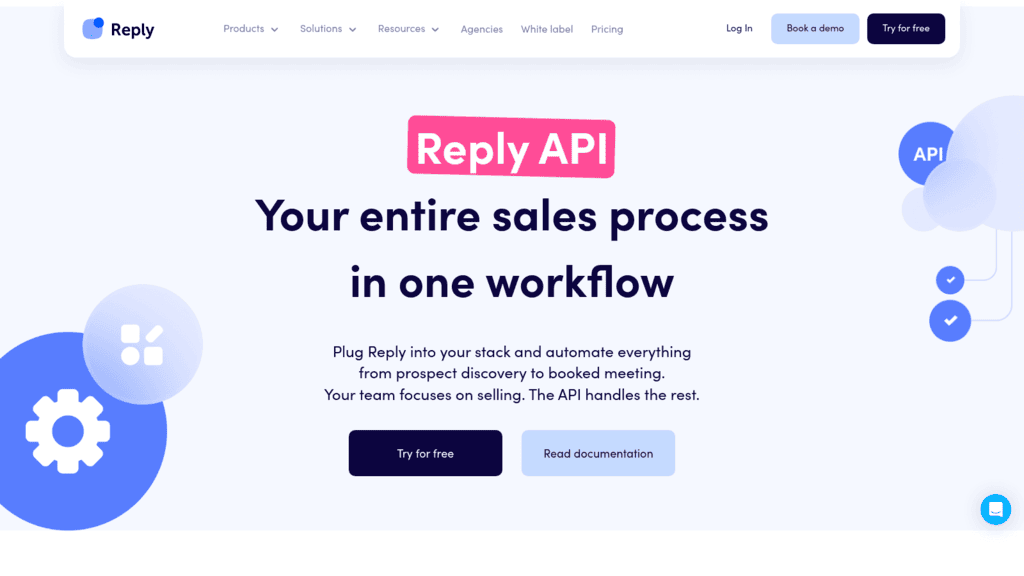
Reply.io as one of the best contact enrichment apis

Best for: Enriching contacts you will then sequence

Overview: We built Reply.io as a sales engagement platform, and the enrichment sits inside it rather than beside it. That is the whole argument for us and against us, depending on what you are building.

If your enriched records are heading straight into a multichannel sequence, keeping data and sending under one API means one auth flow, one contact object, and no reconciliation step between a data vendor and a sending tool. The underlying contact database covers 1+ billion records.

Our v3 API documents 359 endpoints under a single Bearer token, with rate limits of 100 requests per minute and 3,000 per hour per user. Long-running work like bulk validation returns a 202 and a background job you poll.

The honest timing note: enrichment runs in the platform today, where you select contacts on the People page and enrich by LinkedIn URL to refresh role, company and seniority. The five enrichment endpoints are documented and dated for late August 2026.

Key features:

  • Enrich by email or LinkedIn URL to refresh title, employer and seniority on records you already hold
  • Find missing email addresses and phone numbers on partial contacts, so a half-built list becomes sendable
  • Fill AI custom fields, which writes derived attributes into the contact record for use as sequence variables
  • Live Data search across 1+ billion contacts, filtered by department, industry, job title, location and seniority
  • Email validation as an async endpoint, so you screen addresses before they touch a sending domain
  • An MCP server that connects the platform to Claude, Cursor and other MCP clients for orchestration

Pricing: Email Volume starts at $49 per month billed annually ($59 monthly) for 1,000 active contacts, and scales by contact tier to $899 per month at 100,000. Pricing is by active contact rather than per seat, so a growing team does not multiply the bill, but exceeding your tier does raise it. The base plan includes 50 live data credits per month, with more from $20 per month.

Pros: data and sequencing behind one API, plan-level pricing rather than per-seat, 1+ billion contacts including 220+ million in the US, documented rate limits and async job handling, MCP server for agent workflows

Cons: the enrichment endpoints are not callable until late August 2026, and our data is bundled inside the platform rather than sold standalone, so if you want enrichment without a sending tool we are the wrong shape

How to start using it:

  1. Start a 14-day trial and generate an API key under Settings > API Key.
  2. Confirm the key with a call to https://api.reply.io/v3/whoami.
  3. Import a sample list of 100 contacts through the Contacts endpoints.
  4. Run Live Data search against your ICP filters to see match quality on your segment before committing.
  5. Wire the enrichment endpoints when they ship in late August 2026, or run enrichment in the platform UI until then.

Why it’s a good contact enrichment API: the enriched record lands in the same object your sequences already read from, which removes the sync layer most stacks need. For teams whose next step after enrichment is always outreach, that is a genuine architectural saving.

Final verdict: the strongest pick if enrichment is a step in your outbound pipeline rather than a standalone data need, with the clear caveat that you are buying against an August 2026 date for full API parity. Teams that need callable enrichment endpoints this quarter should pick from the entries below and revisit us later.
2. People Data Labs

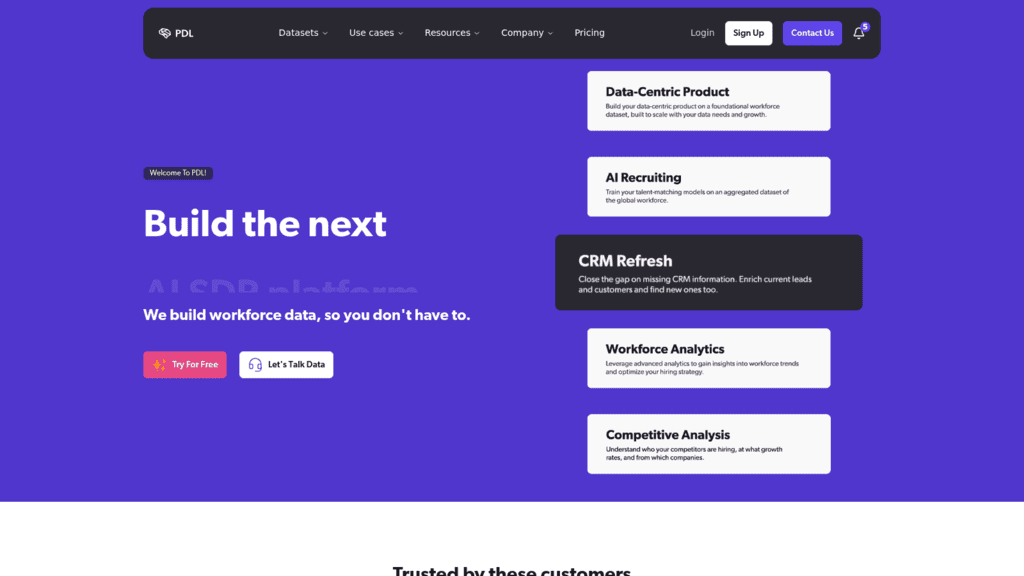
People Data Labs as one of the best contact enrichment apis

Overview: People Data Labs sells structured person and company data to engineering teams that want to build their own logic on top. It is the least opinionated option here: clean JSON, a solid OpenAPI spec, and no interface to speak of.

Key features:

  • Person enrichment from email, LinkedIn URL, name and company, or phone
  • Bulk enrichment endpoints for batch jobs rather than record-by-record calls
  • SDKs and an OpenAPI spec that make it straightforward to generate a typed client

Pricing: a free tier covers up to 100 records per month, and Pro starts at $98 per month from 350 monthly records, with volume discounts as usage grows. Annual commitment saves 20%, and enterprise moves to custom pricing with data-license feeds.

Pros: excellent developer ergonomics, transparent volume pricing, ISO and SOC 2 Type 2 certified

Cons: the free tier obfuscates contact data so you cannot properly evaluate email and phone quality without paying, coverage figures widely cited at 1.5B+ person records come from the vendor rather than an audit, and there is no sending or workflow layer

Why it’s a good contact enrichment API: it is the closest thing here to raw material, which is exactly right if you have engineers who want to own matching and scoring themselves.

Final verdict: the default choice for teams building their own data layer rather than buying a workflow.

3. FullEnrich

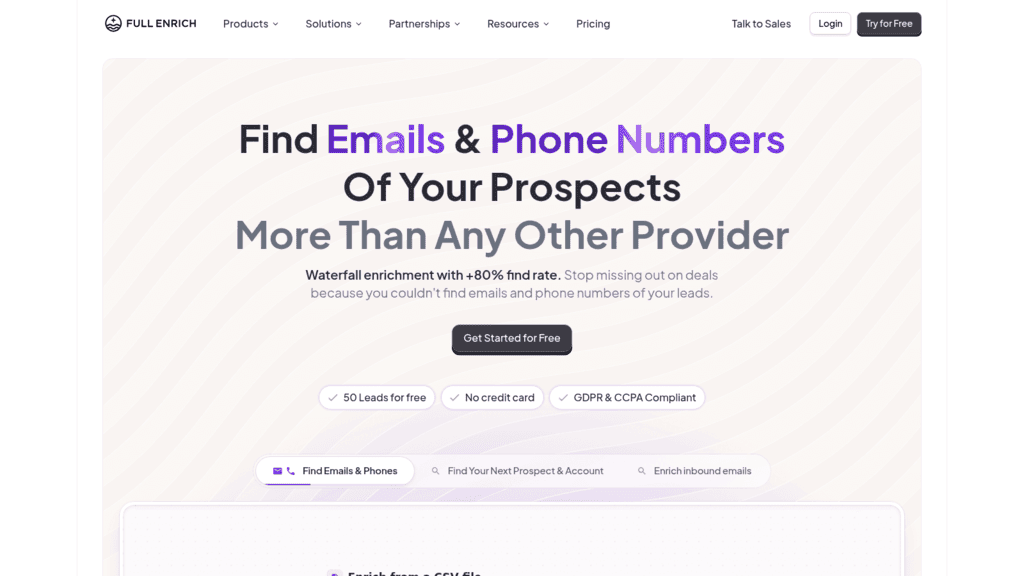
FullEnrich as one of the best contact enrichment apis

Overview: FullEnrich is a waterfall provider that queries more than 25 upstream sources in sequence until one returns a verified result. You pay for outcomes rather than attempts, which changes the economics on difficult lists.

Key features:

  • Waterfall enrichment across 25+ data sources for email and mobile
  • Pay-per-verified-result billing, so a miss costs nothing
  • Unlimited users and integrations on every plan

Pricing: a free tier provides 1,000 credits per month. Credits are priced by field: a work email costs 1, a personal email 3, a mobile 10, and a reverse lookup 1, so your real cost depends heavily on which fields you request.

Pros: high match rates on lists that single-source vendors fail, no charge for misses, unlimited seats

Cons: mobile numbers at 10 credits get expensive quickly, the variable credit cost makes budgeting harder than a flat model, and you inherit the quality of whichever upstream provider answered

Why it’s a good contact enrichment API: when your list is the hard 30% that ordinary providers cannot match, a waterfall is usually the only thing that moves the number.

Final verdict: the right call when match rate matters more than per-credit price.

4. BetterContact

BetterContact as one of the best contact enrichment apis

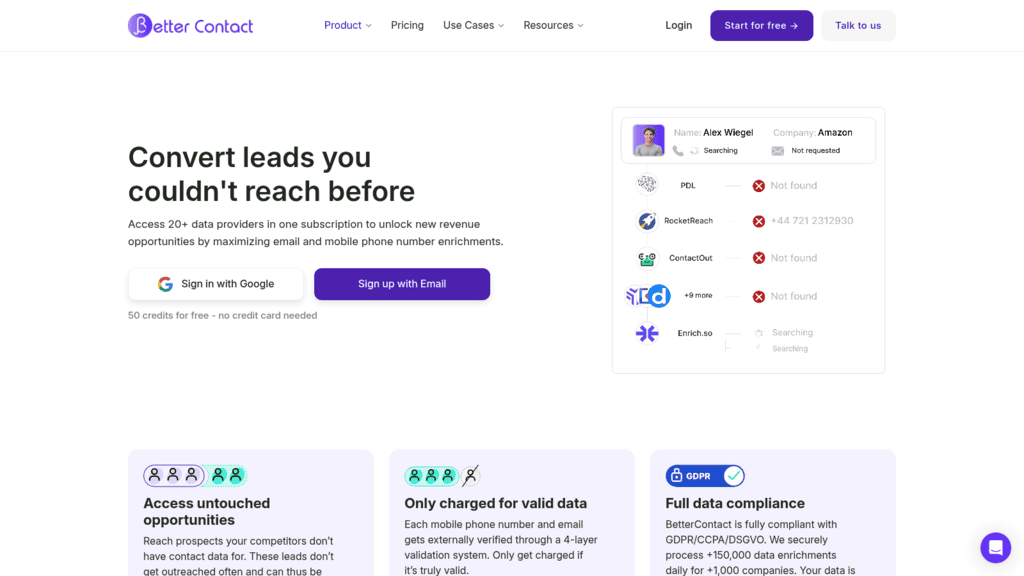
Overview: BetterContact runs the same waterfall idea across more than 20 providers, priced aggressively at the low end. It is the cheapest credible way to test whether a waterfall lifts your match rate.

Key features:

  • Waterfall across 20+ providers including RocketReach, Apollo, ContactOut, Hunter and Prospeo
  • Billing only on valid results, with no charge for misses or catch-all addresses
  • Bring-your-own provider API keys on the enterprise tier

Pricing: Starter is $15 per month for 200 credits, roughly $0.075 per email credit. Pro starts at $49 per month with a slider from 1,000 to 50,000 credits, bringing the effective rate to about $0.049 per email credit at 1,000. Enterprise starts at $799 per month. Signup includes 50 trial credits.

Pros: the lowest entry price of any waterfall here, no charge for catch-alls, transparent per-credit math

Cons: 200 credits on Starter is a very small pool for real testing, the enterprise jump to $799 is steep, and like any waterfall the output quality varies by which provider answered

Why it’s a good contact enrichment API: it makes waterfall enrichment cheap enough to A/B against your existing single provider without a procurement conversation.

Final verdict: the best value entry point into waterfall enrichment.

5. LeadMagic

LeadMagic as one of the best contact enrichment apis

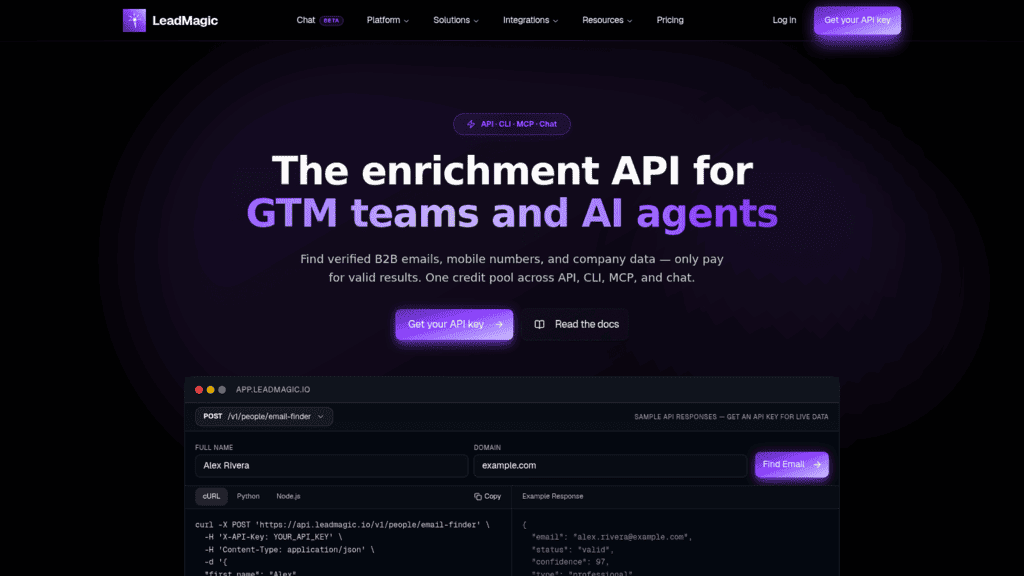
Overview: LeadMagic is built for people who will drive it from code rather than a dashboard. Every plan ships API access, a command-line tool, and an MCP server, which is still unusual in this category.

Key features:

  • Per-endpoint credit pricing so you can model cost precisely before you build
  • An MCP server on every plan, letting an agent call enrichment directly
  • A job-change detector that flags when a contact has moved

Pricing: Basic is $49 per month for 2,000 credits, rising through Essential at $99, Growth at $249, Professional at $499 and Ultimate at $849 for 100,000 credits. Credit costs differ by endpoint: an email finder call costs 1, validation 0.25, a mobile 5, and job-change detection 3.

Pros: API, CLI and MCP on every tier including the cheapest, granular per-endpoint pricing, one shared credit pool across seats

Cons: Basic plan credits do not roll over so unused spend is lost each month, mobile lookups at 5 credits add up fast, and the database is smaller than the large licensed providers

Why it’s a good contact enrichment API: the MCP server and CLI mean an AI agent can enrich a record without you writing an integration layer first.

Final verdict: the most agent-ready option in this list at a self-serve price.

6. Prospeo

Prospeo as one of the best contact enrichment apis

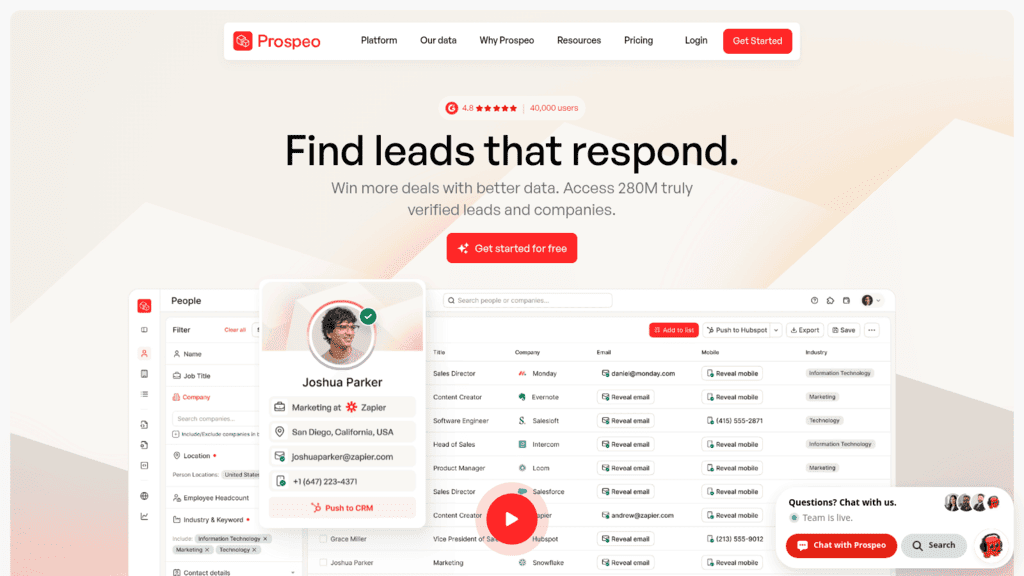
Overview: Prospeo keeps things simple: one credit pool, a flat rate per email, and a free tier large enough to test with. There is no waterfall and no clever routing, which is the point.

Key features:

  • Email finding and enrichment from domain, name or LinkedIn URL
  • A flat credit model where an email costs 1 credit and a mobile costs 10
  • A free tier of 75 credits per month with API access included

Pricing: Starter is $39 per month for 1,000 credits, Growth $99 for 5,000, Pro $199 for 20,000, and Business $369 for 50,000. The free plan gives 75 credits per month.

Pros: the easiest cost model here to forecast, API access from the free tier upward, no surprises in billing

Cons: mobile numbers at 10 credits make phone enrichment expensive, coverage is narrower than waterfall providers on hard lists, and there is no published accuracy benchmark

Why it’s a good contact enrichment API: predictable spend. If you need to tell finance what 20,000 enrichments will cost, this is the simplest answer.

Final verdict: a dependable single-source provider for teams that value budget clarity over maximum coverage.

7. Dropcontact

Dropcontact as one of the best contact enrichment apis

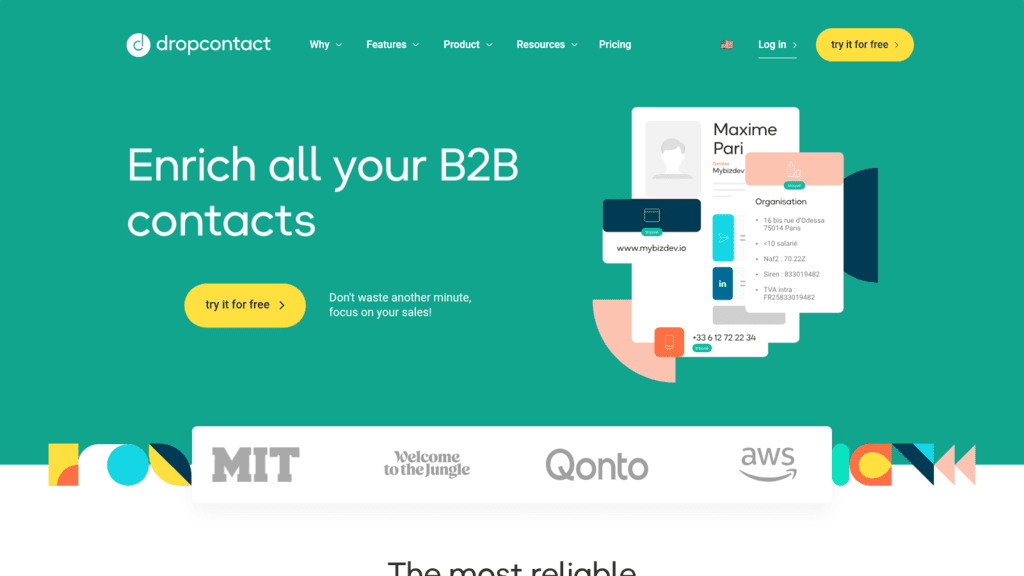
Overview: Dropcontact is the outlier here. It holds no contact database at all, deriving and verifying addresses algorithmically from public signals, which makes its GDPR position far simpler than any database-backed rival.

Key features:

  • Purely algorithmic enrichment with no stored personal database
  • EU servers and full GDPR alignment, with no third-party data purchase
  • Job-change detection and company enrichment on the Growth tier

Pricing: Starter is EUR79 per month for 500 credits, or EUR63.20 billed annually. Growth is EUR120 per month, EUR96 annually, and adds LinkedIn enrichment, job classification, company enrichment and job-change detection. Enterprise starts from 200,000 credits per month. A trial gives 50 free credits.

Pros: the cleanest compliance story in this list, pay-on-success billing, unused Growth credits carry over

Cons: priced in euros so US teams carry currency risk, raw coverage trails database-backed providers, and the useful features sit on Growth rather than Starter

Why it’s a good contact enrichment API: if your prospects are in the EU and your legal team asks where the data came from, “we did not buy any” is a very short conversation.

Final verdict: the correct choice for EU-facing outbound, accepting lower coverage as the trade.

8. Datagma

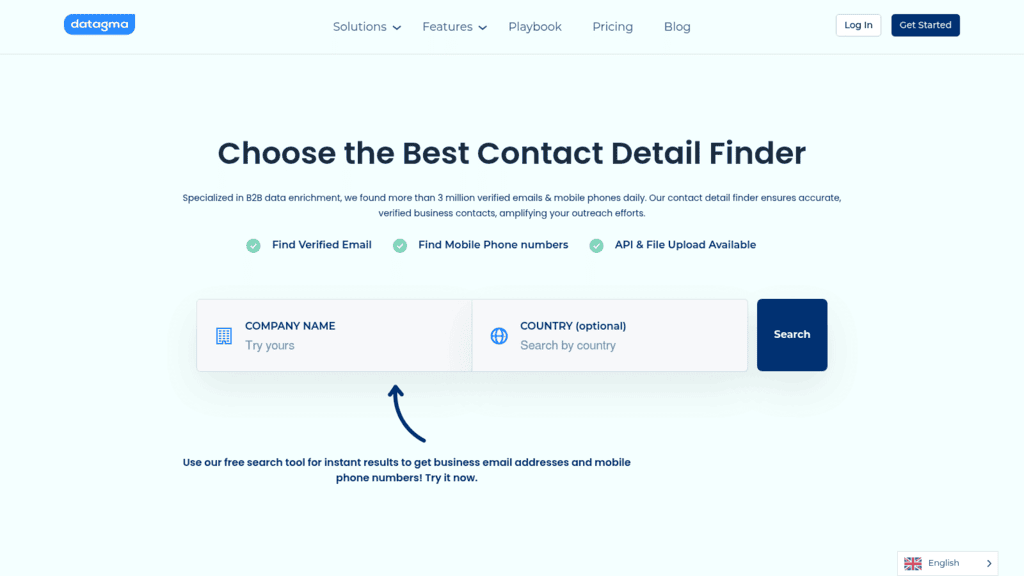
Datagma as one of the best contact enrichment apis

Overview: Datagma bundles person and company enrichment in one call and puts API access on every tier including the free one. That makes it easy to prototype before spending anything.

Key features:

  • Combined person and company enrichment from a single lookup
  • API access on all tiers, free plan included
  • Phone number enrichment alongside email

Pricing: the free tier includes 3 mobile numbers and 90 emails. Regular is $49 per month ($39 annually) for 100 mobiles and 3,000 emails, Popular $99 ($79) for 250 and 7,500, and Expert $249 ($209) for 750 and 22,500. One credit buys an email; a mobile costs 30.

Pros: API on the free tier, person and company data from one endpoint, 20% annual discount

Cons: 30 credits per mobile number is the steepest phone pricing here, the free tier is too small for meaningful evaluation, and it is a smaller vendor than the licensed data majors

Why it’s a good contact enrichment API: free API access removes the usual barrier to testing enrichment quality before procurement gets involved.

Final verdict: a practical prototyping choice that stays reasonable at moderate email volume.

9. Apollo.io

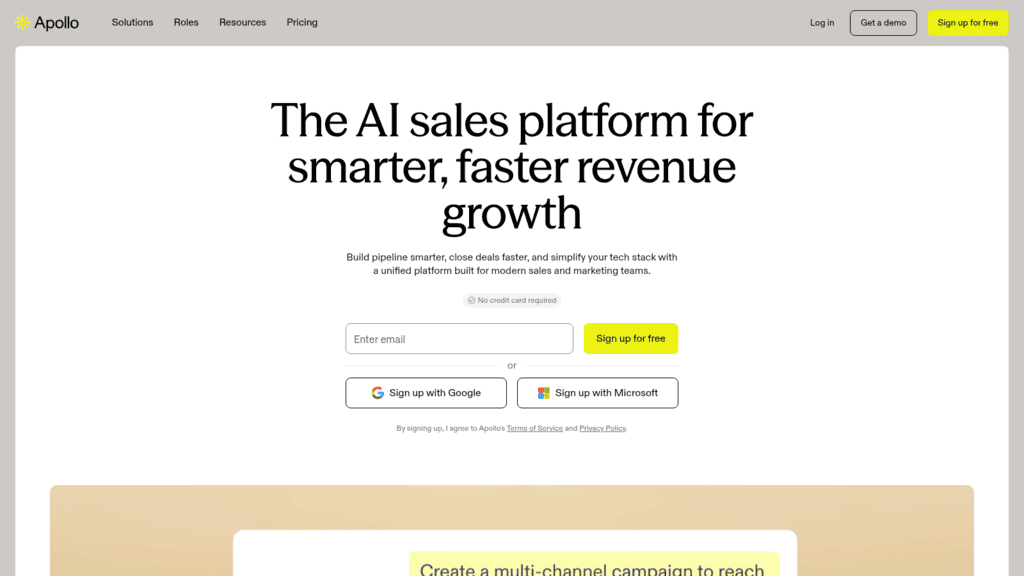
Apollo.io as one of the best contact enrichment apis

Overview: Apollo.io bundles a large prospecting database with sequencing and a CRM-adjacent workflow layer. Its enrichment API is one part of a wider product, which is both the appeal and the caveat.

Key features:

  • People and organization enrichment endpoints with bulk variants
  • A genuine free tier, which most database providers do not offer
  • Sequencing and dialer functionality alongside the data

Pricing: there is a free plan, with Basic at $49 per user per month, Professional at $79 and Organization at $119, all billed annually. Monthly billing runs roughly 15% to 25% higher, and credit allotments scale by tier.

Pros: database breadth at a self-serve price, a real free tier, one vendor for data and outreach

Cons: accuracy varies noticeably by segment and geography, per-seat pricing scales badly for a large team, and credits are tied to seats rather than pooled the way developer-first vendors handle them

Why it’s a good contact enrichment API: for a small team that wants one bill and one login covering data and sending, it remains the most direct answer.

Final verdict: a strong generalist whose API is convenient rather than best-in-class.

10. Wiza

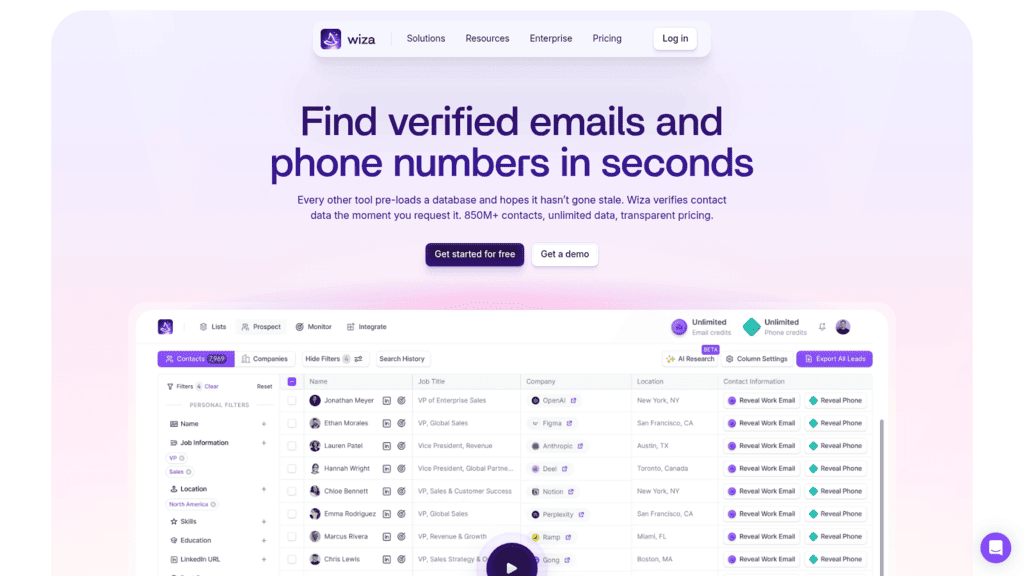
Wiza as one of the best contact enrichment apis

Overview: Wiza turns LinkedIn Sales Navigator searches into exportable contact lists, and the API extends that. The gating is the thing to check before planning around it.

Key features:

  • Enrichment anchored on LinkedIn profile URLs
  • Unlimited email reveals on the annual Email plan
  • Bulk export workflows for list-building at volume

Pricing: a free tier gives 20 valid emails and 5 phones. Starter is $49 per user per month, then $0.15 per email and $0.35 per phone. Email is $83 per user per month billed annually, and Email + Phone is $166 per user per month annually or $199 monthly. API access is only available on Email + Phone and the custom Team plan.

Pros: strong LinkedIn-anchored match rates, unlimited email reveals on annual plans, clear overage rates

Cons: API access effectively costs $166 per user per month, per-seat pricing on top of credit costs, and vendor-cited ratings rather than independent accuracy data

Why it’s a good contact enrichment API: if your prospecting starts in Sales Navigator, its match rate on LinkedIn URLs is genuinely among the better ones here.

Final verdict: good data behind an expensive API gate, so budget for the top tier or look elsewhere.

11. Coresignal

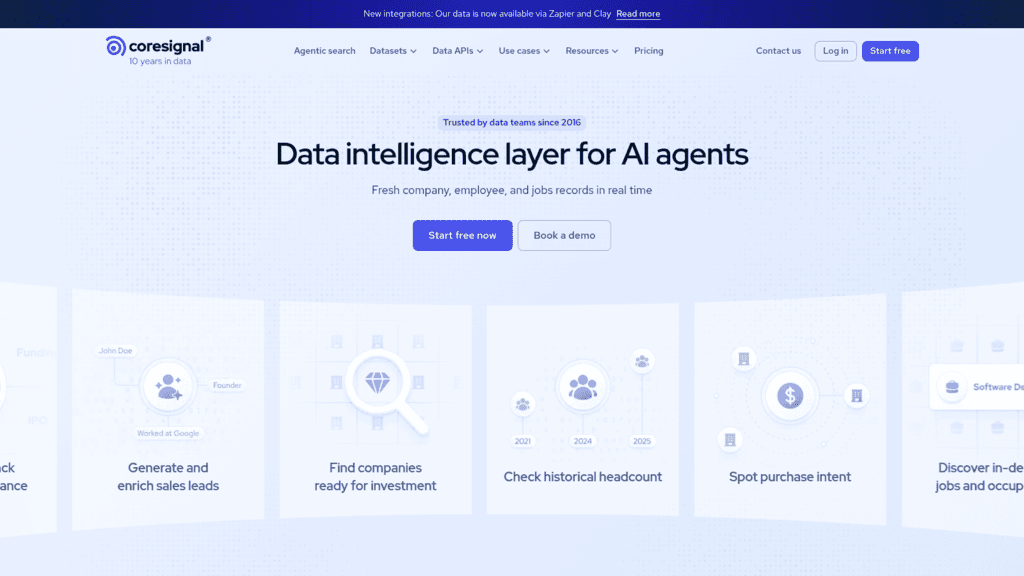
Coresignal as one of the best contact enrichment apis

Overview: Coresignal sits between contact enrichment and firmographic data, with 895M+ employee records and 70M+ companies from 15+ web sources. It suits teams needing the employment graph, not just a contact card.

Key features:

  • Employee, company and job-posting data from one provider
  • Historical headcount API and employee webhooks on the Premium tier
  • Bulk datasets as an alternative to per-record API calls

Pricing: the API has a free tier with 200 Collect and 400 Search credits valid for 7 days. Starter is $49 per month, Pro $800, and Premium $1,500. Per-record cost runs from about $0.196 on the entry tier down to roughly $0.005 once you are buying Premium volume. One Collect credit enriches a record and one Search credit runs a query, and multi-source company data costs double. Bulk datasets start from $1,000 per month.

Pros: exceptional employment-history depth, per-record cost drops sharply at volume, genuine free tier for evaluation

Cons: Search and Collect credits are billed separately so a query-heavy workload costs more than the headline rate suggests, the jump from $49 to $800 is severe, and it is built for data teams rather than sales ops

Why it’s a good contact enrichment API: when you need to know not just who someone is but how long they have been there and what the company’s headcount did last year.

Final verdict: the pick when employment history matters as much as the contact detail itself.

What to Look For in a Contact Enrichment API

The comparison table gets you to a shortlist, and the same logic applies when you evaluate sales prospecting tools more broadly. These are the things that decide which one survives a trial.

Match Rate on Your List, Not Their Database

Every vendor publishes a coverage number and none of them describe your segment. A provider with 1.5 billion records can still miss 40% of your list if you sell to European manufacturers or US local businesses.

Run the same 500 contacts through two or three providers before signing anything. The spread is usually wider than the price difference, which is why match rate matters more than cost per credit.

Ask about your hardest segment, not your easiest, because easy names match everywhere.

What a Miss Costs You

Billing on failure is the biggest hidden variable here. FullEnrich, BetterContact, Dropcontact and Prospeo bill on success, so a miss is free. Others consume a credit whether or not they return anything usable.

At a 60% match rate, a provider charging for misses is effectively 67% more expensive than its sticker price. That gap dwarfs the difference between most tiers.

Check the catch-all policy too, since an address a provider cannot verify is a bounce waiting to happen and some vendors still bill for it.

Freshness and Re-enrichment Cadence

A record enriched once is decaying from that moment. With median tenure under four years, much of any list goes stale annually, which is the argument for calling an API on demand rather than storing a snapshot.

Decide your re-enrichment cadence before picking a vendor, because it changes your volume assumptions. Enriching 10,000 contacts once is a different purchase from refreshing them quarterly.

Vendors with job-change detection, including LeadMagic and Dropcontact, let you refresh selectively instead of re-running the whole list.

What Contact Enrichment Actually Costs

Sticker prices in this category are close enough to be misleading. The real number is cost per usable contact, which folds in match rate and whether misses are billed.

Scenario Typical list size Realistic monthly spend Best-fit picks
Prototyping an integration Under 500 records $0 to $49 Datagma, Prospeo, People Data Labs free tiers
A single SDR’s pipeline 1,000 to 3,000 $39 to $99 Prospeo, LeadMagic, BetterContact
A full outbound team 10,000 to 25,000 $99 to $500 LeadMagic, FullEnrich, Reply.io
Data-warehouse enrichment 100,000+ $800 to $1,500+ Coresignal, People Data Labs enterprise
EU-only, compliance-led Any EUR79 to EUR120 Dropcontact

Those bands assume email enrichment. Phone numbers change the picture sharply: mobiles cost 5 credits at LeadMagic, 10 at FullEnrich and Prospeo, and 30 at Datagma. A phone-heavy workload can cost several times an email-only one on identical volume.

The cost of getting it wrong is worth holding in view too. Thomas Redman’s Harvard Business Review analysis put the price of bad data at roughly $3 trillion a year across the US economy, which puts a $50 monthly difference between tiers in proportion.

How to Wire Enrichment Into Your Outreach

Enrichment is not a one-off cleanup job. Treated as a pipeline step, lead enrichment does considerably more work.

  1. Set your trigger. Decide what starts a call: a new inbound signup, a list import, a CRM record older than 90 days, or a job-change webhook.
  2. Send the strongest anchor you hold. A LinkedIn URL matches better than a name and company. An email matches better than either. Send your best identifier, not all of them.
  3. Validate before you sequence. Run addresses through validation as a separate step, because a matched address is not automatically a deliverable one.
  4. Write back to one system of record. Pick the object your sequences actually read from and enrich that, rather than scattering fields across a CRM and a sending tool. Our outbound API guide covers the pattern.
  5. Re-enrich on a schedule, not on a whim. Quarterly is a reasonable default for most B2B lists; monthly if you sell into high-churn segments like startups or agencies.

Teams that skip step three account for a surprising share of deliverability problems. Matching and validating are different operations, and a provider good at one is not automatically good at the other.

Which Contact Enrichment API Should You Pick?

If you want one answer per situation, here it is.

Pick FullEnrich or BetterContact if your problem is match rate on a difficult list, starting with BetterContact to test the idea cheaply. Pick LeadMagic if an agent or script will be calling, since the MCP server and CLI remove integration work. Pick People Data Labs or Coresignal if your engineers want raw data and will build the matching logic themselves.

Pick Dropcontact if you sell into the EU and compliance is a live constraint rather than a checkbox. Pick Prospeo or Datagma if predictable billing matters more than maximum coverage.

Pick Reply.io if enrichment is one step in an outbound motion you are already running, and you would rather hold one API key than three. Just plan around the late August 2026 date for the enrichment endpoints.

One theme runs through the buying discussions worth reading. In a thread on Reddit, a GTM engineer asked for waterfall enrichment that was HTTP and API only, saying they did not need an interface and wanted to run it inside their own pipeline. That anecdote matches the pricing pages: vendors treating the API as the product, rather than as a dashboard export, are the ones this audience keeps landing on.

Frequently asked questions

What is a contact enrichment API?

It is an endpoint you call with a partial record, usually an email or LinkedIn profile URL, that returns missing fields such as job title, employer, seniority, verified email and direct dial. It replaces buying static lists, because you request current data when you need it rather than storing a snapshot that decays.

How much does a contact data enrichment API cost?

Entry pricing runs from free tiers at Datagma, Prospeo and People Data Labs to roughly $15 to $49 a month for usable volume, with team plans between $99 and $500. The figure that matters is cost per usable contact, since a provider billing for failed lookups at a 60% match rate costs far more than its per-credit rate implies.

Which contact enrichment API has the best match rate?

Waterfall providers such as FullEnrich and BetterContact generally return the highest match rates because they query 20 or more sources until one succeeds. No vendor publishes audited match rates, so test two or three against 500 of your own hardest contacts rather than trusting a coverage claim.

Do enrichment APIs charge you when they find nothing?

It depends on the vendor, and it is the most important question to ask. FullEnrich, BetterContact, Dropcontact and Prospeo bill only on verified results, while several database providers charge for every lookup regardless of outcome. Check the catch-all policy separately, since unverifiable addresses are sometimes billed as successes.

Is there a free contact enrichment API?

Yes, several. Datagma includes API access on its free tier with 90 emails, Prospeo gives 75 credits a month, People Data Labs allows 100 records monthly though it obfuscates contact fields, and Coresignal offers 200 Collect credits for 7 days. These are enough to evaluate integration quality, not to run production volume.

Subscribe to our blog to receive the latest updates from the world of sales and marketing.
Stay up to date.

Related Articles

How to Run Deal Sourcing Outreach With udu and Reply.io

How to Run Deal Sourcing Outreach With udu and Reply.io

How to Run Deal Sourcing Outreach With udu and Reply.io
What’s New in Reply: Jason Gets Smarter, Your Inbox Goes Mobile, and More

What’s New in Reply: Jason Gets Smarter, Your Inbox Goes Mobile, and More

What’s New in Reply: Jason Gets Smarter, Your Inbox Goes Mobile, and More
11 Best Intent Data APIs in 2026 to Find Ready-to-Buy Leads

11 Best Intent Data APIs in 2026 to Find Ready-to-Buy Leads

11 Best Intent Data APIs in 2026 to Find Ready-to-Buy Leads