
11 Best Intent Data APIs in 2026 to Find Ready-to-Buy Leads

11 Best Intent Data APIs in 2026 to Find Ready-to-Buy Leads

Key takeaways:

  • Most intent data is sold as a platform, not an endpoint. Bombora, 6sense and Demandbase all publish no rate card and route API access through a sales conversation.
  • The self-serve options are signal-specific rather than general. RB2B starts free for visitor identification, TheirStack infers buying from hiring, and PredictLeads charges a cent a month to watch an account.
  • Price range in this category is the widest we have measured: RB2B’s $79 a month against UserGems at $120,000 a year, both legitimately called intent data.
  • Our own intent surface is two beta targeting endpoints, not a queryable feed, and we say so plainly below.

Intent data promises the thing every sales team wants: a list of accounts already looking for what you sell, before they fill in a form. The reality is messier, more expensive, and more fragmented than the category’s marketing suggests.

Part of the reason it matters is that buyers now do most of their work before you hear from them. Gartner’s B2B buying journey research found buyers spend only about 17% of the purchase journey meeting with potential suppliers, and any single vendor may get 5% to 6% of that time.

Intent data is the attempt to see into the other 83%. What separates the vendors is which signal they can actually observe, and whether you can reach it from code.

This guide ranks the 11 intent data APIs worth evaluating in 2026, with pricing verified live where it exists. We are listed first, and our entry is direct about how narrow our own intent surface currently is.

Intent Data Is Four Different Products

Vendors use one word for four distinct signals, which is the main reason buyers end up disappointed.

Third-party content intent tracks which companies are reading about your category across a publisher cooperative, the classic form of intent signals. Bombora built the category and effectively defines it; the signal is broad but account-level and never tells you who read what.

First-party visitor identification resolves the anonymous traffic already on your site. Warmly, RB2B and Factors.ai work here, and the signal is far stronger because the intent is directed at you specifically.

Relationship and job-change signals watch people rather than companies. UserGems flags when a champion moves to a new employer, which is arguably the highest-converting signal in B2B and is not intent data in the conventional sense at all.

Inferred operational signals, the category Clay’s intent signals popularized, read public evidence of activity: hiring for a role that implies a project, funding that implies budget, technology changes that imply migration. TheirStack, PredictLeads and Sumble live here.

A team that buys third-party content intent expecting to know which person on which account did what will conclude the data is bad. It is not bad; it answers a different question.

Most Intent Vendors Sell a Platform, Not an API

This deserves stating up front because it shapes the entire list.

The largest names among intent data providers, Bombora, 6sense and Demandbase, publish no pricing and expose data primarily through their own interfaces and pre-built integrations. Bombora’s own materials emphasize being “integrated with the platforms you already know,” naming HubSpot, LinkedIn, Salesforce, 6sense, Apollo and Dun & Bradstreet.

That is a reasonable commercial model and a real constraint if you want to build. API access typically exists, but it is negotiated rather than purchased, and the price is a function of your contract rather than a rate card.

The genuinely API-first options in this category are the smaller, signal-specific vendors. That trade-off, breadth of signal against programmability, is the central decision here.

How We Assessed These Intent Data APIs

We required a real intent signal, some form of programmatic access, and either verified pricing or an explicit statement that pricing is quote-only.

We fetched pricing live rather than repeating figures from other comparisons. Where a vendor publishes nothing, we say so rather than reproducing a third-party estimate as though it came from the vendor.

We also excluded one candidate on verification grounds. Common Room was checked and dropped: a Zoom acquisition was announced in July 2026, and as of this writing its homepage carries no acquisition notice either way, so any statement about its independence, roadmap or pricing would be unverifiable. That is a reason to leave it out, not a judgment on the product.

The 11 Best Intent Data APIs Compared

Pricing is the cheapest tier that includes programmatic access, where such a tier exists.

Tool Best for Key features Main limitation Pricing (from) Rating
Reply.io Acting on a signal immediately Intent-based AI SDR targeting, sequencing in one API Two beta endpoints, no intent feed $49/month ★★★★★
RB2B Starting with visitor intent free 150 free resolutions monthly, person-level on paid US contact-level identification only Free (150 resolutions) ★★★★★
TheirStack Hiring as a buying signal 192M job postings, transparent credit tiers Inference lags actual projects Free (200 credits) ★★★★☆
PredictLeads Watching accounts continuously 1 credit per month to follow a company Credits do not roll over Free (100 calls) ★★★★☆
Sumble Signals tied to named owners Org hierarchy, MCP server on Pro Newer vendor, smaller footprint Free (500 credits) ★★★★☆
Bombora The category-standard intent feed Company Surge, broad publisher cooperative Quote-only, integration-led rather than API-led Quote only ★★★★☆
Warmly Combining visitor ID with outreach Deanonymization, chat, autopilot tiers From $10,000/year, annual commitment $10,000/year ★★★☆☆
Factors.ai Visitor ID plus ABM analytics LinkedIn ad influence, alerts, workflows Steep jump from Lite to Basic $199/month ★★★☆☆
UserGems Champion and job-change signals Highest-converting signal type in B2B $33,000/year entry $2,750/month ★★★☆☆
6sense Enterprise predictive intent Predictive modeling, alerts, list building Custom pricing, no published rate Quote only ★★★☆☆
Demandbase Enterprise account-based GTM Buying groups, advertising, sales intelligence Platform fee plus per-user, quote-only Quote only ★★★☆☆

Ratings weight programmability and verifiable pricing alongside signal quality, which is why an enterprise leader with no rate card scores lower here than in a general ABM comparison.

1. Reply.io
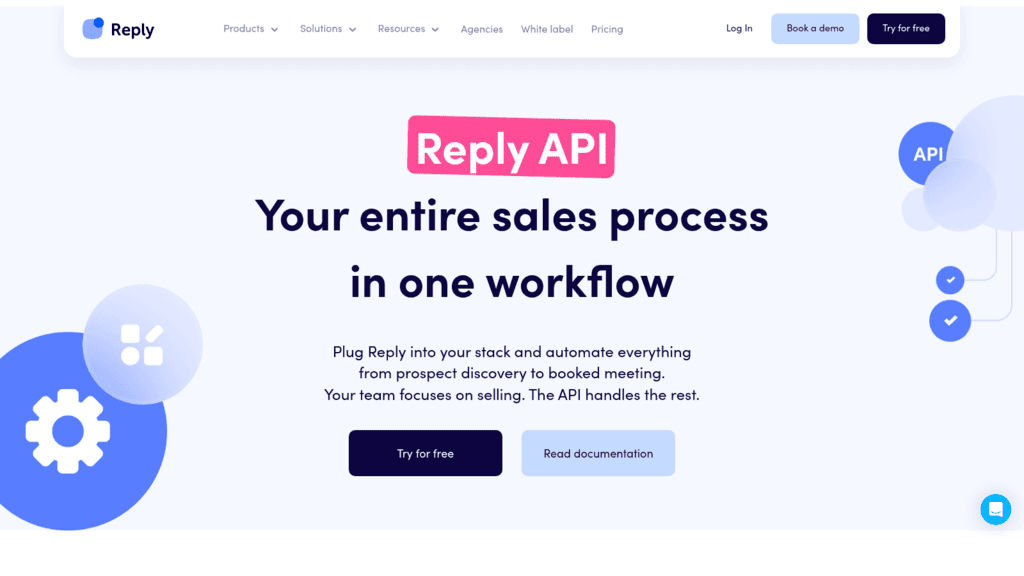
Reply.io as one of the best intent data apis

Best for: Acting on a signal immediately

Overview: We need to size our own claim accurately, because this category rewards precision.

Our intent surface is two beta endpoints inside the AI SDR API: an industries typeahead and a technologies typeahead. They exist so you can configure who Jason targets, filtering accounts by vertical and by the tools they run. They are targeting inputs.

They are not an intent feed. There is no endpoint you can call that answers “which accounts are showing buying signals this week,” and we do not operate a publisher cooperative or a visitor-identification pixel.

So the accurate framing is this: we are where an intent signal becomes an action. Bring intent from Bombora, RB2B or TheirStack, and the same API key that receives it will build the list, draft the sequence, request human approval and run outreach across email, LinkedIn, SMS and calls.

Key features:

  • Industries and technologies typeaheads in the AI SDR intent-signal endpoints, both in beta
  • Jason AI SDR with intent-signal targeting, sold as a managed agent
  • Live Data search across 1+ billion contacts, part of our wider sales engagement platform, to resolve a flagged account into named people
  • Multichannel sequence endpoints so a signal becomes outreach across five channels
  • Approval-mode endpoints so a human confirms the target list before anything sends
  • Webhook and automation endpoints for triggering on events from an external intent source

Pricing: the platform meters active contacts rather than seats, from $49 a month billed annually ($59 monthly) for 1,000 contacts up to $899 at 100,000. Jason, the managed AI SDR where intent targeting actually lives, starts between $500 and $1,000 a month on Starter, roughly ten times the entry platform price.

Pros: the only entry here that turns a signal into multichannel outreach through the same credential, webhooks make external intent sources easy to wire in, approval mode keeps a human in the loop, plan-level pricing with no per-seat penalty

Cons: our intent surface is two beta typeahead endpoints for configuring targeting, not a queryable intent feed, so we generate no intent data of our own; the capability sits inside Jason at $500 a month rather than the $49 platform tier; beta response shapes can change without notice; and what data we do hold is bundled inside a sending platform rather than sold standalone, so there is nothing here to buy as a feed

How to start using it:

  1. Start a 14-day trial and generate an API key at Settings > API Key.
  2. Confirm it with a call to https://api.reply.io/v3/whoami.
  3. Query the industries and technologies typeaheads to see what targeting filters exist before designing around them.
  4. Register a webhook so an external intent provider can push flagged accounts to you.
  5. Run the resulting sequence in approval mode so a person reviews the list first.

Why it’s a good intent data API: an intent signal that nobody acts on within a few days is worthless. We are the layer that closes that gap, and none of the pure data vendors here attempt it.

Final verdict: the right choice when you already have an intent source and need it to produce conversations. If what you need is the signal itself, buy Bombora, RB2B or TheirStack below and point them at us. We do not pretend to be an intent provider.
2. RB2B

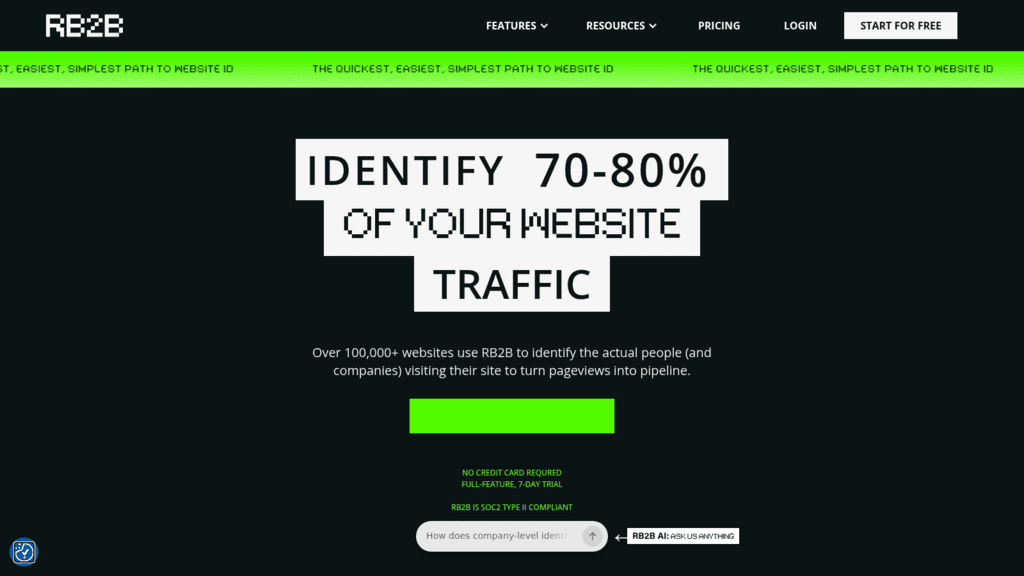
RB2B as one of the best intent data apis

Overview: RB2B identifies the people already visiting your website, and it is the only vendor in this list where you can start for nothing. First-party visitor intent is a stronger signal than third-party content consumption, because the interest is directed at you.

Key features:

  • Person-level identification of US website visitors on paid tiers
  • Slack and Teams alerts as visitors resolve
  • Company-level identification included on the free plan

Pricing: the free plan gives 150 monthly resolutions with company-level identification. Starter is $79 a month for 300 resolutions, Pro from $149 and Pro+ from $199, with the paid tiers adding business email addresses and broader integrations.

Pros: genuinely free to start, by far the lowest paid entry price in this category, person-level rather than account-level resolution on paid plans

Cons: contact-level identification is US-only so international traffic resolves to company level at best, resolution volumes are low compared to enterprise tools, and it identifies visitors rather than surfacing accounts researching elsewhere

Why it’s a good intent data API: someone reading your pricing page today is a better prospect than an account that read a category article last week, and this is the cheapest way to see them.

Final verdict: the best starting point in the whole category, and the one to test before spending five figures elsewhere.

3. TheirStack

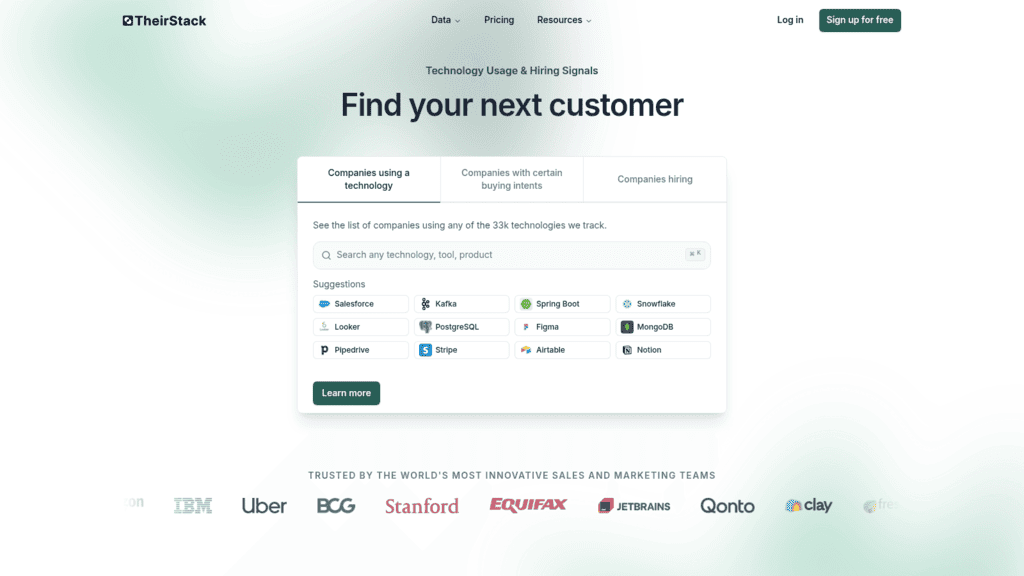
TheirStack as one of the best intent data apis

Overview: TheirStack treats hiring as intent, reading 192 million job postings for evidence of projects underway. A company posting three roles for a migration is telling you about a budget before any vendor conversation starts.

Key features:

  • Buying signals inferred from 192M historical job postings, 278,000 added daily
  • Technology detections across 12M companies and 32,000+ technologies
  • Ten transparent credit tiers with published per-credit costs

Pricing: API plans start free with 200 credits a month. Paid tiers run $59 for 1,500 credits ($0.0393 each), $100 for 5,000, $169 for 10,000, $240 for 20,000, $400 for 50,000, $600 for 100,000, and up to $1,500 for a million ($0.0015). Credits stay valid 12 months. A job costs 1 credit, a company 3.

Pros: the most transparent pricing in this category by a wide margin, signals reach internal projects no visitor pixel or content cooperative can see, credits valid a full year

Cons: hiring is a lagging proxy so a posting may appear well before or after the decision, coverage skews toward companies that hire publicly, and you build the scoring logic that turns postings into priority

Why it’s a good intent data API: it is the only vendor here where you can model the exact cost of an intent program before signing anything.

Final verdict: the best value intent signal available, particularly for technical and infrastructure products.

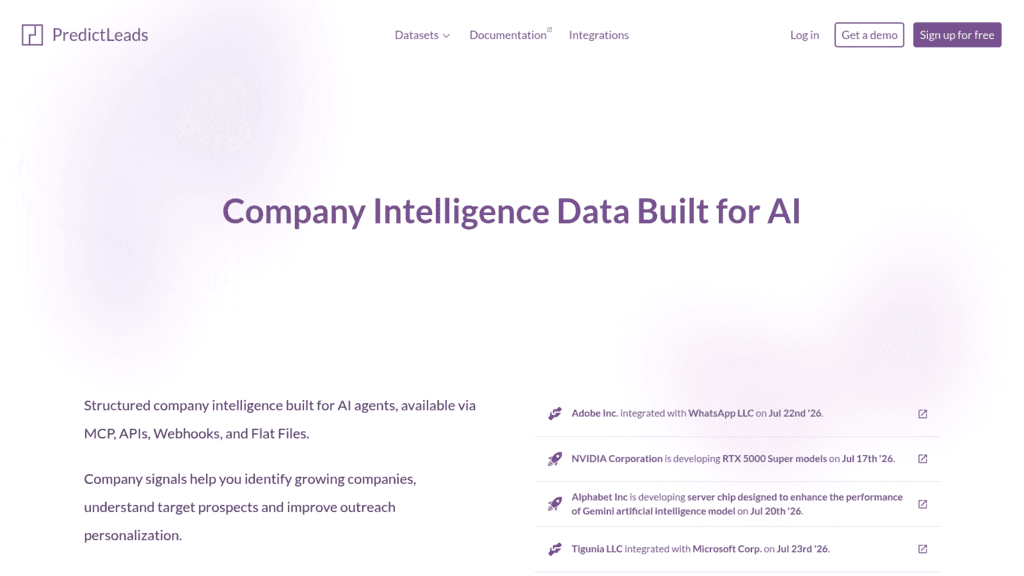
4. PredictLeads

PredictLeads as one of the best intent data apis

Overview: PredictLeads combines job openings, news events and technology detections into a signal feed, and lets you follow specific companies for continuous monitoring at trivial cost.

Key features:

  • Job-opening, news-event and technology-detection datasets in one API
  • Discovery endpoints returning companies matching a signal
  • Company following at 1 credit per month for ongoing watch

Pricing: free up to 100 API calls a month. Pay-as-you-go then runs $0.04 per credit from 101 to 5,000 calls with a $40 monthly minimum, dropping to $0.02 at 10,000, $0.01 at 100,000, $0.004 at 500,000 and $0.002 above. Enterprise access with flat files and real-time webhooks is quote-only.

Pros: following an account costs a cent a month, so watchlists are effectively free, the lowest per-unit cost at volume, one request returns up to 1,000 records

Cons: credits do not roll over so unused allowance is lost monthly, discovery endpoints bill per company returned rather than per request, and exceeding the limit returns an HTTP 402 rather than throttling

Why it’s a good intent data API: compound triggers convert far better than single signals, and this is the cheapest way to combine hiring, funding and technology changes in one call.

Final verdict: the economical choice for continuous account monitoring at scale.

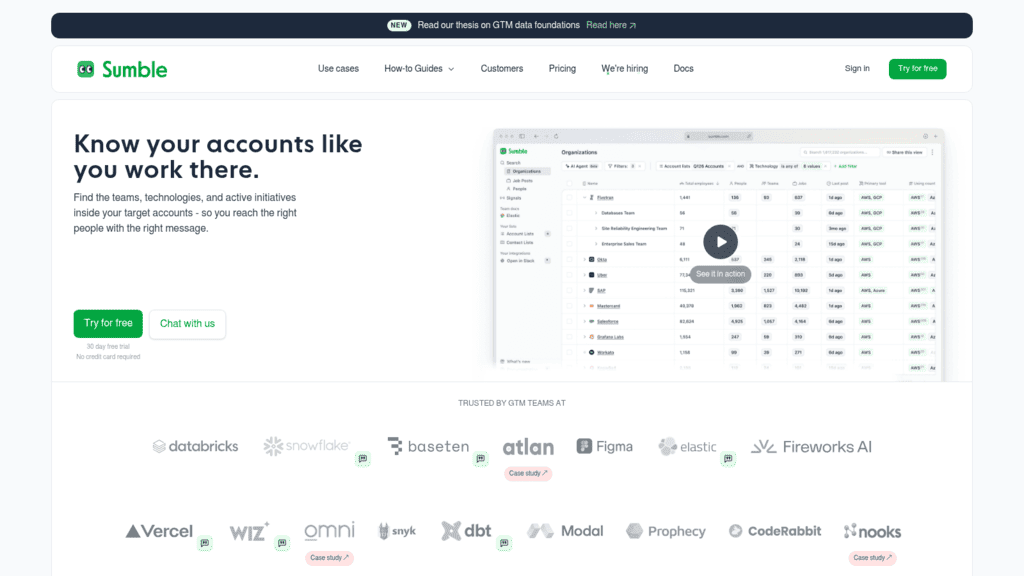
5. Sumble

Sumble as one of the best intent data apis

Overview: Sumble attaches signals to people rather than leaving them at the account level, mapping who owns a technology and who they report to. For acting on intent, that is the difference between a company name and a first email.

Key features:

  • Technology and job-function signals mapped to people-in-org data
  • Reporting hierarchy, so a signal resolves to an owner and their manager
  • An MCP server on Pro for agent-driven signal research

Pricing: the free plan gives 500 credits a month, 7 signals a week, the first page of results and Slack integration, with 30 days of Pro unlocked by signing up with a work email. Pro is $99 a month for 9,900 credits, up to 20 signals a day, ten pages of results, full text search and the MCP server. Enterprise is custom.

Pros: signals arrive with an owner attached, MCP support at $99, a real free tier plus a 30-day Pro trial

Cons: a newer vendor with a smaller signal footprint than the incumbents, 7 signals a week on free is restrictive, and enterprise integrations sit behind a quote

Why it’s a good intent data API: most intent data stops at the account. Knowing which director owns the system in question is what makes the outreach specific enough to answer.

Final verdict: the best fit when signals need to become named-person outreach, and priced for teams rather than enterprises.

6. Bombora

Bombora as one of the best intent data apis

Overview: Bombora effectively created third-party intent data, and its Company Surge scores remain the reference point the category is measured against. It observes content consumption across a publisher cooperative, which no first-party tool can replicate.

Key features:

  • Company Surge intent scoring across a broad publisher cooperative
  • Identity and enrichment, digital audiences, campaign measurement and an insights suite
  • Distribution through HubSpot, LinkedIn, Salesforce, 6sense, Apollo and Dun & Bradstreet

Pricing: quote-only. There is no published pricing for Company Surge or any other product, and every route leads to a demo request or a sales conversation.

Pros: the broadest third-party intent coverage available, pre-built integrations into most major GTM platforms, the category’s most established methodology

Cons: no published pricing of any kind so evaluation requires a sales cycle, the model is integration-led rather than API-led so programmatic access is negotiated rather than purchased, and signals are account-level with no person detail

Why it’s a good intent data API: it sees research happening across the web rather than only on your own property, which is the one thing first-party tools structurally cannot do.

Final verdict: the category standard and the right buy at enterprise scale, provided you accept a sales process and integration-led delivery.

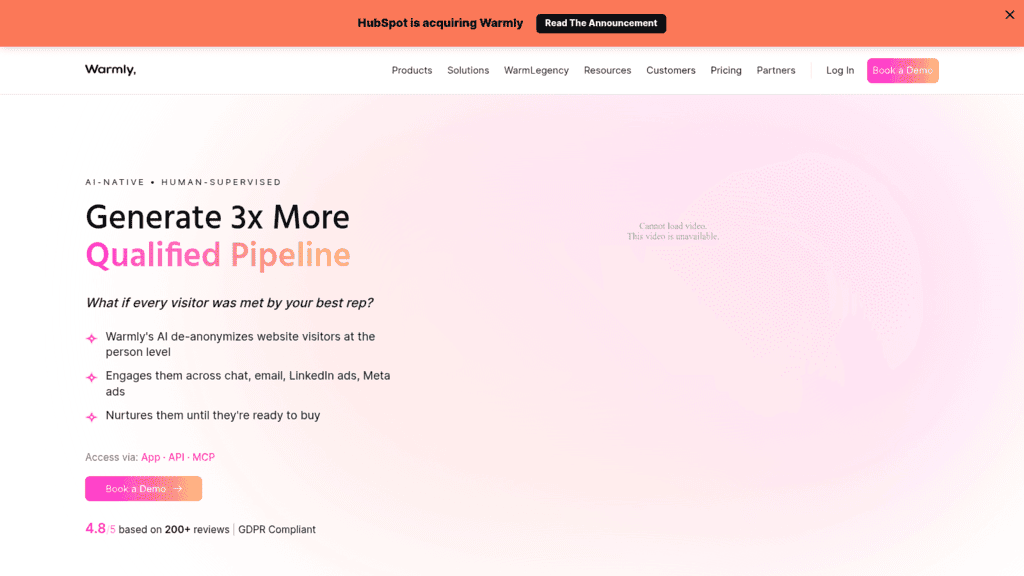
7. Warmly

Warmly as one of the best intent data apis

Overview: Warmly bundles website deanonymization with chat and automated outreach, so the signal and the response live in one product. Its pricing is published, which distinguishes it from most vendors at this level.

Key features:

  • AI web deanonymization identifying companies and people on your site
  • Inbound chat and AI autopilot tiers that act on the identification
  • GTM signals and warm-experience packages as add-ons

Pricing: AI Web-Deanonymization starts at $10,000 a year or $4,875 a quarter. Inbound Chat starts at $20,000 a year or $6,500 a quarter, and AI Inbound Autopilot at $30,000 a year or $9,750 a quarter. Add-ons include a GTM Signals Package at $10,000 a year and Warm Experiences at $10,000 a year.

Pros: published pricing at a tier where most competitors publish nothing, signal and response bundled so nothing needs wiring, quarterly billing available

Cons: $10,000 a year is a serious commitment for the entry product, capabilities are split across tiers so a full deployment stacks quickly, and the value is concentrated on inbound traffic

Why it’s a good intent data API: for teams with meaningful website traffic and nobody to work it, buying identification and response together removes the integration that usually stalls these projects.

Final verdict: a strong mid-market inbound play, priced honestly and worth it only if your traffic justifies it.

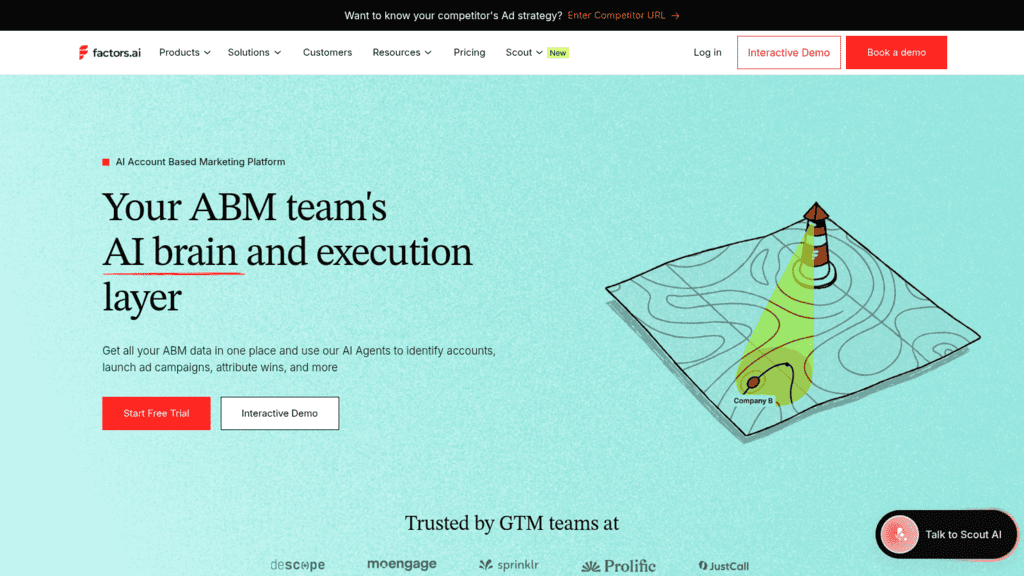
8. Factors.ai

Factors.ai as one of the best intent data apis

Overview: Factors.ai combines visitor identification with account-based analytics, connecting LinkedIn ad exposure to pipeline. It is as much a measurement tool as an intent source.

Key features:

  • Website visitor identification with account-based analytics
  • LinkedIn Ads influence measurement across the account journey
  • Sales alerts and workflow automation on identified accounts

Pricing: Lite is $199 a month. Basic is $6,000 a year, Growth $20,000 a year, and Enterprise from $30,000 a year.

Pros: a genuinely affordable entry at $199 a month, attribution and intent in one tool, LinkedIn ad influence is rare and useful

Cons: the jump from Lite at roughly $2,400 a year to Basic at $6,000 is steep, analytics depth means more setup than a pure signal feed, and the intent signal is limited to your own properties and campaigns

Why it’s a good intent data API: knowing which accounts saw your ads and then visited connects spend to signal, which most intent vendors leave you to reconstruct.

Final verdict: the best pick when measurement matters as much as the signal itself.

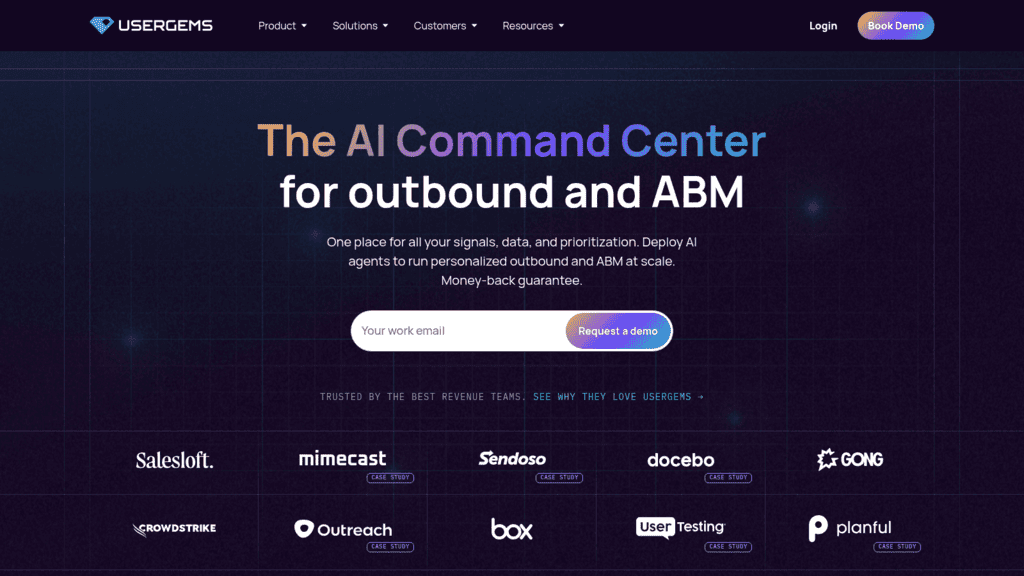
9. UserGems

UserGems as one of the best intent data apis

Overview: UserGems watches people rather than accounts, alerting you when a former champion, user or buyer changes jobs. It is the most reliably converting signal in this list and priced accordingly.

Key features:

  • Job-change tracking across former champions, users and buyers
  • Buyer-change alerts when a contact at an open opportunity moves
  • Relationship mapping across your existing customer base

Pricing: Core is $2,750 a month, or $33,000 a year. Advanced is $5,750 a month ($69,000 a year) and Elite $10,000 a month ($120,000 a year).

Pros: the highest-intent signal available since a champion who already bought once is starting fresh with budget, published pricing at every tier, alerts integrate cleanly into existing workflows

Cons: $33,000 a year is the entry point, the signal volume depends entirely on how large your existing customer base is, and a young company with few past champions gets little from it

Why it’s a good intent data API: a person who bought your product before and just landed somewhere new is not showing intent, they are close to a warm introduction to themselves.

Final verdict: exceptional signal quality, only worth the price once you have a customer base large enough to generate volume.

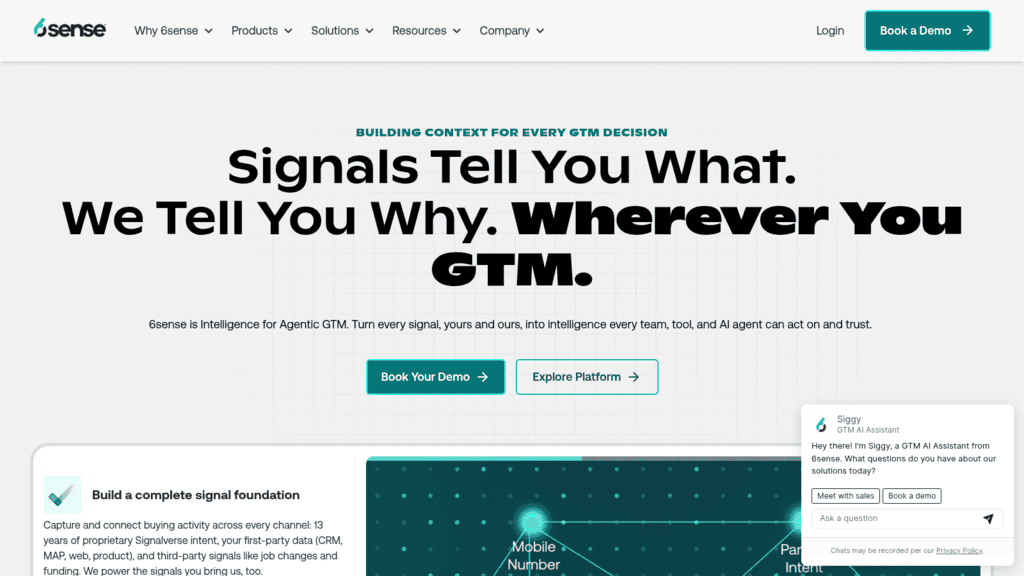
10. 6sense

6sense as one of the best intent data apis

Overview: 6sense is a full revenue intelligence platform with predictive modeling layered over intent signals, aimed squarely at enterprise ABM programs.

Key features:

  • Predictive account scoring built on aggregated intent signals
  • Company and person search with list building and sales alerts
  • Workflow automation and an AI assistant across the platform

Pricing: custom. Public materials describe intent data, predictive modeling, sales alerts, list building, company and person search and workflows, but no tier prices are published anywhere.

Pros: predictive modeling turns raw signals into ranked accounts, breadth covers most of an ABM program in one platform, mature enterprise support

Cons: no published pricing so budgeting requires a sales cycle, it is a platform purchase rather than an API you can call, and it is substantial to implement

Why it’s a good intent data API: the scoring layer is the actual product. Raw intent signals are noisy, and turning them into a ranked list is work most teams would rather buy.

Final verdict: an enterprise ABM commitment, appropriate when the platform is the point rather than the endpoint.

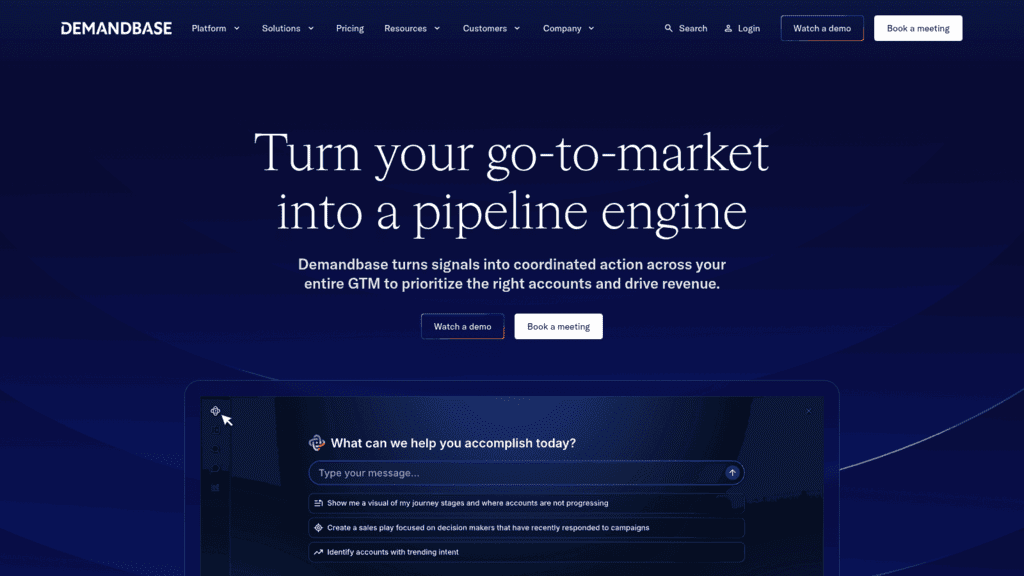
11. Demandbase

Demandbase as one of the best intent data apis

Overview: Demandbase One brings account intelligence, advertising and sales tooling under one platform, with intent as an input to buying-group identification rather than a standalone feed.

Key features:

  • Buying-group identification across an account rather than single-contact scoring
  • Account-based advertising integrated with the intelligence layer
  • Sales intelligence surfaced inside CRM workflows

Pricing: custom. The public pricing page describes a platform fee plus a flat per-user fee, with Data and Advertising as separate purchase paths, but publishes no figures.

Pros: buying-group identification reflects how B2B decisions actually get made, advertising and intelligence in one platform, strong enterprise CRM integration

Cons: no published pricing and a platform-plus-per-user model that compounds with team size, data and advertising are separate purchases, and the API is part of an enterprise agreement rather than a self-serve product

Why it’s a good intent data API: treating the buying group rather than the individual as the unit of intent is more accurate than most competitors, and it matters for large deals.

Final verdict: an enterprise platform decision, strongest for teams running advertising and sales motions together.

What to Verify Before Buying Intent Data

Three checks separate a working intent program from an expensive subscription nobody uses.

Ask Which Signal You Are Actually Buying

A vendor saying “intent data” may mean content consumption across a cooperative, visitors on your own site, hiring activity, or a champion changing jobs. These have different latencies, different precision and different actions attached.

Map each candidate to a specific action before you buy, the same discipline that separates useful AI prospecting tools from shelfware. If you cannot describe what a rep does differently on Tuesday because of a signal, the signal will not get used regardless of accuracy.

The cheapest way to find out is to start with first-party data, since RB2B’s free tier and Factors.ai’s $199 entry both prove the workflow before you commit to a cooperative feed.

Establish Whether the API Is Real

For the enterprise vendors, API access exists but is negotiated as part of a contract rather than purchased from a pricing page. Ask directly during evaluation: what endpoints exist, what the rate limits are, whether historical data is retrievable, and whether API access carries a separate fee.

Getting this in writing before signing avoids the common outcome where a team buys an intent platform and discovers the data can only leave through a pre-built CRM integration.

TheirStack, PredictLeads, Sumble and RB2B are the vendors here where the answer is unambiguous and published.

Decide Who Acts on the Signal, and How Fast

Intent decays. An account researching your category this week is a different prospect from the same account six weeks later, and most intent programs fail on routing rather than data quality.

Buyers are also arriving better informed than the process assumes. Forrester’s 2026 business buying research found twice as many B2B buyers named generative AI or conversational search as their most meaningful research source than any other option, ahead of vendor websites, product experts and sales reps.

If a signal takes three days to reach a rep, much of the buying journey has already happened somewhere you cannot see.

What Intent Data Costs

The figures below group by approach rather than vendor, because two products at wildly different prices can serve the same job depending on where your signal comes from.

Approach Typical spend What you get Best-fit picks
Free evaluation $0 Visitor ID and signal sampling RB2B, TheirStack, PredictLeads, Sumble free tiers
Self-serve signals $59 to $199/month Hiring, technology and visitor signals TheirStack, Factors.ai Lite, RB2B
Programmatic at volume $400 to $600/month 50,000 to 100,000 credits TheirStack, PredictLeads
Mid-market inbound $10,000 to $30,000/year Deanonymization plus response Warmly
Champion tracking $33,000/year+ Job-change and relationship signals UserGems
Enterprise ABM Quote only Predictive scoring and buying groups Bombora, 6sense, Demandbase

The range here is the widest of any category we have compared. RB2B at $79 a month and UserGems at $120,000 a year are both accurately described as intent data, and neither is overpriced for what it does.

That spread is the strongest argument for starting at the bottom. Proving that your team acts on a signal costs nothing with RB2B’s free tier, and a team that ignores 150 free visitor resolutions will also ignore a six-figure cooperative feed.

Choosing an Intent Data API

Work from the signal you can act on fastest.

If you have website traffic and no way to see it, RB2B starts free and Factors.ai adds attribution at $199 a month. If you want inbound identification and the outreach attached, Warmly publishes real prices from $10,000 a year.

If your product maps to projects and hiring, TheirStack is the clearest value in the category and the only vendor whose full cost you can calculate in advance. If you want compound triggers and cheap continuous monitoring, PredictLeads charges a credit a month to follow an account. If signals need an owner attached, Sumble maps them to reporting lines.

If you have a large installed base, UserGems tracks the champions leaving it, which is the highest-converting signal here. If you need to see research happening off your own property, Bombora is the category standard, with 6sense and Demandbase as the enterprise platforms that consume it.

Choose Reply.io as the layer that acts on whichever signal you buy. Push flagged accounts to us by webhook and the same API key builds the list, drafts the sequence, holds it for approval and runs multichannel outreach. We are not an intent provider and we would rather say so than imply otherwise.

Frequently asked questions

What is an intent data API?

It is an endpoint that returns signals suggesting an account is researching or preparing to buy, whether from third-party content consumption, website visits, hiring activity or job changes. In practice the category is split: smaller vendors sell genuine self-serve APIs, while the largest intent providers deliver data through platform integrations under a negotiated contract.

How accurate is intent data?

No vendor publishes audited accuracy, and precision varies enormously by signal type. First-party visitor identification is the most reliable because the visit actually happened on your site; third-party content intent is probabilistic and account-level; hiring inference is evidence-based but lags the decision. Test the workflow on a cheap first-party signal before buying a cooperative feed.

Which intent data providers offer a real self-serve API?

TheirStack, PredictLeads, Sumble and RB2B all publish pricing and expose programmatic access without a sales conversation. Bombora, 6sense and Demandbase publish no rate card and route API access through an enterprise agreement, so budget for a sales cycle before you can evaluate them properly.

Is there a free intent data API?

Yes, for evaluation and light production use. RB2B gives 150 visitor resolutions a month free, TheirStack 200 API credits, PredictLeads up to 100 API calls, and Sumble 500 credits plus a 30-day Pro trial. These are enough to prove whether your team acts on a signal before you commit budget.

How quickly does intent data go stale?

Faster than most processes are built for. An account researching your category is worth contacting within days, not weeks, which is why routing usually fails before data quality does. Given buyers spend only about 17% of the journey with suppliers at all, a signal that takes three days to reach a rep has already lost much of its value.

Subscribe to our blog to receive the latest updates from the world of sales and marketing.
Stay up to date.

Related Articles

11 Best Email Finder APIs in 2026 for Cold Email

11 Best Email Finder APIs in 2026 for Cold Email

11 Best Email Finder APIs in 2026 for Cold Email
11 Best AI Prospecting APIs in 2026 to Find More Leads

11 Best AI Prospecting APIs in 2026 to Find More Leads

11 Best AI Prospecting APIs in 2026 to Find More Leads
11 Best B2B Data APIs in 2026 to Find More Prospects

11 Best B2B Data APIs in 2026 to Find More Prospects

11 Best B2B Data APIs in 2026 to Find More Prospects