12 Best Lead Enrichment APIs in 2026 for Better Lead Data

12 Best Lead Enrichment APIs in 2026 for Better Lead Data

Key takeaways:

  • Lead enrichment happens at the moment of capture. A form fill arrives with an email and nothing else, and you have seconds to turn it into a routed, scored, qualified record.
  • Latency is the specification most buyers forget to check. The Companies API publishes 50 to 1,000 requests per second; several rivals publish nothing at all.
  • Free tiers cover real production volume here. Abstract API allows 100 requests, FullEnrich 1,000 credits a month, and Generect charges only for results.
  • Our enrichment endpoints land in late August 2026, so today we are the system a lead lands in, not the service that enriches it on the way.

A lead arrives on your site, types a work email into a form, and hits submit. The next two seconds decide whether it reaches the right rep with context, or sits in a queue as a row saying [email protected] and nothing else.

That gap is expensive. Thomas Redman’s MIT Sloan Management Review analysis puts the cost of bad data at 15% to 25% of revenue for most companies, and a lead record with no company, no headcount and no industry is bad data by any definition.

A lead enrichment API closes that gap in the request itself, applying lead enrichment at the moment of capture rather than overnight. You pass the email or domain you just captured, and the response gives you enough to route, score and personalize before the tab closes.

This guide ranks the 12 lead enrichment APIs worth wiring into a capture flow in 2026, with pricing fetched live. We are listed first and our entry states plainly what is callable today and what is not.

Lead Enrichment Is Not the Same as Contact Enrichment

The two get used interchangeably and solve different problems, which is why buying the wrong one feels like the vendor underdelivered.

Contact enrichment is the batch form of data enrichment, run over records you already own. You have 40,000 rows in a CRM, many with stale titles, and you refresh them on a schedule. Latency is irrelevant; cost per record and match rate are everything.

Lead enrichment is a synchronous operation on a record that did not exist a second ago. Someone filled in a form. You have one identifier, usually a work email, and you need company, size, industry and ideally a title before routing logic fires.

That difference changes what matters. A batch job tolerates a two-second response and a 60% match rate. A form handler cannot: a slow call blocks the thank-you page, and a miss routes the lead to the wrong queue.

It also changes the shape of the data you want back. Batch enrichment wants depth. Real-time enrichment wants a small, reliable field set delivered fast, which is why several vendors here deliberately return less than competitors.

How We Assessed These Lead Enrichment APIs

Every tool here exposes an API a developer can call on a self-serve plan, with pricing we verified live rather than repeating from other comparisons.

Because this is the real-time use case, we weighted differently than we would for a batch tool:

  • Whether lead enrichment API access is published at all, along with rate limits and throughput
  • Whether there is a free tier large enough to run production traffic through
  • Whether a miss consumes a credit, since form traffic includes plenty of personal addresses that will never match
  • Whether the vendor returns a small reliable payload or a large sparse one

We dropped candidates whose pricing sits behind a calculator or a sales call with no published unit economics, unless the credit costs were public. Where a vendor publishes credit costs but not tier prices, we say so rather than inventing a tier.

The 12 Best Lead Enrichment APIs Compared

Pricing shown is the cheapest plan that includes API access.

Tool Best for Key features Main limitation Pricing (from) Rating
Reply.io Leads that become sequences immediately Live Data, validation, sequencing in one API Enrichment endpoints ship late August 2026 $49/month ★★★★★
The Companies API Sub-second form enrichment 50 to 1,000 requests per second published Company data only, no contact fields $95/month ★★★★★
Abstract API Free real-time firmographics 100 free requests, clean domain lookup 1 request per second on free Free (100 requests) ★★★★☆
CompanyEnrich Best value at scale Full API on every tier, 60 to 600 req/min Newer vendor, smaller footprint $49/month ★★★★☆
FullEnrich Highest match rate on hard leads 25+ source waterfall, pay per verified result Waterfalls add latency by design Free (1,000 credits) ★★★★☆
Generect Pay only for results $0.03 per valid email, unlimited free search Thin published tier documentation Free searches ★★★★☆
HubSpot Data Hub Teams already inside HubSpot CRM-native sync and data quality tooling Value drops sharply outside HubSpot Free tier ★★★★☆
BetterContact Testing waterfalls cheaply 20+ suppliers, catch-alls not billed Starter’s 200 credits go fast $15/month ★★★★☆
Ocean.io Lookalike expansion from a lead Transparent per-credit costs Tier prices sit behind a calculator ~$99/month ★★★☆☆
Datagma Person and company in one call API on every tier including free 30 credits per mobile number Free (90 emails) ★★★☆☆
Dropcontact EU form traffic under GDPR Algorithmic, no stored database Euro pricing, lower raw coverage EUR79/month ★★★☆☆
Enrow One pool across every lookup type No result, no charge, unlimited seats on Pro No published accuracy or SLA EUR15/month ★★★☆☆

Ratings weight latency, published throughput and free-tier viability, which is why a narrow fast vendor outranks a broader slow one here.

1. Reply.io
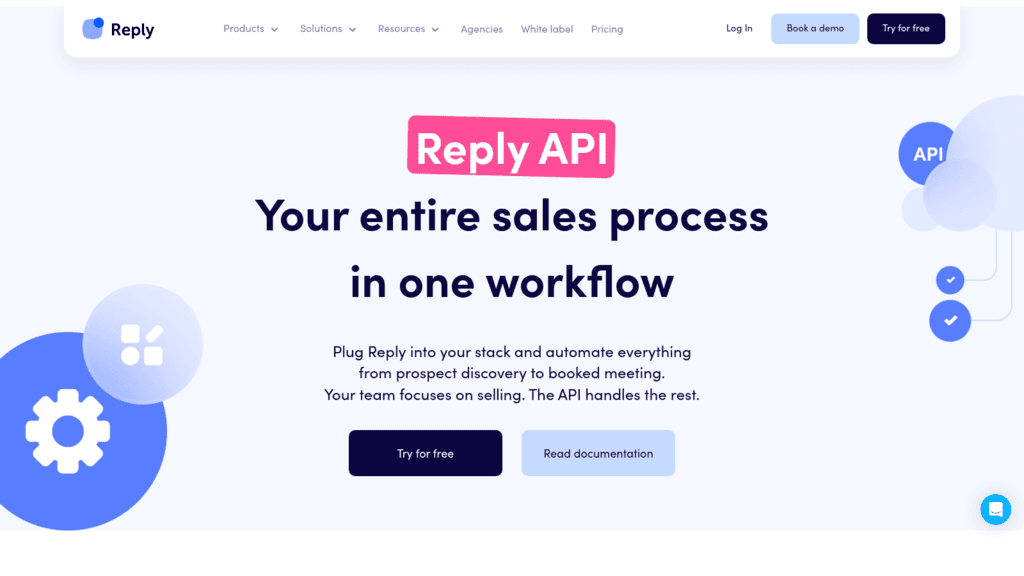
Reply.io as one of the best lead enrichment apis

Best for: Leads that become sequences immediately

Overview: Our position in this list is specific, and worth stating before the feature bullets.

Today we are the destination rather than the enricher. A lead you capture can be pushed into our Contacts endpoints, validated asynchronously, and dropped into a multichannel sequence in the same API call chain. What we cannot yet do programmatically is fill in the missing fields on the way through.

The five enrichment endpoints, including enrich by email and enrich by LinkedIn URL, are documented and dated for late August 2026. Until then, enrichment runs inside the platform on the People page rather than through the API.

So the honest recommendation for a real-time capture flow this quarter is to enrich with one of the specialists below and land the result in us. After August, that becomes one fewer vendor.

Key features:

  • Enrich by email and by LinkedIn URL, arriving late August 2026
  • Async email validation with background-job polling, callable today
  • Live Data search across 1+ billion contacts for expanding a captured lead into its buying group
  • Contacts and Lists endpoints, documented in our public API, that accept enriched records from your form handler
  • Multichannel sequence endpoints so a captured lead becomes an active campaign, drawing on our 1B+ contact database
  • Documented rate limits of 100 requests per minute and 3,000 per hour per user

Pricing: billing is by active contact rather than seat. A thousand active contacts costs $49 a month billed annually or $59 monthly, rising to $899 at 100,000. Fifty live data credits come with the base plan and additional packages start at $20 a month.

Pros: a captured lead becomes a running sequence through one credential, no per-seat cost as the team grows, async job handling for bulk validation, published rate limits, deliverability tooling included

Cons: the enrichment endpoints are not callable until late August 2026, so we do not enrich a form fill today, our 100 requests per minute is a platform-level limit rather than a throughput guarantee for synchronous form traffic, and our data is bundled inside a sending platform rather than sold as a standalone enrichment service

How to start using it:

  1. Begin a 14-day trial and issue an API key at Settings > API Key.
  2. Confirm it against https://api.reply.io/v3/whoami.
  3. Post a test lead through the Contacts endpoints from your form handler.
  4. Schedule an async validation job and poll /v3/background-jobs/{id} for the result.
  5. Swap your interim enrichment vendor for our endpoints when they land in late August 2026.

Why it’s a good lead enrichment API: enrichment is only worth doing if the enriched lead gets contacted. We are the part of the chain where that actually happens, and holding it behind the same key removes a sync.

Final verdict: the right destination for enriched leads and the right long-term consolidation play, but not the service that enriches your form fills this quarter. Pair us with The Companies API or Abstract API for now.
2. The Companies API

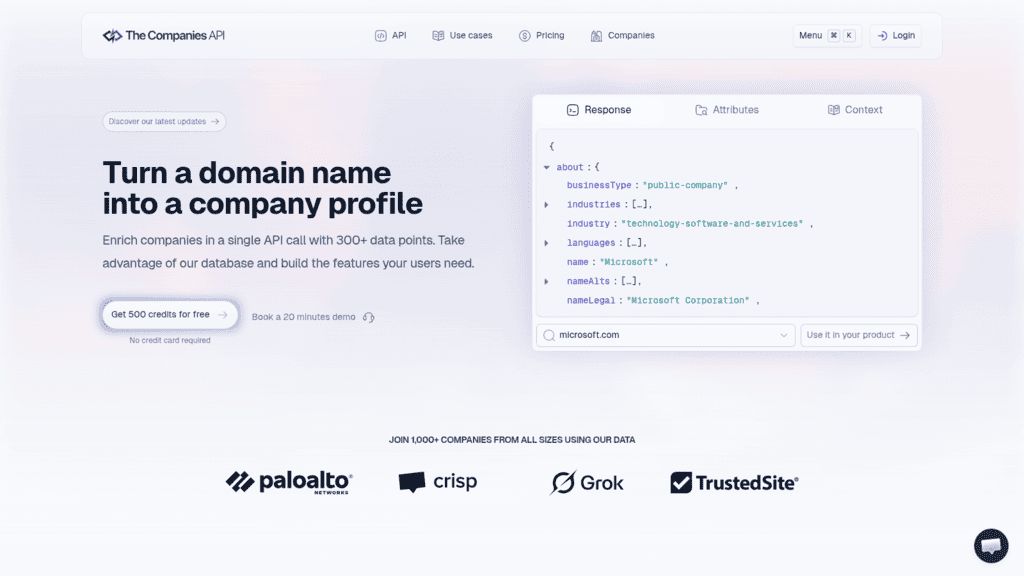
The Companies API as one of the best lead enrichment apis

Overview: For synchronous enrichment, throughput is the specification that matters, and this is the only vendor here that publishes it prominently at every tier. It does company data and nothing else, which is why it is fast.

Key features:

  • Domain-to-company enrichment across roughly 50 million companies
  • Published rate limits of 50, 250 and 1,000 requests per second by tier
  • Every API feature and the full database available on all plans

Pricing: three tiers, each raising both volume and throughput. Startup costs $95 monthly for 50,000 credits, overage at $2.50 per thousand, capped at 50 requests a second. Scaleup is $295 for 250,000 credits, $1.75 per thousand, 250 a second. Enterprise is $595 for 500,000 credits, $1.50 per thousand, 1,000 a second. Yearly billing includes two free months.

Pros: the only clearly published throughput figures in this comparison, no feature gating between tiers, flat and predictable credit pricing

Cons: company data only so you need a second vendor for contact fields, the $95 entry is higher than several rivals, and 50 million companies is a smaller universe than crawl-based competitors reach

Why it’s a good lead enrichment API: a form handler that blocks on a slow call is a conversion problem. Knowing you have 50 requests per second of headroom before you build is worth more than a marginally cheaper credit.

Final verdict: the best pure real-time company enrichment option, and the one to default to for high-traffic capture flows.

3. Abstract API

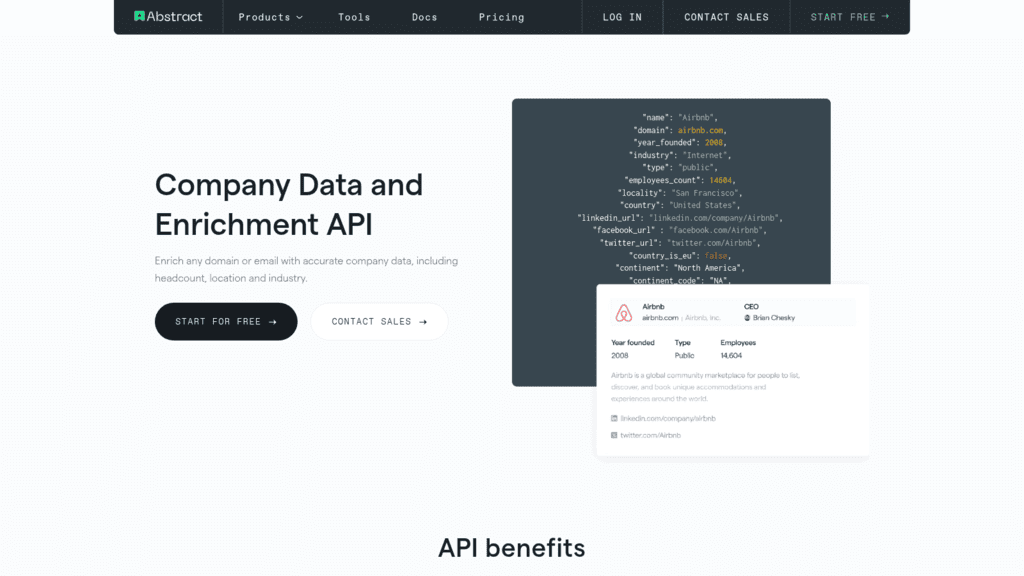
Abstract API as one of the best lead enrichment apis

Overview: Abstract API’s company enrichment endpoint does a narrow job simply, which is exactly what a form handler wants. It is also the fastest thing here to get into production.

Key features:

  • Domain input returning company name, founding year, employee count, industry and location
  • Social profile URLs for LinkedIn, Facebook and X
  • Coverage across 175+ countries with weekly updates

Pricing: 100 requests cost nothing and need no card, throttled to one per second. Standard, at $99 a month on annual billing, raises that to 60,000 requests and three per second. Enterprise is quoted and brings a 99.99% uptime SLA, SSO and a commercial license.

Pros: genuinely free to start with no card, integrates in roughly ten minutes, a published uptime SLA at the enterprise tier

Cons: 1 request per second on free and 3 on Standard are low ceilings for busy forms, the field set is thinner than dedicated firmographic vendors, and there is no company search, only lookup by domain

Why it’s a good lead enrichment API: for adding company context to a signup form, the field set is sufficient and the integration cost is close to zero.

Final verdict: the right first call for lightweight enrichment, with the rate ceiling as the thing to watch as traffic grows.

4. CompanyEnrich

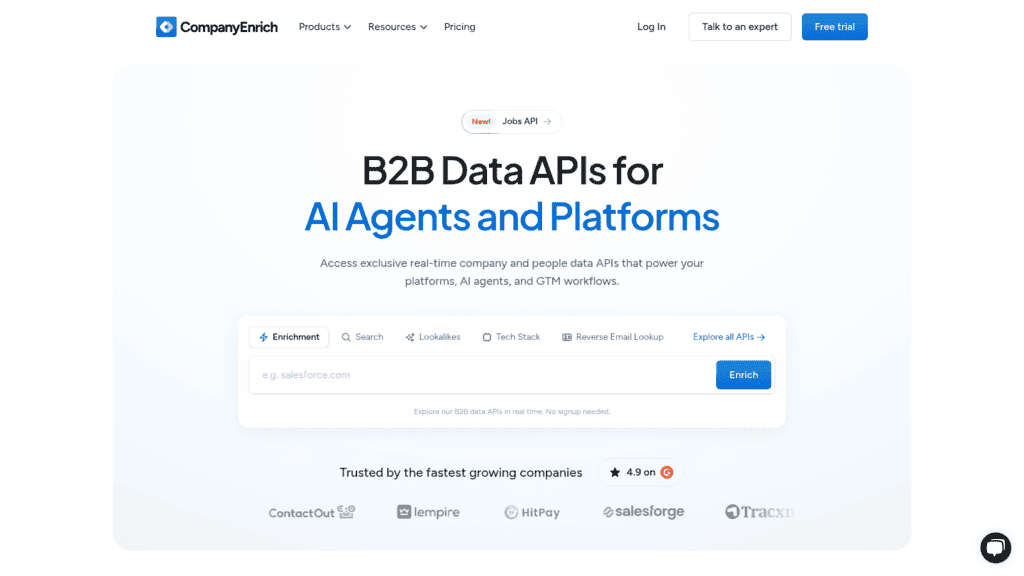
CompanyEnrich as one of the best lead enrichment apis

Overview: CompanyEnrich prices aggressively and, unusually, puts full API access on every plan including the cheapest. Its rate limits rise with tier and are published, which most competitors do not do.

Key features:

  • Domain-based enrichment covering company and people data
  • Published rate limits of 60, 120 and 600 requests per minute by tier
  • Credit rollover on Pro and above, plus async and batch endpoints on Scale

Pricing: 500 trial credits arrive without a subscription. Beyond that, $49 covers 5,000 credits a month at $0.0098 apiece, $149 covers 50,000 at $0.0030, and $549 covers 500,000 at $0.0011. Endpoints draw different amounts, and a mobile lookup costs 30 of them.

Pros: per-credit cost falls roughly nine-fold from Starter to Scale, nothing gated behind an enterprise conversation, credit rollover above Starter

Cons: a newer and smaller vendor than the established names, some endpoints cost far more than one credit, and there is no published accuracy benchmark

Why it’s a good lead enrichment API: the combination of published rate limits, rollover and a nine-fold volume discount makes it the easiest vendor here to grow into.

Final verdict: the best value pick once your form volume is real rather than hypothetical.

5. FullEnrich

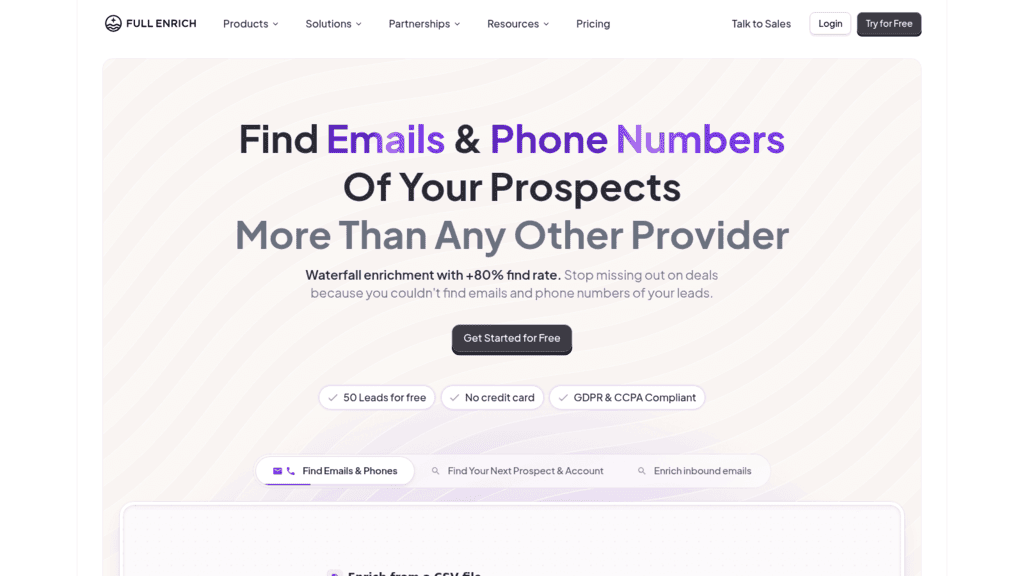
FullEnrich as one of the best lead enrichment apis

Overview: Ask FullEnrich for an address and it works down a chain of 25-plus suppliers, stopping at the first verified hit. Match rates climb sharply as a result. So does response time, and for a form handler that trade matters.

Key features:

  • Waterfall enrichment across 25+ sources for email and mobile
  • Pay-per-verified-result billing, so a miss costs nothing
  • Unlimited users and integrations on every plan

Pricing: the free tier provides 1,000 credits a month, the most generous allowance here. Credits are consumed by field, with a work email at 1, a personal email at 3, a mobile at 10 and a reverse lookup at 1.

Pros: the highest match rates in this list, no charge for failures, a free tier large enough for genuine production testing

Cons: querying providers in sequence means response times are inherently longer than a single-source lookup, so it suits asynchronous enrichment better than a blocking form handler, and mobile lookups at 10 credits get expensive

Why it’s a good lead enrichment API: when a lead matters enough that a miss is unacceptable, paying more per result and waiting longer is the correct trade.

Final verdict: the match-rate leader, best used asynchronously after the form has already returned.

6. Generect

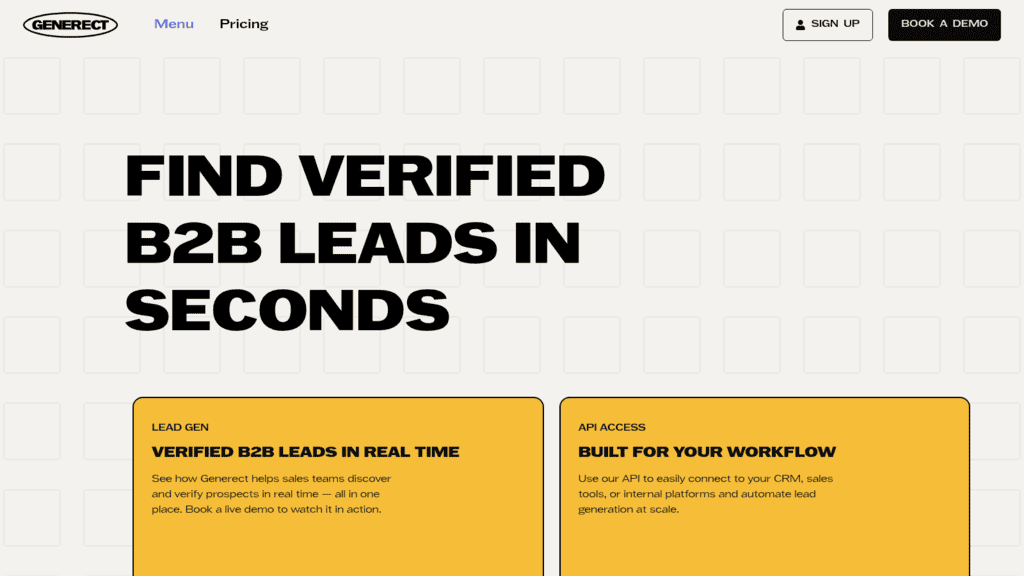
Generect as one of the best lead enrichment apis

Overview: Generect delivers lead generation, contact enrichment and company data as real-time APIs on pure pay-per-result terms. It is also the data layer behind our own database, which we would rather disclose than leave you to discover.

Key features:

  • Unlimited free searching, with charges applying only to results
  • Lead generation, contact enrichment and company endpoints delivered in real time
  • Volume discounts that reduce per-contact cost as usage grows

Pricing: you can search as much as you like at no cost. Billing begins at the result: three cents for a valid email, two cents for an export, both falling under enterprise volume terms. Nothing is charged monthly.

Pros: the cleanest incentive alignment here since you pay only on success, no monthly commitment at all, free unlimited search lets you size before spending

Cons: published documentation of enterprise tiers is thinner than the established brands, no accuracy benchmark is published, and buying raw endpoints means you build the surrounding workflow yourself

Why it’s a good lead enrichment API: form traffic contains a lot of addresses that will never enrich. Paying nothing for those changes the economics more than any per-credit discount.

Final verdict: an excellent direct-from-source option, particularly where match rates on your traffic are unpredictable.

7. HubSpot Data Hub

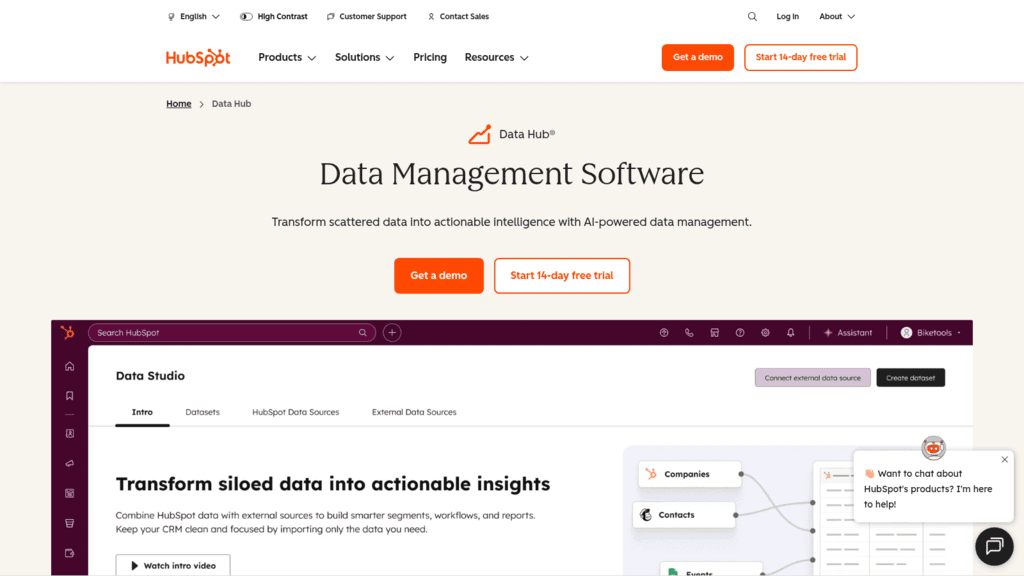
HubSpot Data Hub as one of the best lead enrichment apis

Overview: HubSpot Data Hub absorbed Clearbit, and Clearbit’s pricing now redirects to HubSpot. If your CRM is HubSpot, enrichment happening natively inside the record is a materially different experience from calling an external API and syncing the result.

Key features:

  • CRM-native enrichment and data sync with no integration to maintain
  • Data quality tooling including deduplication and formatting automation
  • Datasets and reporting built on the enriched records

Pricing: a free tier exists. Paid access opens at $10 per seat monthly for new customers on Starter, then steps up to $800 a month at Professional and $2,000 at Enterprise.

Pros: zero integration work if you already run HubSpot, enrichment lands directly on the object your workflows read, data quality automation included rather than bolted on

Cons: the value drops sharply if HubSpot is not your CRM, the jump from Starter to Professional at $800 is steep, and you are buying a platform rather than an endpoint

Why it’s a good lead enrichment API: the enrichment nobody has to wire up is the enrichment that actually stays running.

Final verdict: the obvious answer inside HubSpot and a poor one outside it.

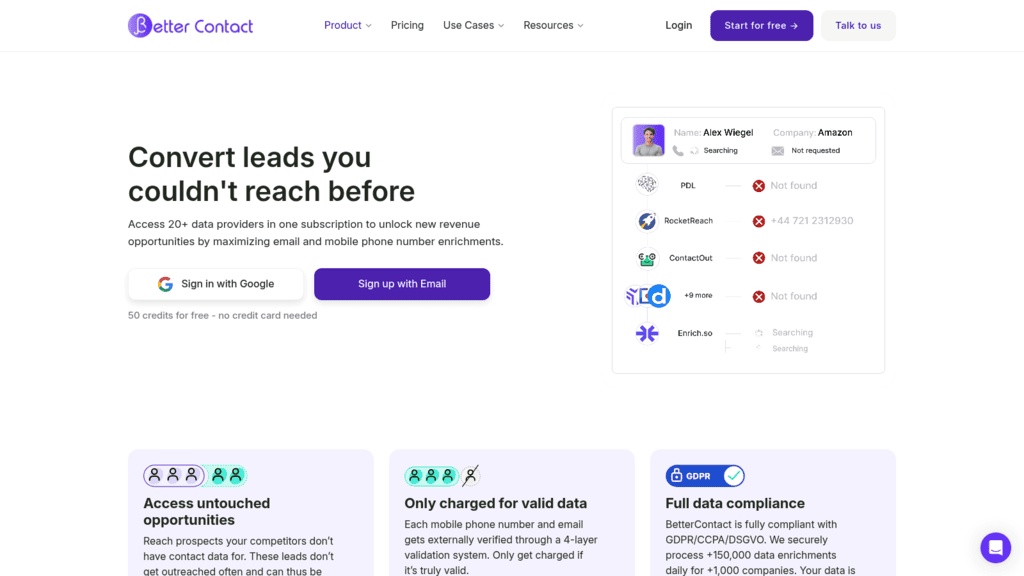
8. BetterContact

BetterContact as one of the best lead enrichment apis

Overview: The same multi-provider idea, executed across 20-plus suppliers and priced lower than anyone else attempting it. That combination makes BetterContact the cheapest honest experiment in whether waterfalls are worth it for your traffic.

Key features:

  • Waterfall across 20+ providers including RocketReach, Apollo, ContactOut, Hunter and Prospeo
  • No charge for misses or catch-all addresses
  • Bring-your-own provider API keys on the enterprise tier

Pricing: Starter is $15 a month for 200 credits, about $0.075 per email credit. Pro opens at $49 a month with a slider from 1,000 to 50,000 credits, working out near $0.049 per email credit at the low end. Enterprise starts at $799. Signup includes 50 trial credits.

Pros: the lowest entry price of any waterfall, catch-alls explicitly not billed, transparent per-credit arithmetic

Cons: 200 credits on Starter is a very thin pool, the leap to $799 for enterprise is abrupt, and sequential provider queries add latency the same way FullEnrich does

Why it’s a good lead enrichment API: fifteen dollars is below the threshold where anyone asks questions, which makes it the easiest way to get real comparative numbers in front of a decision.

Final verdict: the cheapest credible way into multi-source enrichment.

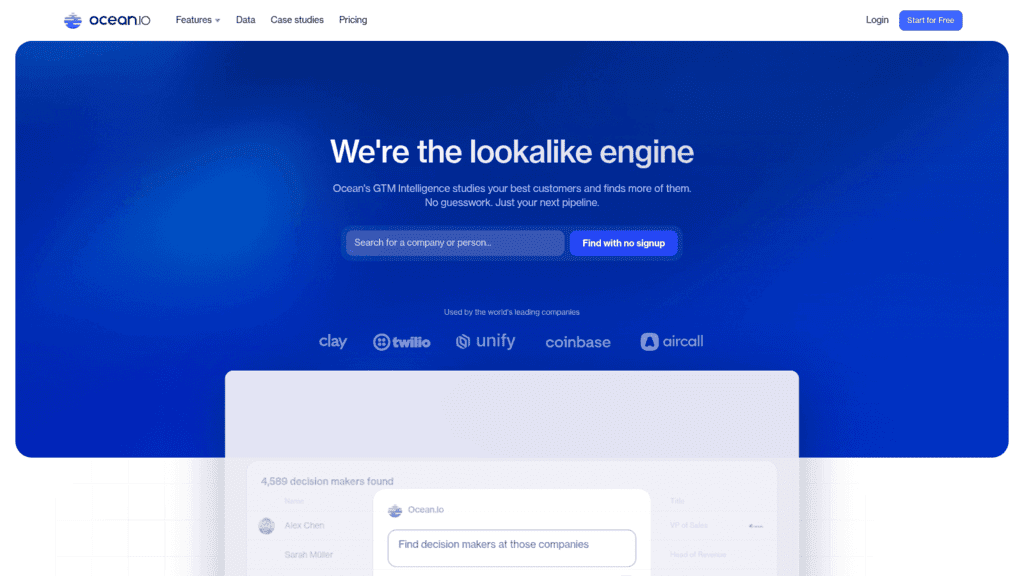
9. Ocean.io

Ocean.io as one of the best lead enrichment apis

Overview: Ocean.io’s distinguishing capability is lookalike expansion: from one captured lead it finds companies that resemble it. That turns a single form fill into a target list rather than a single record.

Key features:

  • Lookalike company discovery from a seed account
  • One credit system shared across the platform and the API
  • Published per-operation credit costs

Pricing: credits cost 1 for a verified email, 10 for a direct phone number and 0.2 for a search result. Run the site’s calculator and roughly 1,700 monthly credits lands near $99 a month on yearly billing. Per-tier plan names and prices sit behind that calculator rather than on a published rate card, so treat the $99 figure as a calculator anchor rather than a listed tier.

Pros: lookalike expansion is genuinely useful and rare, per-operation credit costs are published clearly, one balance covers platform and API

Cons: tier pricing is not published as a rate card so budgeting requires the calculator, direct phone numbers at 10 credits are costly, and the lookalike model matters less if you already know your target list

Why it’s a good lead enrichment API: one good inbound lead often signals a whole segment. Expanding it automatically is a better use of the signal than enriching it alone.

Final verdict: worth it for the lookalike capability, with pricing you have to derive rather than read.

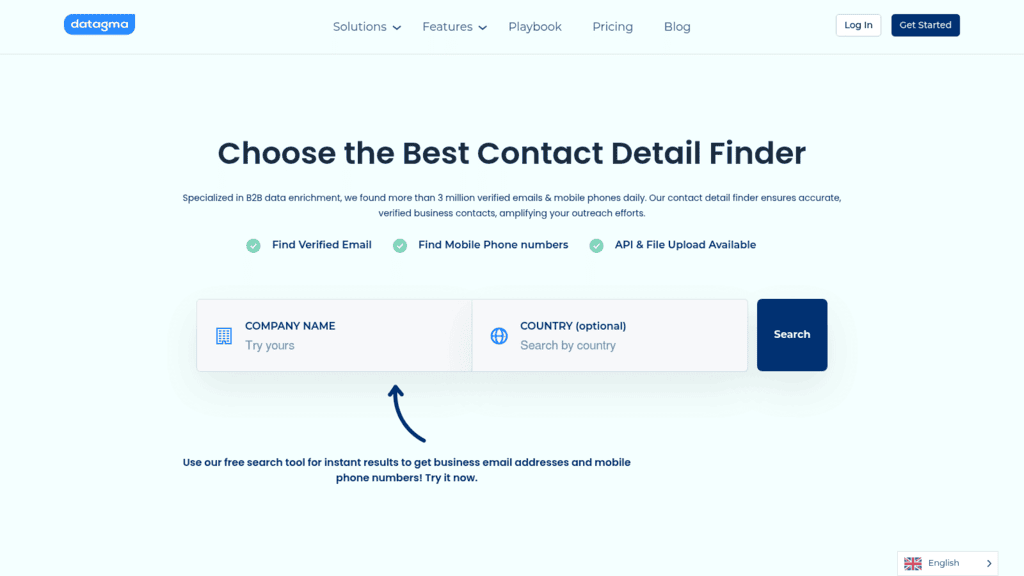
10. Datagma

Datagma as one of the best lead enrichment apis

Overview: Datagma returns person and company attributes from a single call and puts API access on every tier including the free one, which makes it unusually easy to prototype a capture flow against.

Key features:

  • Combined person and company enrichment from one lookup
  • API access on all tiers, free plan included
  • Phone and email enrichment alongside firmographics

Pricing: the free tier covers 3 mobile numbers and 90 emails. Regular is $49 a month or $39 annually, Popular $99 or $79, and Expert $249 or $209, with an enterprise tier above. One credit buys an email; a mobile costs 30.

Pros: API on the free tier removes the usual barrier to prototyping, one endpoint answers both the person and company question, 20% annual discount

Cons: 30 credits per mobile is the steepest phone pricing here, the free allowance is too small for meaningful evaluation, and it is a smaller vendor than the licensed data majors

Why it’s a good lead enrichment API: a single call that returns both sides keeps a form handler simple, which matters more in synchronous code than in a batch job.

Final verdict: a practical prototyping choice that stays sensible at moderate email volume.

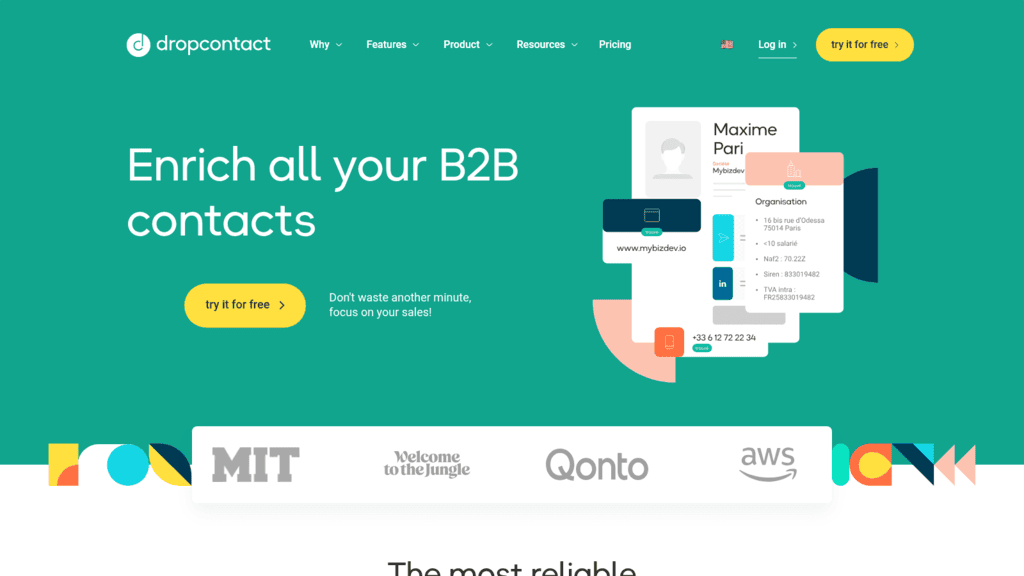
11. Dropcontact

Dropcontact as one of the best lead enrichment apis

Overview: Dropcontact holds no contact database at all, deriving and verifying addresses algorithmically. For EU-facing capture forms that removes an entire category of compliance argument.

Key features:

  • Purely algorithmic enrichment with no stored personal database
  • EU servers with full GDPR alignment and no third-party data purchase
  • Job-change detection and company enrichment on the Growth tier

Pricing: Starter is EUR79 a month, or EUR63.20 annually, for 500 credits. Growth is EUR120 or EUR96 annually and adds LinkedIn enrichment, job classification, company enrichment and job-change detection. Enterprise starts from 200,000 credits a month. A trial provides 50 free credits.

Pros: nothing personal is stored, so the compliance conversation is short; you are billed only on success; Growth credits survive into the next month

Cons: EUR79 for 500 credits is the weakest credit-per-euro ratio on this page, deriving addresses rather than looking them up costs real coverage, and US buyers carry the exchange-rate risk

Why it’s a good lead enrichment API: when a prospect asks where their data came from, “we derived it, we did not buy it” is a considerably shorter conversation under GDPR.

Final verdict: the correct pick for EU form traffic, accepting lower coverage as the cost.

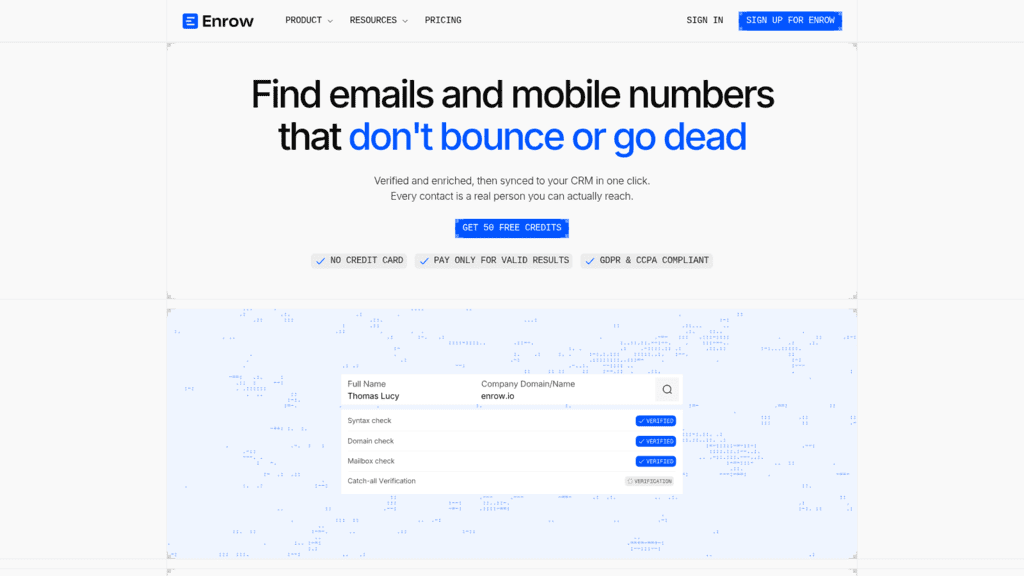
12. Enrow

Enrow as one of the best lead enrichment apis

Overview: Enrow pools email finding, phone lookup, verification and catch-all checks into one credit balance, priced in euros, with unlimited team members from the Pro tier.

Key features:

  • A single credit pool across finder, phone finder, verifier and catch-all verification
  • No result, no charge across every operation type
  • Unlimited members from Pro upward

Pricing: Start is EUR15 a month, or EUR9 annually, for 1,000 credits and one member. Pro is EUR75 or EUR45 annually for 10,000 credits with unlimited members, Scale EUR360 or EUR216 for 50,000, and Custom from EUR1,000. Annual billing saves 40%, and a trial gives 50 credits with no card.

Pros: one pool means an unpredictable mix of lookups does not break a budget, unlimited seats from Pro, a steep 40% annual discount

Cons: no published accuracy or SLA of any kind, euro pricing creates currency exposure, and it carries limited third-party review

Why it’s a good lead enrichment API: form traffic produces an unpredictable mix of work, and a shared pool absorbs that better than separate allowances.

Final verdict: good value and simple mechanics, weakened by the absence of any published quality benchmark.

What Matters in Real-Time Lead Enrichment

Batch enrichment and real-time enrichment fail differently. These are the checks specific to the synchronous case.

Never Block the Form on the Enrichment Call

The most common mistake is awaiting the enrichment response before returning the thank-you page. A vendor’s slow afternoon then becomes your conversion problem.

Accept the lead, return immediately, and enrich in a background job or webhook. If you truly need enrichment before routing, set an aggressive timeout, usually 500 milliseconds, and route on partial data when it expires.

Published throughput matters here. The Companies API states 50 to 1,000 requests per second and CompanyEnrich states 60 to 600 per minute; most others publish nothing, which means you are load-testing in production.

Decide What a Miss Should Do

Personal addresses, typos and freemail domains never enrich, and can be a substantial share of inbound traffic. Your handler needs a defined path for them rather than a null that breaks routing.

Vendors that bill only on success, including FullEnrich, BetterContact, Generect, Dropcontact and Enrow, make this cheaper as well as simpler. At a 60% match rate, a provider charging for misses is effectively 67% more expensive than its sticker price.

Decide up front whether an unenriched lead goes to a general queue, a nurture track or a human, and test that path as carefully as the happy one.

Enrich the Company Before the Person

For routing and scoring, company attributes do almost all the work, which is why AI lead finders lead with firmographics. Headcount, industry and country decide the queue; a job title rarely changes it.

Company lookups are faster, cheaper and higher-match than person lookups, because there are fewer companies than people and firmographics change more slowly than jobs. Split the two calls and you can route on the fast one, appending the slow one later.

Buyers increasingly arrive already informed, which raises the cost of a slow or misrouted response. Forrester found that 63% of sales leaders expected digital buying behavior to significantly affect their organization within two years, while only 37% treated digitizing the buyer’s journey as a top priority.

What Lead Enrichment APIs Cost

Because form traffic is unpredictable and misses common, budget by capture volume rather than advertised tier.

Scenario Monthly enrichments Realistic cost Best-fit picks
Prototyping a form handler Under 1,000 $0 Abstract API, FullEnrich, Datagma, Generect free tiers
A single marketing site 5,000 to 20,000 $49 to $99 CompanyEnrich, Abstract API
High-traffic capture 50,000 to 250,000 $95 to $549 The Companies API, CompanyEnrich
Match rate above all Any Pay per result FullEnrich, BetterContact, Generect
Already on HubSpot Any Free to $800 HubSpot Data Hub
EU-only traffic Any EUR79 to EUR120 Dropcontact

The free tiers are genuinely production-capable at small scale. FullEnrich’s 1,000 monthly credits, Abstract API’s 100 requests and Generect’s charge-only-on-results model mean a site with modest form volume can run enriched for nothing while it proves the value.

Waterfall and single-source vendors are not competing on the same axis. FullEnrich beats The Companies API on match rate and loses on latency, and both stay true at any price.

Choosing a Lead Enrichment API for Your Stack

Pick from the constraint that binds first, and from where enrichment sits in your outbound lead generation flow.

Among real-time lead enrichment API providers, The Companies API publishes real numbers when throughput is the constraint, with CompanyEnrich the better value once volume grows. If cost is the constraint and traffic is small, Abstract API is free to start and takes minutes to wire up.

If match rate is the constraint and you can enrich asynchronously, FullEnrich leads and BetterContact tests the same approach for $15. If you would rather pay only for results, Generect charges three cents per valid address and nothing else.

If your CRM is HubSpot, HubSpot Data Hub removes the integration entirely. If your traffic is European, Dropcontact is the compliance answer. If one good lead should become a segment, Ocean.io expands it.

Choose Reply.io as the destination those enriched leads land in, and as the consolidation play once our endpoints ship in late August 2026. Today we are honest that we are not the service enriching your form fill.

Buyer discussions in this category tend to circle the same question. In a thread on r/LeadGeneration, someone prospecting into EMEA asked simply which enrichment provider to choose among the many available, and the anecdotal answers split by region rather than by feature. That matches what the pricing pages imply: coverage is geographic before it is technical, and the vendor that wins in North America frequently loses in Europe.

Frequently asked questions

What is a lead enrichment API?

It is an endpoint you call at the moment a lead is captured, passing the one identifier you have (usually a work email or a domain) and receiving company and person attributes back. It differs from batch contact enrichment in that it runs synchronously against a record that did not exist a second earlier, so latency and rate limits matter as much as match rate.

What is a real-time lead enrichment API, and which providers offer one?

Real-time means the call returns fast enough to inform routing while the request is still open, typically under a second. The Companies API publishes 50 to 1,000 requests per second, CompanyEnrich publishes 60 to 600 per minute, and Abstract API allows 1 to 3 per second by tier. Waterfall providers like FullEnrich and BetterContact query several sources in sequence, so they suit asynchronous enrichment better.

Is there a free B2B lead enrichment API?

Yes, several with meaningful allowances. FullEnrich provides 1,000 credits a month, Abstract API 100 requests with no card, Datagma 90 emails with full API access, and Generect allows unlimited free searching while charging only for results. A low-traffic site can run enriched on these indefinitely.

Which is the best lead enrichment API for sales teams?

It depends on whether speed or coverage binds first. For routing inbound leads fast, The Companies API and CompanyEnrich publish the throughput to support it. For maximum match rate on difficult leads, FullEnrich queries 25+ sources. Teams already in HubSpot usually get more from Data Hub than from any external endpoint, simply because nobody has to maintain it.

Do lead enrichment API providers charge when the lead does not match?

Many do, and it matters more here than in batch work because form traffic contains plenty of personal addresses that will never resolve. FullEnrich, BetterContact, Generect, Dropcontact and Enrow all bill only on verified results. Check the catch-all policy separately, since an unverifiable address is sometimes billed as a success.

Subscribe to our blog to receive the latest updates from the world of sales and marketing.
Stay up to date.

Related Articles

How to Run Deal Sourcing Outreach With udu and Reply.io

How to Run Deal Sourcing Outreach With udu and Reply.io

How to Run Deal Sourcing Outreach With udu and Reply.io
What’s New in Reply: Jason Gets Smarter, Your Inbox Goes Mobile, and More

What’s New in Reply: Jason Gets Smarter, Your Inbox Goes Mobile, and More

What’s New in Reply: Jason Gets Smarter, Your Inbox Goes Mobile, and More
11 Best Intent Data APIs in 2026 to Find Ready-to-Buy Leads

11 Best Intent Data APIs in 2026 to Find Ready-to-Buy Leads

11 Best Intent Data APIs in 2026 to Find Ready-to-Buy Leads