Best 12 Crunchbase Alternatives for 2026 You Can Use Today

Best 12 Crunchbase Alternatives for 2026 You Can Use Today

Company data is valuable, but only when it helps your team identify the right accounts, understand why they matter, and act on those insights quickly.

Crunchbase is a very strong platform for tracking companies, funding rounds, investors, acquisitions, and broader market activity. But for sales teams, that’s usually only one part of the much bigger workflow. 

Reps also need reliable contact data of decision makers within those accounts, additional enrichment, buying signals, and a clear path from research to outreach.

Below, we’ll break down 12 Crunchbase alternatives that help B2B teams source better account data, identify decision-makers, and turn company intelligence into meetings and closed deals.

Top alternatives to CrunchBase at a glance

Before we go all in, here is a brief table summarizing how the tools compare on core areas: 

Tool Best for Key capability Outreach capability Starting price
Reply.io Contact data and outreach B2B leads + multichannel outreach (AI) Yes $49/user/mo
PitchBook Deep financial and deal-level analysis Cap tables, valuations, M&A data No On request
CB Insights Industry reports and market maps Analyst-written research and market maps No On request
Breeze Intelligence Real-time enrichment of company profiles Domain-based real-time enrichment No $45/mo
UpLead High-accuracy contact filtering 95% accuracy guarantee + 50+ filters No $99/mo
LinkedIn Sales Navigator Relationship-based prospecting Relationship Explorer + real-time alerts No $99.99/mo
LeadIQ Capturing leads during live browsing One-click LinkedIn data capture No $36/user/mo
Hunter.io Domain-based email discovery Email finder and verifier by domain Limited $34/mo
Adapt.io Budget-friendly lead database 150M+ contacts with Chrome extension No $49/mo
Harmonic Finding startups before funding rounds AI startup classification + Scout agent No ~$25,000/yr
EasyVC Matching startups with investors AI investor matching + founder coaching No $89.99/mo
Brevoir AI-driven investment insights Thesis-filtered deal flow + attributed sourcing No $49/mo

How did we choose the CrunchBase alternatives in this list?

We picked these Crunchbase alternatives based on their ability to help B2B teams find targeted accounts, uncover account data and buying signals, and then actually use all that context to make meaningful sales decisions. 

Here are the main criteria we followed:

  • Company and contact data quality: how accurate, complete, and current each platform’s company and contact data really is. Because account research loses a lot of value when reps still have to double-check every key detail by hand.


  • Database coverage: how well each tool covers different industries, regions, company sizes, funding stages, and buyer segments. A database can look impressive at first glance, but that doesn’t mean much if it does not line up with your real target market.


  • Search, filtering, and enrichment: how easy it is to build targeted account lists, apply firmographic or technographic filters, identify the right decision-makers, and fill in missing data.


  • Sales triggers and intent signals: whether they can surface signals sales teams can actually use, whether that’s funding rounds, hiring activity, technology changes, website visits, or broader intent data.


  • Workflow fit and integrations: what happens after the research part. Can the tool plug into the CRM and the rest of the sales stack without creating extra admin work? And just as important, can reps go from account insight to actual outreach with ease? 

Pricing, scalability, and compliance: how clear the pricing is, whether there’s a free trial, how well it can scale with a growing team, and what the company publicly shares around standards like GDPR and CCPA.

Convert Competitors` Fans Into Hot Leads

Stop chasing cold leads.
Start talking to people who already want what you sell.

Your competitors’ followers?
They know the problem. They’re paying attention.
Some are even looking for something better, right now.

This playbook shows you exactly how to turn them into hot leads:

→ Find and pull competitor followers in minutes
→ Clean, segment, and enrich your list for max fit
→ Launch outreach that’s personal, not pushy
→ Automate follow-ups so no lead slips away

Which are the best CrunchBase alternatives?

While there are many tools like Crunchbase, not all offer the same value for their money. The ones below solve problems that Crunchbase leaves on the table, including outdated contact records, limited outreach capabilities, surface-level data coverage, and more.

Let’s unpack that.

Reply.io: best for contact data and outreach

Reply.io is one of the strongest Crunchbase alternatives for sales teams that need account discovery, but also want to turn that into action right away. Reply is an AI-powered lead generation and sales engagement platform that helps teams find targeted leads, enrich their records, and launch multichannel outreach campaigns (emails, LinkedIn, SMS, calls, WhatsApp).

For the data side, it comes with a native B2B lead database with 1+ billion contacts across 150+ countries, 60+ million company profiles, advanced filtering, intent signals, email validation, and contact enrichment.

Sales teams can build targeted prospect lists using filters like industry, role, seniority, company size, location, tech stack, and more. And once they do, each record can include the contact-level details needed for outreach — verified emails, job titles, company data, LinkedIn profiles, and other enrichment fields.

From there, teams can launch multichannel sequences across email, LinkedIn, calls, SMS, and WhatsApp. Those sequences can also react to prospect behavior in real time, so reps are following real engagement signals instead of just working through a static list.

And for teams that want to automate even more of the process, Jason AI is Reply’s AI sales agent that learns about your business, finds relevant accounts, researches prospects, personalizes messages, and even handles replies and books meetings on your behalf.

Key features

  • Live B2B data with 1+ billion contacts, 60+ million companies, advanced filtering, intent signals, and enrichment
  • AI Variables for personalized subject lines, openers, value props, CTAs, and custom fields
  • Jason AI for fully autonomous lead sourcing, outreach, reply handling, and meeting booking
  • Multichannel sequences across email, LinkedIn, calls, SMS, and WhatsApp
  • LinkedIn automations (messages, connection requests, profile views, and more) 
  • Deliverability toolkit with warm-up, validation, sender reputation monitoring, and SPF, DKIM, and DMARC support
  • Website visitor tracking that identifies company traffic and routes high-intent accounts into targeted sequences

Pricing

Reply.io starts at $49 per user per month for email outreach, while multichannel plans start at $89 per user per month. Jason AI SDR starts at $500 per month. There’s also a 14-day free trial, and you don’t need a credit card to start.

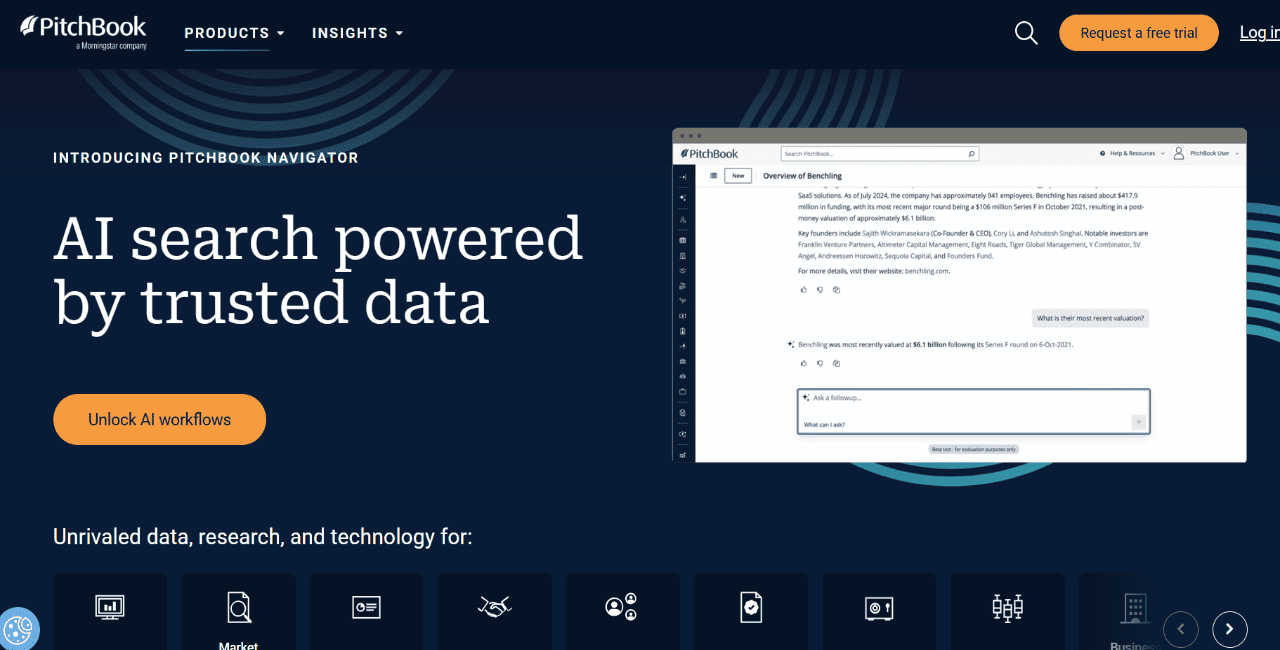
PitchBook: best for deep financial and deal-level analysis

PitchBook is a strong Crunchbase alternative for investors, analysts, and corp dev teams that need a lot more than surface-level company info.

The platform goes deep into private market data — company profiles, investor records, valuations, cap tables, M&A activity, fundraising history, market research, and sector reports. It’s especially useful for due diligence, deal sourcing, benchmarking, and tracking companies from early rounds all the way to exit.

That said, PitchBook is not built for outbound sales work. It can tell you a lot about a company’s financial story, but if your team wants contacts, enrichment, and outreach, you’ll still need other tools for that.

Key features

  • Company and investor profiles across private and public markets
  • Cap table visibility and valuation data
  • M&A tracking and deal analysis
  • Sector reports and market benchmarking
  • Due diligence support for investment and corp dev work

Pros

  • Deep deal-level detail
  • Very strong for private market research
  • Useful when diligence really matters

Cons

  • Hard to justify for smaller teams
  • Not made for sales outreach
  • Pricing is not public

Pricing

PitchBook pricing is quote-based. Most outside estimates put annual contracts somewhere in the five-figure range.

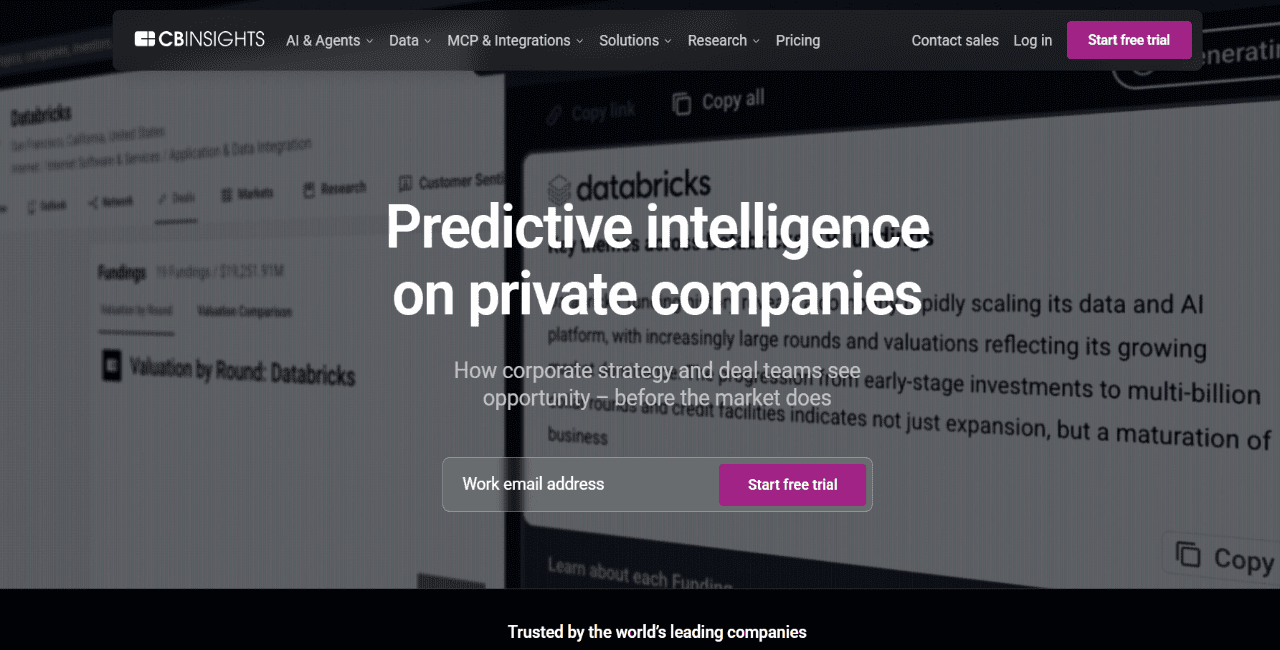
CB Insights: best for industry reports and market maps

CB Insights is a better fit for strategy, innovation, corp dev, and investment teams than for day-to-day sales prospecting.

It combines company data with analyst-led research, market maps, funding trackers, technology trend analysis, and sector insights. So if the goal is understanding where a market is going, which companies are picking up momentum, and how new categories are forming, CB Insights does that well.

Where it stops is execution. It is a research platform first. Sales teams that need decision-maker data and a way to actually run outreach will need another layer in the stack.

Key features

  • Market maps for competitive landscapes
  • Analyst-written reports on sectors and trends
  • Funding trackers and startup momentum signals
  • Company profiles with more strategic context
  • Technology trend analysis across emerging categories

Pros

  • Strong research angle
  • Good for competitive intelligence
  • Useful for market planning

Cons

  • No outreach workflow
  • Enterprise-style pricing
  • Less useful for everyday prospecting

Pricing

CB Insights pricing is only available on request.

Breeze Intelligence: best for enriching inbound company profiles

Breeze Intelligence, previously Clearbit, now lives inside HubSpot and makes the most sense for teams already running there.

Breeze Intelligence as one of the visitor tracking tools

Its main job is enrichment. It helps add company and contact data to CRM records, identify buyer intent, shorten forms, and improve lead routing through HubSpot credits. Instead of working with half-complete inbound records, teams can fill in the missing details and make qualification easier.

For outbound-heavy teams, though, it is not really a standalone Crunchbase replacement. A lot of the value depends on your HubSpot setup, your workflow, and how credits are being used.

Key features

  • Enrichment for company and contact records
  • Buyer intent signals
  • Shorter inbound forms using existing data
  • Lead routing based on enriched fields
  • Native fit inside HubSpot workflows

Pros

  • Strong option for HubSpot users
  • Helpful for inbound qualification
  • Keeps CRM data cleaner

Cons

  • Very tied to HubSpot
  • Not built for outbound execution
  • Costs rise with credit usage

Pricing

Breeze Intelligence credits start at $45 per month for 100 credits, though the full cost depends on the HubSpot setup around it.

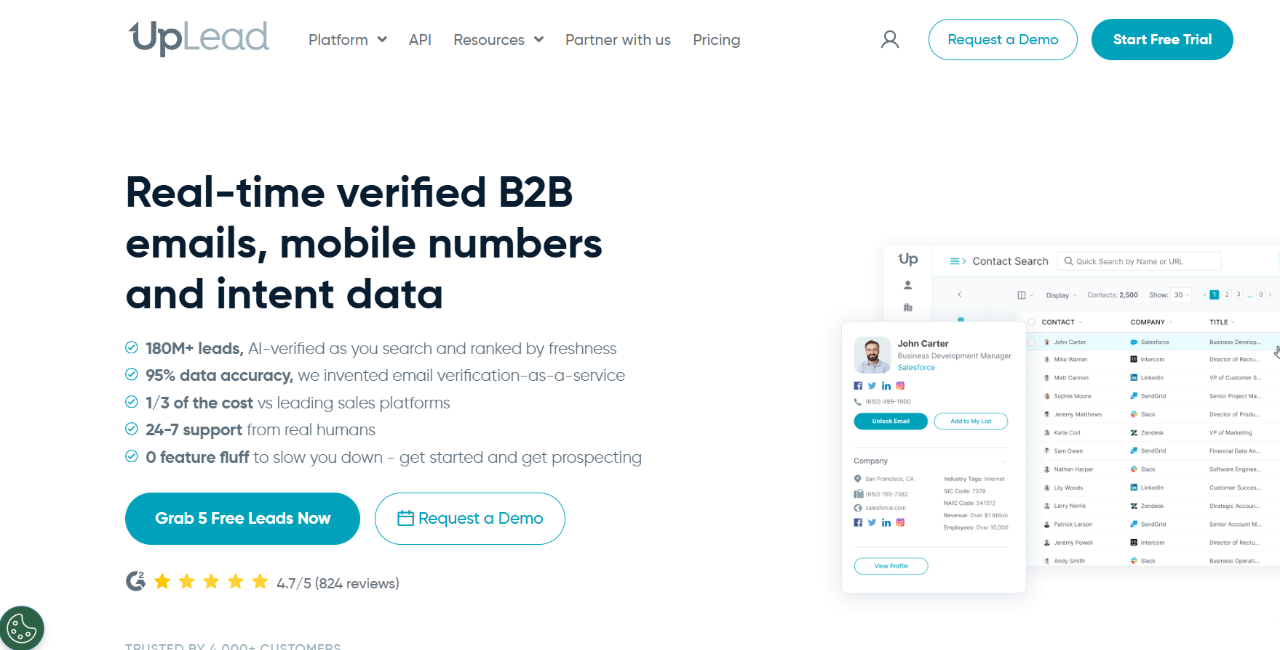
UpLead: best for high-accuracy contact filtering

UpLead is a B2B contact database built for teams that care a lot about clean lists and verified emails.

UpLead as one of the 6sense Alternatives

It offers real-time email verification, mobile numbers, 50+ search filters, technographic data, CRM integrations, and a stated 95% accuracy rate. That makes it useful when the priority is getting more reliable contact data before pushing anything into CRM or outreach.

Still, UpLead is mainly a data tool. It helps with finding and verifying contacts, but it does not go nearly as far on sequencing, AI personalization, or deliverability as a dedicated engagement platform.

Key features

  • Real-time email verification before export
  • Search filters across role, industry, revenue, company size, and more
  • Technographic data for tool-based targeting
  • CRM integrations
  • Buyer intent on higher plans

Pros

  • Strong focus on cleaner data
  • Pricing is more transparent than many competitors
  • Trial is available

Cons

  • Credit limits can get in the way
  • Not a full outreach platform
  • Intent features are tiered

Pricing

UpLead starts at $99 per month for 170 credits, or $74 per month on annual billing. There’s also a 7-day trial with 5 credits.

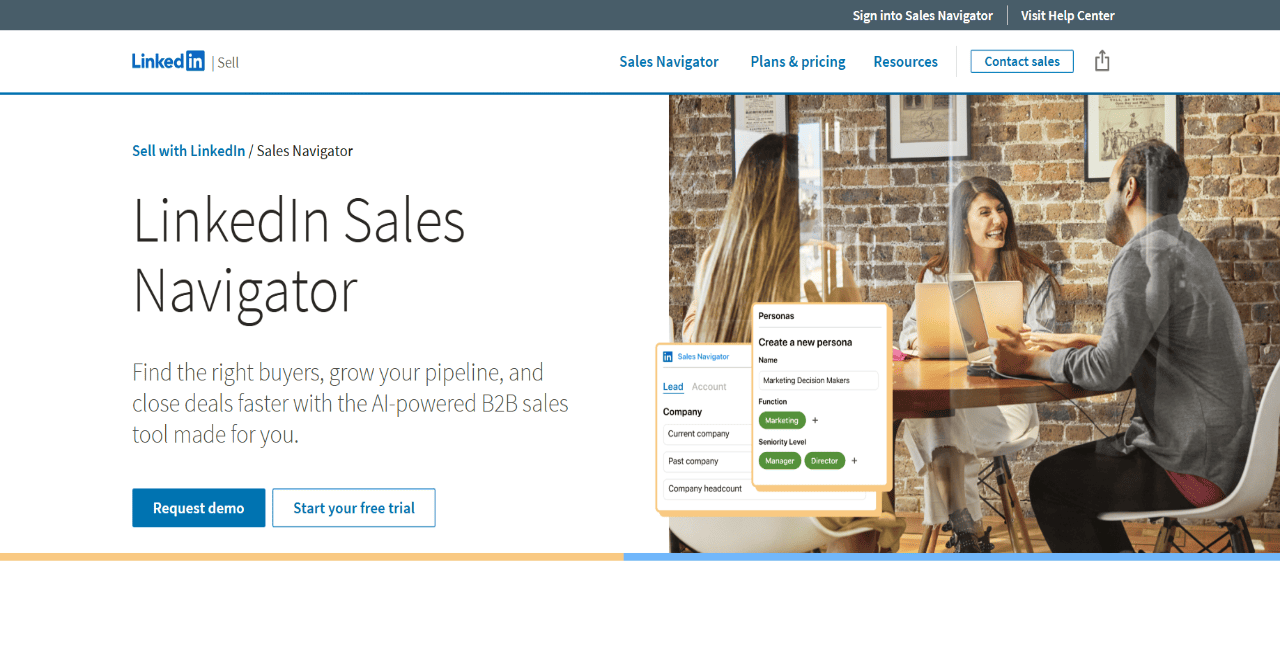
LinkedIn Sales Navigator: best for relationship-based prospecting

LinkedIn Sales Navigator is one of the stronger Crunchbase alternatives for reps who prospect through account mapping, relationship signals, and LinkedIn itself. 

LinkedIn Sales Navigator as one of the Cognism alternatives

Because it runs on LinkedIn’s own network data, reps can search for prospects, save leads and accounts, track job changes, monitor activity, and use InMail. It becomes especially useful when you need to understand buying committees and figure out the warmest way into an account.

The main thing missing is obvious enough: verified contact data and execution. Sales Navigator does not give you scaled email data or multichannel campaigns, so most teams pair it with enrichment and outreach tools.

Key features

  • Advanced lead search across role, seniority, geography, company size, and more
  • Real-time alerts on job changes and account activity
  • Relationship mapping across target accounts
  • InMail for out-of-network contact
  • CRM integrations on higher plans

Pros

  • Native LinkedIn data is a big advantage
  • Excellent for account mapping
  • Good fit for warm outbound motions

Cons

  • No verified email data at scale
  • InMail limits are real
  • You still need another tool for automated sequences

Pricing

Sales Navigator Core starts at $119.99 per month, or $1,079.88 per year on annual billing.

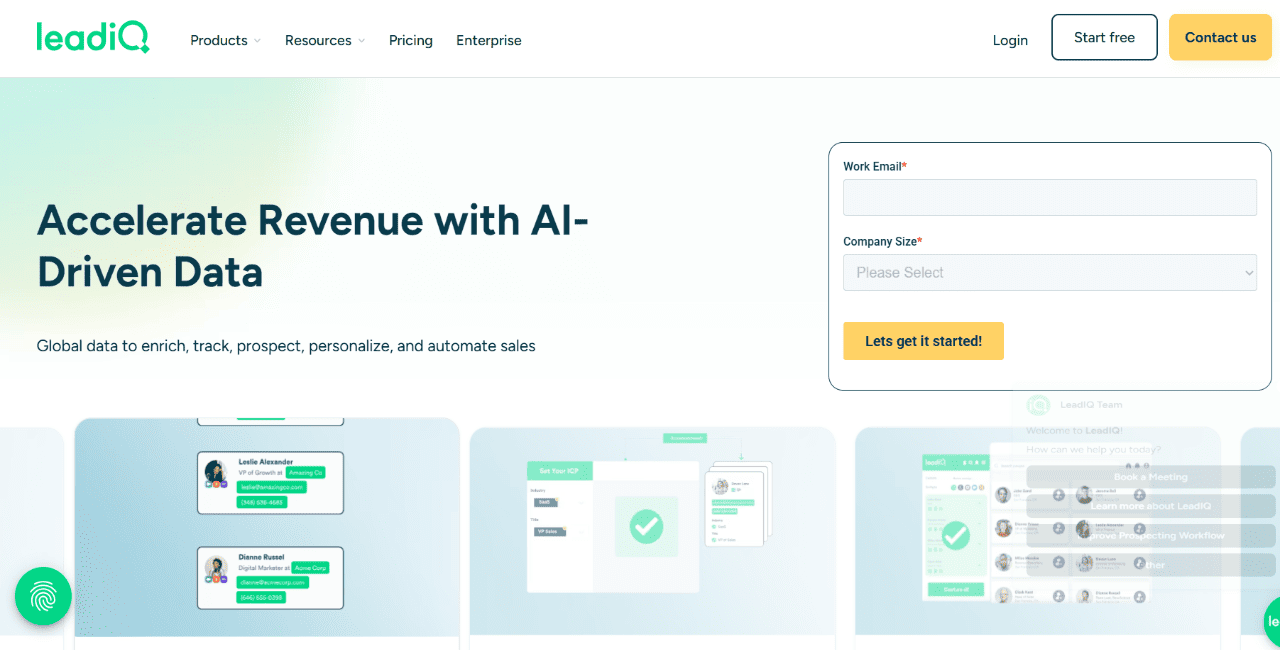
LeadIQ: best for capturing leads during live browsing

LeadIQ is built for SDRs and BDRs who prospect while they work, not for teams that want to sit inside a huge static database all day.

LeadIQ as one of the Cognism alternatives

Its Chrome extension helps reps grab contact data, enrich records, and send those leads into CRM or engagement platforms while browsing LinkedIn, company sites, and other tools. It also includes job change tracking and Scribe AI for writing personalized email snippets based on the prospect and account data it finds.

That makes it useful for live prospecting. It is not, however, a full outreach platform. It helps reps capture and prep leads, while actual campaign execution usually happens elsewhere.

Key features

  • Chrome extension for live lead capture
  • CRM sync with Salesforce, HubSpot, Salesloft, Outreach, and others
  • Job change alerts
  • Scribe AI for email snippets
  • Enrichment for incomplete records

Pros

  • Fast when prospecting on LinkedIn
  • Job change alerts are genuinely helpful
  • Fits nicely with CRM and engagement tools

Cons

  • Not meant for end-to-end outreach
  • Less useful for bulk list building
  • Coverage can vary by market

Pricing

LeadIQ has a free plan with 50 credits. Its pricing page lists Pro at $15 per month, with enterprise pricing available separately.

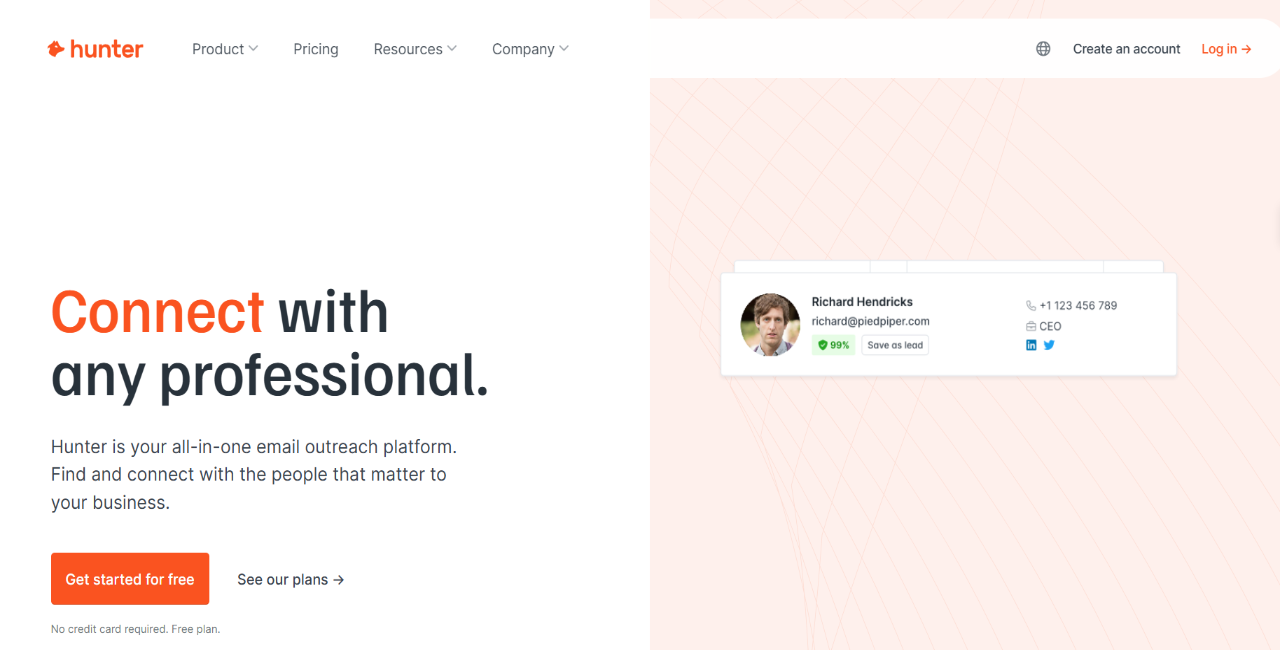
Hunter.io: best for domain-based email discovery

Hunter.io is a lightweight option built around one specific job: finding and verifying business emails from company domains.

Teams can use Domain Search to pull emails tied to a domain, Email Finder to locate one specific person, and Email Verifier to check deliverability before sending. There is also a simple campaign feature for basic cold email.

Hunter is practical, no question. But it is also narrower than most Crunchbase alternatives here. No phone numbers, no deep company intelligence, no broader multichannel workflow.

Key features

  • Domain Search for company-wide email discovery
  • Email Finder for person-specific lookups
  • Email Verifier before outreach
  • Basic cold email campaigns
  • Chrome extension for website and LinkedIn lookups

Pros

  • Fast and simple for email discovery
  • Free plan helps
  • Verification workflow is easy to use

Cons

  • No phone numbers
  • Limited company intelligence
  • Outreach features stay pretty basic

Pricing

Hunter has a free plan with 50 credits per month. Paid plans begin at $49 monthly, or $34 per month when billed annually.

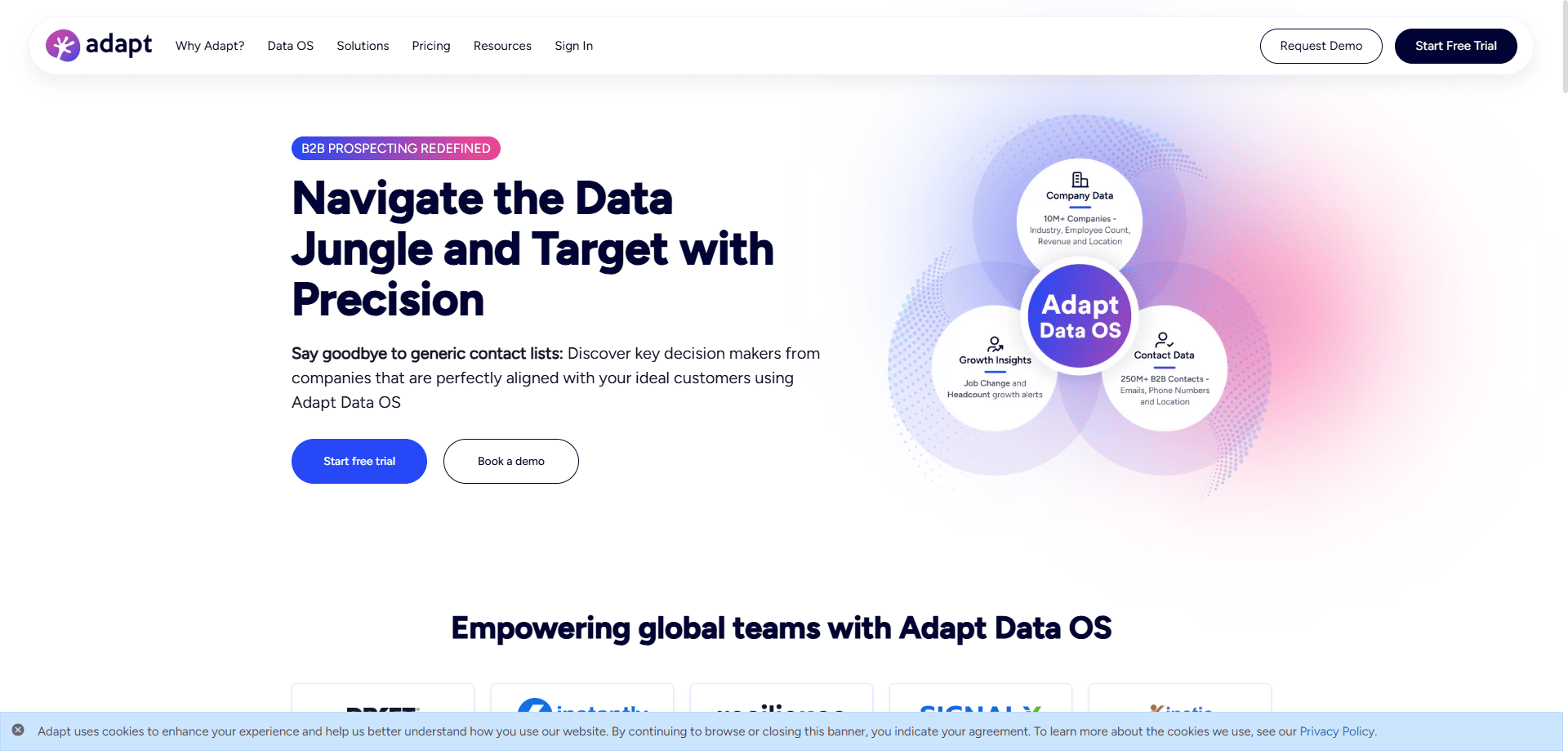
Adapt.io: best for budget-friendly lead data

Adapt.io is aimed more at smaller sales teams, founders, and solo operators that want affordable prospecting data without a huge upfront commitment.

Adapt.io, an an email permutator

It includes contact and company search, filtering, enrichment, CRM integrations, and a Chrome extension for finding prospects on LinkedIn and company websites. The free plan also makes it easy to test without much friction.

For lighter prospecting, it can do the job. For bigger outbound motions, teams may run into credit limits and contact caps fairly quickly. And like many data-first tools, it is not trying to be a full sales engagement platform.

Key features

  • Lead Builder for contact search
  • Chrome extension for live prospecting
  • Enrichment for company and contact fields
  • CRM sync with HubSpot, Salesforce, Pipedrive, and others
  • Dynamic lists for keeping prospect groups updated

Pros

  • Lower-cost entry point
  • Free plan is useful
  • Good for smaller prospecting setups

Cons

  • Limits can make scaling harder
  • Intent data is not especially deep
  • No full outreach workflow

Pricing

Adapt.io has a free plan with 25 email credits and 25 contacts per day. Paid plans start at $49 per month.

Harmonic: best for finding startups before funding rounds

Harmonic is a startup discovery platform built more for VC firms, corp dev teams, and innovation groups than for standard sales teams.

It tracks 35M+ company records and 195M+ people records, with AI search, network mapping, exports, and startup intelligence. The real value is in surfacing companies through earlier signals — team changes, hiring, growth patterns, and other public signals before they show up more visibly elsewhere.

Harmonic is strong on discovery. It is not an outreach platform. Once a team identifies companies or founders they care about, they still need other tools for verified contacts and execution.

Key features

  • Startup database with millions of company and people records
  • AI search agent
  • Growth signals around hiring and team activity
  • Founder intelligence
  • Export and data-delivery options

Pros

  • Strong for early-stage startup discovery
  • AI search is useful here
  • Good fit for investors and corp dev teams

Cons

  • Pricing is custom
  • Not a sales engagement tool
  • Contact data and outreach need separate tools

Pricing

Harmonic pricing is available on request rather than through public plans.

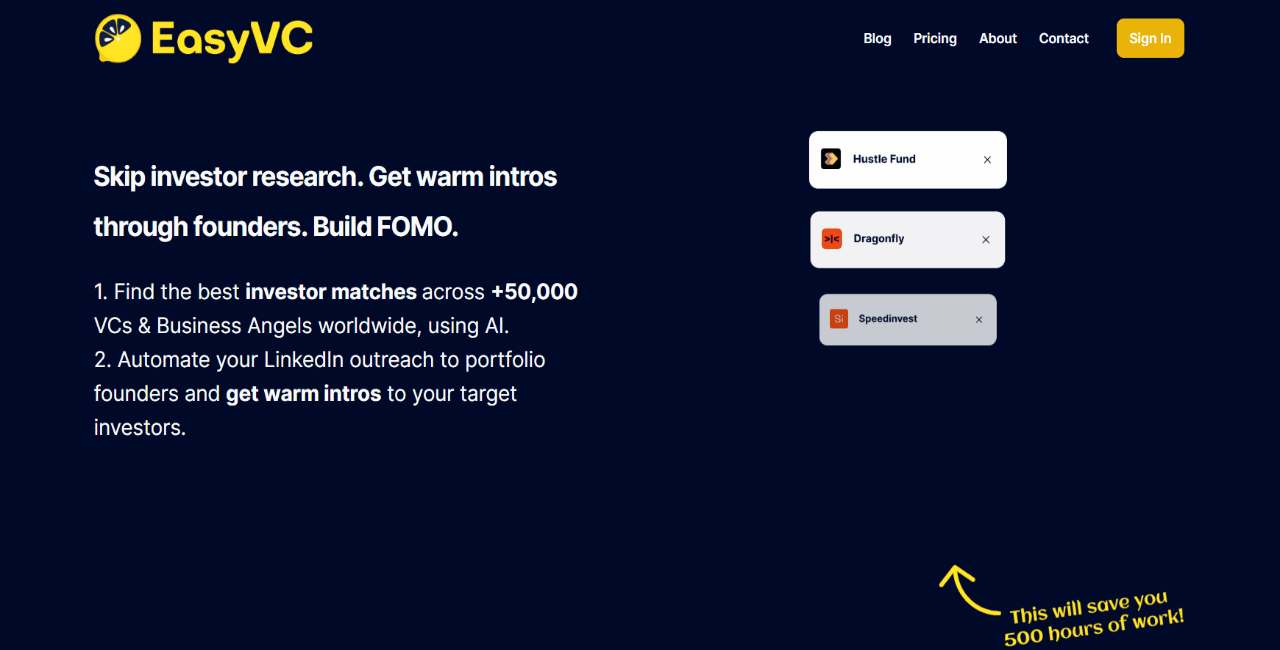
EasyVC: best for matching startups with investors

EasyVC is much narrower than most platforms on this list, but that is also the point.

It is built for founders who want to find relevant investors and run a more structured fundraising process. Instead of acting like a general company intelligence platform, it focuses on investor matching based on stage, sector, geography, and thesis fit. There is also pitch deck guidance, fundraising support, warm intro workflows, and one-on-one coaching.

Useful for fundraising, yes. Broader business development or sales intelligence work? Not really.

Key features

  • AI-based investor matching
  • Investor database by stage, sector, and thesis
  • Pitch deck support
  • Fundraising strategy guidance
  • Founder coaching

Pros

  • Very specific fundraising use case
  • Hands-on support is part of the appeal
  • Helpful for founder-led investor outreach

Cons

  • Narrow scope
  • Not a company intelligence platform
  • Limited usefulness outside fundraising

Pricing

EasyVC starts at $119.99 per month, or $89.99 per month with annual billing.

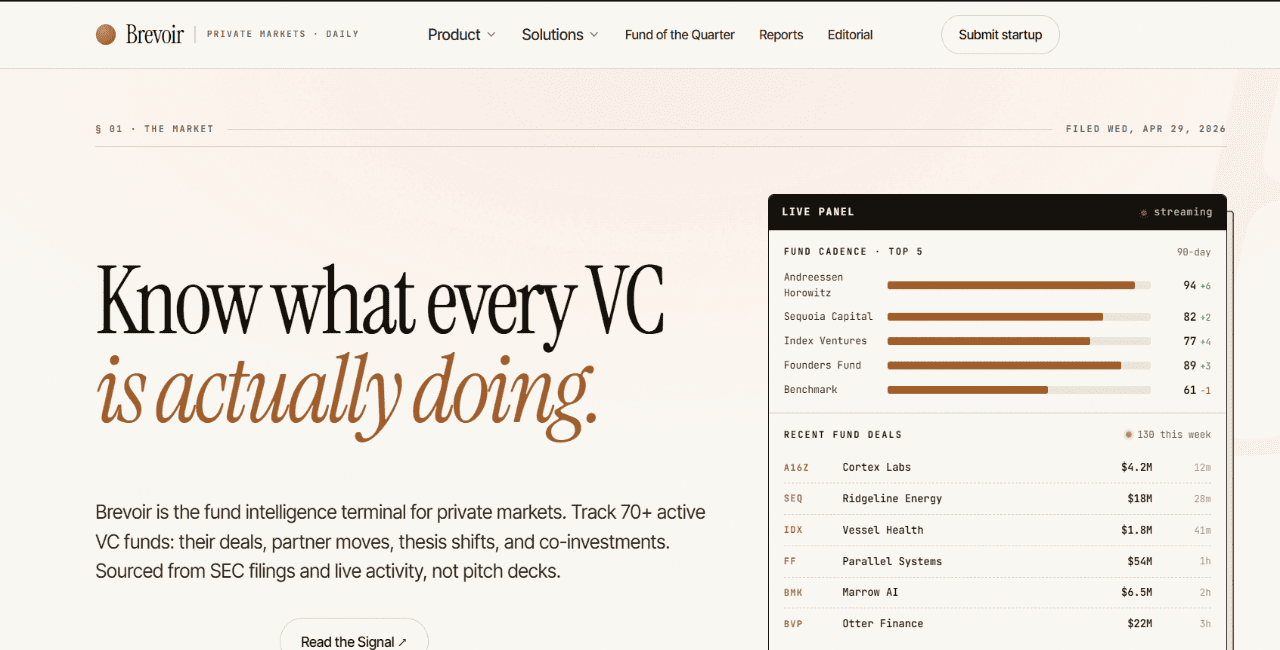
Brevoir: best for AI-driven investment insights

Brevoir is a private market intelligence tool built for angels, emerging fund managers, family offices, and startup investors.

It helps users track funds, discover startups, monitor sector momentum, run diligence, and follow investment activity. The platform also includes a thesis-based feed, startup discovery, deck analysis, fund tracking, and fundraising signals.

Compared with institutional-grade tools, it is more affordable. But it is still mainly an intelligence product. Once someone finds a company they want to reach, they will need other tools for contact data and outreach.

Key features

  • Thesis-based deal flow
  • Sector momentum tracking
  • Fundraising signals
  • Fund tracking across activity and focus
  • Startup and deck analysis

Pros

  • More affordable than many institutional tools
  • Discovery is thesis-driven
  • Free plan exists

Cons

  • No full contact database
  • No outbound workflow
  • Still a newer platform

Pricing

Brevoir has a free plan. Paid plans start at $49 per month for Scout, with higher tiers for Investor and Syndicate.

Turn company research into pipeline

The right Crunchbase alternative depends on what your team actually needs it for, whether that’s purely market research and account discovery, or a more consolidated sales suite that also has outreach, personalization, and analytics features.

Before you choose a platform, it’s always a good idea to audit your current prospecting process. If your team has to rely on separate tools to find decision-makers, verify emails, enrich contacts, personalize outreach, and manage follow-ups, scaling that workflow gets a lot harder than it needs to be.

Reply.io brings most of that entire sales motion into one platform, with real-time company data, 1B+ contacts, enrichment, AI personalization, multichannel sequences, and deliverability tools.

You can start with the 14-day free trial and see how it fits your outbound workflow.

FAQ: CrunchBase alternatives

What are the best Crunchbase alternatives?

Some of the strongest Crunchbase alternatives are Reply.io, PitchBook, CB Insights, Breeze Intelligence, UpLead, LinkedIn Sales Navigator, and LeadIQ. The better option depends on what you actually need from the tool — investor research, company data, contact enrichment, or a way to turn research into outreach.

Are free Crunchbase alternatives worth it?

They can be useful for lighter research, yes. But most free options come with limits pretty quickly — fewer credits, limited exports, thinner data, that kind of thing. In practice, a trial of a paid platform is usually a better test if you want to see how it fits into a real workflow.

Is Crunchbase worth it?

For company research, funding data, investor tracking, and market discovery, yes, it can be. The catch is that for most sales teams, that is only one part of the job. If you also need verified contacts and a way to run outreach, Crunchbase usually is not enough on its own.

Who competes with Crunchbase?

The main direct Crunchbase competitors include PitchBook, CB Insights, Harmonic, Breeze Intelligence, UpLead, and LinkedIn Sales Navigator. Reply.io is a better fit for teams that want to go beyond company research and handle contact data, enrichment, and outreach in the same workflow.

What should you look for in a Crunchbase alternative?

Look at the parts that matter after the research step — data quality, contact-level coverage, filters, enrichment, CRM sync, and whether the platform helps your team actually act on the insight. The best tool is not just the one that helps you find companies but also automates what happens next.

Subscribe to our blog to receive the latest updates from the world of sales and marketing.
Stay up to date.

In this article

Your Superhuman SDR

Jason learns your product, tone, and strategy — then runs outreach with the precision of your best rep.

Your Superhuman SDR
Book a demo

Related Articles

Top 12 GTM Outbound Sales Platforms to Try in 2026

Top 12 GTM Outbound Sales Platforms to Try in 2026

Top 12 GTM Outbound Sales Platforms to Try in 2026
What’s New in Reply: New API, AI Custom Fields, LinkedIn Enrichment, and More

What’s New in Reply: New API, AI Custom Fields, LinkedIn Enrichment, and More

What’s New in Reply: New API, AI Custom Fields, LinkedIn Enrichment, and More
Best 12 CRM for Marketing Agencies in 2026

Best 12 CRM for Marketing Agencies in 2026

Best 12 CRM for Marketing Agencies in 2026