
RocketReach vs ZoomInfo Pricing and Features 2026

RocketReach vs ZoomInfo Pricing and Features 2026

Both RocketReach and ZoomInfo help businesses find B2B contacts, but they’re built for slightly different jobs.

RocketReach is easier to start with, more transparent around pricing, and works well when you need to find contacts fast. ZoomInfo is feature-heavier, more expensive, and better suited for teams that also need deeper sales intelligence, buyer intent data, CRM enrichment, and more structured account-level workflows.

So, here’s a practical RocketReach vs ZoomInfo comparison based on pricing, features, data quality, intent signals, outbound execution, and the types of teams each platform best makes sense for.

What is RocketReach?

RocketReach is a B2B contact database and lead intelligence platform used to find potential leads, along with their professional emails, phone numbers, social profiles, and company data.

Perhaps its biggest strength is speed. Sales reps, recruiters, founders, agencies, and business development teams can search for specific people or companies, reveal contact details, build lists, and export that data into a CRM or outreach tool with little to no setup.
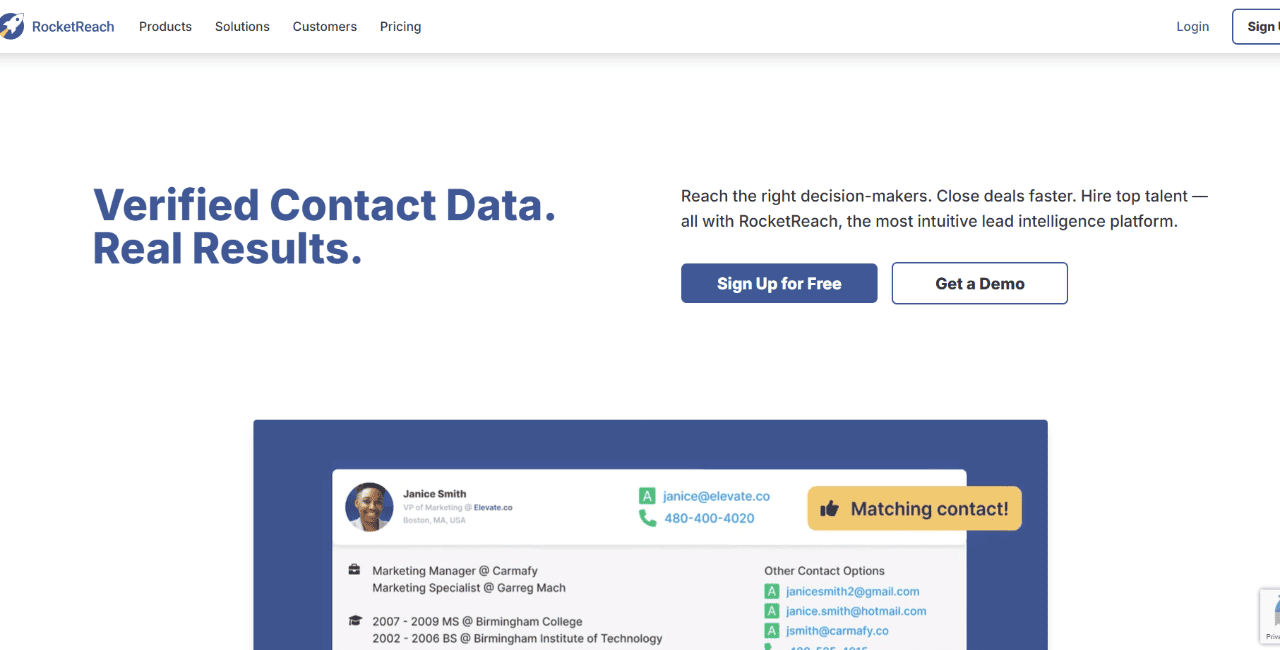
RocketReach as one of the Cognism alternatives

RocketReach is especially useful when you already have a clear idea of who you want to reach. For example, if you need VP Sales contacts at Series B SaaS companies in North America, RocketReach can help you find the names, emails, phone numbers, and company details pretty quickly.

The platform has also moved beyond simple contact lookup. In 2026, RocketReach includes lightweight email sequences, AI-assisted personalization, intent data, browser-based prospecting, and API access, shifting towards a more GTM-oriented platform. 

The catch is that RocketReach still covers just one layer of the sales/GTM process (data and prospecting), so B2B teams will still need a sales automation platform like Reply.io to launch outreach at scale and manage buyer journeys. 

What is ZoomInfo?

ZoomInfo is a sales intelligence and go-to-market platform built around B2B contact data, company data, buyer intent signals, enrichment, workflow automation, and AI-assisted prospecting.

It’s commonly used by sales, marketing, RevOps, recruiting, and enterprise GTM teams that need more than individual contact lookup. ZoomInfo helps teams build account lists, map buying committees, identify in-market companies, enrich CRM records, track website visitors, monitor company signals, and prioritize accounts based on fit and timing.
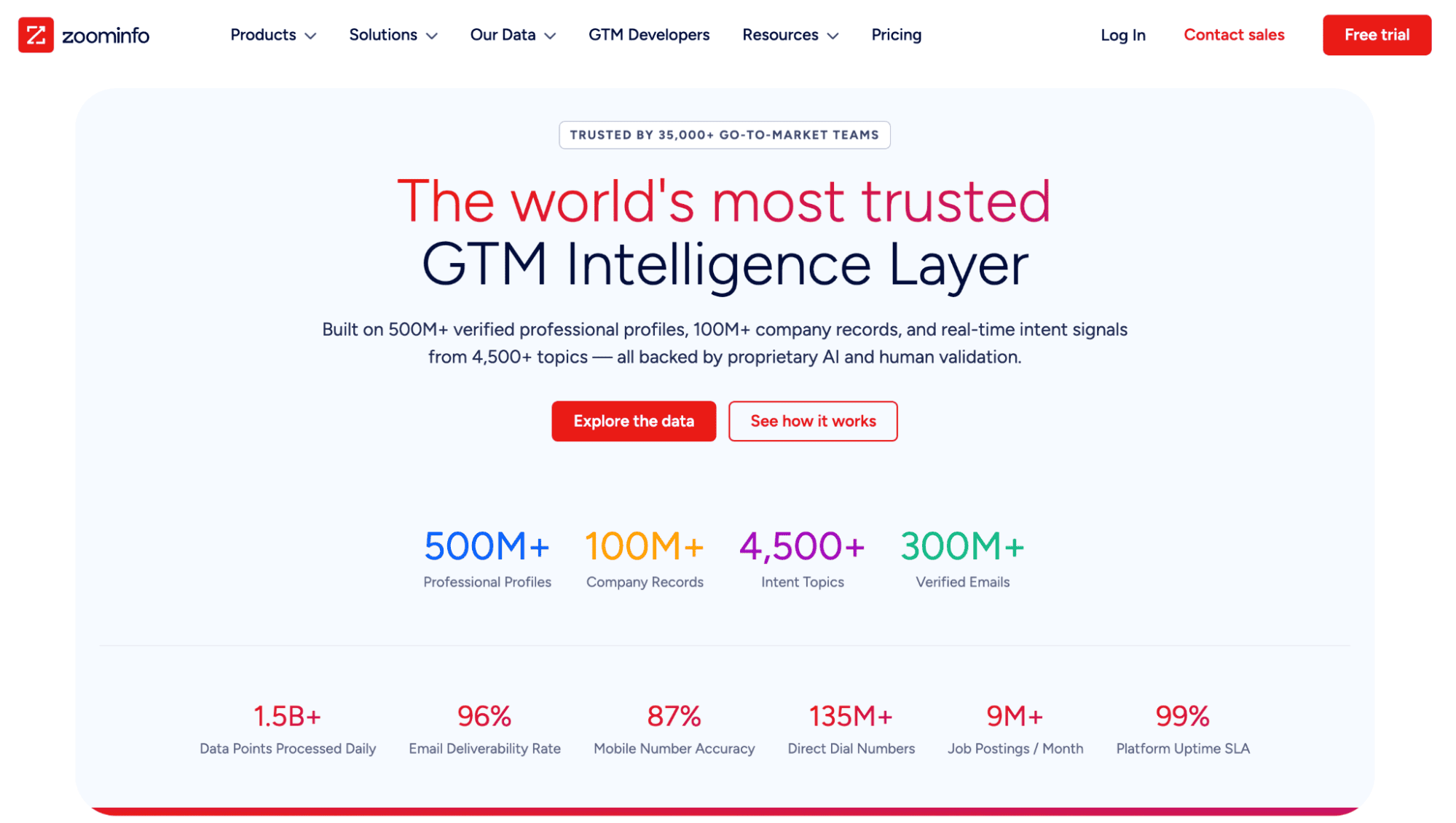
Hero section promoting GTM Intelligence Layer with headline “The world's most trusted GTM Intelligence Layer” and action buttons “Explore the data” and “See how it works.”

All this makes ZoomInfo a stronger fit for larger teams working with more complex accounts. So if your sales motion includes territory planning, account-based selling, and multiple buying roles, ZoomInfo gives you a much broader data layer than RocketReach.

Of course, that comes with a tradeoff — ZoomInfo usually means sales-assisted buying, annual contracts, onboarding, admin setup, and a lot more internal discipline to actually justify the much bigger investment.

The 2026 AI in Sales Playbook

AI is changing sales fast, new tools show up every week, but most teams don’t need more noise. They need practical ways to save time, find better leads, personalize outreach, and build smarter systems.

That’s why we put together this free playbook, which includes:

→ 50+ AI tools for prospecting, outreach, research, CRM, automation, and productivity

→ AI workflows sales teams use to save hours every week

→ A simple framework for deciding what to automate and what to keep human

→ 8 practical AI prompts for better prospecting and outreach

→ The best AI models for sales and what each one does best

→ AI setups used across outbound, GTM, customer success, partnerships, and more

→ Expert resources and creators worth following to stay ahead

Get your free copy and start building a smarter sales workflow right away!

RocketReach vs ZoomInfo: quick comparison

For those in a rush or simply wanting a brief overview of RocketReach vs ZoomInfo, here’s how they stack up on the key features teams usually care most about: 

Category RocketReach ZoomInfo
Best for Fast contact lookup and smaller teams Enterprise sales intelligence and GTM teams
Core strength Email, phone, and profile discovery Account intelligence, enrichment, and buyer signals
Database Broad people and company coverage Deep B2B contact and company intelligence
Intent data Available, expanded in 2026 More mature account and person-level intent workflows
Outreach Email sequences and AI-assisted personalization Sales automation, workflows, and integrations
CRM workflows Useful integrations and API access Stronger CRM enrichment and RevOps controls
Pricing More transparent and self-serve Quote-based and usually much more expensive
Setup Easier to adopt More complex, better for larger teams

The simple version is to choose RocketReach if you mostly need reliable contact discovery, and ZoomInfo if you need a deeper sales intelligence platform for enterprise GTM operations.

But here’s the thing to keep in mind. If one of your main bottlenecks is turning contacts into meetings and closed deals, neither database is enough on its own. You also need an AI sales engagement tool like Reply.io that offers multichannel outreach (email, LinkedIn, calls, and more), AI personalization, deliverability, and analytics.

RocketReach vs ZoomInfo features: where each platform wins

Both RocketReach and ZoomInfo cover the core building blocks of B2B prospecting, but they approach them differently. Below, we’ll compare the features that have the biggest impact on day-to-day prospecting, lead generation, and outbound performance.

Lead database and contact coverage

Both RocketReach and ZoomInfo give teams access to large B2B contact databases, but they shine in different workflows.

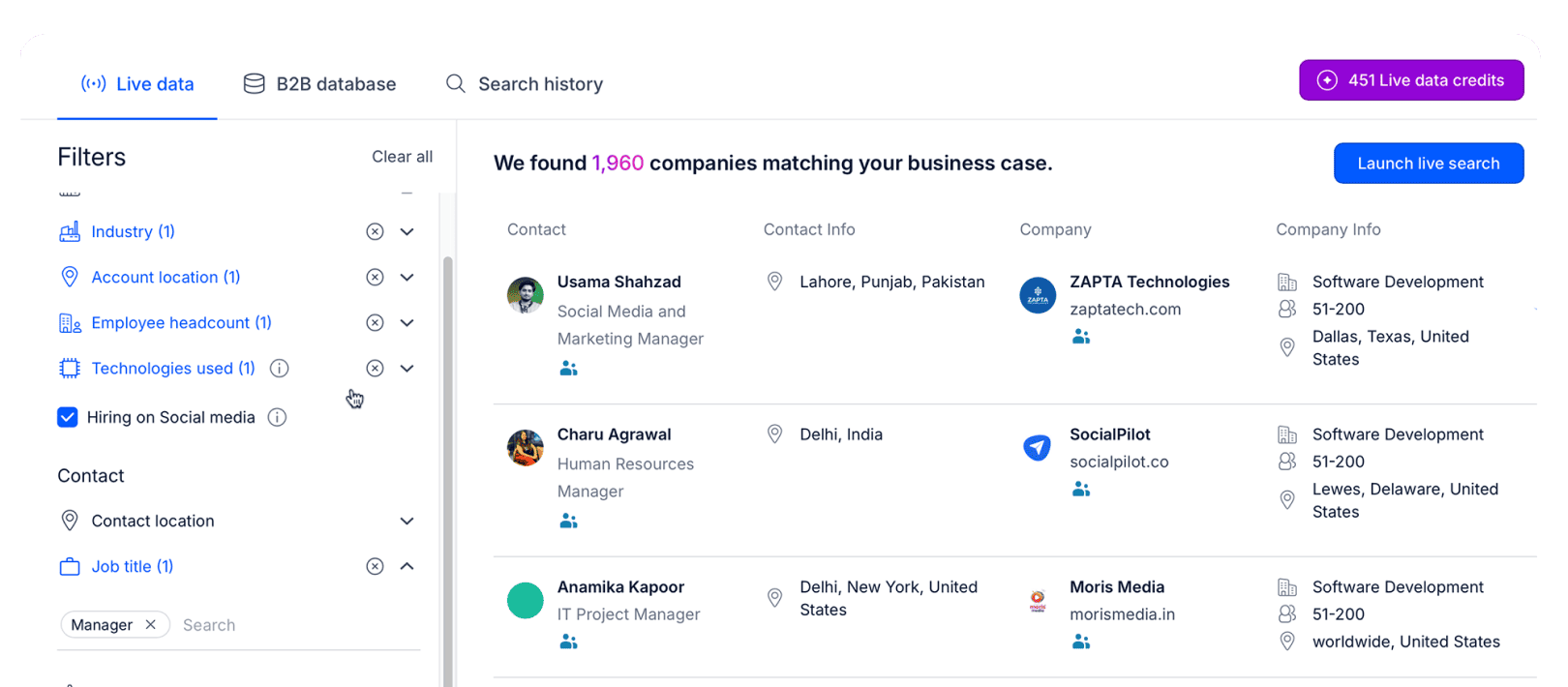
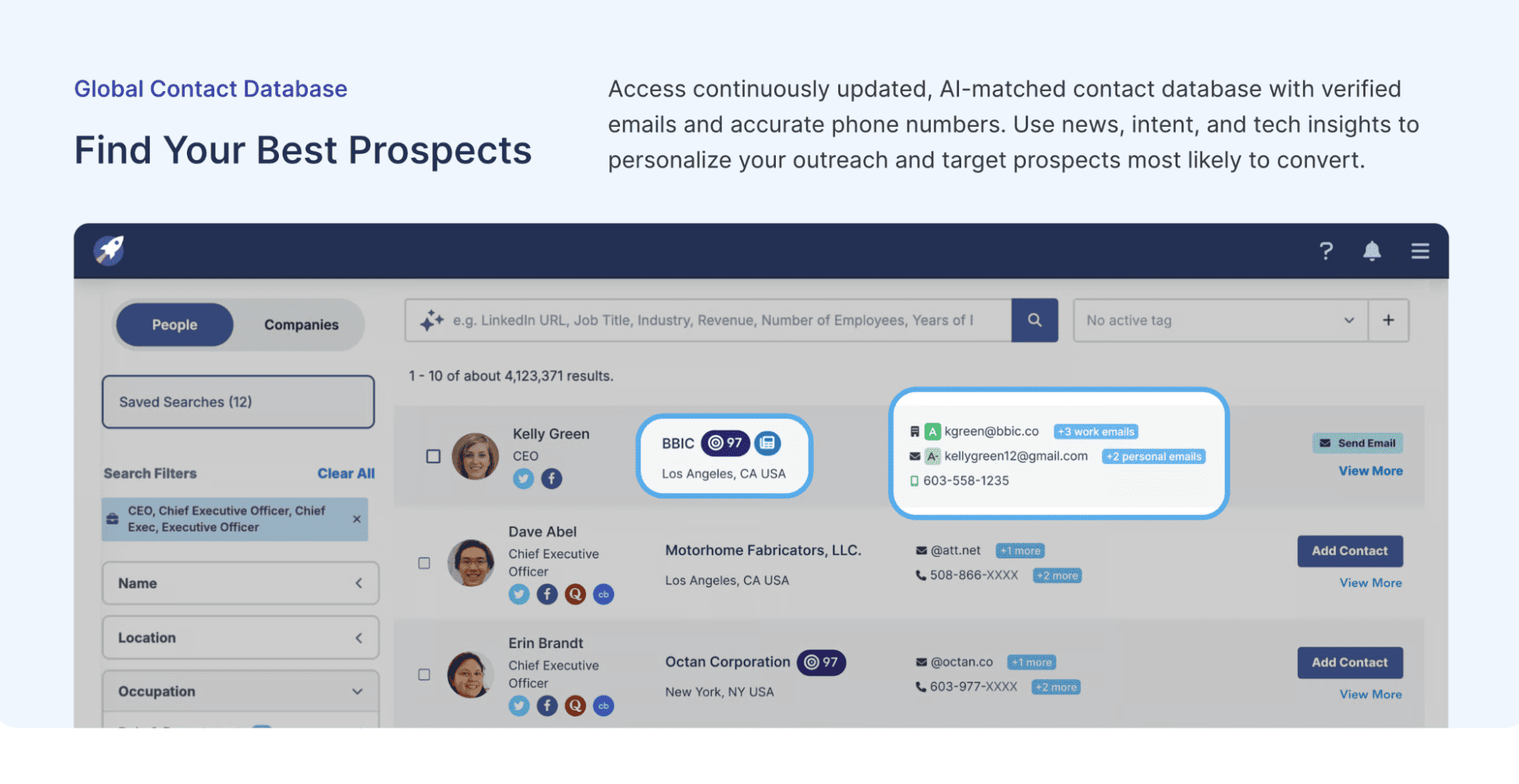
RocketReach is very strong when everything starts with a person or company search. You can search by name, company, job title, location, industry, and other filters, then reveal emails, phone numbers, LinkedIn profiles, and company details. It’s therefore simple and useful for direct prospecting, recruiting, founder-led sales, and agency list building, and it also comes with an AI matching feature to find new targeted leads on autopilot. 

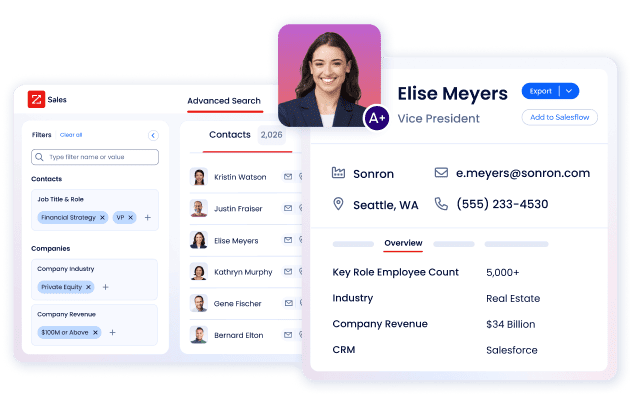
Global Contact Database banner with title “Find Your Best Prospects” and a screenshot of a contact-search interface

ZoomInfo goes deeper on company and account intelligence, as it’s primarily built for teams that need to understand not only who works at a company, but also company size, revenue, department structure, technologies used, hiring trends, buyer signals, org changes, and overall account fit. It also offers deeper enrichment and GTM workflow automations.

zoominfo as one of the prospecting tools that integrate with salesforce

In reality, B2B outbound rarely works by exporting the biggest possible list and hoping for the best. A good list needs three key things:

  • The right accounts
  • The right people inside those accounts
  • The right timing and message for each person

For smaller teams, RocketReach may be enough to build targeted lists and feed an outreach platform. For enterprise teams, ZoomInfo usually gives much stronger infrastructure for account-based sales, territory planning, and CRM enrichment.

Data accuracy, verification, and enrichment

Data accuracy should be one of the most important parts of any RocketReach vs ZoomInfo features comparison. The good news is that both platforms are heavily focused on providing accurate and verified data. 

A database can look very impressive on a landing page, but outbound performance depends on how many records are actually usable. If emails bounce, job titles are outdated, direct dials are wrong, or company data is messy, your team pays for it twice. First through the subscription, then through wasted rep time and damaged deliverability.

When evaluating and testing any prospecting tool, look at:

  • Verified email match rate
  • Bounce rate after export
  • Direct dial and mobile number accuracy
  • Job title freshness
  • Company size and industry accuracy
  • Duplicate records
  • CRM field quality
  • Enrichment coverage for your ICP

RocketReach is good for quick contact discovery, especially when users need emails and phone numbers fast, and it comes with news updates on your key accounts to provide more relevant context. 

ZoomInfo is generally stronger for enrichment-heavy workflows, and in fact, many larger teams use it to clean CRM records, enrich accounts, add missing fields, and maintain better data hygiene across their entire sales and marketing stacks.

For outbound sales, the rule is very straightforward: always verify before sending. Exporting a list and assuming it’s campaign-ready is how bounce rates creep up and domains get into trouble. Every campaign should include email verification, bounce protection, and list hygiene before contacts enter a sequence.

Buyer intent data and sales intelligence signals

A B2B lead database helps answer “who should we contact?”, while intent data helps answer “why now?”, and that difference is important. 

Reaching a perfect-fit account at a random moment is very different from reaching that same account when it’s showing potential signs of market fit at this very moment, be it growing their team, researching your category, visiting competitor pages, expanding into a new region, or showing signs of technology adoption.

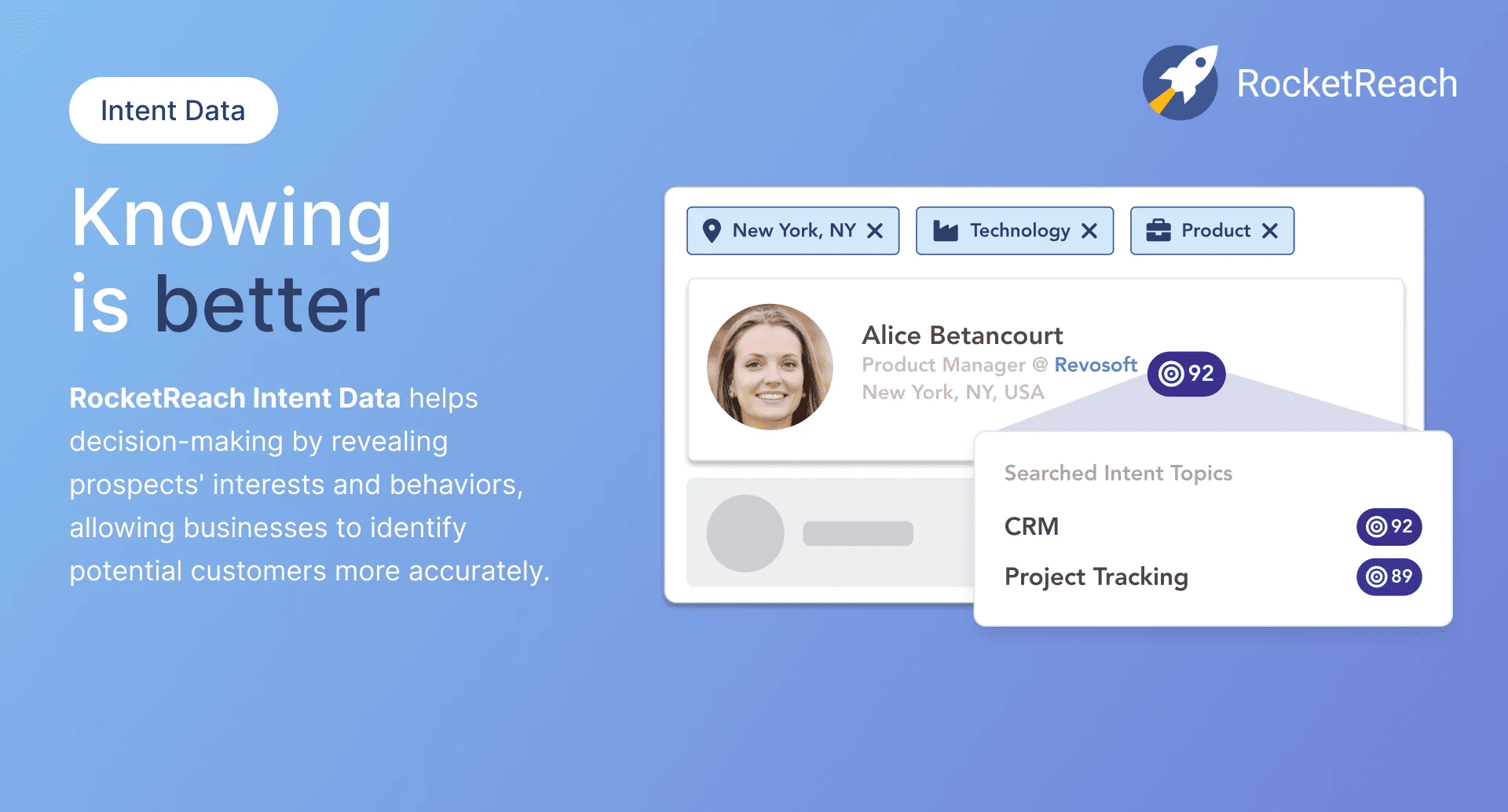
RocketReach now offers access to more than 35,000 intent topics and over 50 million new signals per week. Teams can use these signals to identify active accounts, then combine them with company and contact filters to find the right decision-makers.

RocketReach Intent Data hero: blue gradient background, large 'Knowing is better' text, profile card with tags, and RocketReach logo in corner.

ZoomInfo goes deeper with account-level intent, website visitor tracking through WebSights, person-level intent, Scoops with verified company events like funding rounds, leadership changes, hiring, and expansions, and Champion Tracking to alert teams when previous users move to new companies. These signals can be combined with firmographics, technographics, hiring data, and org changes to prioritize accounts more precisely.

Copilot then brings those signals together to surface relevant accounts, buying-group members, and recommended actions, making ZoomInfo stronger for larger teams running account-based sales.

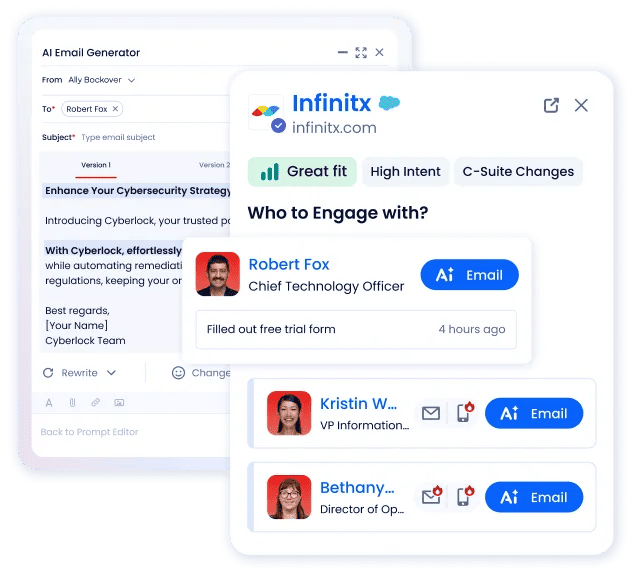
UI of Infinix AI Email Generator showing contact cards with names, titles, and an Email button for each contact.

Still, intent data isn’t magic. A company researching your category does not automatically mean the exact person you found is ready for a demo. Sales teams still need to identify the right buying roles, understand the likely pain point, and build outreach around that context.

Outreach automation, sequencing, and AI

RocketReach now includes email sequences, automated follow-ups, AI-assisted personalization, and even an autopilot mode that runs these workflows at your set pace, all of which is a meaningful upgrade since users can move from contact discovery to basic outreach without exporting every list into another tool.

For simple, low-scale email campaigns, that may be enough.

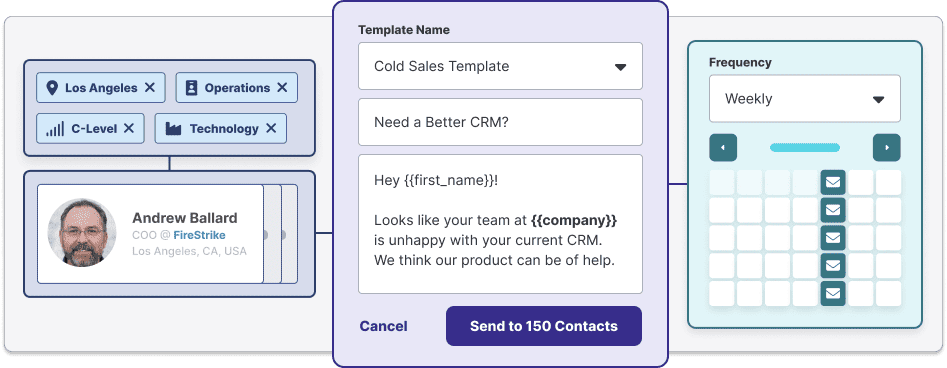
UI mockup of a CRM template editor with tag filters left, template form center, and weekly calendar right.

ZoomInfo handles outreach through Engage, its sales engagement product for building automated email and call sequences, assigning daily tasks, using templates, tracking activity, and running a power dialer from the same workspace. Teams can also use Workflows to trigger actions when a contact or account meets specific conditions, such as adding a prospect to a sequence, updating the CRM, or assigning the lead to a rep.

Copilot supports the execution layer by summarizing account research, surfacing recommended contacts, preparing talking points, and suggesting next steps before a rep reaches out.

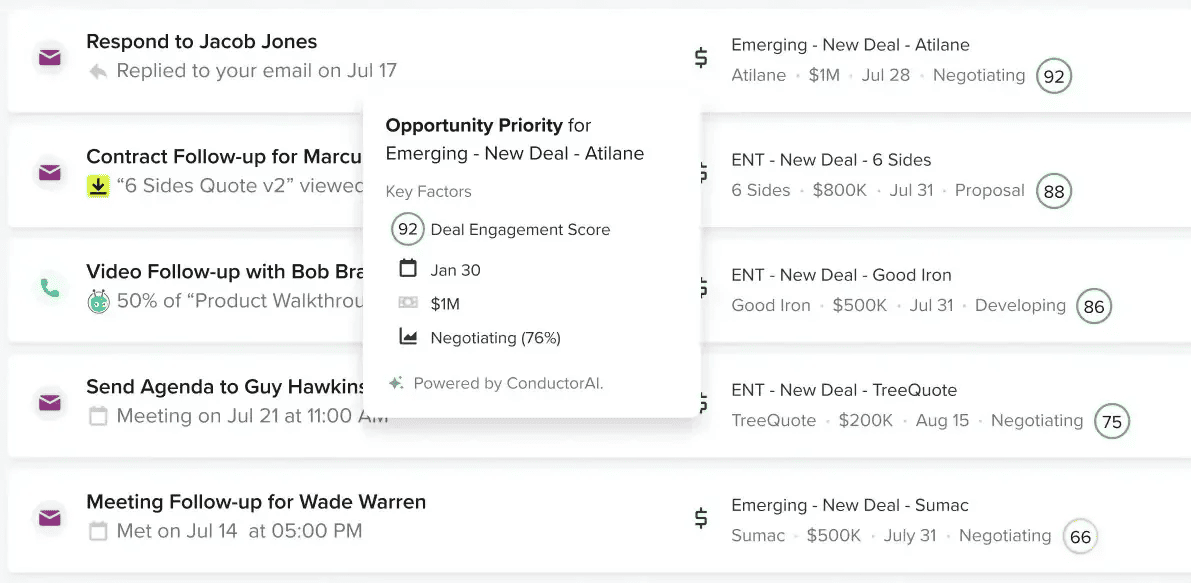
Email inbox with multiple messages; a floating panel reads 'Opportunity Priority for Emerging - New Deal - Atlane' showing a 92 Deal Engagement Score and key factors such as Jan 30, $1M, Negotiating (76%).

Still, many teams using RocketReach or ZoomInfo also use separate tools for outreach execution. And honestly, that makes sense, because effective outbound usually needs more than basic email sends:

  • Multichannel sequences (email, LinkedIn, calls, SMS, or messenger touchpoints)
  • Tailored AI personalization based on uncovered prospect data
  • Email deliverability monitoring
  • Inbox rotation and sending limits
  • Reply detection and follow-up handling
  • Meeting booking
  • Sequence-level analytics

This is where many comparison articles stop too early. They compare database size and pricing, then ignore what happens after the lead is found. But finding a contact is only the first step. In reality, revenue comes from turning that contact into a qualified conversation. 

This is why many businesses pair RocketReach or ZoomInfo with an AI outreach platform like Reply.io, which comes with its own B2B database, built-in enrichment and email verification, coordinated multichannel outreach sequences, deep AI personalization, analytics, and more. With this stack in place, you can fully automate the entire process from contact discovery to outreach to booked meetings.

RocketReach vs ZoomInfo pricing 2026

RocketReach is cheaper and much easier to budget for. There’s a Free plan with 5 lookups, and then three paid plans: Essentials, Pro, and Ultimate. 

Public pricing lists Essentials at $69/month for 100 lookups and email-only access, Pro at $119/month for 250 lookups with emails and phone numbers, and Ultimate at $209/month for 1,000 lookups, while annual billing brings the effective monthly price down.

ZoomInfo pricing works very differently — it’s quote-based and, in most cases, far more expensive. Its main SalesOS tiers are usually Professional, Advanced, and Elite, but the actual pricing is not published publicly. 

Buyer-reported estimates commonly put Professional at around $15K/year, Advanced at roughly $25K-$30K/year, and Elite at $40K+/year. Higher tiers usually add more credits, stronger enrichment, buyer intent data, deeper integrations, automation, and workflows built for larger GTM teams.

Pricing verdict: RocketReach wins if you need affordable contact lookup, emails, phone numbers, and predictable monthly pricing. ZoomInfo costs a lot more, but it can make sense for larger GTM teams that need enterprise-grade sales intelligence, buyer intent, CRM enrichment, and account-level workflows.

Which should you choose: RocketReach or ZoomInfo?

Choose RocketReach if:

  • You need fast email and phone lookup
  • You want simpler, more transparent pricing
  • You are a founder, recruiter, agency, freelancer, or smaller sales team
  • You already have a CRM and outreach platform
  • You care more about contact discovery than enterprise GTM intelligence
  • You do not need heavy RevOps controls or complex enrichment workflows

Choose ZoomInfo if:

  • You run a larger sales, marketing, or RevOps team
  • You need deeper company and account intelligence
  • You sell into buying committees, not single contacts
  • You need buyer intent data, technographics, org signals, and CRM enrichment
  • You can justify a larger annual contract
  • You have the team structure to turn intelligence into actual sales plays

Choose neither as your only tool if:

  • Your bottleneck is outbound execution
  • You already have enough lead data but low reply rates
  • Your emails are landing in spam
  • Your team lacks coordination across email and LinkedIn outreach
  • You need meaningful personalization at scale
  • Your campaigns are not converting contacts into meetings

RocketReach and ZoomInfo can help you find and understand buyers, but you still need a system in place to reach them, personalize emails, follow-ups, and LinkedIn messages, manage deliverability, handle replies, and book meetings.

Reply.io: the best RocketReach and ZoomInfo alternative for AI-powered outbound

Reply.io is one of the best RocketReach and ZoomInfo alternatives for teams that want B2B contact data and AI-powered outreach under one roof. 

Reply is an AI sales engagement and lead generation platform that comes with a native lead database with over 1 billion live contacts and accounts, enrichment, email verification, and intent signals to help you find and prioritize targeted leads. 

data in Reply.io as an extra to your personal CRM

With just a few clicks, you can add those leads into coordinated outreach campaigns with automated emails, follow-ups, LinkedIn touchpoints (connection requests, messages, etc.), SMS, calls, and WhatsApp. These sequences follow conditional logic, which means they adjust in real time based on each lead’s engagement behavior. 

So for instance, if your initial email goes unopened for 3 days, Reply launches an automated LinkedIn connection request; once accepted, it cancels the scheduled email follow-up and writes up a tailored LinkedIn message, and so on.

how to send a second follow up email after no response with conditional sequences

Each message is personalized with Reply’s AI engine based on all the available and uncovered lead/company data, and teams can also use its AI variables feature to create their own custom templates, and Reply will research each lead/account to fill in those gaps.

For most outbound teams, the problem isn’t just finding contacts but also turning those contacts into repeatable and scalable pipeline without breaking deliverability, wasting SDR time, or sending generic messages that nobody wants to read or respond to. 

RocketReach helps you find people, ZoomInfo helps you understand accounts, and Reply.io helps you run the outbound engine that turns those prospects into conversations, and eventually, booked meetings.

Jason AI: when you want an AI sales agent to run the execution

Jason AI is Reply’s very own AI sales agent that joins your team as a full-time SDR, learns everything about your product, ICP, and sales strategy, and then starts finding relevant prospects, building targeted lists, launching multichannel sequences, personalizing messages, handling replies, and even booking meetings on your behalf. 

Think of Reply.io as the infrastructure for AI-powered lead generation and outbound sales automation, while Jason AI is the agent that can run most of the execution on top of that infrastructure.

That is especially useful for lean sales teams, founders, agencies, and companies that want to scale outbound without immediately hiring more SDRs or stitching together five different tools.

For example, instead of manually exporting leads from a database, verifying them, writing sequences, setting follow-ups, monitoring replies, and booking meetings, Jason AI can help run that entire workflow from prospecting to booked call.

That doesn’t make RocketReach or ZoomInfo irrelevant. Both can still be incredibly useful sources of data and sales intelligence. But if the goal is meetings and pipeline, execution is usually where the biggest gains come from.

Final verdict: RocketReach vs ZoomInfo in 2026

RocketReach is the better choice for fast contact discovery, simpler pricing, and smaller prospecting workflows, whereas ZoomInfo is better for larger GTM teams that need deeper company intelligence, buyer intent data, enrichment, and RevOps control.

But neither tool should be judged by data alone.

If your goal is to build a repeatable outbound engine, you need the full workflow: lead data, targeting, personalization, multichannel outreach, deliverability, analytics, and meeting booking. 

That’s where Reply.io and Jason AI give teams a more complete path from finding leads to booking meetings, both powered with a native lead database and an AI engine that turns that data into tailored outreach.

FAQ

Is RocketReach better than ZoomInfo?

RocketReach is better if you need fast, affordable contact lookup with simpler pricing. ZoomInfo is better if you need deeper sales intelligence, buyer intent data, CRM enrichment, and enterprise GTM workflows.

Is ZoomInfo more expensive than RocketReach?

Yes. ZoomInfo is usually much more expensive than RocketReach. RocketReach offers more self-serve pricing, while ZoomInfo is quote-based and commonly sold through annual contracts with pricing based on seats, credits, features, and add-ons.

Does RocketReach have intent data?

Yes. RocketReach has expanded its intent data capabilities, including more intent topics and real-time signals. However, ZoomInfo is generally stronger for teams that need deeper account-level and person-level intent workflows.

What is the best RocketReach and ZoomInfo alternative?

Reply.io is a strong RocketReach and ZoomInfo alternative if your team needs more than data. It combines B2B lead data, enrichment, multichannel outreach, AI personalization, deliverability tools, analytics, and Jason AI SDR in one platform.

Do I still need an outreach tool with RocketReach or ZoomInfo?

In most cases, yes. RocketReach and ZoomInfo can help you find contacts and account intelligence, but sales teams still need sequences, deliverability controls, personalization, reply handling, and meeting booking to turn data into pipeline.

Subscribe to our blog to receive the latest updates from the world of sales and marketing.
Stay up to date.

Related Articles

10+ Best Personal CRM Tools for Sales in 2026

10+ Best Personal CRM Tools for Sales in 2026

10+ Best Personal CRM Tools for Sales in 2026
How to Build a Simple GTM Process That Just Works in 2026

How to Build a Simple GTM Process That Just Works in 2026

How to Build a Simple GTM Process That Just Works in 2026
How to Build a GTM Strategy with AI for Growth in 2026

How to Build a GTM Strategy with AI for Growth in 2026

How to Build a GTM Strategy with AI for Growth in 2026