
Most sales managers only ever hear a small slice of their team’s calls. Everything else buyers say on those calls, from objections and competitor names to the real reasons deals stall, ends up in recordings very few of us have time to replay, or it never gets captured at all.
Conversation intelligence platforms solve this by recording and analyzing every call, then turning what buyers said into coaching and CRM updates. Below, we break down what these tools actually do, which features matter, and the top-rated conversation intelligence platforms, along with real pricing and a side-by-side comparison.
What is a conversation intelligence platform?
A conversation intelligence platform is software that records your sales calls and meetings, transcribes them, and nowadays uses AI to analyze what was said, and how to improve. Managers use that analysis to coach reps and keep the CRM accurate, working from what buyers actually said instead of whatever a rep remembered to type in after the call.
That’s also the short answer to what is conversation intelligence in the modern day — AI that turns unstructured talk into structured, searchable data. It’s often confused with conversational AI, but the two do opposite jobs. Conversational AI talks to customers (chatbots, voice agents), while a conversational intelligence platform listens to the conversations your team has and tells you what happened in them.
The bigger source of confusion is that three types of tools now sell under the same label:
| Tier | What it does | Examples |
| AI notetakers | Record, transcribe, summarize, and push notes to the CRM | Fathom, Fireflies.ai (lower plans) |
| Conversation intelligence | Adds call scoring, coaching, topic trackers, and team analytics | Avoma, Jiminny, Chorus |
| Revenue intelligence | Adds deal risk, pipeline views, and forecasting on top of conversation data | Gong, Zoom Revenue Accelerator |
Buying the wrong tier is an expensive mistake either way, since a five-person team rarely needs forecasting, while a 200-seat sales org will outgrow a basic notetaker really fast.
Features of conversation intelligence platforms that actually matter
There’s no shortage of tools on the market that now record calls and write summaries, so those features no longer separate one product from another. What does separate them is how much of that conversation data turns into action.
And the results speak for themselves, with Gong Labs analyzing over 1 million opportunities across 1418 organizations, and finding that sellers who use AI to guide their deals produce 35% higher win rates.
Here’s what to look for:
- Reliable capture → recording across Zoom, Google Meet, Microsoft Teams, and your dialer, ideally with a bot-free option for buyers who dislike meeting bots.
- AI call scoring → automatic scorecards against your sales methodology (MEDDICC, SPICED, BANT), so coaching doesn’t depend on a manager finding time to listen.
- Topic trackers → alerts when prospects mention competitors, pricing, or specific objections across every call, not just the ones someone reviewed.
- CRM sync → fields like next steps, deal stage, and decision timeline updated automatically after each call.
- Deal and pipeline views → risk flags for deals that go quiet or lose stakeholders.
- Real-time assistance → live prompts during calls, which matters most for high-volume phone teams.
If a tool nails capture and summaries but falls short on trackers and CRM sync, you’re paying for a notetaker with a bigger price tag.
The 10 best conversation intelligence platforms in 2026
There’s no single best conversation intelligence software for every team. Gong is the strongest pick for enterprise revenue teams, Avoma offers the best value for SMB and mid-market teams, and Fathom is the best free starting point. Here’s the full list, with pricing pulled from each vendor’s site in October 2026.
1. Gong
Gong is the category’s consistent heavyweight and the default choice for most larger revenue teams. It captures calls, emails, and meetings, then layers deal boards, forecasting, and AI agents (like AI Deal Predictor) on top of the conversation data.
Best for: enterprise and upper mid-market teams that want conversation intelligence, deal management, and forecasting in one system.
Pricing: custom quote only, and Gong charges per-user licenses plus a platform fee that scales with the number of users.
Keep in mind: the platform fee makes Gong a heavy commitment for small teams.
2. Chorus by ZoomInfo
Chorus records and analyzes calls, meetings, and emails, with a strong focus on coaching, onboarding, and deal intelligence. Its biggest advantage is the ZoomInfo connection, so you get contact and company data sitting right next to the conversation history, and reps can see the full relationship before the next call.
Best for: sales teams already paying for ZoomInfo who want call insights next to their contact data.
Pricing: not published, and Chorus is sold through ZoomInfo’s sales team, so you’ll need to book a demo for a quote.
Keep in mind: with no public pricing, it’s hard to benchmark Chorus against self-serve tools before a sales call.
3. Avoma
Think of Avoma as an all-in-one meeting assistant that grows into full conversation intelligence through add-ons. The base plans cover recording, transcription in 70+ languages, AI notes, scheduling, and CRM note syncing, while the Conversation Intelligence add-on brings AI call scoring, custom scorecards (SPICED, Sandler, MEDDICC), smart trackers, and coaching recommendations.
Best for: SMB and mid-market teams that want strong conversation intelligence without enterprise pricing.
Pricing: Startup $19, Organization $29, and Enterprise $39 per recorder seat per month (billed annually). The Conversation Intelligence add-on is another $29 per seat per month, viewers are always free, and there’s a 14-day free trial.
Keep in mind: the full CI experience means paying for the add-on on top of your seat, so budget for both.
4. Jiminny
Coaching is where Jiminny truly stands out. The platform records and transcribes calls across Zoom, Google Meet, and Microsoft Teams, scores calls automatically, tracks themes like competitor mentions and MEDDPICC elements, and plugs into 25+ dialers, including Aircall, RingCentral, and Dialpad. Ask Jiminny answers plain-language questions about a single call or across many deals, and deal alerts flag opportunities that go quiet.
Best for: mid-market sales teams on Salesforce or HubSpot that care most about structured coaching.
Pricing: a flat fee per user that includes recording, transcription, and AI, with no platform fee or usage credits. Exact rates are shared on a demo, and there’s a 14-day free trial.
Keep in mind: Jiminny is lighter on forecasting than Gong or Zoom Revenue Accelerator.
5. Sybill
Sybill positions itself as a “deal memory” for the whole revenue team. It records calls, writes summaries and pre-meeting briefs, drafts follow-up emails, and autofills CRM fields from conversations. Ask Sybill pulls context across meetings, dialer calls, emails, and the CRM, so reps can ask questions about any deal in plain language.
Best for: AEs who lose hours to post-call admin and want deal context ready before every meeting.
Pricing: Free plan with 500 AI credits per week, Pro at $30 per user per month, and Business at $90 per user per month (CRM autofill, deal workspaces, API and MCP access), with custom pricing for Enterprise.
Keep in mind: the credit system takes some getting used to, since asking Sybill questions uses credits while automatic summaries don’t.
6. Attention
Attention leans hard into AI agents, where its coaching agent grades discovery, objection handling, and methodology coverage, a CRM agent updates stage, next steps, MEDDPICC, and 20+ custom fields in Salesforce or HubSpot, and a follow-up agent drafts the recap email about two minutes after the call ends. Every call gets scored against your framework of choice.
Best for: teams whose main pain is CRM hygiene and follow-up speed.
Pricing: demo-led, with no public price list on Attention’s website.
Keep in mind: the value depends heavily on how well you configure the agents and fields upfront.
7. Zoom Revenue Accelerator
Zoom Revenue Accelerator turns Zoom into a revenue platform by recording calls on Zoom, Microsoft Teams, Google Meet, and in-person conversations, scoring them with AI scorecards, and detecting themes like objections and competitor mentions. It also offers real-time conversation intelligence through Sales Assist, which suggests next steps and objection handling during live calls. Higher tiers also add deal health dashboards and forecasting.
Best for: companies that already run on Zoom and want CI without adding another vendor.
Pricing: sold through Zoom’s sales team, with no list price on the product page.
Keep in mind: it’s strongest inside the Zoom ecosystem, so teams on other meeting tools get less out of it.
8. Dialpad
Dialpad is a phone and contact center platform with conversation intelligence built directly into its calling. Dialpad AI transcribes calls in real time, pops up Live Coach Cards when set keywords come up, scores calls with AI Scorecards, tracks methodology steps with AI Playbooks, and writes recaps with action items when the call ends.
Best for: phone-heavy outbound and inside sales teams that want calling and CI in one product.
Pricing: Dialpad AI is included across its products, and plans are quoted through sales.
Keep in mind: the CI is built around Dialpad’s own calling, so it fits best if you’re also moving your phone system.
9. Fathom
Back in the day, Fathom started as a free AI notetaker but has grown into a credible coaching tool. The free plan still includes unlimited recordings, transcription, and AI summaries, while the Business plan adds CRM field sync, deal views, coaching metrics, and AI scorecards. It’s also one of the few tools offering a bot-free capture option (in beta on Mac).
Best for: small teams and startups that want to start for free and add coaching later.
Pricing: Free forever plan, Premium at $16 per user per month, Team at $15, and Business at $25 per user per month (two-user minimum on team plans).
Keep in mind: CRM field sync, coaching metrics, and AI scorecards only come with the Business plan.
10. Fireflies.ai
Of all the tools here, Fireflies.ai reaches furthest beyond sales, transcribing in 100+ languages, recording Zoom, Google Meet, Teams, and 10+ other platforms, and building a searchable knowledge base of every meeting. Conversation intelligence features like sentiment analysis, talk-time analytics, and topic trackers are only available on the Business plan.
Best for: companies that want one meeting tool across sales, success, and internal teams.
Pricing: Free plan, Pro at $10 per seat per month, Business at $19, and Enterprise at $39 (all billed annually).
Keep in mind: sales-specific coaching is lighter than in Avoma or Jiminny.
Conversation intelligence platforms comparison
The table below puts all 10 tools side by side. Fathom and Fireflies.ai are the best conversation intelligence platforms free to start with, while Gong, Chorus, and Zoom Revenue Accelerator sit firmly in enterprise territory.
| Tool | Best for | Tier | Starting price | Free plan |
| Gong | Enterprise revenue teams | Revenue intelligence | Custom quote + platform fee | No |
| Chorus by ZoomInfo | ZoomInfo customers | Conversation intelligence | Via ZoomInfo sales | No |
| Avoma | SMB and mid-market | Conversation intelligence | $19/seat + $29 CI add-on | No (14-day trial) |
| Jiminny | Coaching-led teams | Conversation intelligence | Flat per-user fee, on demo | No (14-day trial) |
| Sybill | Deal context and CRM admin | Conversation intelligence | $30/user | Yes |
| Attention | CRM hygiene and follow-ups | Conversation intelligence | On request | No |
| Zoom Revenue Accelerator | Zoom-first companies | Revenue intelligence | Through Zoom sales | No |
| Dialpad | Phone-heavy teams | Phone + CI | Quoted by sales | No |
| Fathom | Small teams and startups | Notetaker + coaching | $15/user | Yes |
| Fireflies.ai | Cross-team use | Notetaker + CI | $10/seat | Yes |
Whichever conversation intelligence software you pick, the tool only shows you what happens on calls, so it’s only one part of your sales stack.
Where conversation intelligence fits in your outbound stack
Conversation intelligence tools have one built-in limit, which is that they can only analyze conversations that already happen. They won’t fill an empty calendar, no perfect coaching program will help a rep with three meetings a week. The teams getting the most from AI use it across the whole funnel.
In practice, that means connecting two loops — outbound creates the conversations, and conversation intelligence tells you what’s working inside them. The objections reps keep hearing, the competitors buyers mention, and the phrasing that reliably wins a second meeting should all flow back into your outreach messaging.
This is where an AI sales automation like Reply.io fits next to your CI tool. Reply helps teams find, research, and verify targeted leads, and then turn that data into personalized engagement through conditional sequences across email, LinkedIn, calls, SMS, and WhatsApp:
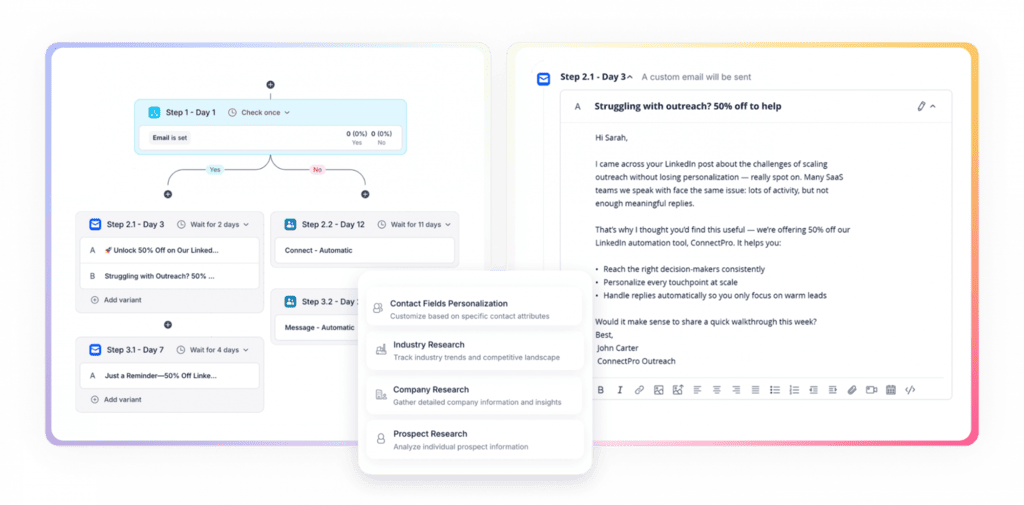
And while AI has transformed conversational intelligence tools, its perhaps greatest use in sales is with AI SDRs. Jason AI is Reply’s AI sales agent that finds your potential buyers, researches them, launches tailored outreach across email and LinkedIn, and then handles replies, answers objections, and books meetings on its own.