How AIOps Streamlines Sales in 2026: A Step-by-Step Guide
Vlad Oleksiienko17 Jan 2026
If you’re in sales, you must have heard of AIOps.
It’s the new tech that uses artificial intelligence, machine learning, big data, and automation to improve IT operations.
Most sales teams work across cloud, hybrid, and multi-cloud infrastructures. They deal with a complex stack of multiple tools, integrations, and APIs, and that complexity slows down sales.
That’s where AIOps can help. It connects fragmented systems, automates routine tasks, and predicts issues before they disrupt your sales pipeline. The ripple effect is faster, more efficient operations that support your sales success.
Platforms like ScienceLogic, Splunk ITSI, and eG Innovations are already powering this shift in the more general business sense, and then there are tools like Jason AI SDR — a dedicated sales AIOps solution.
Read on as we walk through how AIOps can help power your sales processes.
What technologies and tools make up AIOps for sales?
Several technologies power AIOps solutions, working together to simplify and improve business operations and workflows.
Below are the five foundational technologies for enterprise AIOps tools and what they do:
Real-time analytics: These processes large volumes of data instantly
Anomaly detection: Zeros in on unusual patterns that signal a problem
Machine learning models: These learn from past behavior to predict future events
Event correlation: Connects related alerts and data to show the bigger picture
Automation workflows: These trigger actions automatically
To support these functions, a good AIOps platform must have these key capabilities:
Data ingestion: These include logs, metrics, and traces
Predictive analytics: These help forecast issues before they occur
Root cause analysis: This helps find and fix problems faster
Multichannel automation: Ability to connect to email, CRM, messaging, and other channels
Alert prioritization: Ability to highlight critical issues
Real-time dashboards: These allow IT, sales, and business teams to analyze performance
With that out of the way, let’s break down some of the leading AIOps tools sales teams can consider in 2026.
Jason AI SDR
Jason AI is a next-generation sales AIOps platform designed for outbound automation. It acts as an autonomous AI sales agent that joins your team, learns everything about your business, and starts working around the clock.
For starters, Jason AI leverages its native lead database to continuously look for potential buyers that match your company’s ideal customer profile, adds them to your lead lists, and then researches their LinkedIn profiles, company websites, and other sources to add more context and data.
That uncovered data is then used to create hyper-personalized emails and LinkedIn messages, so each message is highly relevant and actually worth responding to.
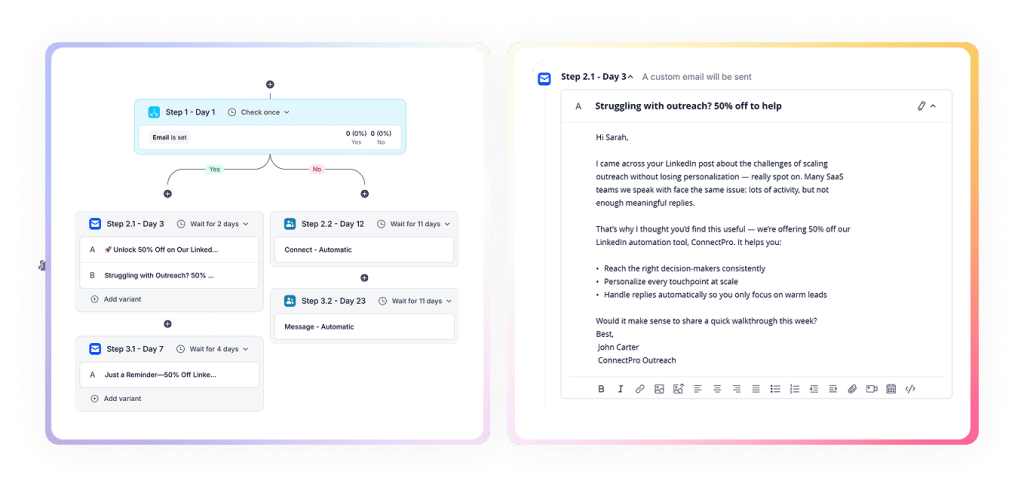
Each recipient gets their own unique conditional outreach sequence that adjusts the next step and message based on their real-time online behavior. So if one prospect hasn’t opened the initial email in 3 days, Jason automatically fires out a LinkedIn connection; once the connection request is accepted, Jason will craft a short personalized LinkedIn message to touch base and build rapport.
On top of that, Jason also reads, interprets, and responds to incoming replies by handling objections, answering questions, and booking meetings on your behalf. By keeping an eye out for key intent signals, Jason AI will always know the perfect time to send each message.
This way, after just a few minutes of setting up Jason AI, sales teams will be getting a steady flow of qualified leads, and they can now spend their time and effort on building connections, showing product demos, and closing deals.
What sets Jason apart is how its AI engine is pre-built to cover much of the entire sales process, without the need for multiple tools, integrations, and other technical stuff.
ScienceLogic
ScienceLogic is basically your central nervous system for AIOps and observability across cloud, on-prem, and all the hybrid chaos in between. Instead of staring at 10 different monitoring tools, you get one view that understands how everything is connected and what actually broke.
It uses AI-driven event correlation and dynamic topology mapping to collapse thousands of alerts into a few real issues and point you to the most likely root cause. From there, you can trigger automated remediation workflows or route the incident to the right owner with all the context attached — not just “server down” noise.
End result? Fewer surprise outages, faster recovery, and more uptime for revenue-critical systems like your CRM, dialers, and data pipelines — the stuff you really can’t afford to lose, especially mid-campaign.
Splunk ITSI
Splunk IT Service Intelligence (ITSI) basically takes all the data you’re already pumping into Splunk and adds an AIOps brain on top of it. Think service health instead of random metrics.
It pulls in logs, metrics, and traces, then correlates events and uses anomaly detection and predictive analytics to flag issues before users start screaming in Slack. On top of that, ITSI’s service health scores show you which services are actually at risk and how bad it is, so you focus on what matters to the business, not just whoever is loudest.
For sales orgs, that means keeping Salesforce, outreach tools, dialers, and comms platforms stable, with fewer “sorry, our system is down” moments and less time firefighting in the middle of peak hours.
eG Innovations
eG Innovations is a full-stack observability platform that doesn’t stop at pretty dashboards, it’s built to answer the “where’s the actual problem?” question end to end. From user experience down to apps, infra, virtualisation, and third-party services, everything sits in one view.
Their AIOps layer handles automatic dependency mapping, anomaly detection, and guided root-cause analysis, so teams don’t waste hours guessing if it’s the app, the network, the hypervisor, or that one third-party API acting up again.
The practical upside is that when your CRM, marketing automation, or calling tools slow to a crawl under load, you can quickly prove where the bottleneck really is and fix it before it turns into a full-blown sales outage.
PagerDuty
PagerDuty is the operations nerve center that turns scattered monitoring alerts into a coordinated incident response. Instead of every team getting spammed with the same noise, PagerDuty ingests signals, enriches them, groups related alerts, and only wakes up the right people when it actually matters.
On-call routing, escalations, and runbooks are all baked in, so once something breaks, the workflow is already defined — who gets paged, what they see, and what they do next. You standardize remediation instead of improvising every incident from scratch.
For sales ops, that means shorter downtime for core systems like your CRM, calling stack, and messaging platforms, and less revenue leaking away because the team can’t dial, log activity, or move deals forward.
Dynatrace
Dynatrace is an observability and AIOps platform that leans heavily into full-stack monitoring automation with an AI engine (Davis) that actually explains what’s going on instead of dumping raw data on you.
It continuously maps your entire environment, correlates signals across apps, infra, services, and user sessions, and then flags anomalies with a probable root cause in real time. From there, you can trigger automated remediation or optimization actions so the same incident doesn’t keep coming back every week.
For sales-critical systems — think heavy campaigns, big send days, or high-volume outreach — that translates into faster, more consistent performance and fewer “everything’s slow but we don’t know why” situations clogging up the pipeline.
The tools above aren’t the only ones worth your attention. Other honorable mentions include:
Vitria: Offer real-time analytics for event processing
InsightFinder: Focuses on root cause detection using unsupervised learning
Moogsoft: AIOps for alert reduction and faster remediation
OpsRamp: Offers infrastructure monitoring and service availability tracking
ZIF (Zero Incident Framework): A no-downtime platform using predictive AIOps
The first step to making the most of your AIOps solution is knowing how it can help beef up your sales process. That’s what we’ll cover next.
How does AIOps improve sales operations in practical terms?
AIOps improves sales operations by stabilizing systems, automating routine tasks, and giving teams real-time insights.
These improvements reduce downtime and speed up decision-making. As a result, sales reps can spend their time on strategies that move the needle.
AIOps platforms can also help monitor CRMs and communication platforms in the cloud, hybrid, and on-premises environments. This end-to-end monitoring helps teams avoid downtime and resolve issues faster. It also keeps your sales pipeline moving.
AIOps use cases
AIOps’ true strength lies in automation and insight. Below are some practical AIOps use cases that show how AIOps helps sales teams work faster and more efficiently:
Lead scoring automation → With AIOps, machine learning models can automatically score leads based on engagement signals, behaviors, and fit. With such insights, sales reps know exactly who to prioritize.
Ticket creation and routing → When something breaks, AIOps tools can automatically create a support ticket and assign it to the right person. With such precision, your team can resolve problems quickly.
Anomaly alerting → AIOps can detect unusual system behavior. For instance, if a CRM slows down or email response rates drop. The system then alerts the right team before it affects sales performance.
Follow-up triggers → AIOps automation can trigger follow-ups based on actions like link clicks, opened emails, or missed meetings. The automation ensures timely, personalized outreach without human intervention.
Fast response when sales tools fail → A malfunctioning CRM or payment processing system can cost you deals. AIOps automates incident responses, helping detect such issues early, sending alerts, and escalating when needed, resulting in faster resolution times and less disruption to the sales process.
Unified views for better decisions → AIOps platforms offer dashboards and role-based views. Hence, sales reps, IT teams, and leadership can see the data that’s important to them. This unified visibility breaks down silos between departments and enables faster, data-backed decisions.
Predictive analytics use cases
One of the most powerful features of AIOps is its predictive capabilities. Below are a few use cases highlighting this potential.
Sales forecasting → AIOps solutions can analyze pipeline activity, deal velocity, and engagement trends to predict revenue outcomes. As a result, teams can set realistic goals aligned with sales targets.
Churn prediction → AIOps can track signs of disengagement or inactivity. More importantly, it can flag deals or customers that are at risk of falling through. With these insights, teams can then take steps to re-engage before it’s too late.
Capacity planning → AIOps can help leaders identify when the team or tech stack may need to scale, especially during high-volume campaigns. This prevents bottlenecks and ensures consistent performance when demand spikes.
These predictive capabilities give leaders a 360-degree view of what’s coming next. That way, they can take action before problems escalate.
How Jason AI SDR fits into sales ops
Jason AI SDR brings AIOps automation directly into outbound sales.
It starts with a dynamic ICP (Ideal Customer Profile). Then it uses real-time data to build personalized multichannel outreach sequences.
In addition, Jason takes care of replies and automatically books meetings based on calendar availability. It also follows approval workflows when needed for the perfect balance of AI automation and real-time oversight.
To top it all off, Jason provides real-time insights so your teams can see what’s working and optimize fast. This functionality makes Jason a powerful tool in any enterprise AIOps setup focused on driving revenue through automation.
How to start implementing AIOps for sales: a step-by-step guide
You may still be wrapping your head around AIOps. However, getting started is easier than you think. You want to start small, focus on clear goals, and build on what works.
Below is a step-by-step guide to help sales and IT teams implement AIOps.
Step 1: Assess current sales processes and identify pain points
Start by identifying the weak spots in your sales operations. Some issues include manual lead scoring, delayed follow-ups, or poor pipeline visibility. These gaps are ideal targets for AIOps automation and insight.
Step 2: Map and integrate all sales-related IT and data sources
Next, integrate your systems. These include CRM tools, marketing automation platforms, communication channels, and analytics tools. The idea is to ensure AIOps platforms can ingest the right data and provide meaningful insights.
Step 3: Implement comprehensive monitoring and observability platforms
Monitoring is the foundation of any effective AIOps strategy. Tools like ScienceLogic, eG Innovations, and Splunk ITSI help track system health in the cloud and on-premises. For sales, this means keeping CRM performance, outreach systems, and integrations in check.
Step 4: Deploy machine learning models for predictive insights
With your systems integrated and monitored, it’s time to apply machine learning (ML). You can use ML to automate lead scoring, detect anomalies in response rates, or forecast deal closure timelines.
Jason AI is a perfect example here. Its engine supports real-time lead nurturingand smart engagement decisions. Jason also adapts to your ICP and continuously updates based on what’s working.
Step 5: Automate alerting, incident detection, and workflow triggers
With everything in place, it’s time to use AIOps automation to reduce delays. Set up triggers that alert the right people when a CRM slows down or a campaign underperforms. You can also fine-tune AI model selections (OpenAI, Claude, Gemini) to match your brand tone and outreach goals.
Step 6: Build role-based dashboards and reporting for actionable insights
Design dashboards that show the right data to the right people. Sales reps need pipeline metrics. Managers need campaign performance. IT teams need system uptime and alerts. Luckily, AIOps platforms support these custom views for better decision-making.
Step 7: Continuously optimize with feedback and fresh data
AIOps is not a one-time setup. You’ll need to retrain models, adjust playbooks, and refine alerts based on feedback.
What are real-world examples of AI Ops enhancing sales?
Companies are already using AIOps to improve operations. They’re also using it to reduce downtime and support business growth.
Many of these stories come from IT operations improvements. However, their outcomes also show measurable benefits that tie back to sales performance.
We’re talking about fewer outages, faster issue resolution, and better customer experiences. Below are concrete examples of how AIOps drive positive outcomes in real-world environments:
IBM: faster issue detection and resolution
IBM has long used AIOps to automate monitoring and anomaly detection. They also used it for root cause analysis in large IT environments. With this automation, teams can identify issues faster. Hence, they can act on them before they affect users or business outcomes.
For example, some IBM users report significant drops in false alerts. Others say they experience faster root cause findings. These benefits translate to improved system uptime and better customer satisfaction.
The two outcomes are key to supporting sales continuity and service reliability.
PagerDuty: reduced downtime and quicker response
PagerDuty uses AIOps to automate incident detection and response across large tech stacks. AIOps allows the company to filter noise, prioritize alerts, and orchestrate automated responses. As a result, teams can reduce incident resolution times.
They can also minimize service disruptions that could otherwise affect the tools sales teams depend on. Faster response means fewer lost leads due to system outages. It also implies smoother digital experiences for customers.
Dynatrace: real-time monitoring and performance gains
Dynatrace uses AI-driven monitoring and root cause analysis. It helps large enterprises maintain performance across complex hybrid systems.
Companies that use Dynatrace report fewer performance slowdowns. They also tell of faster detection of issues that could disrupt CRM or engagement platforms.
These operational improvements contribute to a more reliable sales tech stack. They also reduce lost productivity and increase team confidence in their tools.
Netflix: ensuring service reliability at scale
Netflix is not a classic sales organization. However, it uses practices like Chaos Engineering and automated resilience testing. These practices show another side of how AIOps-style approaches benefit business outcomes.
Netflix continuously tests failures in its systems to identify weaknesses and improve availability. These practices have helped it maintain a high-quality user experience for millions of subscribers worldwide.
This AIOps strategy, in turn, supports retention and revenue stability.
Before and after AIOps adoption metrics
The table below summarizes the results companies share after adopting an enterprise AIOps solution:
Metric
Before AIOps
After AIOps
Incident detection time
Slow, reactive
Faster, often real-time
Fix and recovery speed
Delays due to manual diagnosis
Quicker resolution through automated alerts
Alert volume and quality
High noise, many false positives
Lower noise, high-priority issues highlighted
System uptime
Frequent or unpredictable outages
Improved uptime and service reliability
Team collaboration
Disconnected tools and workflows
Shared dashboards and role-based visibility
Decision-making speed
Data silos and delays
Real-time insights and faster decisions
Companies may express these outcomes differently. However, one thing is undeniable — adding AIOps to your operations helps reduce disruptions and supports smoother customer and sales experiences.
Jason AI SDR real outcomes from sales teams
Sales teams also experience tangible outcomes with a sales-dedicated AI engine like Jason AI:
Lean sales teams save 5+ hours weekly by automating outreach and follow‑up tasks, freeing reps to focus on closing deals.
Some teams see up to a 2× increase in response rates by using personalized multichannel sequences.
Early adoption shows meeting bookings within the first 40 outreach emails, demonstrating fast pipeline impact.
Users reach global audiences through multichannel campaigns in over 50 languages, adapting to local markets.
In most cases, customer feedback highlights how easy Jason AI is to use.
A significant number of clients say it frees up reps’ time. Others talk about how much pipeline growth teams see after deployment.
In addition, many teams are upbeat about combining AI SDR automation with their existing sales and IT operations. They say it provides end‑to‑end visibility and control, amplifying the value of their AIOps investments.
What are the challenges in adopting AIOps?
Like any major tech shift, adopting AIOps comes with its fair share of challenges. That said, knowing what to expect can make the transition smoother and more successful.
Here are some of the most frequent problems companies encounter when rolling out AIOps tools in sales:
Data integration complexity
Sales systems are often spread across different channels. Think CRMs, email platforms, chat tools, and analytics dashboards. And, bringing all that data together in one place can be hard. Inconsistent formats, missing data, and disconnected tools affect implementation.
Alert fatigue
When everything generates an alert, teams may stop paying attention, even to the important ones. This “noise” can bury critical issues under a pile of non-urgent notifications. Worse still, it can reduce trust in the system.
Resistance to automation
Sales reps and managers may worry about losing control or being replaced. Therefore, automation can feel like a threat rather than a support tool. That’s especially true when there’s no clear communication,
False positives in anomaly detection
Early in implementation, AI models may misinterpret normal behavior as a problem. The scenario can create confusion and lead teams to ignore alerts. Or abandon the system in totality.
What are the solutions to make AIOps adoption easier?
Now that we’ve covered the most common pitfalls, here are the key solutions to an efficient and, most importantly, functional AIOps strategy adoption:
Phased adoption, starting small
Rather than trying to automate everything at once, start with a single use case. You can begin with lead scoring or alert prioritization. After that, show results quickly, then expand to more areas.
Comprehensive training and onboarding
Equip your team with training tailored to their role. Reps, managers, and IT should all understand how the system works. They should also know what to expect and where it adds value.
Tuning AI models for the sales context
Generic AI models don’t always fit the nuances of sales. Therefore, customizing alerts, response triggers, and scoring rules helps reduce false positives. It can also make the system more useful from the get-go.
How to measure the ROI and success of AIOps initiatives in sales?
Tracking ROI is a critical part of any AIOps rollout. That said, measuring success starts with defining the right KPIs. Start by tracking the following sales-relevant metrics that connect system performance to your actual business outcomes:
Uptime percentage: Track the availability of critical tools such as CRMs and outreach platforms. Higher uptime means fewer disruptions to sales activities. It also implies better customer experiences. The opposite is true.
Mean Time to Resolution (MTTR): Measure how quickly incidents are resolved after detection. Aim for faster resolutions because they reduce downtime.
Lead conversion rate improvements: Track whether better timing and automation lead to more deals closed. That way, you can validate if AIOps-driven insights are improving sales outcomes.
Sales cycle acceleration: Compare the time to close a deal before and after AIOps adoption. Shorter cycles indicate faster, more efficient pipeline performance.
Customer Satisfaction (CSAT) scores: Gauge the quality of customer interactions when systems are running smoothly. Satisfied customers are more likely to buy, renew, or refer others, and vice versa.
Be sure to involve sales and IT teams in reviewing results, as both teams’ input can help tweak alerts, retrain models, and surface missed insights to create a truly effective AIOps engine in the long run.
Wrapping up: Why AI ops adoption is key to sales success in 2026
Implementing AIOps could be one of the best things you can do to transform your sales process in 2026.
With AIOps, you can automate tasks, predict outcomes, and reduce downtime across systems. When executed correctly, it gives you an undeniable competitive edge.
So, if you’re a sales leader, you should start exploring AIOps platforms, and once you find a good solution, invest in the right training, and launch focused pilot programs.
If you want a sales-specific AI engine, Jason AI is a solid strategic tool for full-scale outbound automation, from finding the right buyers to closing deals.
When used together with traditional AIOps tools, it delivers a robust solution for sales efficiency and growth.
Subscribe to our blog to receive the latest updates
from
the world
of sales and marketing. Stay up to date.
We use cookies to enhance your browsing experience, serve personalised ads or content, and analyse our traffic. By clicking "Accept All", you consent to our use of cookies.