
12 Best Email Enrichment APIs in 2026 for Cold Outreach

12 Best Email Enrichment APIs in 2026 for Cold Outreach

Key takeaways:

  • Email enrichment finds and verifies an address; email validation only checks one you already have. Most bounce problems come from treating them as the same job.
  • Cheap per-credit pricing is misleading. Icypeas at roughly half a cent an email at volume and Findymail at $99 a month can produce the same real cost once match rates and billing-on-miss are accounted for.
  • Gmail requires bulk senders to keep spam complaints under 0.3%, so verification is a deliverability requirement rather than a nice-to-have.
  • Our own enrichment runs in the platform today, with the find-missing-email and phone endpoints landing in late August 2026, and only email validation callable via API right now.

Every cold email campaign has a hidden failure mode that shows up two days after launch: the bounce rate. You built a good list, wrote a decent sequence, and a fifth of it hit addresses that no longer exist or never did.

The scale of the problem is well measured. Validity’s 2025 Email Deliverability Benchmark found roughly one in six emails never reaches the inbox, with global inbox placement averaging about 84%. That is before you account for addresses that were simply wrong.

An email enrichment API attacks this at the source, which is why it sits so early in most outbound lead generation pipelines. Instead of buying a list and hoping, you pass what you know, a name and a domain or a LinkedIn URL, and get back an address the provider has verified as deliverable.

This guide ranks the 12 email enrichment APIs worth using in 2026, with verified pricing and a clear view of which ones charge you when they find nothing. We are one of the entries, listed first, and our section is explicit about what is callable today and what is not.

What Email Enrichment Actually Means

The terminology in this category is genuinely confusing, and vendors do not help.

Email finding takes an identity, typically a full name plus a company domain, and produces a candidate address, the same job AI email finders do in an interface. An email address enrichment API wraps that step in a callable endpoint.

Email verification takes an address and checks whether a mail server will accept it. Email enrichment usually means both together, plus the surrounding context: job title, employer, seniority and sometimes a phone number.

The practical distinction that matters is what happens on failure. A finder that returns an unverified guess has given you a bounce. A finder that verifies before returning has given you a usable address or an honest miss.

Most quality providers now verify inside the find operation and bill only on a verified result, which is why “pay only for valid emails” appears on so many pricing pages. Where a vendor does not say this, assume you are paying for guesses.

Catch-all domains complicate everything. These accept any address at the SMTP layer, so verification cannot confirm a specific mailbox exists. Some vendors charge for catch-all results, some exclude them, and this single policy difference can move your effective cost by 20% or more.

How We Selected These Email Enrichment API Providers

Every tool here has a live, verifiable pricing page and an API a developer can call on a self-serve plan. We fetched each price rather than repeating figures from other comparisons, because this category reprices frequently.

We paid particular attention to three commercial details that pricing pages tend to bury:

  • Whether a failed lookup consumes a credit
  • Whether catch-all addresses are billed as successes
  • Whether credits expire monthly, roll over, or never expire

We also excluded vendors whose API sits behind an enterprise tier when cheaper plans are advertised prominently, because that is a misleading buy for anyone shopping on price. Skrapp is the clearest example, with API access only on its $349 per month Enterprise plan.

Accuracy claims are all vendor-published in this category. No independent audit exists, so we attribute figures rather than presenting them as fact.

The 12 Best Email Enrichment APIs Compared

Pricing below is the cheapest plan that includes API access.

Tool Best for Key features Main limitation Pricing (from) Rating
Reply.io Enrichment feeding a sending platform Find missing emails, async validation, 1B+ contacts Find endpoints ship late August 2026 $49/month ★★★★★
FullEnrich Highest match rate on hard lists 25+ source waterfall, pay per verified result Personal emails cost 3 credits Free (1,000 credits) ★★★★★
Findymail Guaranteed low bounce rate Under 5% bounce guarantee with credit refunds $99 entry with no cheaper tier $99/month ★★★★☆
BetterContact Cheapest waterfall entry 20+ providers, no charge for catch-alls 200 credits on Starter is small $15/month ★★★★☆
Icypeas Lowest cost per email at scale Credits never expire, catch-all verification No published accuracy figure $19/month ★★★★☆
Prospeo Simple predictable budgeting Flat credit model, 75 free credits monthly Mobile numbers cost 10 credits Free (75 credits) ★★★★☆
Hunter Most generous no-result policy No charge on misses, repeat lookups counted once Smaller database than waterfalls Free (50 credits) ★★★★☆
LeadMagic Agent-driven enrichment MCP server and CLI on every plan Basic credits do not roll over $49/month ★★★★☆
Anymail Finder Paying only for delivered mail API on every plan, pay for delivered emails Vendor-published accuracy only $29/month ★★★★☆
Enrow One credit pool across all lookups No result, no charge, unlimited members on Pro No published accuracy or bounce SLA EUR15/month ★★★☆☆
Dropcontact GDPR-constrained outbound Algorithmic, no database, EU servers Euro pricing, lower raw coverage EUR79/month ★★★☆☆
ZeroBounce Validation-first list hygiene 99.6% claimed accuracy, credits never expire Email finding costs 20 credits each Free (100 credits) ★★★☆☆

Ratings weight verified-result billing and match rate over headline credit price. The entries below show the reasoning.

1. Reply.io
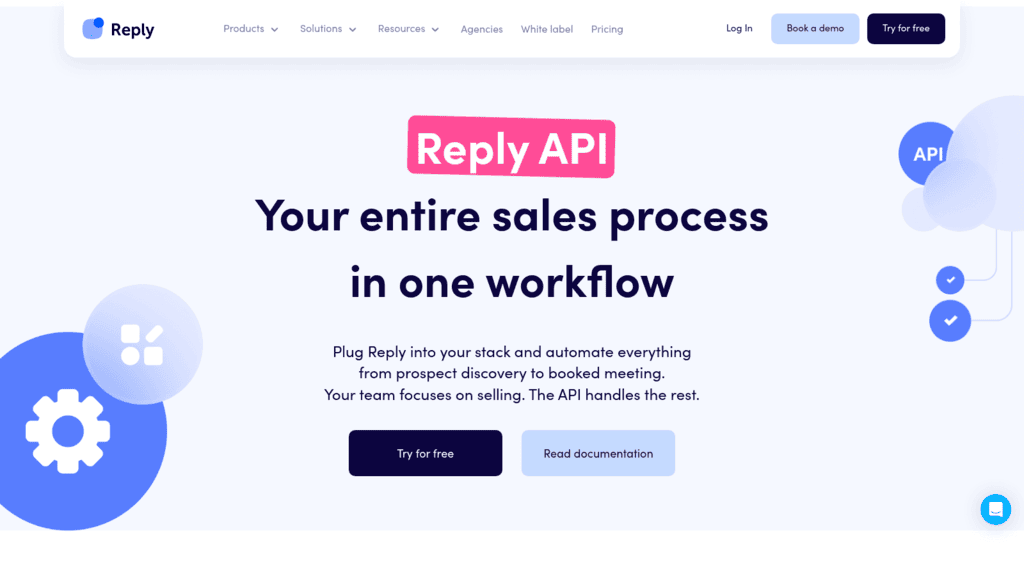
Reply.io as one of the best email enrichment apis

Best for: Enrichment feeding a sending platform

Overview: We are a sales engagement platform first, and email enrichment is a step inside it rather than a product we sell separately. That shapes both the argument for us and the caveat against us.

The case for: an address you find is worth nothing until it is sequenced. Our API covers finding, validating and sending behind one Bearer token, so there is no export step and no reconciliation between a data vendor and a sending tool.

The caveat, stated plainly: of the enrichment surface, only email validation is callable today, through async estimate and schedule endpoints. Find missing email addresses and find phone numbers are documented and dated for late August 2026.

The capability itself is not missing. Inside the app you can already select records and run an enrich-by-LinkedIn-URL pass that refreshes role, company and seniority. It is the endpoint, not the feature, that is pending.

Key features:

  • Find missing email addresses on partial contact records, arriving late August 2026
  • Async email validation through estimate and schedule endpoints, callable today
  • Enrich by email or LinkedIn URL to refresh title, employer and seniority
  • Live Data search across 1+ billion contacts, plus Findy for LinkedIn email lookups
  • Deliverability tooling covering warm-up, sending limits and domain configuration, with plan-level pricing by active contact
  • Rate limits of 100 requests per minute and 3,000 per hour, with 202 responses and background jobs for bulk work

Pricing: contact volume sets the price, not headcount. A thousand active contacts costs $49 a month annually or $59 monthly, and the same ladder reaches $899 at 100,000. Every plan carries 50 live data credits, while extra credits and email validation packages each begin at $20 a month.

Pros: finding, validating and sending behind one API key, 1+ billion contacts with strong US coverage, plan-level pricing so extra seats do not multiply the bill, deliverability tooling included rather than sold separately, async job handling for bulk validation

Cons: validation is the only piece you can call today, since find-email and find-phone do not arrive until late August 2026, and we sell this as part of a sending platform rather than as a data subscription, so a team that only wants addresses is buying more product than it needs

How to start using it:

  1. Take the 14-day trial and issue an API key from Settings > API Key.
  2. Test the credential against https://api.reply.io/v3/whoami before anything else.
  3. Schedule a validation job against 1,000 of your existing addresses and poll the background job for results.
  4. Compare the invalid rate against what your current provider reported, which is the fastest quality check available.
  5. Add the find-email endpoints to your pipeline when they ship in late August 2026.

Why it’s a good email enrichment API: the bounce problem and the sending problem are the same problem, and solving them in two disconnected systems is how teams end up with a burned domain and no idea which vendor caused it.

Final verdict: the right pick when enrichment exists to feed outbound you already run, with the honest caveat that full API parity arrives in late August 2026. If you need callable email-finding endpoints this month, FullEnrich or Hunter below will serve you better today.
2. FullEnrich

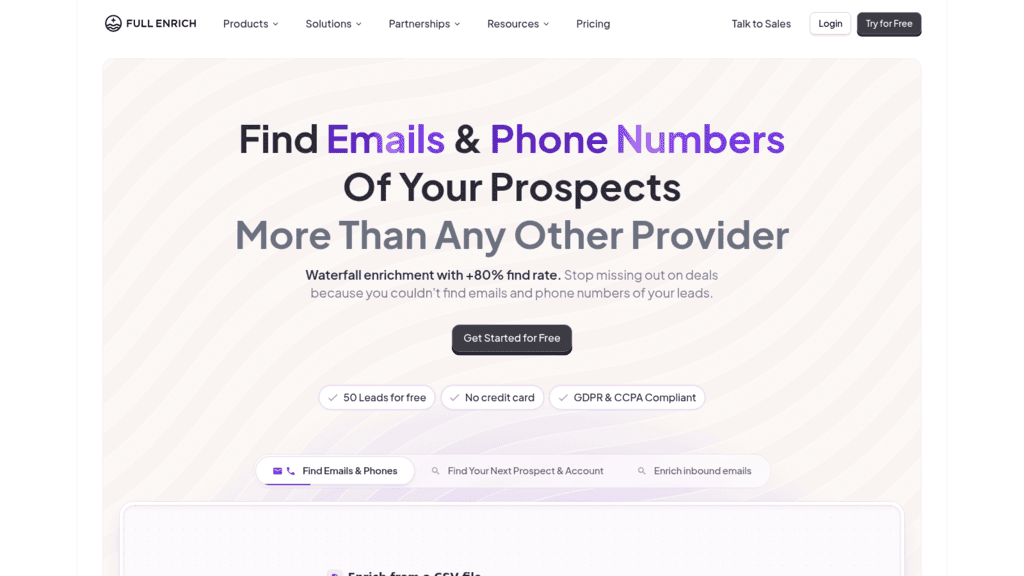
FullEnrich as one of the best email enrichment apis

Overview: FullEnrich queries more than 25 upstream providers in sequence until one returns a verified result. On lists that single-source vendors struggle with, this is usually the approach that moves the match rate.

Key features:

  • Waterfall enrichment across 25+ data sources for both email and mobile
  • Pay-per-verified-result billing, so misses cost nothing
  • Unlimited users and integrations on every plan

Pricing: the free tier gives 1,000 credits per month. Each field carries its own credit price, one for a work address, three for a personal one, ten for a mobile and one for a reverse lookup, so the field mix drives your bill far more than the headline rate does.

Pros: among the highest match rates available, no charge for failed lookups, a 1,000-credit free tier that is large enough for genuine evaluation

Cons: personal emails at 3 credits and mobiles at 10 make mixed workloads expensive, the variable credit model complicates forecasting, and output quality varies with whichever upstream provider answered

Why it’s a good email enrichment API: the hard 30% of any list is where campaigns are won, and a waterfall is the only reliable way to reach it.

Final verdict: the strongest match rate here, and the free tier makes it easy to prove before paying.

3. Findymail

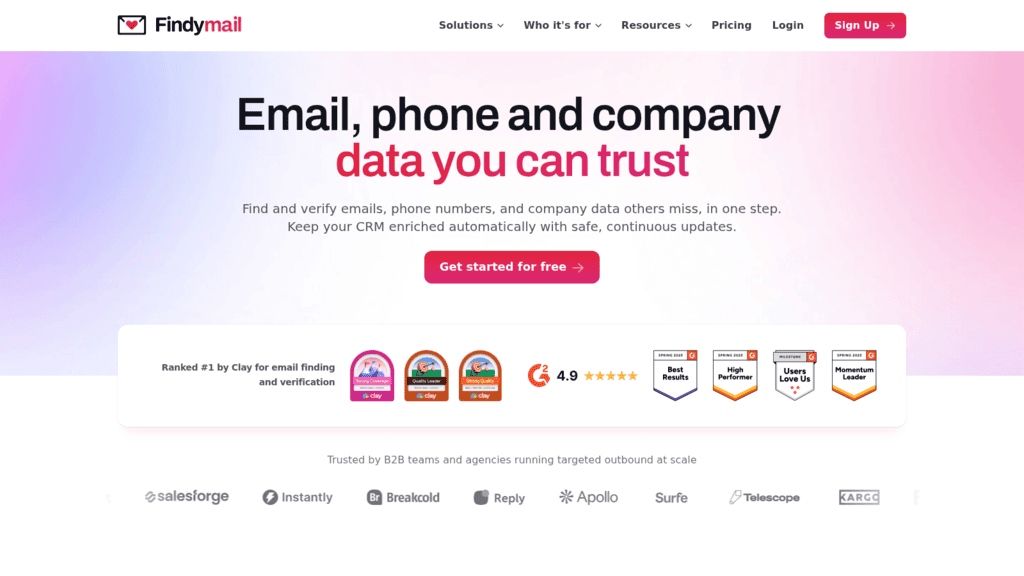
Findymail as one of the best email enrichment apis

Overview: Findymail is verification-first and backs it commercially. It guarantees a bounce rate under 5% and refunds credits if you exceed it, which is the strongest published guarantee in this category.

Key features:

  • A bounce-rate guarantee under 5%, with credit refunds if breached
  • Finder and verifier credits bundled in the same plan
  • Credit rollover up to twice the monthly allowance

Pricing: Starter is $99 per month for 5,000 finder credits plus 5,000 verifier credits, with annual billing giving two months free. An email costs 1 credit and a phone 10. Enterprise adds custom volume and auto-refill. A free account includes 10 credits.

Pros: the only real bounce-rate SLA in this list, no charge when nothing is found, credits roll over up to 2x

Cons: $99 is the entry point with no cheaper self-serve tier, the free account’s 10 credits barely allow a test, and phone lookups at 10 credits are costly

Why it’s a good email enrichment API: a contractual bounce ceiling shifts deliverability risk to the vendor, which is worth more than a few cents per credit if your domain reputation matters.

Final verdict: the safest choice for protecting a sending domain, priced accordingly.

4. BetterContact

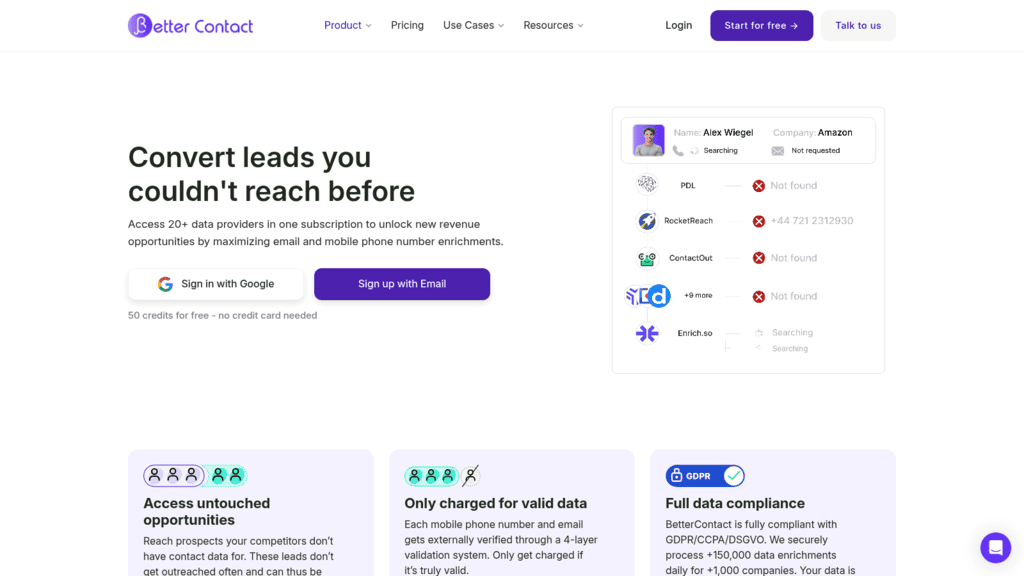
BetterContact as one of the best email enrichment apis

Overview: BetterContact runs a waterfall across more than 20 providers at the lowest entry price in this comparison, which makes it the cheapest way to test whether waterfall enrichment lifts your numbers.

Key features:

  • Waterfall across 20+ providers including RocketReach, Apollo, ContactOut, Hunter and Prospeo
  • Charges land only on verified hits, so misses and catch-alls cost nothing
  • Bring-your-own provider API keys on the enterprise tier

Pricing: Starter is $15 per month for 200 credits, about $0.075 per email credit. Pro opens at $49 a month and slides between 1,000 and 50,000 credits, working out near $0.049 per email credit at the bottom of that range. Enterprise starts at $799 per month. Signup includes 50 trial credits.

Pros: cheapest waterfall entry available, catch-alls explicitly not billed, transparent per-credit arithmetic

Cons: 200 credits on Starter is a thin pool for real testing, the jump to $799 for enterprise is abrupt, and results vary with the answering provider

Why it’s a good email enrichment API: at $15 you can benchmark a waterfall against your current single-source provider without a budget conversation.

Final verdict: the best value way into waterfall enrichment.

5. Icypeas

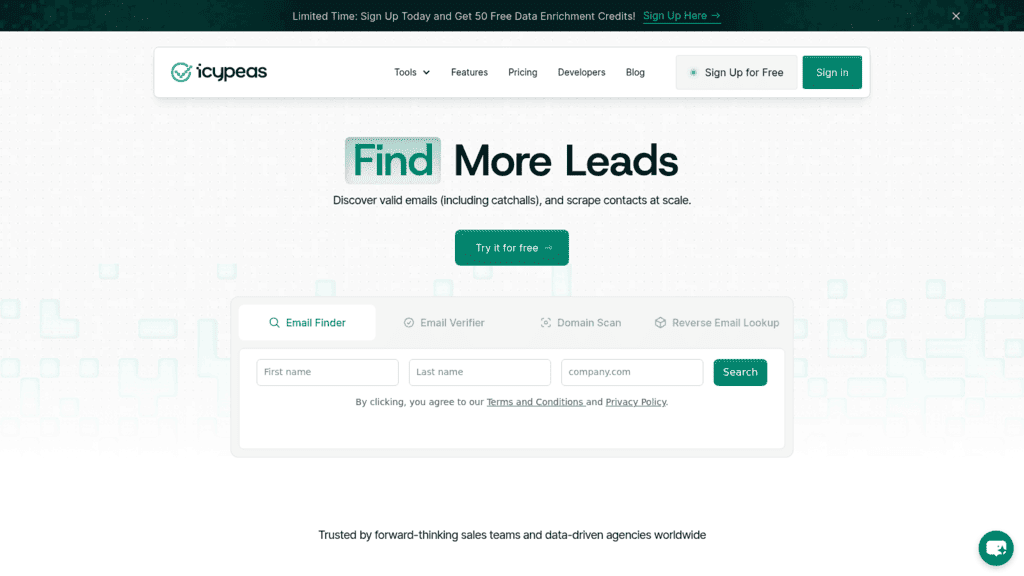
Icypeas as one of the best email enrichment apis

Overview: Icypeas competes almost entirely on unit cost and gets to roughly half a cent per email at volume. Its credit terms are unusually generous alongside that.

Key features:

  • Catch-all verification included on every tier
  • API access on all plans, plus Make, Zapier and n8n connectors
  • Credits that never expire and roll over indefinitely

Pricing: Basic is $19 per month for 1,000 credits, about $0.019 each. Premium is $39 for 4,000 credits at roughly $0.0097, Advanced $89 for 10,000 at about $0.0089, and Hypergrowth from $499 for 100,000 at roughly $0.005, scaling to $34,930 per month for 10 million. Annual billing saves 20%, which lowers each of those rates further.

Pros: the lowest cost per email at scale, credits never expire which removes monthly waste, API and catch-all verification on the cheapest tier

Cons: no published accuracy figure at all so quality is unverifiable before testing, a smaller brand with less third-party scrutiny, and catch-all handling still requires your own judgment

Why it’s a good email enrichment API: when volume is high and you already have a verification step, paying half a cent rather than five cents per address compounds quickly.

Final verdict: the cost leader, best used alongside your own quality checks.

6. Prospeo

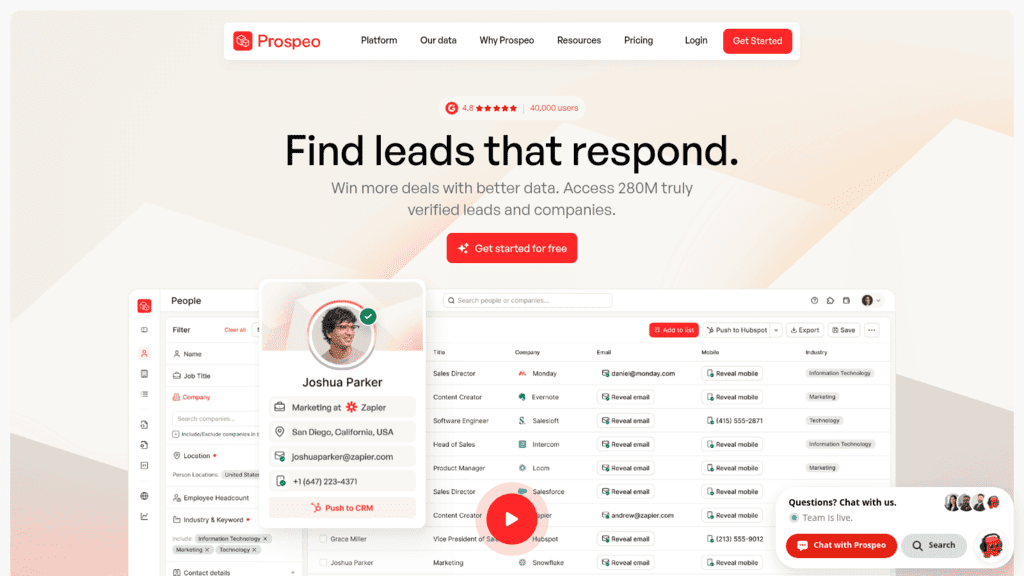
Prospeo as one of the best email enrichment apis

Overview: Prospeo keeps a single credit pool and a flat rate, with no waterfall routing or tiered field pricing. Simplicity is the product.

Key features:

  • Email finding from domain, name or LinkedIn URL
  • A flat model where an email costs 1 credit and a mobile costs 10
  • 75 free credits per month with API access included

Pricing: four paid steps sit above a free plan of 75 credits a month, $39 for 1,000 credits, $99 for 5,000, $199 for 20,000 and $369 for 50,000.

Pros: costs are the easiest here to forecast, API access from the free tier, no billing surprises

Cons: mobiles at 10 credits make phone work expensive, coverage trails waterfall providers on difficult lists, and no accuracy benchmark is published

Why it’s a good email enrichment API: when you need to tell someone exactly what 20,000 lookups will cost, this is the simplest answer in the list.

Final verdict: a solid single-source provider for teams that value predictability.

7. Hunter

Hunter as one of the best email enrichment apis

Overview: Hunter is the most established brand in email finding, with clean documentation and the most generous credit policy here. It trades raw coverage for reliability and clarity.

Key features:

  • Domain search, email finder and verifier endpoints
  • No charge when nothing is found or verification fails
  • Repeat lookups within a billing period counted only once

Pricing: the free tier gives 50 credits per month. Starter is $49 per month ($34 annually) for 2,000 credits, Growth $149 ($104) for 10,000 and Scale $299 ($209) for 25,000. Enterprise is custom. A finder call costs 1 credit per email found, bulk domain search 1 credit per up to 10 emails, and verification 0.5 credits. Team members are unlimited on every tier.

Pros: the most generous no-result policy available, deduplicated repeat lookups, unlimited seats on all plans, mature and well-documented API

Cons: the database is smaller than waterfall providers so match rates on obscure companies trail, per-credit pricing is higher than budget rivals, and there is no phone data

Why it’s a good email enrichment API: free misses plus deduplicated repeats means your billed credits map closely to actual value received, which is rarer than it should be.

Final verdict: the dependable default, especially for teams that want documentation and support alongside the data.

8. LeadMagic

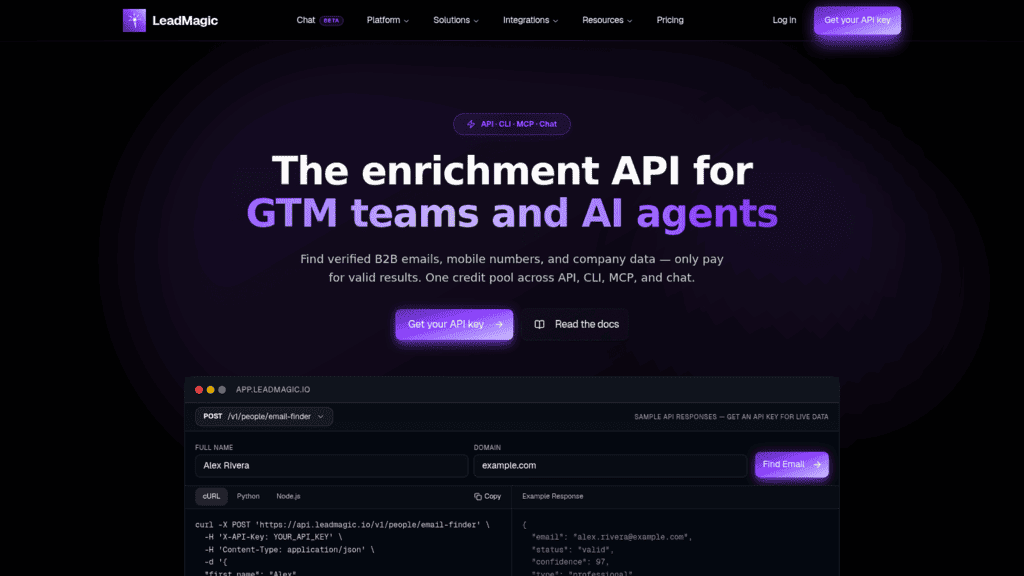
LeadMagic as one of the best email enrichment apis

Overview: LeadMagic is built for programmatic use, shipping API access, a CLI and an MCP server on every plan including the cheapest. Its per-endpoint credit pricing makes cost modeling unusually precise.

Key features:

  • Per-endpoint credit costs, so you can price a workflow before building it
  • An MCP server on every tier for agent-driven enrichment
  • A job-change detector for triggering re-enrichment

Pricing: Basic is $49 per month for 2,000 credits, then Essential $99 for 5,000, Growth $249 for 20,000, Professional $499 for 50,000 and Ultimate $849 for 100,000. An email finder call costs 1 credit, validation 0.25, a mobile 5 and job-change detection 3.

Pros: API, CLI and MCP on every tier, granular per-endpoint pricing, one shared credit pool across seats

Cons: Basic credits expire monthly with no rollover, the database is smaller than the licensed majors, and email validation at 0.25 credits is pricier than dedicated validators

Why it’s a good email enrichment API: validation at 0.25 credits alongside finding at 1 means you can verify inside the same pipeline without a second vendor.

Final verdict: the best fit when enrichment is called by code rather than configured in a dashboard.

9. Anymail Finder

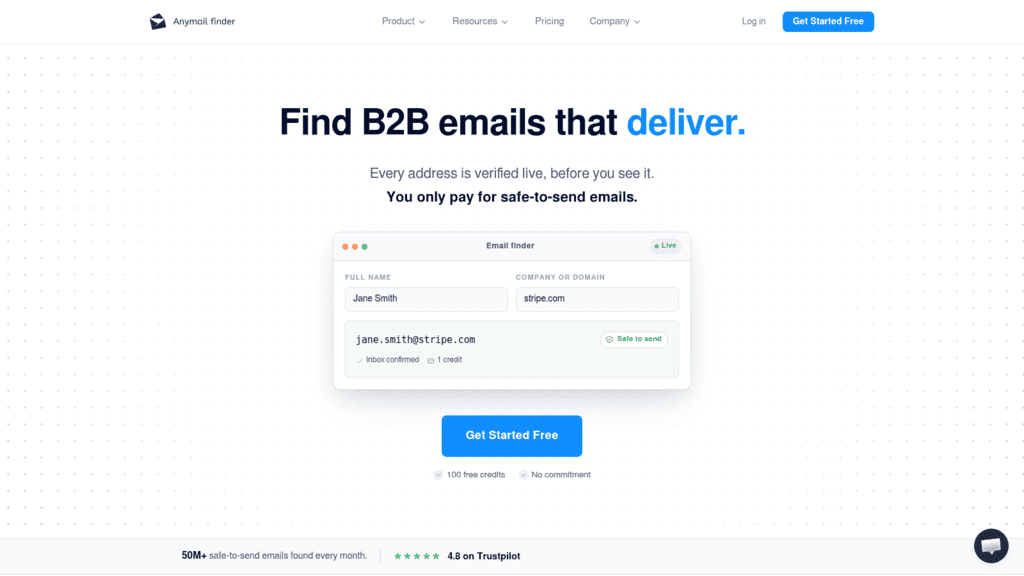
Anymail Finder as one of the best email enrichment apis

Overview: Anymail Finder verifies in real time against the recipient’s mail server and bills only for addresses it considers deliverable. API access is on every plan, and there are eight self-serve tiers to fit volume closely.

Key features:

  • Real-time verification against the recipient mail server before returning a result
  • API access on all eight self-serve plans
  • Pay only for emails classified as deliverable

Pricing: Starter is $29 per month for 400 credits, then Basic $49 for 1,000, Pro $89 for 2,000, Business $149 for 5,000, Best Value $199 for 10,000, Enterprise $299 for 25,000, Large $499 for 50,000 and Massive $799 for 100,000. Annual billing saves around 33%, and a free trial gives 100 credits over 14 days with no auto-charge.

Pros: eight tiers means you rarely overbuy, API on every plan, a 100-credit trial with no card trap

Cons: its accuracy and coverage figures are vendor-published rather than independently audited, no phone data, and per-credit costs are mid-range rather than cheap

Why it’s a good email enrichment API: the granular tiering suits teams whose volume sits awkwardly between the two-tier structures most competitors offer.

Final verdict: a straightforward, well-priced finder with unusually flexible plan sizing.

10. Enrow

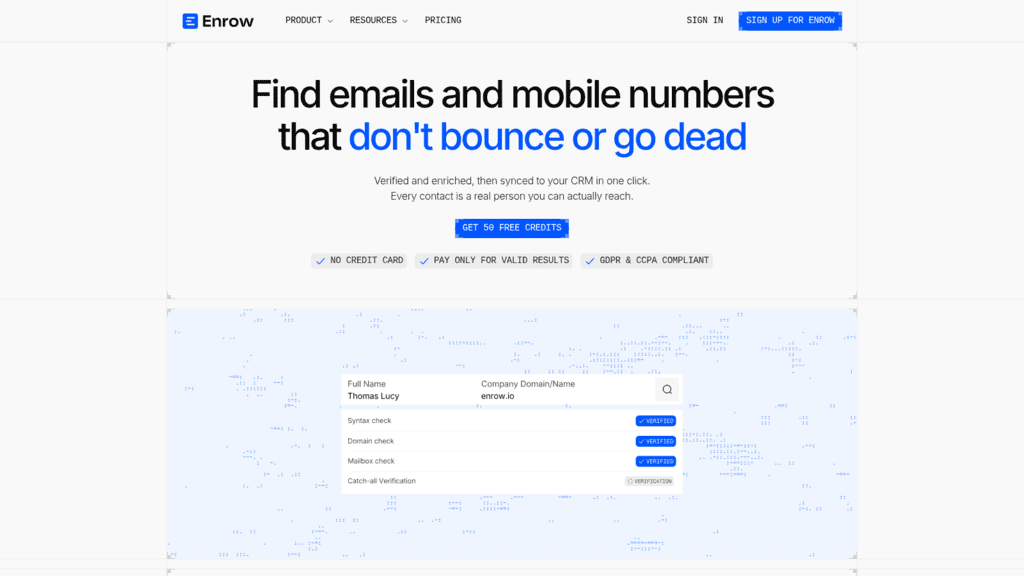
Enrow as one of the best email enrichment apis

Overview: Enrow pools email finding, phone finding, verification and catch-all checks into one credit balance, priced in euros. Its Pro tier includes unlimited team members, which is unusual at that price.

Key features:

  • A single credit pool covering finder, phone finder, verifier and catch-all verification
  • No result, no charge billing
  • Unlimited members from the Pro tier upward

Pricing: Start is EUR15 per month (EUR9 annually) for 1,000 credits and one member. Pro is EUR75 (EUR45 annually) for 10,000 credits with unlimited members, Scale EUR360 (EUR216) for 50,000, and Custom from EUR1,000 for unlimited credits. Annual billing saves 40%, and a free trial gives 50 credits with no card.

Pros: one pool across all operation types simplifies budgeting, unlimited seats from Pro, a steep 40% annual discount

Cons: no published accuracy or bounce SLA at all, euro pricing creates currency exposure for US teams, and it is a smaller vendor with limited third-party review

Why it’s a good email enrichment API: a unified credit pool means an unexpected mix of email and phone work does not blow a budget built on separate allowances.

Final verdict: good value and simple mechanics, held back by the absence of any published quality benchmark.

11. Dropcontact

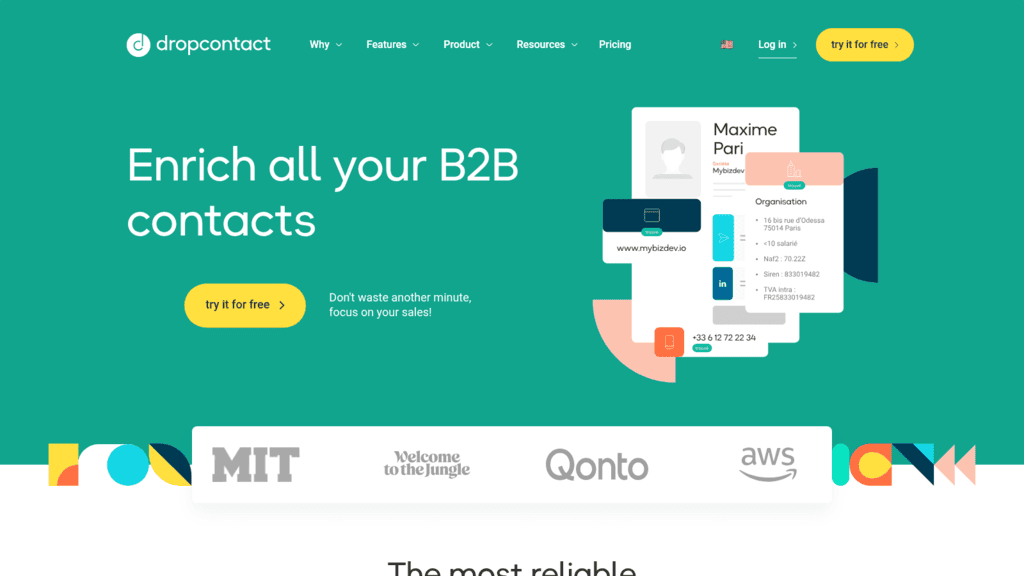
Dropcontact as one of the best email enrichment apis

Overview: Dropcontact holds no contact database at all, deriving and verifying addresses algorithmically. For EU-facing outbound that removes a whole category of compliance argument.

Key features:

  • Purely algorithmic derivation and verification with no stored personal database
  • EU servers with full GDPR alignment and no third-party data purchase
  • Job-change detection and company enrichment on the Growth tier

Pricing: Starter is EUR79 per month (EUR63.20 annually) for 500 credits. Growth is EUR120 (EUR96 annually) for 500 credits and adds LinkedIn enrichment, job classification, company enrichment and job-change detection. Enterprise starts from 200,000 credits per month. A trial gives 50 free credits.

Pros: the cleanest compliance position here, pay-on-success billing, unused Growth credits carry over

Cons: the highest entry price relative to credit volume in this list, raw coverage trails database-backed rivals, and euro pricing adds currency risk

Why it’s a good email enrichment API: when a prospect asks where you got their address, “we derived it, we did not buy it” is a materially better answer under GDPR.

Final verdict: the correct choice for EU outbound, accepting lower coverage and higher unit cost as the trade.

12. ZeroBounce

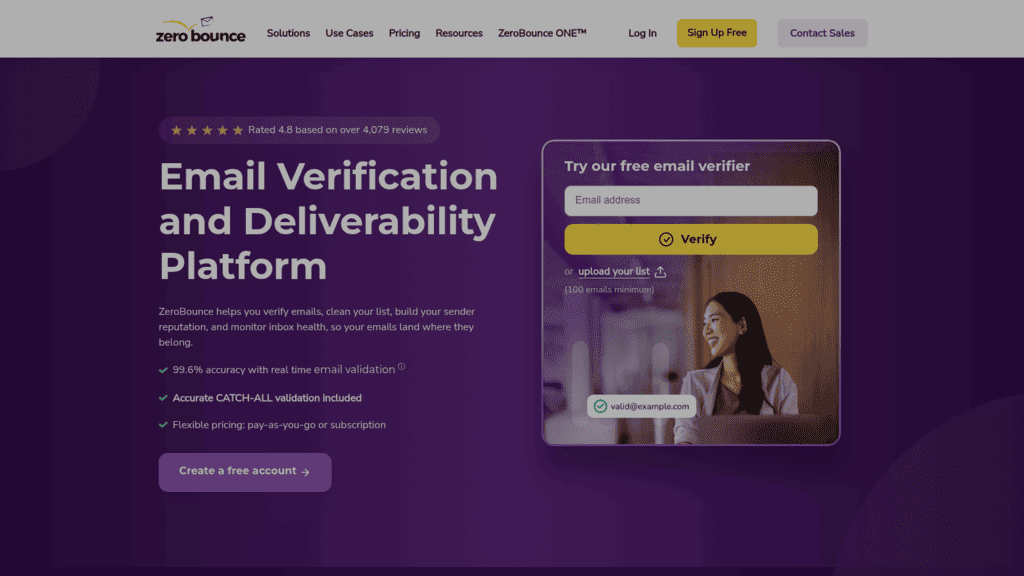
ZeroBounce as one of the best email enrichment apis

Overview: ZeroBounce approaches this from the hygiene side rather than the discovery side. Its validation is the core product and email finding is a secondary capability, which is reflected in the credit costs.

Key features:

  • Email validation with AI scoring and deliverability tooling
  • Inbox placement testing and blacklist monitoring
  • Credits that never expire, with unknown results not charged

Pricing: the freemium tier gives 100 validation credits per month plus 10 email-finder credits, refilling monthly. The ZeroBounce ONE subscription starts at $99 per month for 10,000 credits, with annual billing saving 20% and pay-as-you-go available with 15% off on autopay. Validation costs 1 credit, AI scoring 1, and the email finder 20 credits per successful query.

Pros: strong validation with a vendor-claimed 99.6% accuracy, credits never expire, deliverability tools included beyond validation

Cons: email finding at 20 credits per result is by far the most expensive discovery pricing here, the accuracy claim is vendor-published rather than audited, and it is the wrong shape if finding rather than cleaning is your main need

Why it’s a good email enrichment API: as the hygiene layer after a finder, rather than instead of one, it does a job the discovery-first tools do less well.

Final verdict: excellent for list cleaning, expensive for list building.

What Separates Cheap From Actually Cheap

Per-credit price is the least useful number on these pricing pages. Three other factors move real cost far more.

Match Rate on Your Segment

A provider strong on US tech companies can be weak on European manufacturers or local services, which is the same trap that catches B2B list building. Vendors publish total coverage, never the distribution across segments, so the number tells you nothing about your list.

Run the same 500 contacts through two or three providers and compare. The spread is routinely 20 to 30 percentage points, which dwarfs any per-credit difference between tiers.

Test your hardest segment, not your easiest, because the well-known companies match everywhere.

Whether a Miss Costs You

At a 60% match rate, a provider that bills for failures is effectively 67% more expensive than its sticker price. This single policy matters more than tier selection.

FullEnrich, BetterContact, Hunter, Findymail, Prospeo, Dropcontact and Enrow all bill only on results. Check the catch-all policy separately, because an unverifiable address billed as a success is a bounce you paid for.

Ask what happens on a repeat lookup too. Hunter counts repeats once per billing period, and most competitors charge again.

Deliverability Is the Real Constraint

Finding addresses is only worth doing if the sending survives, which is why deliverability belongs alongside your sales prospecting tools. Google’s sender guidelines require bulk senders of 5,000 or more messages a day to Gmail to authenticate with SPF, DKIM and DMARC, and to keep the Postmaster-reported spam rate below 0.3%.

That threshold is unforgiving. A list with a high invalid rate produces bounces and complaints that push you over it, and recovery takes weeks.

Verification before sending is therefore not an optional quality step. It is the difference between a domain that keeps working and one that quietly stops.

Email Enrichment API Pricing in Practice

The table below shows realistic monthly spend by workload rather than by advertised tier.

Workload Monthly lookups Realistic cost Best-fit picks
Testing an integration Under 1,000 $0 FullEnrich, Prospeo, Hunter free tiers
A single SDR 1,000 to 5,000 $15 to $49 BetterContact, Icypeas, Anymail Finder
A small outbound team 10,000 to 25,000 $89 to $199 Icypeas, Anymail Finder, Hunter
High-volume agency sending 50,000 to 100,000 $299 to $849 Icypeas Hypergrowth, LeadMagic Ultimate
Domain reputation critical Any $99+ Findymail, ZeroBounce
EU-only outbound Any EUR79 to EUR120 Dropcontact

Those bands assume work email lookups. Personal emails cost 3 credits at FullEnrich, and phone numbers cost 5 at LeadMagic and 10 at FullEnrich, Prospeo and Findymail, so a mixed workload can run several times higher on identical volume.

Free tiers are worth exhausting before you buy. FullEnrich’s 1,000 monthly credits are the most generous here by a wide margin, and Prospeo’s 75 and Hunter’s 50 are enough to compare match rates on a real sample.

Choosing an Email Enrichment API

The right answer depends on which failure mode you are most worried about, and how you plan to call it from your outbound API.

If your problem is match rate, pick FullEnrich for the best coverage or BetterContact to test the waterfall approach cheaply. If your problem is bounce rate and domain reputation, Findymail is the only vendor here putting a guarantee behind it, with ZeroBounce as the cleaning layer.

If your problem is unit cost at volume, Icypeas is the fast cheap email enrichment API answer at roughly half a cent per email, with non-expiring credits removing the usual monthly waste. If your problem is integration effort, LeadMagic ships MCP and a CLI on every tier.

If your problem is compliance, Dropcontact is the answer and the euro pricing is the price of it. If you want a dependable generalist with excellent documentation, Hunter remains the safe default.

Choose Reply.io if enrichment is one step in outbound you already run and you would rather hold one API key than three. Just be clear that today only validation is callable, and the find-email endpoints arrive in late August 2026.

One caution on match quality is worth repeating. In a thread on r/gtmengineering, a developer testing enrichment against his own email address found the tool returned a different person’s LinkedIn profile, matched on a similar name. That anecdote is a useful reminder that a returned result is not automatically a correct one, and that testing against records whose right answer you already know is the only way to catch it.

Frequently asked questions

What is the difference between email enrichment and email verification?

Enrichment finds an address you do not have, usually from a name and domain or a LinkedIn URL, and often returns job title and company alongside it. Verification checks whether an address you already hold will accept mail. Most quality providers verify inside the find operation and bill only on verified results, but the operations are priced separately at vendors like ZeroBounce and LeadMagic.

What is typical email enrichment API pricing?

Entry plans run from $15 per month at BetterContact and $19 at Icypeas up to $99 at Findymail, with per-email costs between roughly $0.005 and $0.075 depending on volume and vendor. The meaningful figure is cost per usable address, which folds in match rate and whether misses are billed, and that often differs sharply from the advertised per-credit rate.

Is there a genuinely free email enrichment API?

Yes, several worth using. FullEnrich provides 1,000 credits per month, which is the most generous here, Prospeo gives 75 monthly credits with API access, and Hunter offers 50. ZeroBounce includes 100 validation credits plus 10 finder credits monthly. These allowances are large enough to compare match rates on a real sample before committing.

What is the best email enrichment API 2026 has to offer?

For match rate, FullEnrich leads because it queries 25 or more sources until one verifies. For protecting a sending domain, Findymail is the only provider offering a bounce guarantee under 5% with credit refunds. For cost at scale, Icypeas is cheapest at roughly half a cent per email on its Hypergrowth tier. There is no single winner, because the categories optimize for different failures.

Do email enrichment API providers charge when they find nothing?

The better ones do not. FullEnrich, BetterContact, Hunter, Findymail, Prospeo, Dropcontact and Enrow all bill only on verified results, and Hunter additionally counts repeat lookups once per billing period. Always check the catch-all policy separately, since some vendors treat an unverifiable catch-all address as a billable success even though it may bounce.

Subscribe to our blog to receive the latest updates from the world of sales and marketing.
Stay up to date.

Related Articles

How to Run Deal Sourcing Outreach With udu and Reply.io

How to Run Deal Sourcing Outreach With udu and Reply.io

How to Run Deal Sourcing Outreach With udu and Reply.io
What’s New in Reply: Jason Gets Smarter, Your Inbox Goes Mobile, and More

What’s New in Reply: Jason Gets Smarter, Your Inbox Goes Mobile, and More

What’s New in Reply: Jason Gets Smarter, Your Inbox Goes Mobile, and More
11 Best Intent Data APIs in 2026 to Find Ready-to-Buy Leads

11 Best Intent Data APIs in 2026 to Find Ready-to-Buy Leads

11 Best Intent Data APIs in 2026 to Find Ready-to-Buy Leads