Best 12 Lusha Alternatives for Sales Teams in 2026
Svitlana Shuliak24 Apr 2026
Sales teams usually don’t start looking for Lusha alternatives because they suddenly want a completely different type of tool.
In most cases, the issue is a more practical one — perhaps they want broader data coverage, stronger buyer signals, better automation, or a smoother way to go from finding prospects to actually launching outreach and booking meetings.
And that’s exactly what this guide is about.
We’ll break down the best Lusha alternatives for sales teams in 2026, including pure data vendors, sales intelligence platform options, and platforms that combine prospecting with outbound execution.
What is Lusha?
Lusha is an established sales intelligence platform built to help sales and GTM teams find targeted B2B contacts, enrich records, build prospect lists, and work with intent signals inside one automated workflow.
It’s commonly used by SDRs, account executives, recruiters, and broader GTM teams that need fast access to business emails, phone numbers, company info, and LinkedIn prospecting. Lusha also leans into enrichment and broad API access, so it’s not just a simple one-off contact lookup tool.
A big reason Lusha is still widely used is pretty straightforward — it’s easy to understand and start using right away. Teams can get started quickly, use their native browser extension for web prospecting, and then layer in more advanced workflows over time.
For smaller and mid-sized teams that want verified B2B contact data without jumping straight into a much heavier stack, that’s a very reasonable starting point.
Why sales teams look for Lusha alternatives
Usually, most sales teams start looking for a Lusha alternative once their outbound motion becomes more demanding. That could be because they need more in-depth sales intelligence, or, more commonly, because they want to engage new contacts with AI-powered outreach campaigns with just a few clicks.
So as the sales process matures, teams often start comparing Lusha competitors based on how well they support the entire lead generation and outbound workflow, not just contact discovery.
Common reasons include:
Need for broader contact data coverage → some teams need more depth across industries, geographies, or job functions than a lighter database can offer.
Stronger buyer intent and signals → once teams move past static lists, they usually want job changes, account activity, and buyer intent data to prioritize outreach more effectively.
Better outbound automation → a lot of teams want one place for finding prospects and then engaging them through email, LinkedIn, and calls.
More scalable enrichment → RevOps teams and larger outbound orgs often need cleaner CRM sync, smoother data enrichment, and stronger API workflows.
Pricing fit at higher volume → once usage starts climbing, credit models and packaging suddenly start to matter a lot more.
Top 12 Lusha alternatives for sales teams in 2026
The list below covers the best Lusha alternatives across a few different buckets: contact data providers, all-in-one sales intelligence tools, intent-led platforms, and AI-powered outbound solutions.
Every platform here overlaps with Lusha in terms of prospecting, enrichment, or contact discovery, but each one approaches pipeline creation a little differently.
1. Reply.io
Reply.io is one of the strongest Lusha alternatives for sales teams that want more than a simple contact database. Instead of stopping at prospect discovery, Reply combines a native B2B lead database, AI personalization, multichannel outreach, and analytics under one roof.
For teams that are tired of stitching together separate sales prospecting tools for lead generation and execution, that alone is a big advantage.
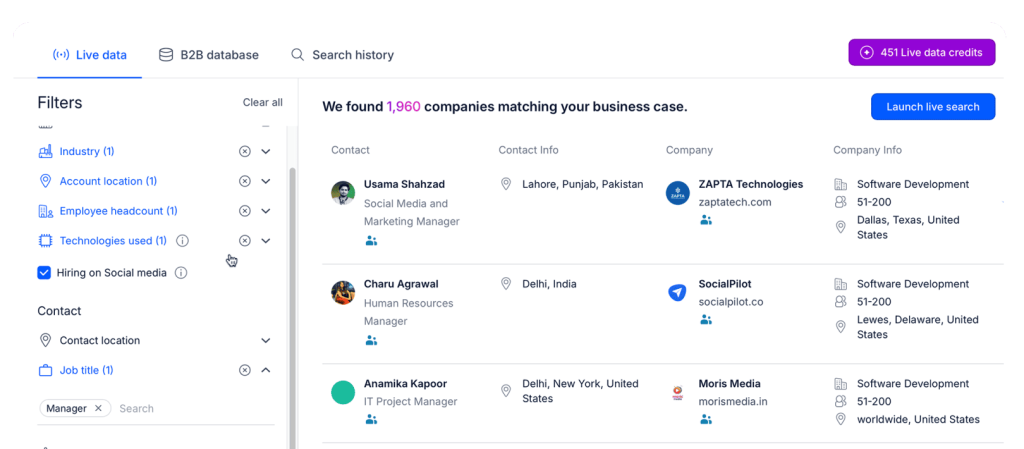
The database has over 1 billion prospects and accounts across regions and industries, offers real-time email validation, built-in enrichment from LinkedIn, company websites, and more, and advanced search filters to narrow down the most relevant potential buyers:
For SDR teams, agencies, and outbound-heavy revenue firms, the real differentiator is the unified workflow.
Reply makes more sense than many data-first Lusha competitors when the goal isn’t just to find targeted leads, but to also enrich them with individual and company data, and then have AI use that context to personalize emails and LinkedIn messages across coordinated sequences.
Each sequence is tailored to each unique lead, with Reply’s AI engine adjusting the messaging, timing, and channel based on real-time prospect behavior.
B2B database with built-in email validation and enrichment
AI personalization
Analytics and reporting
CRM and API integrations
Email deliverability and warm-up
Pricing: Reply offers a 14-day free trial, with Email Volume plans starting at $49/month, Multichannel plans starting at $89/month, and dedicated Agency plans starting at $210/month.
For those interested, here’s a more detailed overview of Reply.io and its full set of features.
2. Jason AI
Jason AI is another solid Lusha alternative for teams that are really looking for a fully autonomous AI sales agent to run the entire lead generation and outreach process for them.
After learning everything about your business, Jason AI starts finding targeted buyers, personalizes emails and LinkedIn messages, creates tailored multichannel sequences, and even handles replies and books meetings on your behalf.
That’s a very different use case from classic contact-data tools, but let’s be honest, it maps pretty closely to what many teams actually need once it comes to scaling sales operations.
Jason AI is especially useful for lean sales teams, founders, and GTM teams that want to scale prospecting without scaling headcount at the same pace. It’s not the best Lusha alternative for companies that just want simple prospect data for one-off email lookups. It’s much more suited for teams that want an AI agent helping run outbound from end to end.
Key features:
Real-time B2B contacts
AI-generated ICP and targeting support
AI personalization
Autopilot and copilot modes
Multichannel automation
Reply handling and meeting booking
Multilingual outreach
Pricing: Jason AI pricing starts at $500 per month, offering the full set of features.
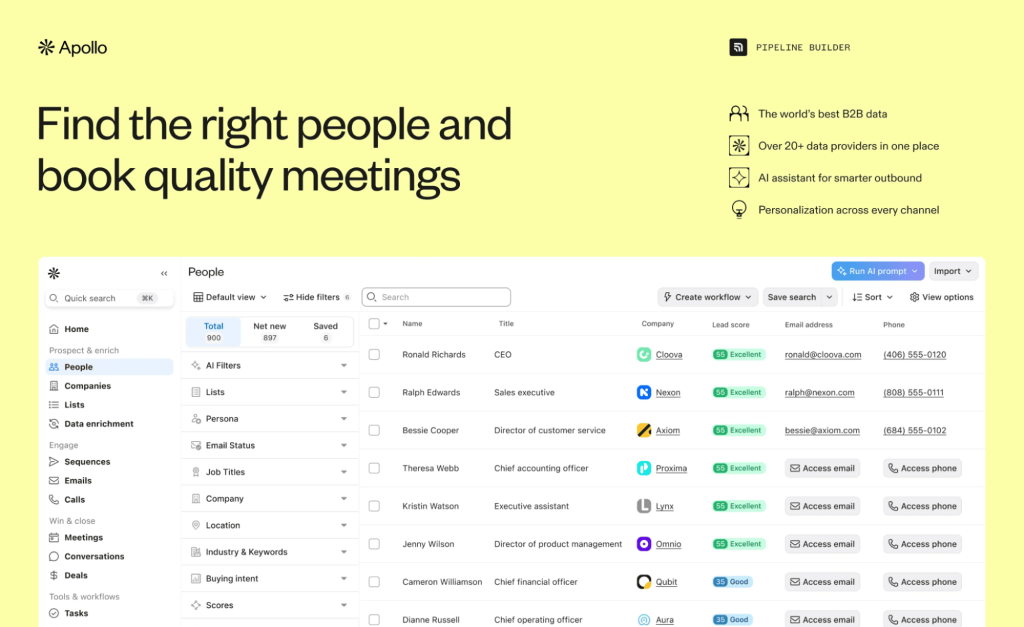
Apollo is one of the most widely used Lusha alternatives because it combines a large B2B database with outreach, enrichment, and workflow features in one platform. It works especially well for teams that want more than contact discovery but don’t necessarily need a more heavy, feature-packed platform. It’s a strong fit for startups, SDR teams, and mid-market companies building a scalable outbound motion.
One of Apollo’s biggest strengths is its breadth. Teams can use it for prospect discovery, list building, data enrichment, and built-in email outreach inside the same product. Compared to Lusha, it often feels like a more complete all-in-one option, especially for teams that want both data and execution under one roof.
Key features:
B2B contact database
Sales engagement and email outreach
Enrichment and integrations
API access on custom plans
Pricing: Apollo offers a Free plan, while paid plans start at $49 per user per month when billed annually, and offers a limited free plan to get a feel for the product.
4. ZoomInfo
ZoomInfo is one of the strongest Lusha competitors for enterprise sales teams that need scale, deeper workflows, stronger data enrichment, and a broader GTM intelligence layer. While Lusha is often the simpler choice for everyday prospecting, ZoomInfo is usually considered by larger companies that want a more comprehensive platform supporting sales, marketing, and RevOps together.
It is built for account prioritization, data enrichment, workflow automation, and more mature outbound or account-based motions. That’s where most of its value comes from.
The tradeoff, of course, is size and cost. Smaller teams that mostly need direct dials, verified emails, and fast prospecting may find it heavier than necessary for their day-to-day work.
Key features:
Contact and company database
Enrichment workflows
Intent and GTM intelligence
CRM and sales workflow support
Pricing:ZoomInfo pricing isn’t publicly available, but most packages are on the premium side and are handled through sales teams.
5. Cognism
Cognism is one of those Lusha alternatives teams usually look at when simple contact lookup is no longer enough. It gives you reliable sales intelligence, phone-verified numbers, and a more structured prospecting setup overall. It also tends to come up for companies that care about compliance, need solid international coverage, and want a stronger data layer behind outbound.
Against Lusha, Cognism usually fits better for mid-market and enterprise teams where contact quality matters a lot more, especially if mobile numbers and global prospecting are part of the day-to-day motion.
The downside is the pricing. It is sold through custom packages, so for smaller teams, it is not always easy to judge the real cost or stack it up side by side with more self-serve tools.
Key features:
Contact and company data
Phone-verified contacts
Prospecting packages
CRM enrichment and data-as-a-service options
Pricing: Cognism uses quote-based pricing, with Standard and Pro-style packaging tailored to team size, usage, and product needs.
6. UpLead
UpLead is another solid Lusha alternative for SMB and mid-market teams that mostly care about two things: accurate contact data and pricing that is easy to understand. That’s really the appeal here — you get verified emails, mobile numbers, enrichment, and even buyer intent data on higher plans, without ending up inside a platform that feels bigger and more complicated than you actually need.
That simplicity makes it a solid option for lean outbound teams, agencies, and businesses that mainly want clean data, quick list building, and a predictable prospecting workflow.
Its main limitation is that it’s much more lightweight and only focused on data. Teams that want multichannel outreach, AI personalization, or a fuller outbound engine will probably need to integrate another platform alongside it.
Key features:
Verified emails and mobile numbers
Data enrichment
Buyer intent on higher plans
Chrome extension, CRM sync, and API options
Pricing: UpLead’s paid plans start at $99 per month for Essentials, $199 per month for Plus, and a free 7-day trial.
7. Seamless.ai
Seamless.ai is a legitimate Lusha competitor for teams that prioritize high-volume prospecting, enrichment, and intent-driven workflows. It positions itself as AI sales software and a business leads platform, which makes it more relevant for teams looking for a larger lead generation engine rather than a simple extension-led contact finder.
The platform is best suited to SDR teams and organizations that prospect aggressively and want features around mass lead discovery, enrichment, and lightweight outreach support inside one ecosystem.
The tradeoff is that pricing isn’t transparent, and the buying experience is more sales-led than many lighter self-serve tools. Still, for companies focused on scale and steady prospect flow, Seamless.AI remains a relevant option in this space.
Key features:
Prospector
Buyer intent
Job change and enrichment workflows
Lightweight email and outreach automation
Pricing: Seamless.AI offers a free plan with limited credits, while paid pricing is customized based on usage and team needs.
8. LeadIQ
LeadIQ is another good Lusha alternative for reps who “live” in LinkedIn and want a faster way to capture contacts, monitor sales triggers, enrich CRM records, and generate outreach with AI. It’s especially useful for SDR workflows where speed and usability matter more than building a heavyweight enterprise data operation.
One of LeadIQ’s biggest strengths is how naturally it fits into the daily routine of most outbound reps. It helps them identify prospects, quickly capture contact data, and move those leads into their CRM or outreach tools with very little friction.
Its main limitation is that it’s better suited to small-scale sales workflows than deep governance or enterprise intelligence use cases. But for teams looking for an efficient LinkedIn prospecting tool and a credible Lusha competitor, it brings very real day-to-day value.
Key features:
Contact finding
Sales trigger tracking
CRM enrichment
AI email generation
Pricing: LeadIQ offers a limited Free plan, with paid plans starting at around $37 per user per month, while enterprise pricing is custom.
9. Hunter.io
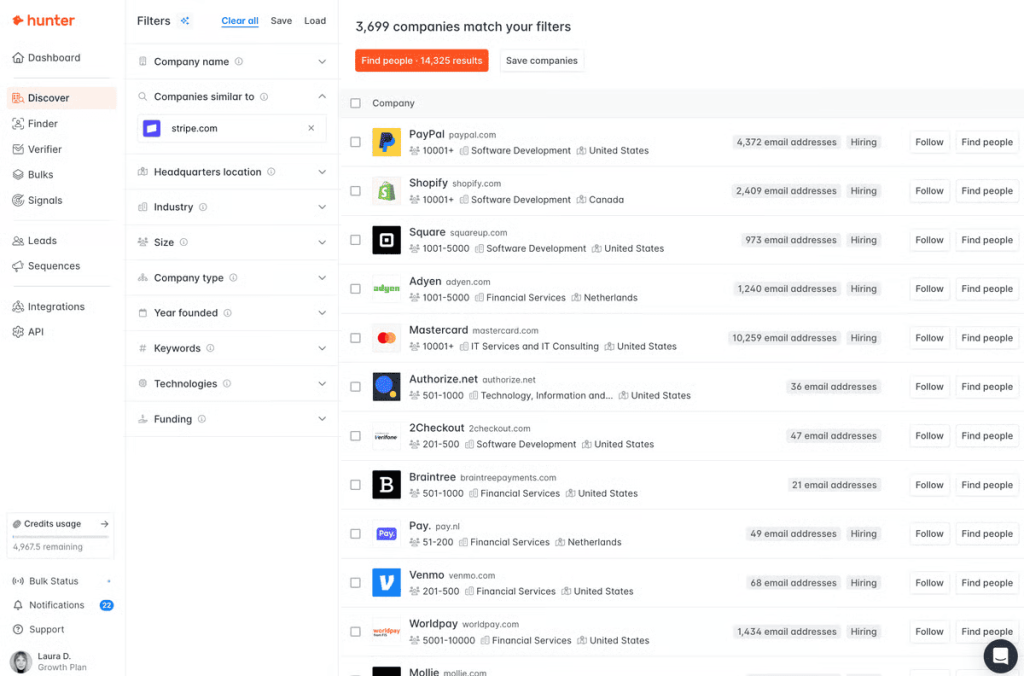
Hunter is one of the better Lusha alternatives for lightweight prospecting and email outreach. It combines email finding, verification, a solid B2B database, intent signals, sequences, and API access, but its center of gravity is still simple — automated email outreach rather than a full GTM intelligence stack.
That makes it especially useful for teams whose outbound workflow is built exclusively around cold emails. So if the main need is finding professional email addresses, verifying them, and running lightweight email campaigns, Hunter is often a better choice than most broader sales intelligence platforms.
Its biggest limitation is that if your team also needs LinkedIn automation, multichannel workflows, and AI personalization at scale, more consolidated platforms will be the better pick.
Key features:
Email Finder and Domain Search
Email Verifier
Discover database and signals
Sequences and API access
Pricing: Hunter offers a Free plan, with paid plans starting at around $35 per month, with a limited freemium plan available to test the product before committing.
10. Kaspr
Kaspr is another Lusha alternative for LinkedIn-first prospecting. It’s mainly built around a solid Chrome extension and web app that help sales reps pull B2B contact data quickly from LinkedIn, Sales Navigator, groups, and events.
Kaspr is designed for reps and smaller teams that want a fast yet practical way to capture contact details, enrich lead lists, and export data into their integrated CRM and/or outreach tools. Compared to Lusha, it follows a fairly similar motion, but often appeals to teams that want a more simple, web-based setup with easy onboarding and a more LinkedIn-centric experience.
Its limitation is, of course, that it’s narrower than a full sales engagement suite or sales intelligence platform, like some other tools on our list.
Key features:
Chrome extension
LinkedIn and Sales Navigator support
Shared credits and team workflows
Enrichment and export capabilities
Pricing: Kaspr offers a limited Free plan with just 15 email credits, with paid plans starting at $49 per user per month when paid annually.
11. ContactOut
ContactOut is another credible Lusha competitor for teams that want an extension-led prospecting workflow with email and phone discovery. Its core use case is pretty simple — find prospects on LinkedIn and company sites, enrich those records with additional context, and move them into campaigns fast.
Compared with Lusha, ContactOut fits a similar discovery-focused workflow, but it also adds campaign support and a broader search experience through both its platform and extension. It’s especially valuable for teams and individual users who want fast prospect lookup with minimal friction and rely heavily on LinkedIn for sourcing.
Its limitation, just like with most other lightweight alternatives, is that it doesn’t offer full outbound execution, deeper sales intelligence, or AI personalization and outreach features.
Key features:
Search portal and neat Chrome extension
Email and phone lookup
Campaign support
API at the enterprise level
Pricing: ContactOut has a Free plan (though with just 5 exports and 5 emails per day), paid plans start at $49 per month, while team and API access are custom-priced.
12. 6sense
6sense is the final Lusha alternative on this list, and it is a strong option for teams that care more about account prioritization than static contact data alone. Instead of focusing mainly on contact discovery, 6sense helps sales teams figure out which accounts are actually likely to buy, understand why they are showing buying intent, surface the right decision-makers inside those companies, and reach out at the right time.
It’s especially well-suited to account-based sales motions, larger B2B organizations, and teams that want to combine sales intelligence, prioritization, and signal-driven outreach.
The drawback here is that it may feel too advanced for smaller teams that just need verified contact emails and direct dials, yet not feature-packed enough for teams needing an AI-powered outreach engine under one roof.
Key features:
Company and people search
Sales alerts
List builder
Chrome extension
Buyer-data-driven prioritization
Pricing: 6sense offers a Free plan with 50 data credits per month, while its broader Sales Intelligence solution is sold through custom pricing (you’ll have to talk to their sales team).
Which Lusha alternative is best for your use case?
There’s no single best Lusha alternative for every sales team, as it really comes down to what problem you are trying to solve. For some teams, it’s simply quality data at scale. For others, it may be outbound execution, account prioritization, LinkedIn prospecting, or simply reducing manual work with AI.
That’s why the best buying decision usually comes down to matching the tool to your exact workflow(s), not just comparing database size or headline pricing.
Here’s the practical breakdown:
Best all-in-one for outbound execution →Reply.io is a strong fit for teams that want quality prospect and company data plus AI-powered multichannel outreach in one platform.
Best AI SDR option → for teams who want an AI agent to find targeted leads, enrich them, and launch outreach on your behalf, Jason AI is one of the best solutions on the market.
Best for enterprise sales intelligence → ZoomInfo is better suited to larger GTM teams that need scale, enrichment, and process depth.
Best transparent data-first option for SMBs → UpLead is a good fit for teams that simply want clean data and predictable pricing.
Best for LinkedIn prospecting: Reply.io, LeadIQ, Kaspr, and ContactOut all work well for teams that do heavy LinkedIn prospecting.
Best for intent-led account prioritization: 6sense is the strongest option for teams building an account-based, signal-driven motion.
Wrapping up
The best Lusha alternatives in 2026 do a lot more than simply reveal contact data.
They help sales teams enrich records, prioritize the right accounts, automate outreach, and generate more sales pipeline with less manual work.
That’s exactly why AI software has become such an important part of virtually all modern sales workflows. It helps teams move faster, personalize at scale, and spend more time actually building client relationships and closing deals.
If you want a platform that combines B2B contact data with AI-powered outreach across email, LinkedIn, calls, and more — Reply.io is a great place to start. And if you want an AI sales agent that can take on most of the lead gen and outreach motion for you, Jason AI is the natural next step.
Subscribe to our blog to receive the latest updates
from
the world
of sales and marketing. Stay up to date.
We use cookies to enhance your browsing experience, serve personalised ads or content, and analyse our traffic. By clicking "Accept All", you consent to our use of cookies.