
White Label LinkedIn Lead Generation w/ AI SDRs in 2026

White Label LinkedIn Lead Generation w/ AI SDRs in 2026

For years, white label LinkedIn lead generation meant putting your logo on a tool that simply fires connection requests and templated messages. And to be honest, that was worth the money back when sending at scale was the hard part.

That’s no longer the case, however. Sending messages is the easy part, but what your clients really pay for now is everything around it: the targeting, the research, the personalization, and the coordination with other channels.

This article covers what a LinkedIn lead gen offer is made of in 2026, when white labeling one beats licensing software, why the AI SDR is the layer worth putting your name on, and how the whole thing runs end to end.

LinkedIn lead generation in 2026: where it sits in the sales motion

LinkedIn stopped being a standalone channel quite some time ago. It’s the identity layer of B2B outbound now, the place a prospect often goes to check whether the person emailing them is real and credible. That’s why we always recommend having your LinkedIn touchpoints next to emails in coordinated sequences.

Strip an offer down and you get five building blocks:

  1. Targeting → who counts as a lead, and who quietly doesn’t.
  2. Data and enrichment → verified contacts, plus enough researched context to say something specific and relevant.
  3. Sequenced touches → the actual choreography across LinkedIn and email.
  4. Reply handling → questions, objections, “not right now,” and follow-ups
  5. Meetings and reporting → booked calls, and proof of where they came from.

The touchpoints themselves are more varied than many teams use in their lead gen process. While many software tools can automate connection requests and messaging, an AI sales agent like Jason AI can also view profiles, post comments, leave voice notes, and send InMail messages. It also continuously finds targeted leads, researches them, and adjusts the touchpoint, timing, and messaging in real time based on each lead’s engagement levels.

Touch What it signals Where it fits The catch
Profile view Low-cost curiosity, lands in their notifications Before the connection request Roughly 80-150 views a day on a free account before throttling
Post comment Public interest, visible to their whole network Warming a target days before you ask Only works when you have something worth saying
Connection request A direct ask for access The opening step for 2nd and 3rd degree About 100 a week on a rolling window
Direct message The actual conversation Once the request is accepted 10-30 a day to new connections
Voice note Effort, and a pattern break Mid-sequence, after a message goes quiet Reads as personal, so it can’t be templated
InMail Paid access without connecting When the request is ignored 50 credits a month on Sales Navigator Core

Those limits are the reason LinkedIn punishes bad lists harder than email providers do. LinkedIn caps invitations at roughly 100 per week on a rolling seven-day window, per Overloop’s 2026 breakdown, with restrictions running 24 to 72 hours when you push it. You can’t buy your way out with volume, but you sure can make each of those 100 count.

This is another reason why layered sequences beat single shots so decisively. Another Overloop benchmark assessed Belkins’ data across 20 million outreach attempts, and found that single-action campaigns had a 1.07% reply rate against 5.26% for campaigns running five nurturing actions, while a message paired with a profile had 11.87%.

How to Dominate Linkedin in 2026

Stop guessing what works on LinkedIn.

Start posting content that brings you real leads.

Inside, you’ll learn how to:

→ Turn LinkedIn posts into real sales conversations
→ Position yourself as the go-to expert in your niche
→ Write content that people save, share, and DM you about
→ Build a simple system that turns posts into meetings

White label LinkedIn lead generation: buying the software vs owning the platform

There are two ways to put this capability into your business. You can license automation software like Reply.io and run campaigns inside the vendor’s product, or you can take a white label of that same Reply engine and run it under your own brand, on your domain, with your own logo and support desk.

The difference isn’t purely cosmetic. With software, you’re a customer of a platform your clients can go buy themselves. With a white label, you *are* the platform — the client logs into your product, renews with you, and treats the tool as part of what they’re buying from you.

In short, go the white label route when:

  • You already have repeatable demand and delivery is your bottleneck, not sales
  • You run retainers rather than projects, so recurring licence revenue compounds
  • You want clients renewing with your brand instead of discovering the vendor’s
  • You’re a SaaS or solution vendor with an existing customer base that needs outbound
  • You’re a reseller or VAR entering a market where building the thing would cost years

It’s probably the wrong call if you sell one-off projects, have only a handful of clients, or need product changes no vendor will build for you.

LinkedIn lead gen agencies charge between $3,000 and $25,000 a month, while the in-house alternative runs $76,000 to $131,000 a year per SDR, and that’s before tools and management, according to Cleverly’s 2026 pricing breakdown.

Model Whose brand Who owns the client Who does the work What you keep
White label Yours You The vendor’s tech, your team Licence margin plus service fees
Reseller The vendor’s Shared The vendor A commission per seat
Outsourced delivery Yours in front, theirs behind You Their people The spread on their fee
Affiliate The vendor’s The vendor The vendor A referral cut

If you’re pressure-testing the numbers, what the market pays for lead generation is a useful reference point before you set a price. And if you’re weighing this against other ways to add a product line, we’ve mapped the wider category of the top white label products agencies build on.

How a white label LinkedIn setup works

You get the surface, which includes the interface, the domain your clients log into, the logo and colors, the knowledge base, the support channel, the billing relationship, and the client roster.

The vendor covers the infrastructure, which includes product maintenance, updates, security posture, and ongoing engineering to keep LinkedIn and email integrations alive, since both keep changing the rules.

LinkedIn adjusts its limits and detection continuously, and email providers tightened authentication requirements hard during 2025. A white label partner absorbs that maintenance permanently.

The real value with white label LinkedIn lead generation lands in four key areas:

  • Time to market gets measured in weeks instead of quarters.
  • You add a product line without hiring engineers, which changes what you can sell and not just how you deliver it.
  • Retention improves, because a client logging into your software every morning churns differently than one on a services retainer.
  • Recurring licence revenue is worth a multiple at exit that services revenue simply isn’t.

Reply’s white label is very easy to get up and running: book a consultation, choose the feature set you need, receive the customized build, done.

This way, you’ll have one of the top AI lead generation platforms under your own brand, covering everything from finding targeted leads and launching outreach to booking meetings, all under one roof, with full SOC 2 certification and GDPR compliance.

Reply.io offers a native lead database with over 1 billion live contacts and accounts, lead enrichment, conditional LinkedIn + email sequences that adjust in real time, email deliverability, and reporting.

And for those who want to take it one step further, Reply has its very own AI sales agent — Jason AI, which runs the entire lead gen process on your behalf.

When it comes to LinkedIn specifically, Reply’s automation includes connection requests, direct messages, profile views, post comments, voice messages, and InMail. Combined with emails and follow-ups, you’ll have tailored campaigns running like clockwork for all your leads.

Why AI SDRs are the strongest thing to white label right now

When you rebrand a custom AI agent that researches every prospect, writes to each one individually, handles the replies, and books meetings, you’ve essentially built something your clients would need to assemble from multiple tools and integrations.

The performance gap this closes is measurable. Expandi’s analysis of 13.2 million connection requests, via Overloop, puts personalized requests at roughly 45% acceptance against 15% for generic ones, while Belkins found AI-assisted first messages replying at 4.19% versus 2.60% without.

Personalization was always the answer, it just never used to be affordable or possible at three hundred prospects a week per client, until AI sales agents like Jason AI came about. Interestingly enough, Gartner predicts that by 2028 AI agents will outnumber human sellers tenfold.

Just keep in mind that more AI doesn’t mean more pipeline, which is why white label LinkedIn lead generation with AI lives or dies on the model you pick.

How the Reply.io + Jason AI white label runs LinkedIn lead generation end to end

Now that we’ve covered the theory, here’s one worked example of those five building blocks running inside a single system, so you can see how white label LinkedIn lead generation works with Jason AI.

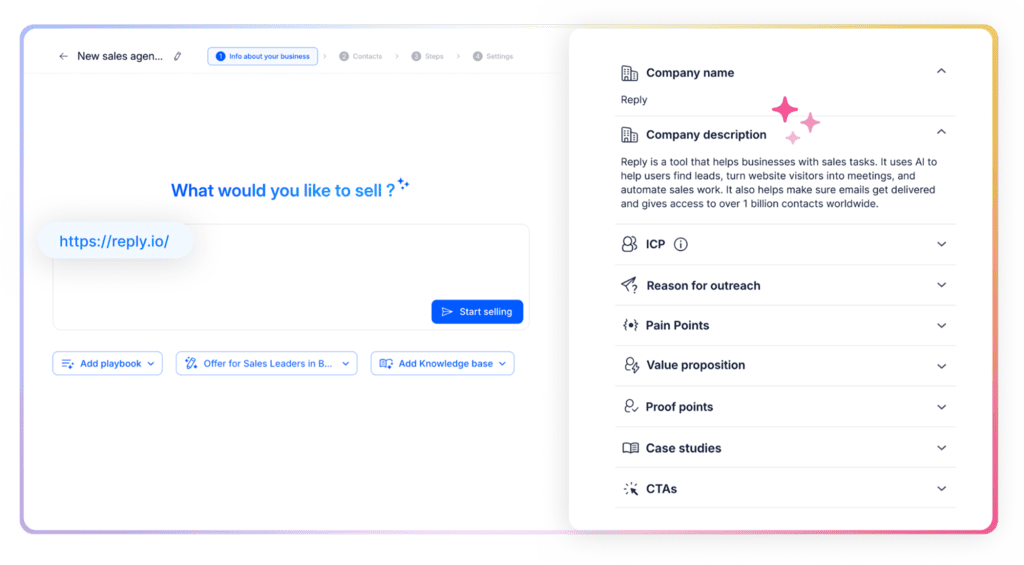
Jason learns each client’s ICP, product, and rules

You train Jason on one client the way you’d brief a new hire: ICP, pain points, value props, proof points, case studies, and the objections it’s allowed to handle alone. That becomes the mental model behind every lead it finds, researches, and scores, and every message it writes.

Jason AI onboarding screen collecting company info, ICP, and CTAs, the client briefing step behind white label LinkedIn lead generation

Its AI SDR Playbooks feature then turns that briefing into something reusable. You can build custom ones for fintech, one for logistics, one for SaaS, so onboarding the 10th client becomes cloning a playbook and swapping the specifics, rather than building from scratch. You also choose the underlying model per sequence, whether that’s Claude, Gemini, Mistral, or OpenAI.

Finding the right people without buying three more tools

Jason runs natively on Reply Data, a live database of over a billion contacts and accounts across 150+ countries, verified in real time, along with sourced LinkedIn URLs, intent signals, and other enriched data.

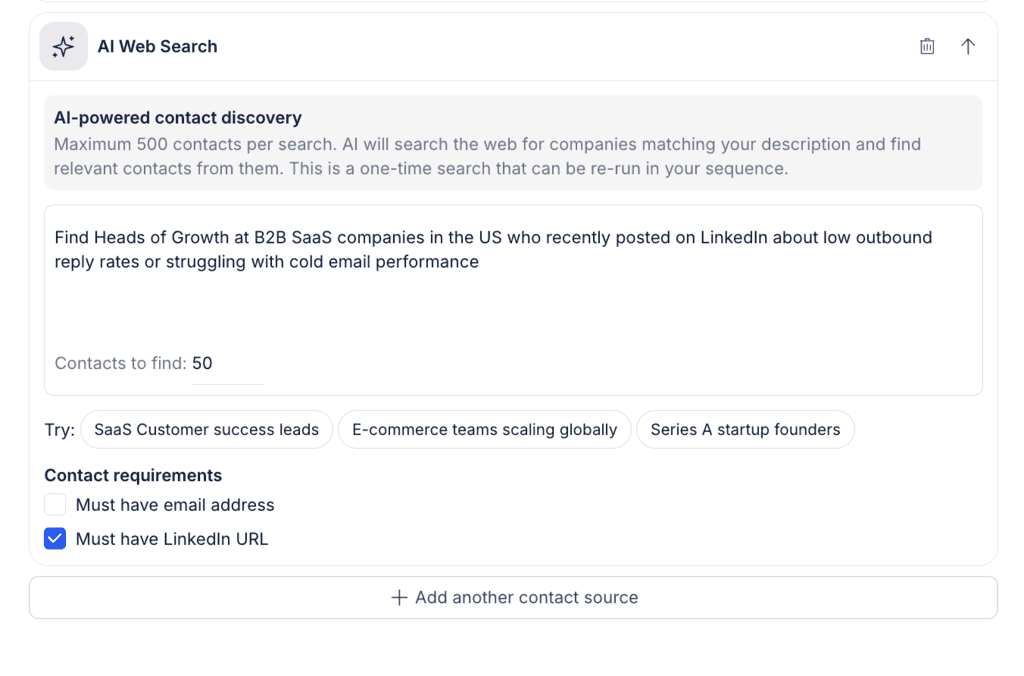
When filters can’t express a segment, AI Web Search can.

You simply describe your ideal customer in plain language, including behaviors and situations that not even LinkedIn itself covers, and Jason goes and finds those people across the web.

Jason AI's AI Web Search panel finding contacts from a plain-language description, part of executing a sales outreach plan

Any LinkedIn or Sales Navigator search pastes straight in without a browser extension, and you can pull a competitor’s followers and have Jason AI score them against the ICP before anything gets sent.

Researching every lead before the first touch

This is where that 45% acceptance rate we mentioned earlier gets built. Custom Research lets you define, in a sentence, what insights you want on every prospect, and Jason pulls it from public sources across the whole sequence.

Once the research layer is complete, Jason AI will use all the uncovered data to craft personalized and relevant LinkedIn messages, and if need be, emails and follow-ups too, always at the individual contact level, not the segment level.

On top of that, advanced ICP scoring labels each lead with a score and its reasoning, LinkedIn activity tracking watches what your targets are actually doing and posting about, and website visitor tracking catches the ones already looking at your brand.

Running coordinated LinkedIn and multichannel sequences

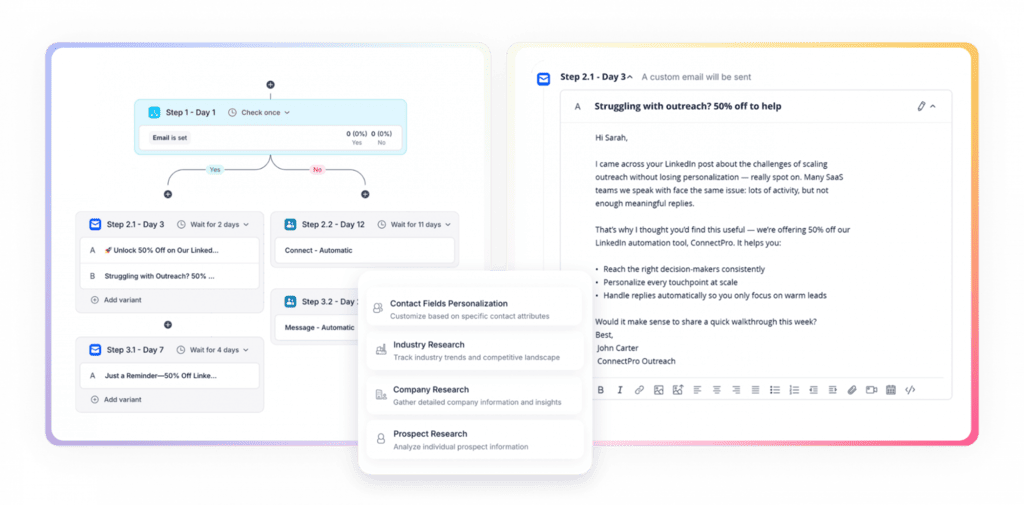
Jason AI sequences combine LinkedIn profile views, post comments, connection requests, messages, and voice notes, along with emails, follow-ups, and calls in one cohesive flow.

Conditional logic runs on real signals: connection accepted, email opened, link clicked, replied.

In practice, that may look like this:

  1. Day 1, the first email goes out. No open after three days.
  2. Jason views their LinkedIn profile, comments on a recent post, then sends a connection request.
  3. Request accepted on day 6, Jason then writes a short DM built on the research hook and cancels the email follow-up that was queued for day 8.
  4. Had the request gone unanswered by day 10, Jason drops back to email with a different angle, sends it in the prospect’s timezone, and A/B tests a new subject line.

Jason AI conditional sequence builder with branching LinkedIn and email steps, showing coordinated white label LinkedIn lead generation

Handling replies, objections, and booked meetings

Jason AI classifies incoming replies and handles a large share directly: answering questions, working simple objections, sharing resources, proposing next steps. It also connects to your Google Calendar and Calendly to suggest real times during communication and avoid double bookings.

For a white label operator, the control knob here is definitely worth mentioning. Approval Mode routes every response past a human first, so you can run new clients with full oversight, then switch specific sequences to Automatic once you’re happy with the quality. That’s your client’s brand in the inbox, so earning that trust in stages is the right sequence.

Keeping client accounts separate, safe, and reportable

Each client gets its own workspace, its own agent, and its own playbooks, with dashboards down to the sequence, channel, and playbook level. Sending controls cover daily caps, delays, ramp-up, and throttling on both email and LinkedIn, which is what keeps twenty client accounts out of trouble.

The deliverability side is fully handled under the hood too: SPF, DKIM and DMARC checks, Google Postmaster integration for spam monitoring, native email warm-up, and unlimited mailboxes. And all of it sits behind your brand, with the vendor carrying SOC 2 and GDPR compliance underneath.

Turning it into an offer clients renew

With a white-labeled AI sales agent, you’re selling the outcome, not access to a tool.

Clients sign for booked meetings, then stay because their team works in your software every day, and leaving you now means losing that too. A services-only agency retainer has no such anchor, which is why clients often reopen it every quarter.

Some things stay human permanently, like the offer itself, the ICP judgment, the sales call, and the close. And remember, an AI SDR scales whatever is in your playbook, so a weak value proposition just travels further and faster.

Layer Who owns it What it costs you What you charge for
Strategy and offer You, always Your time A setup or strategy fee
Data and research Jason AI and Reply Data Contact volume in the plan Bundled into the retainer
Sequencing and sending The platform Licence per client workspace A monthly platform fee
Reply handling Jason AI and your team Review time, shrinking Bundled into the retainer
Meetings booked Shared Nothing extra The performance layer

Five steps to launch with Jason AI:

  1. Pick the two client types you already understand best.
  2. Build one playbook per type, with real proof points, won/lost data, and brand rules.
  3. Settle who owns the LinkedIn accounts, in writing, before you sign anyone.
  4. Run your first two clients in Approval Mode until reply quality is boring.
  5. Move sequences to Automatic one at a time, watching reply sentiment as you go.

Where to start

Pick the layer your clients can’t replicate and put your name on that one. Sending LinkedIn messages isn’t worth the big bucks anymore, but research, personalization, and reply handling are, and those are the parts an AI sales agent like Jason AI does at a cost no headcount plan could ever match.

Settle account ownership before you sign anyone, launch with two client types instead of ten, and let the playbooks do the scaling. If that’s the business you want to run, Reply’s white label ships the product and Jason AI together, under your brand, in weeks.

FAQ

Is white label LinkedIn lead generation allowed under LinkedIn’s rules?

LinkedIn prohibits software that automates activity through the browser, which is why extension-based tools carry the most restriction risk. Cloud-side execution with human-like pacing, per-account daily caps, and one account per real person is the safer posture.

Should I white label a platform or resell a done-for-you service?

White label a platform when you have delivery capability and want recurring licence revenue plus client ownership. Resell a service when you have demand but no delivery team and would rather take a spread than build one. The platform route is slower to start but worth considerably more in year three.

How much should I charge for white label LinkedIn lead generation?

The market for managed LinkedIn lead gen sits between $3,000 and $25,000 a month depending on the scope and industry. The structure that works best is a platform fee that recurs regardless of output, plus a performance layer tied to qualified meetings. Charge the setup fee separately, because ICP and playbook work is real work.

Can an AI SDR really handle LinkedIn replies on its own?

es for the routine majority: questions it has answers for, common objections, scheduling, and resource requests. Run it in Approval Mode until you’ve watched a few hundred responses, then automate per sequence. Keep pricing negotiations, complaints, and anything touching a client’s existing customer in human hands.

How many client LinkedIn accounts can one operator run?

The constraint is accounts and account health, not software seats. With roughly 100 invitations per account per week, ten clients means ten sets of LinkedIn credentials and ten warming schedules to manage. Per-client workspaces and separate agents keep the data and reporting clean, and the pacing discipline is what keeps the accounts alive.

Subscribe to our blog to receive the latest updates from the world of sales and marketing.
Stay up to date.

Related Articles

How to Use Automated Sales Prospecting in 2026

How to Use Automated Sales Prospecting in 2026

How to Use Automated Sales Prospecting in 2026
How to Build a Sales Outreach Plan in 2026 (All You Need to Know)

How to Build a Sales Outreach Plan in 2026 (All You Need to Know)

How to Build a Sales Outreach Plan in 2026 (All You Need to Know)
How to Use Lead Prospecting in 2026 with AI SDRs (The Right Way)

How to Use Lead Prospecting in 2026 with AI SDRs (The Right Way)

How to Use Lead Prospecting in 2026 with AI SDRs (The Right Way)