
For most of the last decade, the entire infrastructure playbook was pretty simple: move everything into one big cloud and consider the job done. In 2026, that’s being rewritten, as workloads spread back out across cloud regions, edge sites, private data centers, and sovereign clouds.
The shift doesn’t stay inside the IT department, either. It changes who sits on the buying committee, what gets asked in the very first security review, and when and where your buyers actually show up.
Below, we break down how this kind of setup works, how the main models compare, what’s driving the shift, and what it means for the way B2B teams find and win customers.
What is distributed infrastructure?
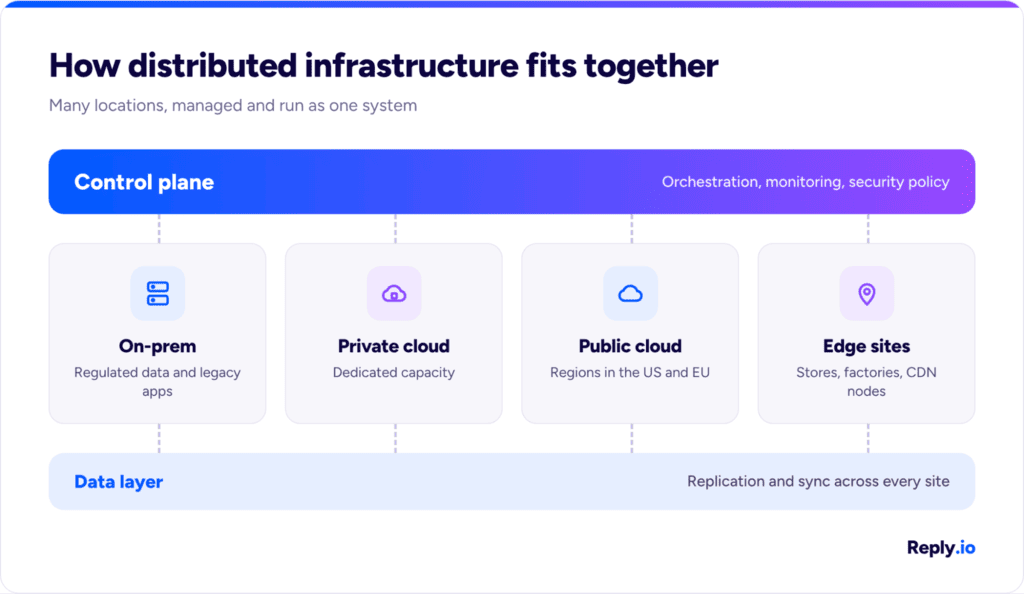
Distributed infrastructure is a setup where compute, storage, and networking are spread across multiple locations, such as cloud regions, on-premises data centers, edge sites, or several cloud providers, but run and managed as one system. If one site goes down or gets overloaded, the others keep the service running.
The idea is simple, but every working setup rests on the same five building blocks:
- Compute nodes → the servers, virtual machines, or containers that run workloads at each site.
- Storage and data layer → the databases and file stores, plus the replication that keeps copies in sync across sites.
- Network → the links between sites, from private connections to the public internet, and the security rules on top of them.
- Traffic management → load balancers, DNS routing, and CDNs that send each request to the healthiest and closest location.
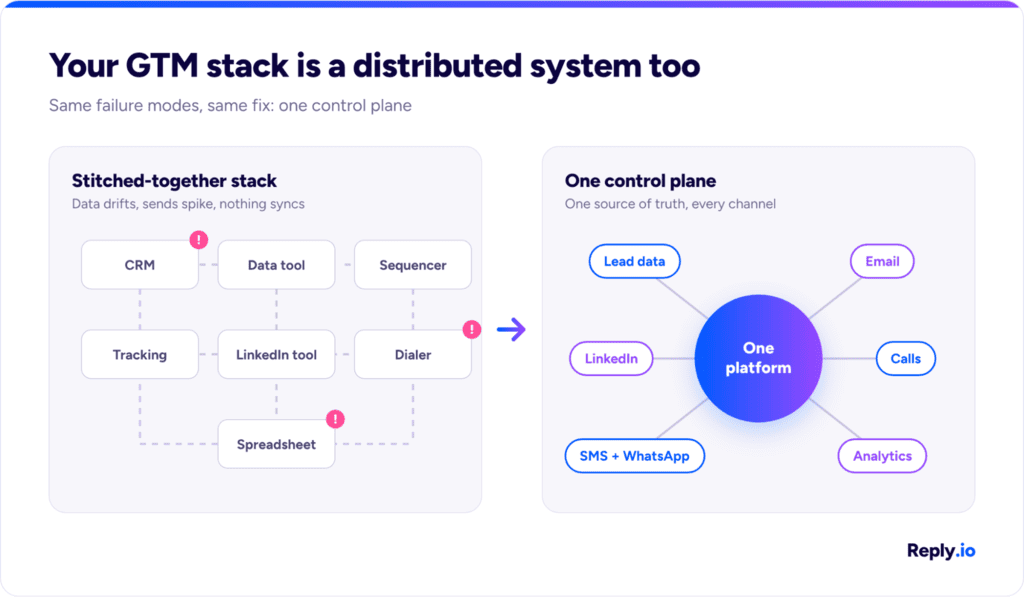
- Control plane → the orchestration, monitoring, and policy layer (Kubernetes being the most common example) that makes many sites behave like one.
It also helps to separate two terms that people constantly mix up. Distributed IT infrastructure describes where the physical and virtual resources actually sit, whereas distributed systems describe how software splits work across those resources, using microservices, message queues, and consensus protocols so that every node agrees on what’s true.
So, if you’re wondering what is distributed system infrastructure, it’s the combination of both — the hardware footprint plus the software patterns that let it run as a single service.
A typical B2B SaaS product is a great example. Imagine an app runs in one AWS region in Virginia and another in Frankfurt, static content is served from a CDN with hundreds of edge locations, EU customer data stays in the EU region, and a single Kubernetes setup deploys the same code to both. To the customer, it’s one product, but behind the scenes, it’s a distributed system with dozens of moving parts.
Centralized vs distributed vs decentralized infrastructure
Centralized infrastructure keeps everything in one place under one owner, a distributed setup spreads resources across many places under one owner, and decentralized infrastructure spreads them across many places with no single owner at all. The difference that matters the most here is control, because a distributed setup still has one team and one control plane setting the rules:
| Centralized | Distributed | Decentralized | |
| Where resources live | One data center or one cloud region | Several regions, clouds, on-prem sites, and edge locations | Thousands of independent nodes run by different parties |
| Who’s in control | One owner, one control plane | One owner, one control plane across every site | No single owner, rules enforced by protocol and consensus |
| What one failure does | Can take the whole service down | Traffic reroutes to healthy regions | The network barely notices |
| Speed for remote users | Slower the farther they are from the hub | Fast, served from a nearby location | Varies from node to node |
| Governance and compliance | Simplest to audit | Rules must be enforced in every region and site | Hardest, since nobody is fully accountable |
A quick note on the wording: plenty of vendor decks say “decentralized” when what they really mean is distributed. Almost every enterprise setup is distributed, while decentralized mostly applies to blockchains and peer-to-peer networks, where removing the central owner is the entire point.
Distributed hybrid infrastructure vs distributed cloud
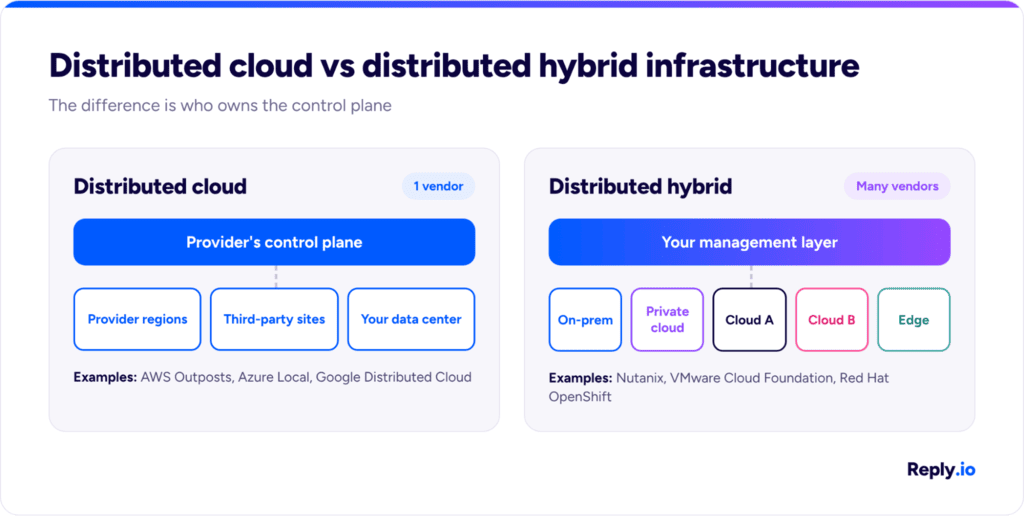
Distributed hybrid infrastructure (DHI) is a single management layer that runs workloads across on-premises data centers, private clouds, public clouds, and edge locations, often mixing several vendors. Distributed cloud is narrower, where one public cloud provider runs its own services in many places, including its own regions, third-party facilities, and your data center, all from that provider’s control plane.
In practice, AWS Outposts, Azure Local, and Google Distributed Cloud are distributed cloud offerings, since they bring one provider’s cloud into your own facility. DHI covers platforms like Nutanix Cloud Platform, VMware Cloud Foundation, and Red Hat OpenShift, which span whichever environments you choose. Gartner now even tracks DHI as its own market with a dedicated Magic Quadrant, which tells you how mainstream the category has become.
The trade-off between them is simple — distributed cloud is simpler when you’re committed to one provider, while DHI gives you the freedom to mix vendors and avoid lock-in, at the cost of more integration work on your side.
What’s pushing companies to go distributed in 2026
Four forces are doing most of the pushing, and each of them has hard numbers or hard deadlines behind it:
- Data sovereignty → Gartner forecasts worldwide sovereign cloud IaaS spending to reach $80 billion in 2026, up over 35% from 2025. Europe’s spend is set to grow 83% this year and overtake North America in 2027, and 20% of current workloads are expected to move from global to local cloud providers.
- Edge and AI inference → IDC puts global edge computing spending at $265 billion in 2025, heading towards $450 billion by 2029. Running AI models close to where data is created cuts latency and keeps sensitive data local.
- Cheaper switching → the EU Data Act has applied since 2025, where Cloud providers must support customers who want to switch, notice periods are capped at two months, and from January 2027, providers can’t charge switching fees at all, which makes multi-provider setups far less expensive to run.
- Resilience → teams that lived through a major cloud region outage now design for it, so that one region failing doesn’t take revenue down with it.
None of this comes for free, though. Distributed setups trade simplicity for resilience and speed, and the bill shows up in four places:
- Data consistency → keeping copies in sync across regions without conflicts is the hardest problem in distributed computing.
- A larger attack surface → every new site adds another set of access rules, encryption keys, patches, and logs to manage.
- Operational overhead → more sites mean more monitoring and a bigger on-call rotation.
- Cost sprawl → the same Flexera report found that organizations estimate 29% of their IaaS and PaaS spend is wasted.
How distributed infrastructure shapes GTM
When infrastructure spreads out, the buying decision, the data, and the buyers spread out with it. That changes four things for sales and marketing teams, whether you sell infrastructure yourself or any software product that touches company data.
Buying committees get bigger and more technical
Forrester found that buying groups now average 13 internal stakeholders and nine external participants per purchase in 2026, and that purchases involving generative AI features have groups twice that size. Any product that has to run across a hybrid estate pulls in platform engineering, security, data, legal, and procurement, and each of them can block the deal.
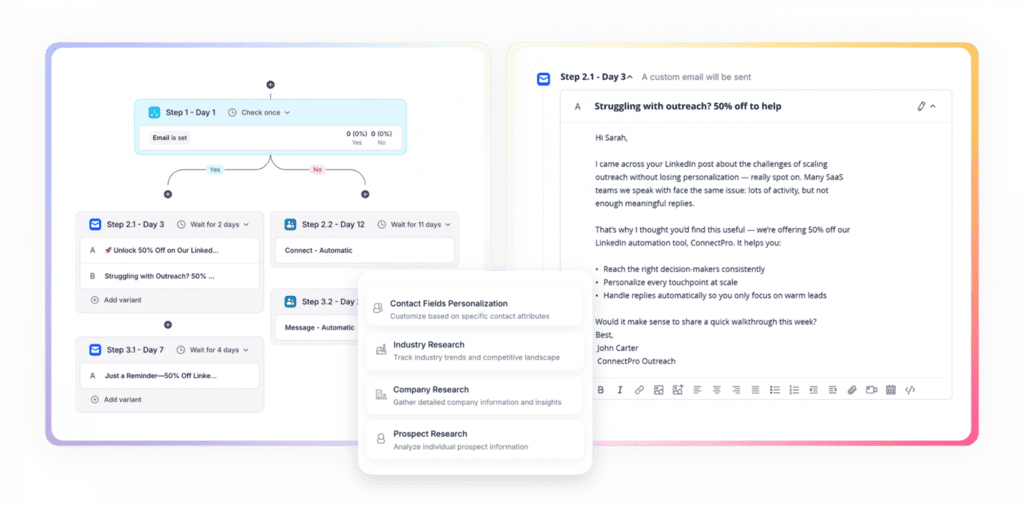
That’s why single-threaded deals tend to die quietly. You need to reach several roles within the same account, with messaging tailored to each — uptime and integrations for the platform lead, residency and access controls for security, data lineage for the data team, and total cost and exit terms for procurement.
“Where does our data live?” becomes a qualifying question
Data residency used to come up during the final security review. With sovereign cloud spending growing fastest in Europe, the Middle East, and Asia Pacific, it now comes up on the first call, and sometimes it decides whether you make the shortlist at all.
In practice, that means segmenting target accounts by region and regulatory regime (GDPR, the EU Data Act, and sector rules like DORA for EU financial services), and not only by industry and headcount. It also means having your answers ready before the buyer asks you where data is stored, which sub-processors touch it, and which transfer mechanisms you rely on.
Buyers research alone, across time zones and channels
Gartner found that 67% prefer a rep-free buying experience, and 45% used AI during a recent purchase. On top of that, distributed companies tend to have distributed teams, so the platform lead may be in Berlin, the CFO in New York, and procurement in Singapore.
So every touchpoint has to land within each person’s working hours and in the channel they actually use. It also has to carry value on its own, because many buyers won’t take a call until they’ve already done most of their research.
Buying signals come from more places
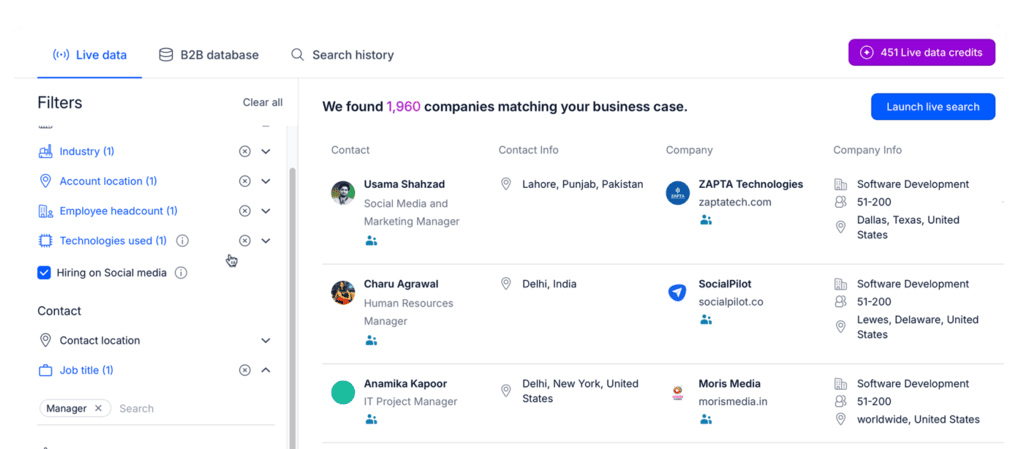
Infrastructure changes leave a trail that sales teams can follow. New cloud region launches, job posts for platform engineers or cloud FinOps roles, migrations off VMware after Broadcom’s licensing changes, new EU entities, and fresh compliance certifications all point to a team that is actively re-architecting and probably buying.
Each of these is one of the intent signals that sales and BD teams can build their outreach plays around. Speed matters here more than anywhere else, since a signal acted on within days beats the same signal acted on a month later, when the shortlist is already set.