
How to Use Targeted Lead Generation in 2026 to Book More Meetings

How to Use Targeted Lead Generation in 2026 to Book More Meetings

Most outbound fails long before anyone reads the actual message. In many cases, the email or LinkedIn message lands in front of someone who was never going to buy in the first place, or perhaps at a moment when they had no reason to care.

Targeted lead generation fixes the problem at the source, so that instead of growing the list, you shrink it to the accounts and people who fit your ideal customer profile and show some signs of interest at this very moment, and only then build every message around their unique profile.

In this guide, we’ll cover how targeted lead generation works, when it pays off, a 6-step process to run it, how to measure results, and what it costs.

What is targeted lead generation?

Targeted lead generation is the process of finding and engaging only the accounts and people who match your ideal customer profile (ICP) and show signs they could potentially buy soon. You pick a narrow audience first, then build your list and messaging around it.

That’s also the key difference between a lead and a targeted lead. A lead is anyone who might be interested, like a name on a list, a webinar signup, a LinkedIn connection.

Targeted leads pass two extra filters — they fit your ICP (right industry, company size, role, and tech stack), and they have a trigger that makes your offer relevant right now, such as a new VP of Sales, a hiring spree, or a fresh funding round.

Put simply, targeted lead generation vs lead generation is a trade of volume for relevance:

General lead generation Targeted lead generation
Who you contact Anyone in a broad market Accounts and roles that match your ICP
List size Thousands of contacts per campaign Hundreds, split into small segments
Message One template for everyone One message per segment, personalized per prospect
Timing Whenever the campaign launches Triggered by intent signals
Success metric Number of leads Meetings booked and pipeline created

For sales teams, this means fewer contacts per campaign, but far more targeted sales leads that actually turn into conversations, and eventually, into closed deals.

When targeted lead generation pays off

The benefits of targeted lead generation show up fastest in B2B motions where every wasted conversation is expensive, so it works especially well when:

  • Your deal size is large, so each meeting is worth the research behind it.
  • Several people sign off on the purchase, and you need to reach specific roles inside specific accounts.
  • Your market is crowded, and a relevant message is the only way to stand out from competitors pitching the same buyers.
  • Your team is small, so limited sending capacity and rep time have to go to the accounts most likely to convert.

If you sell a low-cost product that almost any business could use, a broader approach may still be the better fit.

What are the disadvantages of targeted lead generation?

The main disadvantages of targeted lead generation are a smaller pool of prospects, more upfront work, and the risk of filtering too hard. Each one is manageable if you plan for it:

  • A smaller pool means that once you work through a tight segment, you need fresh accounts or new triggers to keep the pipeline moving.
  • Setup takes longer, since ICP work, verified data, and intent tracking all need time and tools before the first email goes out.
  • Overly strict filters can cut out accounts that would have bought.

There’s also a timing catch. The LinkedIn B2B Institute’s 95:5 rule estimates that only about 5% of B2B buyers are in-market at any given moment, and targeted outreach is built to catch that exact 5%. That’s why the accounts that fit your ICP but aren’t ready yet still need a lighter nurture track that keeps you top of mind until they are.

Building Outbound from Scratch [2026 Playbook]

This playbook shows you how to build outbound from zero, step by step.

What’s inside:

→ How to define your ICP and micro-segments
→ Proven outbound message frameworks
→ Copy-paste cold email templates
→ A practical outbound tool stack
→ 30 quick outbound shortcuts used by top sellers

Get the playbook free and start sending better outbound.

How to do targeted lead generation in 6 steps

Here’s the process we recommend for running it as a repeatable outbound system, from defining who to contact to measuring which segments actually book meetings.

1. Build your ideal customer profile from closed-won deals

The most reliable ICP comes from real deals, so pull your last 20 to 30 closed-won accounts and look for the traits they share, like industry, headcount, region, tech stack, the role that signed, and ideally, what was happening at the company right before they bought.

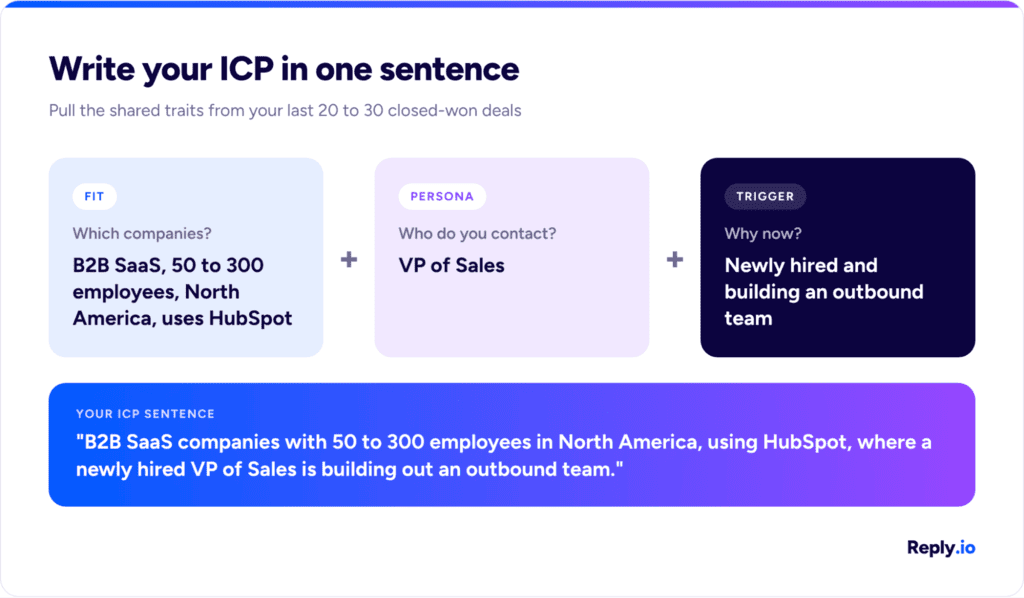
Then compress all of it into one sentence that combines fit, persona, and trigger. For example:

*“B2B SaaS companies with 50 to 300 employees in North America, using HubSpot, where a newly hired VP of Sales is building out an outbound team.”*

That one sentence tells you which filters to apply and what to talk about, and it’s also much easier to share with your team compared to a 10-page persona document.

targeted lead generation ICP sentence combining fit, persona and trigger

Just as importantly, write down who to exclude as well, including industries with procurement cycles you can’t support, company sizes that tend to churn, regions you can’t serve, existing customers, and accounts with open opportunities. Exclusions keep your lists clean and also prevent awkward double-touches from different reps.

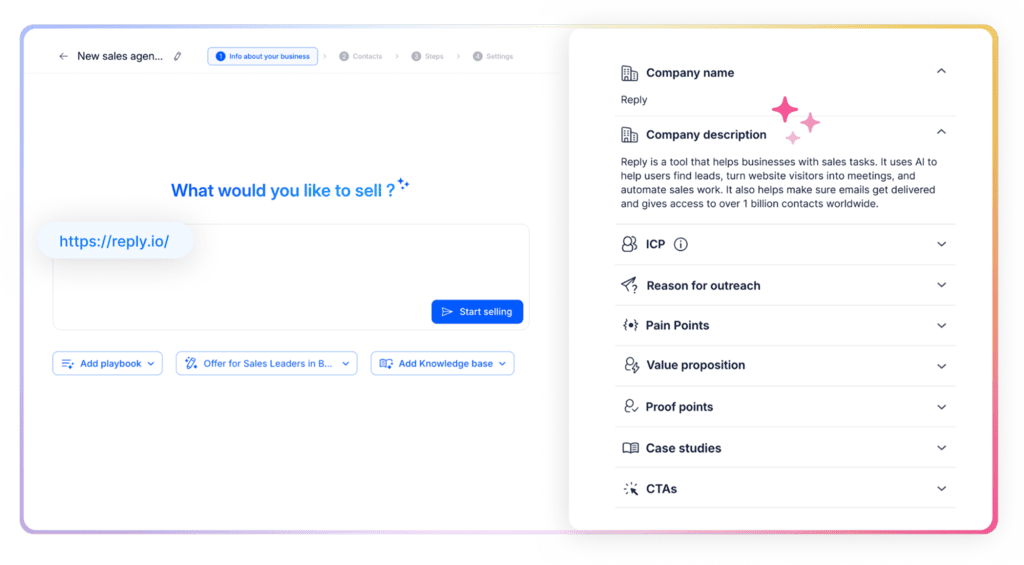
This is also something that AI can help with. For instance, an AI sales agent like Jason AI will join your team as a full-time SDR, and as its first task, will learn everything about your business, audience, and internal playbooks to help pinpoint exactly what kind of leads to start looking for:

b2c home improvement targeted lead generation ai

2. Turn the ICP into a verified, current list

Next, translate your ICP sentence into database filters. Using the example above, that means industry = software, headcount = 50 to 300, location = US and Canada, tech stack = HubSpot, department = sales, and seniority = VP or director.

This is where your data source is absolutely crucial.

Reply Data gives you access to a B2B contact database of 1B+ live contacts and accounts across 150+ countries, with filters for location, industry, headcount, tech stack, department, role, and seniority. You can preview results before spending credits, and built-in email verification keeps bad addresses out of your sequences.

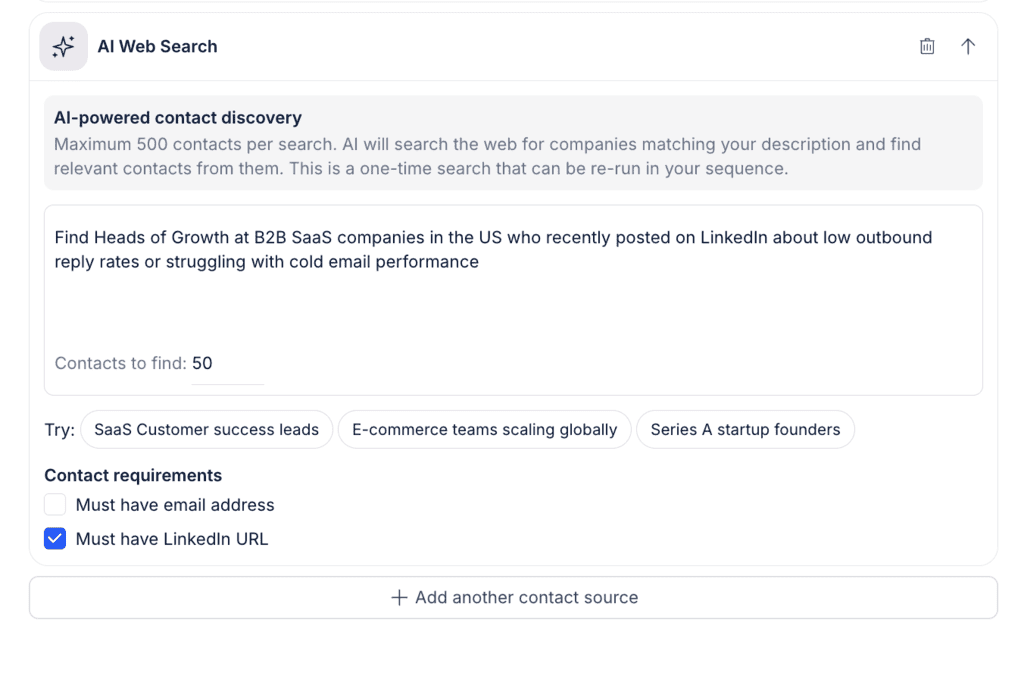
And if you want to take it one step further, Jason AI can run the entire search for you, around the clock. With its AI Web Search feature, you can simply describe in plain language what kind of leads you’re after, and Jason will make sense of it and start working right away:

targeted b2b lead generation

3. Segment by problem, not just by firmographics

An ICP tells you who fits, while segments tell you what to say to them. Most targeting strategies combine four types of data:

  1. Firmographic → industry, company size, revenue, and location.
  2. Technographic → the tools a company uses, like its CRM or email platform.
  3. Behavioral → actions prospects have taken, such as visiting your pricing page or engaging with your LinkedIn posts.
  4. Intent → signals that they’re actively researching a problem or solution like yours.

Keep segments small, usually a few hundred contacts each, so you can compare results cleanly. Location can work as a segment too, and it’s the backbone of local lead generation.

4. Use intent signals to time your outreach

Timing is the part of targeting most teams skip, but it just might be the most important one. According to 6sense’s B2B Buyer Experience Report, the vendor that buyers contact first wins about 8 out of 10 deals, and that first contact usually happens around 61% of the way through the buying journey.

To put it simply, by the time a buyer talks to sales, they often have a favorite already, so your goal is to get into the conversation before the shortlist is set.

Intent signals show you when an account in your ICP is on the move, and the most useful ones for outbound include:

  • Job changes → a new leader in your target role usually reviews tools and vendors in their first months.
  • Hiring → open roles your product supports, like SDR positions for a sales tool.
  • Funding → fresh budget and pressure to grow quickly.
  • Tech stack changes → adding or dropping a tool that connects to yours.
  • Website and LinkedIn activity → visits to your pricing page or engagement with your content.

Reply.io tracks intent signals and job changes in real time and brings them straight into your outreach, while Jason AI takes it a step further with ICP scoring and LinkedIn activity tracking, so every prospect comes with a score and the reasoning behind it. That way, your team knows exactly which accounts to contact today and which can wait.

5. Write one message per segment and run it across channels

Once your segments and signals are in place, each segment gets its own message, with a specific opener, the shared pain, one proof point, and one clear CTA. This is what targeted sales lead generation looks like in practice, where the segment defines the core message and personalization adapts it to each person.

This is where an AI outreach platform is non-negotiable. Both Reply.io and Jason AI turn all the uncovered and enriched data from their database, LinkedIn, and other integrated sources into tailored emails, follow-ups, and LinkedIn messages, giving that true one-to-one engagement even at scale.

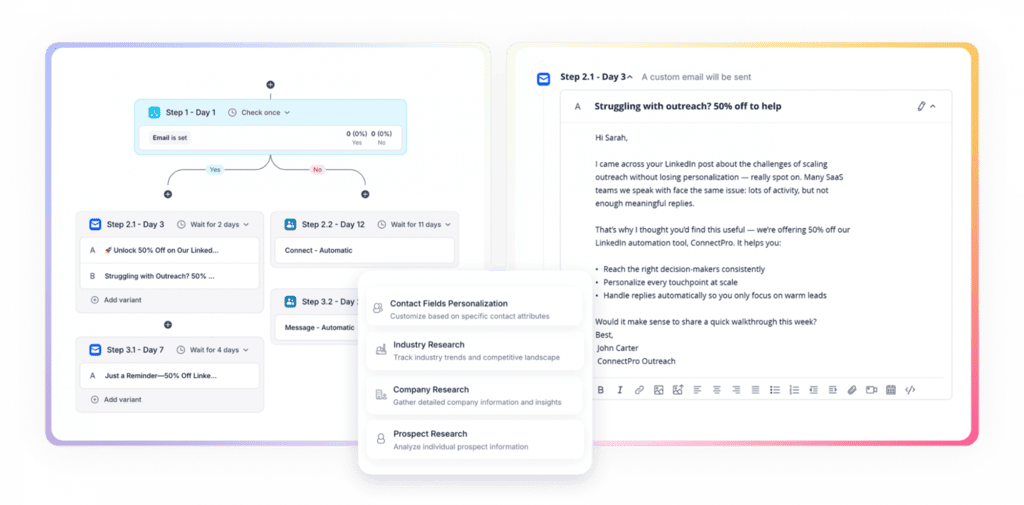
Each lead gets a tailored, multichannel sequence that follows conditional logic, so the channel, messaging, and timing all get adjusted in real time based on engagement. A common example is setting an automated LinkedIn connection request 3 days after the first email goes unopened, and then if it’s accepted, write a short personalized LinkedIn message and cancel the scheduled email follow-up.

targeted b2b networking and lead generation

The LinkedIn steps also leave room for targeted B2B networking and lead generation, since a new connection who doesn’t book a meeting today will still see your content later.

With Jason AI, you’ll have your own AI sales rep that works 24/7 to find leads that match your ICP, enrich their data profiles through research, use that data to craft personalized emails and LinkedIn messages, and then even handle replies and book meetings on your behalf!

6. Measure every segment and cut what doesn’t book meetings

Targeting only pays off if you measure it at the segment level, because campaign averages hide which segments are carrying the results and which are dragging them down, so track these five metrics for each segment:

Metric What it tells you
Reply rate Whether the targeting and message resonate at all
Positive reply rate How many replies show real interest or ask for a meeting
Meetings per 100 contacts How efficiently a segment turns into conversations
Cost per meeting What each booked meeting costs in data, tools, and rep time
Meeting-to-opportunity rate Whether those meetings are with people who can actually buy

How much does targeted lead generation cost?

There’s no single price for targeted lead generation, because it depends on whether you run it in-house, hire an agency, or use an AI SDR. That’s why the most useful number to track is cost per meeting, not cost per lead, because a cheap lead that never replies is still the most expensive one on your list.

Most teams choose one of three models:

  • In-house → you pay for a data source, a sales engagement tool, and rep time. For example, Reply.io starts at $49 per user per month but combines a rich B2B database, enrichment, automated outreach, AI personalization, LinkedIn touches, and analytics.
  • Agency → you pay a monthly retainer or a per-meeting fee, and the agency runs the campaigns for you.
  • AI SDR → an AI agent runs prospecting and handles replies, so you pay for the platform instead of extra headcount.

To compare them fairly, use the same formula for each: total monthly cost ÷ meetings booked = cost per meeting. As an illustration, if your tools and rep time cost $6,000 a month and you book 30 meetings, you’re paying $200 per meeting. Weigh that number against your average deal size and close rate to see whether that model is worth it.

If you’re working with a tight budget, our tips on lead generation for startups show how to get started without a big team.

For many teams, the AI SDR model brings cost per meeting down the fastest, because the research and follow-ups that eat up rep time run on their own.

Jason AI runs the entire lead generation and outbound for you, finding ICP-matching leads, personalizing every message, handling replies, and booking meetings straight into your calendar. It’s fluent in over 50 languages so you can enter new markets with ease, and it has an Approval mode where you can decide on the level of control your team has over the execution.

What is the biggest mistake in lead generation?

The biggest mistake in lead generation is contacting people who have no reason to buy and then blaming the copy when they don’t reply. Remember, no subject line can save a list built on the wrong accounts or the wrong timing.

A few other mistakes come up again and again when teams roll out targeted lead generation strategies:

  • Working from stale lists → contacts change jobs, and every bounce chips away at your sender reputation.
  • Sending one message to every segment → if “new VP of Sales” and “hiring SDRs” get the same email, segmenting was pointless.
  • Measuring opens instead of meetings → open rates are unreliable and say nothing about pipeline.
  • Stopping after one email → step one gets the most replies, but follow-ups across email and LinkedIn still catch prospects who missed the first touch.
  • Ignoring deliverability → even perfect targeting fails if emails land in spam. Google’s sender guidelines, for example, require bulk senders to keep spam complaint rates below 0.3%.

If you’re unsure how to generate targeted leads without falling into these traps, test everything on a single segment first and only scale what books meetings.

Start with one segment

Targeted lead generation works when you know exactly who fits and reach them at the moment your offer actually matters to them. Start this week with one ICP sentence and one intent signal, then launch a single multichannel sequence and judge it by the meetings it books.

When you’re ready to scale, Reply.io brings the data, signals, sequences, and analytics together in one place, and there’s a free 14-day trial for you to check it out right away. And if you’d rather have an AI SDR join your team, Jason AI can run the whole process for you around the clock.

FAQ

Are targeted leads better than buying leads?

In most cases, yes, because bought lead lists are often shared with other sellers, rarely verified, and not filtered for your ICP or timing. Targeted leads take more effort upfront, but they come with fit and context, which is what gets replies.

How often should you refresh a targeted lead list?

Re-verify contacts right before every campaign and rebuild your segments at least once a quarter. People change roles constantly, so a list that was accurate three months ago can bounce today.

Can you automate targeted lead generation?

Most of it can be automated. Platforms like Reply.io handle list building, enrichment, intent tracking, multichannel sequences, and reporting. The ICP definition and segment strategy should still come from your team, because they depend on your own deals and positioning.

How is targeted lead generation different from account-based marketing?

Account-based marketing (ABM) focuses on a short list of named, high-value accounts, often with custom campaigns for each one. Targeted lead generation works at the segment level, using shared traits and signals to reach more accounts with relevant messages. Many teams use both, running targeted outbound for the wider ICP and ABM for their top accounts.

Subscribe to our blog to receive the latest updates from the world of sales and marketing.
Stay up to date.

Related Articles

B2B SaaS Marketing Strategy in 2026 [Step-by-Step Guide]

B2B SaaS Marketing Strategy in 2026 [Step-by-Step Guide]

B2B SaaS Marketing Strategy in 2026 [Step-by-Step Guide]
How an Automated Voice Messaging System Will Improve Outreach in 2026

How an Automated Voice Messaging System Will Improve Outreach in 2026

How an Automated Voice Messaging System Will Improve Outreach in 2026
Outbound Marketing Software in 2026 (Top Picks)

Outbound Marketing Software in 2026 (Top Picks)

Outbound Marketing Software in 2026 (Top Picks)