
Best Company Profile APIs in 2026 for Developers

Best Company Profile APIs in 2026 for Developers

Key takeaways:

  • Profile APIs differ most in what a single record actually contains. Some return a flat firmographic row, others a nested object with locations, headcount history, funding and employee arrays.
  • LinkedIn-sourced profiles carry platform risk that vendor pages rarely mention. LinkedIn’s own User Agreement prohibits automated scraping, and providers have shut down over it.
  • Published pricing runs from $31 a month at Lix to $500 for a ScrapIn pay-as-you-go bundle, while Harmonic and Crunchbase publish nothing self-serve.
  • Design your join key before you buy. Domains break on rebrands and subsidiaries, and remapping later is far more expensive than choosing correctly now.

A company profile API returns a structured record about an organization: what it does, how big it is, where it operates, who works there and what has changed recently. It sounds like a solved problem until you compare two providers and find their profile objects share barely half their fields.

This guide compares seven of them from the perspective of someone writing the integration. It covers what each record contains, how the endpoints are shaped, where LinkedIn-derived data carries risk, and what each one costs.

Pricing was read off each vendor’s own page. Where a provider does not publish, that is stated rather than estimated.

What Is a Company Profile API?

A company profile api takes an identifier, usually a domain, a company name or a LinkedIn URL, and returns a structured record describing that organization.

The identifier you supply matters as much as the fields you get back. Domain lookups are the most common and the most fragile, since companies rebrand, run multiple domains and operate country sites. Registry numbers are precise but jurisdiction-bound. LinkedIn URLs resolve cleanly but tie you to one platform’s identifiers and its terms.

Record shape is where providers genuinely diverge. A minimal profile is a flat row: name, domain, industry, size band, location. A rich profile is a nested object carrying multiple locations, headcount by function, funding rounds, technologies, social links and sometimes an employee array. Both are sold as a company profile, and only one will populate the screen you are building.

Where the question is simply which company owns a domain rather than everything about it, our roundup of company enrichment APIs covers the shallower call.

Endpoint structure follows from that. Most providers expose an enrich call keyed on an identifier, a search call taking filters and returning many records, and increasingly a bulk or async path for volume. The good ones document rate limits, pagination and what happens when a match fails, since a partial match returned as a confident record is worse than an honest miss.

The Best Company Profile APIs

The second column tells you what you can look a company up by, which usually decides the shortlist faster than the field list does.

Tool Lookup key What the record holds Main limitation Pricing (from) Rating
Reply.io ICP filters, not identifiers People at matching companies No profile-by-domain endpoint $49/month ★★★★☆
Lix LinkedIn URL, search LinkedIn company and people profiles LinkedIn terms risk $31/month ★★★★☆
ScrapIn LinkedIn URL, domain Real-time LinkedIn-sourced profiles Per-tier credits not published $500 pay as you go ★★★★☆
Unipile Connected account Profiles plus messaging in one API Runs through a real logged-in account EUR49/month ★★★★☆
Apify Any source you can scrape Whatever the actor returns You maintain the actor $29/month ★★★★☆
Harmonic Domain, name Company and people records, weekly refresh Publishes no pricing Quote only ★★★★★
Crunchbase Domain, permalink Funding, investors, acquisitions API requires approval Approval required ★★★★☆

Two of those, Harmonic and Crunchbase, cannot be evaluated on price without a conversation, and one, Crunchbase, gates API access behind an approval process. Plan for both before you build against them.

Reply.io
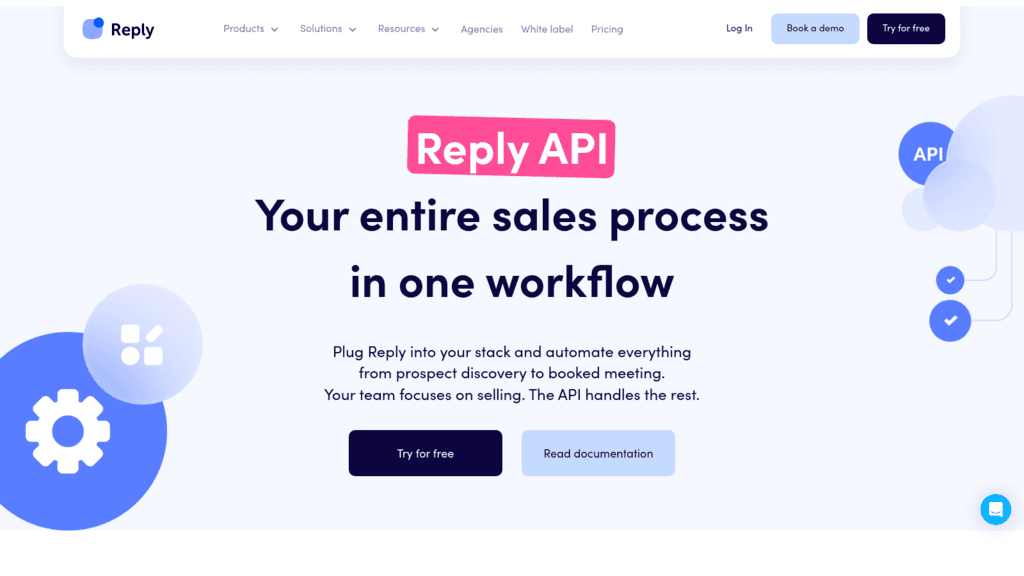
Reply.io as one of the best company profile apis

Best for: Reaching people at profiled companies

Overview: The boundary comes first because it decides whether we are relevant at all. We do not expose a company profile endpoint. You cannot POST a domain and receive a company record from us, and if that is your requirement, the providers below sell precisely that.

Our company data works the other way around. Industry, location and headcount are filters inside a people search across more than 60 million company profiles in the contact database, which returns people rather than organizations.

That makes us the step after profiling rather than a substitute for it. Once another provider has told you which companies fit, our API finds the right people inside them and runs the outreach on the same credential.

Two things remain true in August 2026. The filter-driven search sits behind a Beta label across every one of its endpoints, and enrichment, all five calls of it, has not yet left the Coming soon state in our docs.

Key features:

  • Filter dimensions covering industry, geography, company size, seniority and stack
  • Lookup endpoints that turn a filter value into the ID the search expects
  • A search that hands back individuals working at companies fitting the brief
  • Enrollment calls that begin outreach with no file changing hands
  • Event notifications pushed on reply, open and meeting rather than polled for
  • Two-way syncs that land results in HubSpot, Salesforce or Pipedrive

Pricing: You are billed on stored contacts rather than seats or calls, from $49 a month on annual terms at 1,000 active contacts. The base plan carries just 50 live data credits a month, which is a testing allowance, with larger packages from $20 a month. A 14-day trial applies and there is no free tier.

Pros: filtering and outreach share one credential, large underlying company footprint, event webhooks, CRM write-back, published throughput

Cons: there is no company-profile-by-domain endpoint, so company attributes exist only as search filters inside a beta people search, and the included data credits are far too few for production volume

How to start using it:

  1. Start the trial, then issue yourself a v3 token from the API Key screen.
  2. Translate your company brief into filter IDs with the lookup endpoints.
  3. Fire a Live Data search on that filter set and wait for it to finish.
  4. Run the addresses it returns through validation before committing them.
  5. Push what survives into a sequence, then listen on the reply webhook.

Why it’s a good company profile API companion: It converts a company definition into contacted people, which is what most profile lookups are ultimately for.

Final verdict: Useful downstream of a profile provider, not instead of one. If you need a domain-in, profile-out call, buy from the list below.
Lix

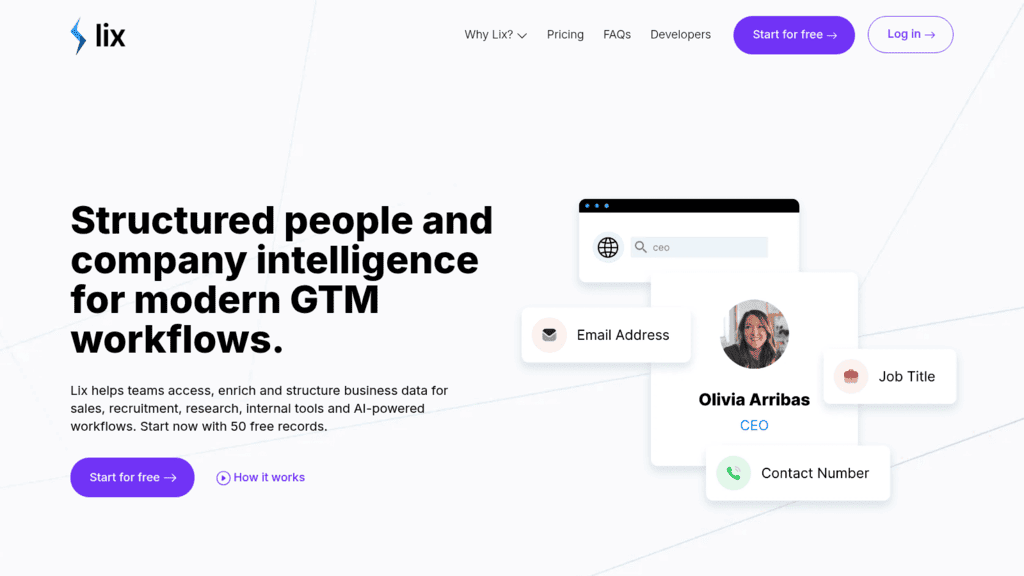
Lix as one of the best company profile apis

Overview: Lix returns LinkedIn company and people profiles through an API and a spreadsheet add-on, positioned for teams who want LinkedIn-shaped data without building the collection themselves.

Key features:

  • Company and people profiles keyed on LinkedIn URLs
  • Search endpoints mirroring LinkedIn’s own filter structure
  • Google Sheets integration alongside the REST API

Pricing: A free tier exists, with paid plans at $31, $39, $49, $87 and $109 a month, and per-credit pricing around $0.15 at the low end.

Pros: low entry price, familiar filter structure, spreadsheet access for non-developers

Cons: depends on LinkedIn data with the platform risk that implies, coverage limited to what LinkedIn exposes, smaller vendor

Why buyers shortlist it: It is the cheapest route to LinkedIn-shaped company records, provided you accept the sourcing question that comes with it.

Final verdict: Good value for LinkedIn-centric work, with a dependency worth understanding first.

ScrapIn

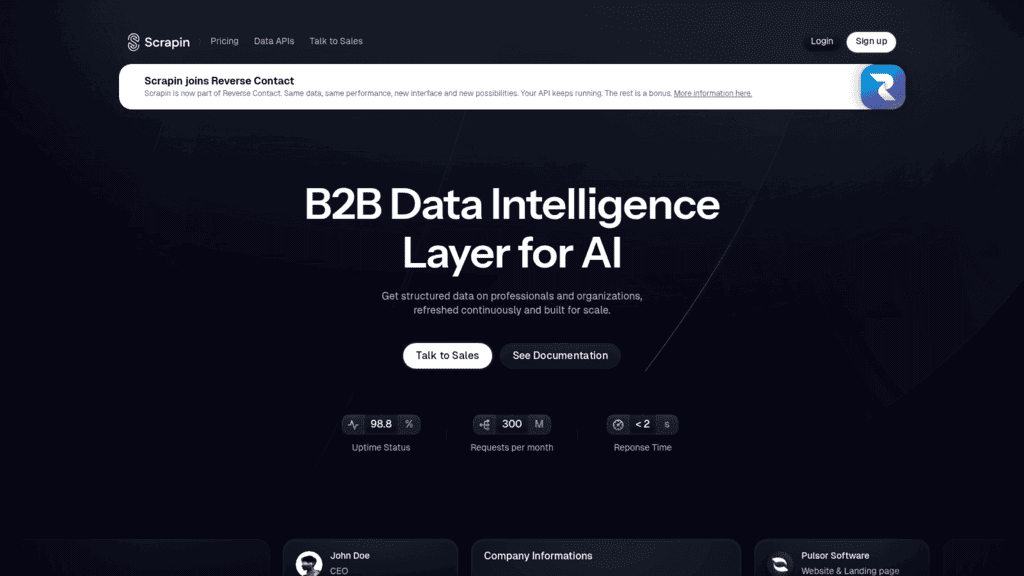
ScrapIn as one of the best company profile apis

Overview: ScrapIn returns LinkedIn-sourced company and person profiles in real time rather than from a cached index, which matters when a record’s freshness is the reason you are calling.

Key features:

  • Real-time profile retrieval rather than a stored snapshot
  • Both company and person endpoints on the same credential
  • Domain-to-profile resolution alongside direct URL lookups

Pricing: A paid trial costs $30 for seven days, and pay-as-you-go starts at $500 with twelve-month credit validity. Enterprise terms are annual and custom. Per-tier credit counts are not published.

Pros: genuinely real-time rather than cached, twelve-month credit validity, domain resolution included

Cons: per-tier credit counts are not published, $500 entry is steep for testing, same LinkedIn dependency as its peers

Its real strength: Freshness. A cached profile from six months ago is a different product from one fetched at request time.

Final verdict: Worth the entry price when profile currency genuinely matters, hard to justify for occasional lookups.

Unipile

Unipile as one of the best company profile apis

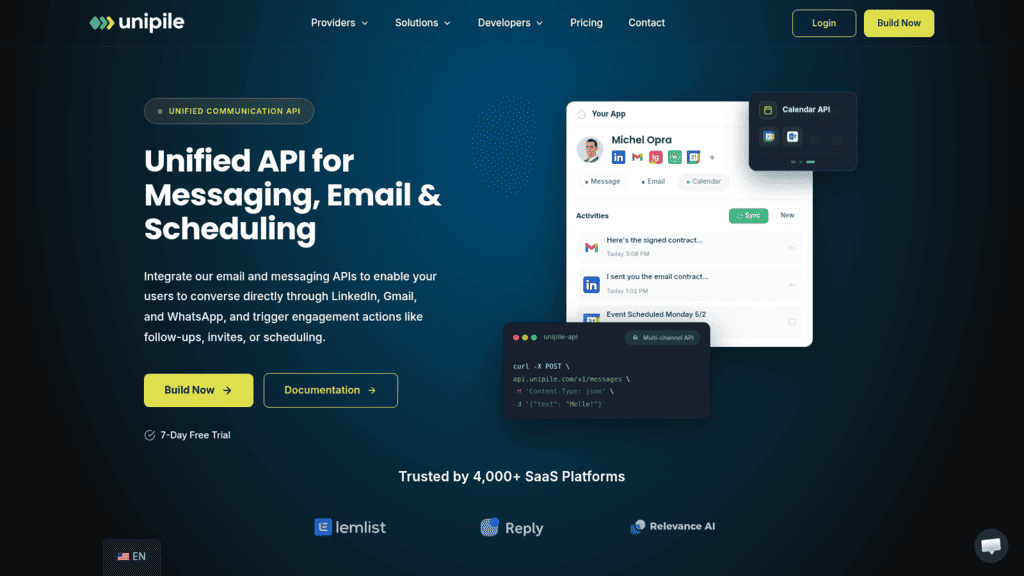
Overview: Unipile is unusual here because it acts through a real logged-in account rather than an external index, which means it can read profiles and also send messages through the same API.

Key features:

  • A unified surface of 100-plus endpoints covering both reading profiles and sending
  • No per-request metering; calls are uncapped
  • Cost driven by how many accounts you connect rather than how hard you use them

Pricing: One plan billed pay-as-you-go, with a EUR49 monthly minimum covering up to 10 accounts and EUR5.00 per account per month between 11 and 50, falling above that. A 7-day trial requires no card.

Pros: unlimited API calls, profile reading and messaging on one integration, predictable account-based cost

Cons: operates through a real account with the platform exposure that carries, priced in euros, better suited to product builders than end teams

Where it fits: Teams embedding LinkedIn functionality into their own product rather than pulling a one-off dataset.

Final verdict: The right layer if you are building a product on top of LinkedIn, less relevant for straightforward enrichment.

Apify

Apify as one of the best company profile apis

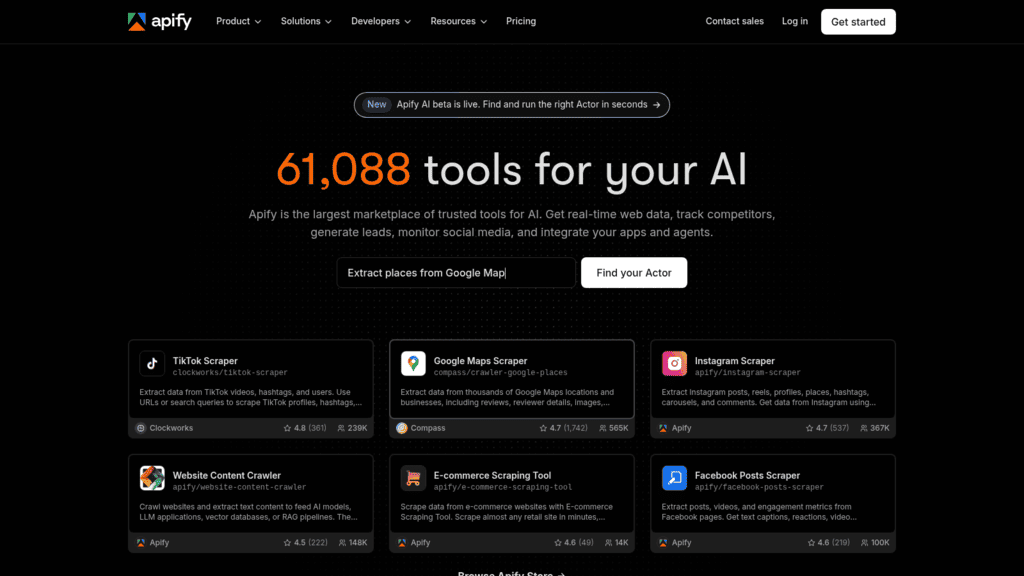
Overview: Apify sells scraping as infrastructure, with a public library of ready-made actors. That makes it the answer when the profiles you want live somewhere nobody packages commercially: regional registries, vertical directories, marketplace listings.

Key features:

  • A public library of ready-made actors spanning a wide range of sources
  • Proxies, scheduling and result storage all operated for you
  • The option to author your own actor when no existing one fits

Pricing: Free accounts carry $5 of prepaid usage each month. Paid tiers begin at $29 monthly and climb through $199 and $999, all on top of metered usage, with Enterprise negotiated. Anything unspent is forfeited when the billing cycle closes.

Pros: unlocks sources with no commercial equivalent, operations handled on your behalf, deep actor catalog

Cons: prepaid usage expires monthly, actors break when target sites change, compliance is entirely your responsibility

What it is genuinely good at: Building a profile source that does not exist commercially, at the cost of maintaining it.

Final verdict: The right answer for unusual sources, and the wrong one if a packaged provider already covers your need.

Harmonic

Harmonic as one of the best company profile apis

Overview: Harmonic aims squarely at private markets and early-stage companies, rebuilding its records weekly. Where a company falls inside that focus, no other entry here returns a fuller profile.

Key features:

  • A corpus in the tens of millions for organizations and hundreds of millions for individuals
  • Records rebuilt every week instead of on an irregular crawl schedule
  • Warehouse-native delivery via S3, BigQuery or Snowflake beside the REST API

Pricing: All products are quote-only with no published price. Financing and investor data plus no-code CRM sync are add-ons rather than included.

Pros: rich nested records including people, weekly refresh cadence, warehouse-native delivery options

Cons: publishes no pricing, coverage skews to startups and private markets, add-ons priced separately

Where it beats the alternatives: Depth on companies that are too young or too private for traditional providers to describe well.

Final verdict: The strongest record here for venture and startup-focused work, sold through a conversation.

Crunchbase

Crunchbase as one of the best company profile apis

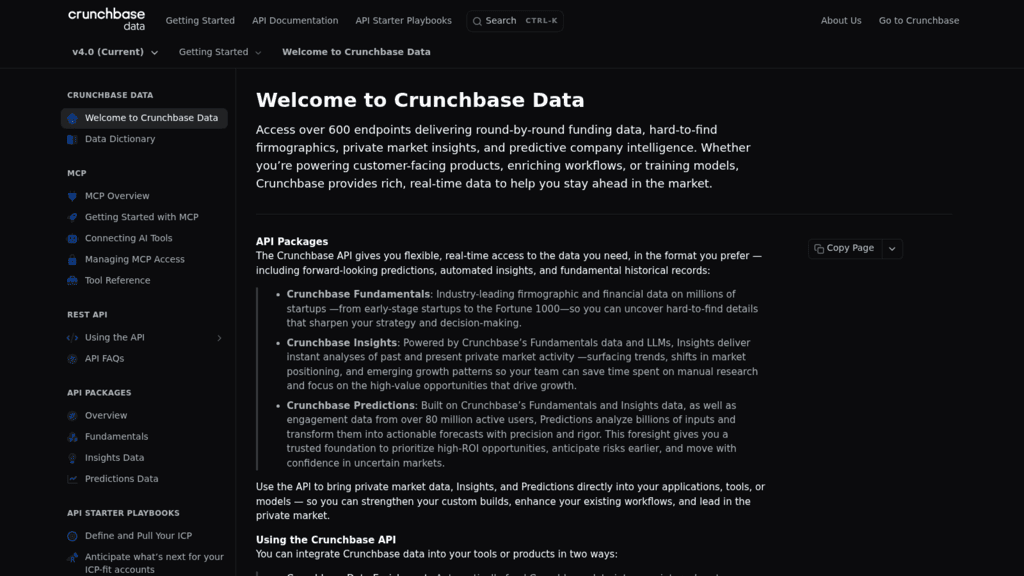
Overview: Crunchbase is the reference source for funding history, and its REST API exposes the same data that powers its website, though access is granted rather than simply purchased.

Key features:

  • Funding rounds, investors, acquisitions and IPO history
  • Read-only REST API mirroring the public dataset
  • Entity permalinks that stay stable across name changes

Pricing: API access requires approval as a developer rather than a self-serve signup, and per-tier API pricing is not published on the public pricing page.

Pros: authoritative funding data, stable permalinks as join keys, well-documented REST interface

Cons: API access is approval-gated, pricing not published, coverage is thin outside funded companies

Why it earns a place here: Nothing else here describes funding history as reliably, and for investor-adjacent products that is the whole record.

Final verdict: Essential if funding data matters, and worth starting the approval process early.

How We Chose These Company Profile APIs

Each provider needed a documented API returning structured company records, a current product, and a distinct sourcing method. We did not require published pricing, but every entry states whether it exists and whether access is gated.

Two candidates were checked and dropped. NinjaPear, the successor product from the team behind the shut-down Proxycurl, returns a 404 on its own product page, so it could not be verified as a current offering. Brandfetch, which serves company logos and brand assets through an API, blocks automated access entirely and could not be captured or priced.

Neither would have shown up without actually trying them, the same way Proxycurl’s closure only became obvious to anyone who tested it. Ranking well two years ago is no evidence a vendor is still trading.

LinkedIn Company Profile APIs and the Risk Nobody Prices

Four of the seven providers here derive data from LinkedIn, and their marketing pages are consistently quiet about what that means.

Section 8.2 of LinkedIn’s User Agreement prohibits scraping or copying the service with software, bots or scripts, and bars unauthorized automated methods for adding contacts or sending messages. That applies to the provider, and depending on your arrangement, potentially to you.

This is not theoretical. Proxycurl, one of the best-known LinkedIn data APIs, shut down permanently in July 2025 after LinkedIn filed suit alleging fake accounts were used to scrape profiles. Any integration built on it stopped working. The successor product’s page now returns a 404, which is its own kind of answer.

The practical implications are worth stating plainly. Build an abstraction layer so a provider swap is a configuration change rather than a rewrite. Cache what you are permitted to cache so a sudden outage does not empty your product overnight. And avoid architectures where LinkedIn-derived data is the single point of failure for a core feature.

Unipile takes a different approach by operating through a real logged-in account rather than an external index, which changes the risk profile without eliminating it, since the account itself remains subject to the same terms. If you need company records without that dependency, Harmonic and Crunchbase source theirs elsewhere, and our comparison of company lookup APIs covers more providers in that category.

What to Look For in a Company Profile API

Five things determine whether a profile integration ages well.

What a record actually contains. Ask for a real sample response rather than a field list. Nested arrays for locations, funding or employees change your storage design; a flat row does not.

How failed matches are reported. A provider that returns a low-confidence guess as a confident record will quietly poison your database. Look for an explicit confidence score or a clean null.

Whether identifiers are stable. Crunchbase permalinks survive rebrands; domains do not. If you store the provider’s ID, find out what happens to it when a company changes name or is acquired.

Rate limits and bulk paths. Enriching 50,000 records through a synchronous endpoint at a few requests per second takes days. Check for a bulk or async route before you plan the migration.

Refresh cadence. Harmonic refreshes weekly; scraped sources refresh when you call them; cached indexes vary. Match the cadence to how fast the fields you care about actually change.

There is a cost argument underneath all of this. Gartner’s survey of 210 sales leaders found AI saves sellers an average of 4.8 hours a week, while 72% of sales organizations fail to reinvest that time in high-value activity. Automated profile lookups only pay off if the saved research turns into more conversations rather than simply less work, which is the same conclusion our lead enrichment roundup reaches from the data side.

How Much Do Company Profile APIs Cost?

Entry prices span more than an order of magnitude, and two providers will not quote at all without a conversation.

Tool Published pricing Entry price Billed on
Apify Yes $29/month Prepaid usage plus overage
Lix Yes $31/month Plan tier and credits
Reply.io Yes $49/month Active contact count
Unipile Yes EUR49/month Connected accounts
ScrapIn Partly $500 pay as you go Credits, 12-month validity
Crunchbase No Approval required Negotiated
Harmonic No Quote only Negotiated

We meter differently again: our API charges on the size of the contact set you keep, not the number of records you pull, which suits you only if messages are the end goal.

Those models are not comparable per record. Unipile’s unlimited calls on an account fee is unbeatable at high volume per account and pointless at one lookup a week, while ScrapIn’s $500 entry buys freshness that a cached index cannot match at any price.

Work out your monthly lookup volume and how stale a record may be before comparing anything, since those two numbers move the ranking more than the price does. Teams whose real need is people rather than organizations should start from our B2B data APIs comparison instead.

How to Design a Company Profile Integration

The integration is straightforward. Keeping it correct as data changes is where the work sits.

Choose the Join Key Before You Write Code

Pick domain, provider ID or registry number deliberately and store all of them where available. Retrofitting a different key across a populated database is among the most tedious migrations there is.

Store the Raw Response, Not Just Your Mapping

Keep the provider’s full payload alongside your parsed fields. When you later need a field you did not originally map, you have it without re-purchasing every record.

Record Provenance and Timestamps on Every Field

Store which provider returned each value and when. Multi-provider setups make this essential, and it is the only way to answer why two systems disagree about a headcount.

Handle Partial Matches Explicitly

Decide in advance what confidence threshold you accept and what happens below it. Writing an uncertain match into the same field as a certain one destroys the distinction permanently.

Refresh on a Schedule Matched to the Field

Headcount and funding change on different clocks than industry or location. Refresh volatile fields quarterly and stable ones far less often rather than re-enriching whole records on a fixed cycle, which is the same discipline that keeps prospecting tools accurate over time.

Designed that way, provider changes and data corrections stay cheap instead of becoming migrations.

Matching a Provider to the Record You Need

Work backward from the field that actually matters.

If you need funding history, Crunchbase is the reference source and the approval process is worth starting early. If you need depth on young private companies, Harmonic’s weekly-refreshed records are the strongest here. If you need LinkedIn-shaped company and people data, Lix is the cheapest entry and ScrapIn the freshest, with the platform dependency that both carry. If you are building LinkedIn functionality into a product rather than pulling data, Unipile is the layer designed for it. And if your source is not packaged by anyone, Apify is the honest answer, with maintenance as the price.

If the profile lookup is really a step toward contacting someone, that is where we fit, downstream, with the boundary restated: we filter on company attributes, we do not return a company profile from an identifier.

Whatever you choose, request a real sample response for three companies you know well, including one subsidiary and one that recently rebranded. Those cases reveal more about a provider’s entity resolution than any coverage number on its homepage.

Frequently asked questions

What is the difference between a company profile API and a company lookup API?

The terms overlap heavily and many vendors use them interchangeably. The useful distinction is depth: a lookup usually resolves an identifier to a canonical company and returns a compact record, while a profile returns a fuller object that may include locations, headcount history, funding, technologies and employees. If you only need to confirm which company a domain belongs to, a lookup is cheaper and faster.

Is there an official LinkedIn company profile API?

Not for general prospecting use. LinkedIn’s own APIs are partner-gated through its Marketing and Talent Solutions programs and are not self-serve purchasable. Everything sold as a “LinkedIn company profile API” is a third party sourcing that data independently, which LinkedIn’s User Agreement prohibits. Providers have shut down over this, most notably Proxycurl in July 2025, so build with a provider swap in mind.

What does a company profile API endpoint usually look like?

Most providers expose three shapes. An enrich endpoint takes an identifier such as a domain or LinkedIn URL and returns one record. A search endpoint takes filters and returns many records with pagination. A bulk or async endpoint accepts a batch and returns a job you poll, which is what you want above a few thousand lookups. Check the failed-match behavior, since a null and a low-confidence guess are very different for your data quality.

Can I get company profiles and email addresses from one API?

Sometimes, though the combined providers are usually weaker at one half. Contact enrichment and company profiling are distinct datasets built differently, so many teams pair a profile provider with a separate contact source. Our own platform sits on the contact and outreach side and does not return company profiles from a lookup, which is why this list ranks the profile specialists above us for that specific call.

How much does a company profile API cost?

Published entry prices here run from $29 a month at Apify to $500 for a ScrapIn pay-as-you-go bundle, while Harmonic quotes and Crunchbase gates access behind an approval process. Billing models differ enough that per-record cost is the only fair comparison: account-based pricing like Unipile’s favors high volume per account, while credit models favor sporadic use.

Subscribe to our blog to receive the latest updates from the world of sales and marketing.
Stay up to date.

Related Articles

How to Build and Use an Automated Follow Up System in 2026

How to Build and Use an Automated Follow Up System in 2026

How to Build and Use an Automated Follow Up System in 2026
How to Build a B2B Marketing Automation Strategy for 2026 and Beyond

How to Build a B2B Marketing Automation Strategy for 2026 and Beyond

How to Build a B2B Marketing Automation Strategy for 2026 and Beyond
Best AI GTM Agent Tools for Future-proof B2B Teams in 2026

Best AI GTM Agent Tools for Future-proof B2B Teams in 2026

Best AI GTM Agent Tools for Future-proof B2B Teams in 2026