15+ Company Research Tools for Faster B2B Outreach
George Vitko05 Mar 2026
Most outbound doesn’t fail because the copy is bad. It fails because the targeting is lazy.
You’re emailing the wrong companies, the wrong people, at the wrong time… and then you call it “low reply rates.” In reality, you just didn’t have the context.
Company research tools fix that. They help you quickly answer the questions that actually matter before you hit send: Who’s the buyer? What’s changing inside the account? What stack do they run? Are they hiring, expanding, or actively evaluating tools?
This guide breaks down 15+ research tools that speed up B2B outreach, what each category is best for, and how to use them without turning research into a full-time job.
What do company research tools do, and why are they essential?
Company research tools give B2B teams reliable company + contact context so outreach is targeted, timely, and grounded in reality.
At a practical level, they help you:
identify the right accounts (and filter out bad fits)
find and validate decision-makers
spot triggers that make outreach feel “right now” instead of random
The payoff is simple: faster list-building, cleaner segmentation, better qualification, and outreach that’s relevant enough to earn replies.
Most tools fall into a few buckets: databases, enrichment platforms, intent providers, and competitive/market intelligence. The next section breaks down the best options across those categories.
Which tools are the best for effective B2B company research in 2026?
There’s no shortage of tools here, but they’re not all built for the same job.
Some are best for raw coverage (big databases). Others shine on intent signals, enrichment, technographics, or tracking company changes over time. And yes, some are “free,” but usually limited enough that they only work as a supporting layer.
Below is a curated list across databases, intent providers, and AI-powered research platforms, with a quick comparison table first so you can scan the landscape before diving into the details.
Tool
Primary strength
Best for
Jason AI
AI prospecting, multichannel automation, automatic meeting booking, 1+billion lead database, and more.
Full-cycle automated prospecting and outreach
Saleshandy
Bulk prospecting, cold email
SMB outbound campaigns
LinkedIn Sales Navigator
Decision-maker discovery
Relationship-based selling
Bombora
Intent surge data
Intent-driven prioritization
Cognism
GDPR-compliant global data
EU prospecting
UpLead
Verified emails, technographics
Segmented list building
Seamless.ai
AI verification, large filters
Enterprise list scaling
Lusha
EU contact data
Compliant outbound
Adapt.io
Lead scoring, SaaS focus
Tech sales teams
ZoomInfo
Enterprise data depth
Large GTM operations
Lead411
Direct dials, intent triggers
Phone-based outreach
Apollo.io
Data + outreach automation
Startups, mid-market
Crunchbase
Funding intelligence
Trigger-based targeting
SalesIntel
Human-verified US data
High-accuracy dialing
LeadIQ
LinkedIn capture + CRM sync
Social prospecting
Recollective
Qualitative research
Buyer insight analysis
AI Assistants
Public data analysis
Contextual account research
1. Jason AI SDR
Jason AI from Reply.io tops our list of company profile research tools. Unlike most options on this list, Jason is an AI-powered sales agent that can do more than just help you find targeted accounts.
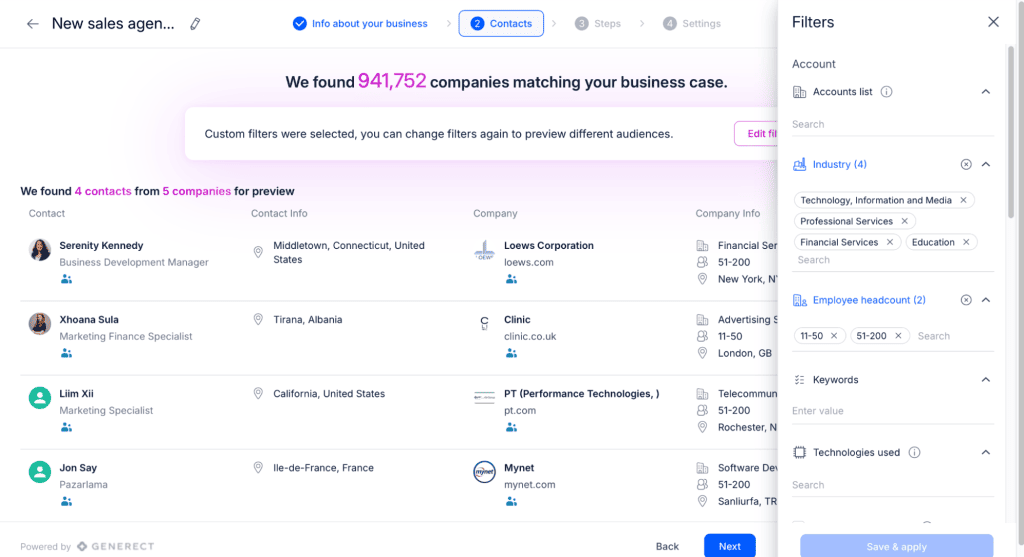
First, Jason learns about your product, ideal customer profile (ICP), and positioning. Then, it sources leads that match your ICP from its native database of 1B+ B2B contacts and companies. It then enriches each qualified account with additional context from LinkedIn, company websites, and more, and identifies key decision-makers within those companies.
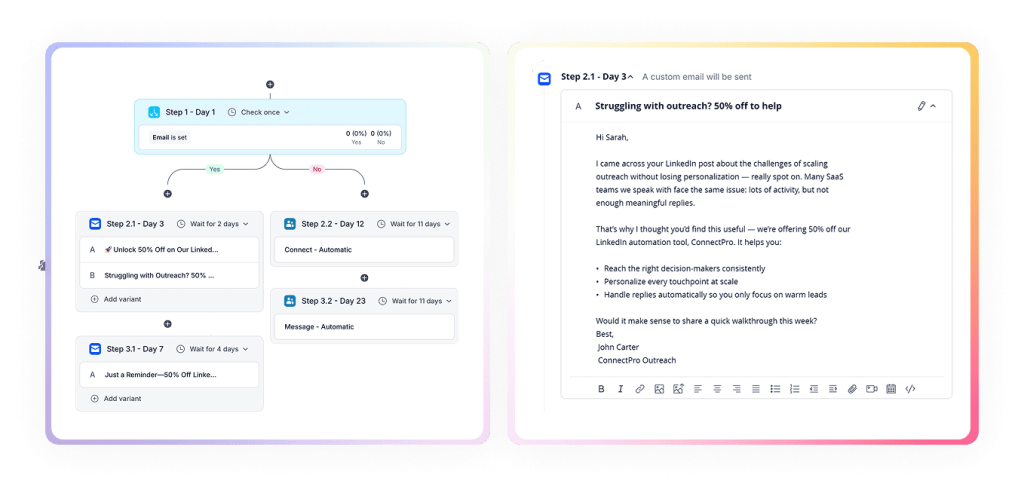
After that, Jason uses that data to write personalized emails, follow-ups, and LinkedIn messages across tailored, multichannel sequences. These sequences follow conditional logic, meaning they adjust the messaging, channel, and timing in real time based on prospect behavior.
Jason AI also responds to replies and handles objections based on your custom sales playbook, and even books meetings on your behalf.
Key features:
Native B2B database (1B+ contacts): Gives you access to global companies and verified decision-makers across industries and regions.
Multichannel automation: Launches coordinated outreach campaigns at scale, but tailored to each unique lead.
AI personalization engine: Generates tailored messaging based on company data, LinkedIn insights, and more, along with its AI variables feature.
Real-time intent signals: Enables you to prioritize accounts already researching related solutions or showing clear signs of interest.
Native calendar integration: Allows you to book qualified meetings instantly.
50+ language support: Enables you to launch global outreach campaigns with localized messaging.
Verdict:
Jason is one of the best AI tools for company research, offering automated full-cycle prospecting, outreach, reply management, and meeting booking under one roof.
2. Saleshandy Lead Finder
Saleshandy Lead Finder is built for bulk prospecting when you want to go from simple search to building contact lists fast. It pulls work emails and phone numbers, lets you filter by role and company attributes, and can drop leads into your outreach flow without living in spreadsheets. What’s nice is that it’s not just about finding emails but checking multiple sources to return accurate contact and account details in real time.
Key features:
Email + phone discovery for B2B contacts
Filtering for targeted list building
Real-time enrichment from multiple sources
Export/sync into outreach workflows
Verdict:
Good for SMB teams that want quick list building with contact details they can actually send to.
3. LinkedIn Sales Navigator
Sales Navigator is still the fastest way to understand who matters inside an account. You get deeper filters than standard LinkedIn, plus tools that help map relationships, spot job changes, and find the next-best stakeholder when you’re multi-threading. It won’t hand you verified emails, but it’s hard to beat for deciding who you should talk to and what changed in your target accounts recently.
Key features:
Advanced lead/account search and filtering
Relationship Explorer / relationship mapping
Lead highlights like job changes and activity
InMail messaging
Verdict:
Best when your workflow starts with LinkedIn research and relationship paths.
4. Bombora
Bombora is intent data, plain and simple. It tracks topic-level research behavior and flags companies showing a surge in interest around specific themes, so you can prioritize accounts that are actively researching your category. It’s not a contact database, so you still need people + emails from somewhere else, but as a timing signal it can be very useful.
Key features:
Company Surge intent signals
Topic and cluster-based intent tracking
Integrations/activation into GTM workflows
Account prioritization based on intent
Verdict:
Best as a “who’s in-market” layer to rank accounts before outreach.
5. Cognism
Cognism is a data provider that leans hard into compliance and phone coverage, especially for Europe. If you prospect in regulated markets and care about direct dials, that’s a big part of the appeal. Cognism also talks about building GDPR compliance into the platform, including things like DNC checking.
Key features:
GDPR-first compliance positioning
Phone-verified mobile/direct dial focus
Strong EMEA coverage
CRM workflow integrations
Verdict:
A solid choice when Europe coverage and compliance controls are non-negotiable.
6. UpLead
UpLead is mainly about verified data and clean segmentation. The platform highlights real-time email verification, plus firmographic and technographic filters so you can build lists that match your ICP instead of guessing. It’s typically used as a “find + verify + export” tool, then you run outreach elsewhere with an AI platform like Reply.io.
Key features:
Real-time email verification
Technographic + firmographic filtering
List building and exports
Enrichment options for contact records
Verdict:
Good when deliverability and list quality matter more than additional automation around outreach, personalization, and so on.
7. Seamless.ai
Seamless.ai is a high-volume contact discovery tool that talks openly about crawling the web in real time to find and validate contact information. In practice, teams use it to build big lists quickly, then push that data into their outreach stack. Seamless also offers a separate enrichment product meant to keep all records current.
Key features:
Real-time contact search and validation
Data enrichment for stale records
Filters to narrow searches (including technographics)
Team features to reduce duplicate research
Verdict:
Best for teams that want volume and speed, and can manage the downstream cleaning and sequencing.
8. Lusha
Lusha is popular for one reason: the browser workflow. You’re on LinkedIn (or another B2B site), click the extension, and pull verified contact details without leaving the page. It also emphasizes GDPR/CCPA compliance and third-party audits, which is relevant if your team sells across regions. Once again, you’ll still need an outreach platform like Reply.io to actually turn that data into AI-personalized emails and LinkedIn messages, but it’s a solid data/intelligence layer nonetheless.
Key features:
Chrome extension for contact discovery
Verified emails and phone numbers
Compliance messaging (GDPR/CCPA)
CRM integrations
Verdict:
A strong pick for LinkedIn-heavy prospecting when you want speed and compliance guardrails.
9. Adapt.io
Adapt.io is more of an enrichment + scoring layer than a “click and export 10k leads” tool. It adds firmographic/technographic context to records, then helps score and route leads based on multiple parameters. If you care about keeping your CRM fresh, it also pushes API-based enrichment pretty hard.
Key features:
Firmographic + technographic enrichment
Lead scoring and routing tools
API-driven enrichment workflows
Data integrity / refresh focus
Verdict:
Best when you already have leads and need better scoring, qualification, segmentation, and cleaner CRM data.
10. ZoomInfo
ZoomInfo is the enterprise-grade sales intelligence solution — large company/contact coverage plus layers like intent and website visitor identification. WebSights is their visitor product, which identifies companies visiting your site and can be used as a prioritization signal. It’s not lightweight, but for teams that want deep segmentation and a data backbone feeding multiple systems, it’s a very solid choice.
Best for enterprise GTM teams that need scale, segmentation depth, and intent/visitor signals in one stack.
11. Lead411
Lead411 combines a contact database with buyer intent messaging and leans into unlimited searches/exports as part of its positioning. It also emphasizes verified emails and direct dials. In practice, it fits teams that want prospecting data plus extra prioritization context, without living inside a credit-based model.
Key features:
Verified emails and direct dials
Buyer intent data positioning
Unlimited searches/exports
Company data for targeting
Verdict:
Good for outbound teams already have outreach software and simply want contact data plus intent signals, without micro-managing credits.
12. Apollo.io
Apollo is a combined prospecting + outreach platform. You can research accounts, build lists, enrich contacts, and push into sequences in the same place. One thing to be aware of: Apollo uses a credit system for activities like exporting contacts outside the platform, so the way and scale you use it matters for budgeting and workflow design.
Key features:
B2B database for prospecting and list building
Integrations with common sales stacks
Outreach and engagement features (within platform scope)
Export credits / credit system for platform activities
Verdict:
Best when you want research + sequencing under one roof and are fine designing around the credits model.
13. Crunchbase
Crunchbase is a company intelligence platform, not a contact database. It’s useful for relevant account triggers: funding rounds, investors, acquisitions, leadership events, and news signals. That makes it great for timing research and account selection, then you take the company list to a B2B database like Reply Data to find the decision-makers within those firms.
Key features:
Funding/investor data and filters
Company profiles with news and signals
Key people events and leadership changes
Company Insights features (analysis layer)
Verdict:
Best for spotting high-growth accounts and timing outreach around real events.
14. SalesIntel
SalesIntel’s core pitch is accuracy. They talk about human-verified records and a rolling refresh cycle, plus a big focus on direct dials. If your team is tired of calling dead numbers or emailing stale addresses, this is the kind of tool that’s built around fixing that problem first. One thing to keep in mind is that this platform won’t have the more advanced AI features like deep personalization, multichannel outreach, LinkedIn automation, or advanced analytics that tools like Reply.io offer.
Key features:
Human-verified contact records
Rolling refresh cycle (90-day positioning)
Direct dial and mobile emphasis
Enrichment workflows for RevOps/data hygiene
Verdict:
Strong option for US-heavy outbound teams that care about data accuracy and phone coverage more than bells and whistles.
15. LeadIQ
LeadIQ is another tool built for reps who live in Chrome. It’s a LinkedIn-centric capture workflow: find a person, grab contact data, see whether the record already exists in your CRM/sales tools, and sync it in one click. It also shows basic company context (industry, size, news/funding) right in the extension, which speeds up first-pass research.
Key features:
Chrome extension for capture + enrichment
CRM and sales engagement syncing
Visibility into sync status / duplicates
Company insights surfaced during research
Verdict:
Best for LinkedIn-first teams that want research → capture → sync to feel effortless.
16. Recollective
Recollective is a different kind of company research tool. It’s designed for qualitative research and insight communities: gathering feedback, running async and live activities, and pulling out themes from real customer language. It also highlights AI-powered analysis to help summarize large volumes of qualitative input. This won’t replace your contact database, but it’s very useful when you want sharper messaging and better objections handling grounded in actual buyer feedback.
Key features:
Online qualitative research and insight communities
Async + live research activities in one platform
AI-assisted analysis
Reporting for themes and sentiment
Verdict:
Best as a supporting layer for messaging, positioning, and buyer insight, not lead sourcing.
17. AI-powered research assistants
These tools help with the context side of account research. They’re useful for summarizing public updates, pulling key points from news/press, and giving you first-pass angles before outreach. Perplexity stands out by providing clear citations with answers, which helps when you want to validate sources quickly, while Delve AI leans more toward persona and competitor-style analysis. Other ChatGPT alternatives can help, but none of these replace verified contact data, they simply make your pre-outreach research much faster.
Key features:
Web-backed summaries with citations (Perplexity)
Competitor/persona-style analysis (Delve AI)
Fast account briefs to support personalization
Verdict:
Great for speed and context, but you still need a database/enrichment tool for verified decision-makers, plus an outreach tool like Reply.io to turn that data into meaningful connections.
How to choose the right company research tool for your B2B outreach?
Not all research tools solve the same problem. Some are great at coverage, others win on data freshness, and some are only useful if you already have a strong outbound stack around them.
Here’s what actually matters when you’re picking one:
Coverage that matches your market: database size is irrelevant if it’s weak in your region, industry, or seniority level.
Accuracy and freshness: look for verification and frequent refresh cycles so you’re not emailing dead inboxes or calling the wrong person.
Filters you’ll really use: firmographics, tech stack, intent, and triggers (funding, hiring, leadership changes) should be easy to apply.
CRM + outreach integrations: you want the tool to drop contacts into your CRM and outbound tool with ease.
Intent + company-change signals: this is what gives you timing — funding, hiring spikes, tech changes, new leadership, “in-market” behavior, and so on.
Compliance controls: make sure it supports the basics out of the box (GDPR/CCPA/DNC), and that opt-outs/suppression lists are handled properly.
Pricing that doesn’t punish you for scaling: don’t just look at the starter price. Look at what happens when you add seats, export more data, or grow usage.
How to use company research tools for top-performing outreach?
Good outreach is mostly workflow. You define who you want, filter down to the right accounts, prioritize by intent, then push clean data straight into execution. If any of those steps are sloppy, you feel it in replies.
Here’s the practical approach:
Start with a tight ICP: industry, company size, triggers, and the roles you actually want to talk to.
Use layered filters: firmographics first, then technographics, then roles/seniority, then intent signals.
Prioritize before you send: score accounts by fit + activity so you’re not spending touches on low-probability targets.
Sync data into outreach systems: avoid CSV workflows. Push enriched records into your CRM/outbound tool and personalize using real fields (not fake “nice website” lines).
This is also where tools like Jason AI shine: it takes the enriched company/context data, turns it into AI-personalized emails and LinkedIn messages, and runs multichannel sequences that adjust timing and channel based on engagement.
Capture data while researching: extensions and quick enrichment reduce manual lookup time.
Keep data clean: dedupe, suppress bounces, re-verify regularly so deliverability doesn’t degrade.
If you want a simple mental model: target → filter → enrich → prioritize → sync → outreach → review → iterate.
Choosing the best company research tools for B2B outreach
Good outreach is built on three things: accurate data, filters that match your ICP, and a workflow that doesn’t fall apart the moment you try to scale.
Pick tools based on where you sell (coverage), how fresh the data is (verification/refresh), what you need to segment on (firmographics, tech stack, intent), and how cleanly everything plugs into your CRM and outbound stack. If a tool forces constant exports and deduping, it’s not really saving time or worth the investment.
And don’t overthink about building the “perfect stack.” A practical setup is usually more simple than most thing: one solid database, one enrichment layer (if needed), and something that turns research into outreach without manual glue.
If you want to execute that end-to-end in one place, Reply.io’s native database makes it easy to find target accounts and decision-makers, and then launch AI-powered outreach right away with just a few clicks.
Subscribe to our blog to receive the latest updates
from
the world
of sales and marketing. Stay up to date.
We use cookies to enhance your browsing experience, serve personalised ads or content, and analyse our traffic. By clicking "Accept All", you consent to our use of cookies.