30+ Best Alternatives to “Looking Forward to Working With You” in 2026
Eugene Suslov01 Mar 2026
Most people end emails the same way because it’s easy. The problem is that the same handful of sign-offs have been copy-pasted into oblivion, so they don’t sound thoughtful anymore. They sound like a template.
In this guide, you’ll get practical alternatives you can drop into real emails (cold outreach, follow-ups, partnerships, intros, and everything in between). You’ll also learn a simple way to create your own variations so your closing actually fits the situation — and how to use AI to generate tailored sign-offs that match the tone and stage of the conversation.
Why your sign-off matters more than you think
Generic closings create inbox fatigue. They also make a message feel mass-sent, even if the rest of the email is decent.
Here’s why it’s worth changing them up:
Less template energy: Overused lines like “looking forward to working with you” read like autopilot.
More replies: Small language tweaks can change engagement, and the sign-off is part of that.
Stronger first impression: Your last line is what lingers — make it sound like a person wrote it.
Better tone in remote work: When everything is text, the closing does a lot of “tone work” for you.
More context alignment: A first touch, a follow-up, and a warm reply shouldn’t all end the same way.
And when you’re running outbound at scale, context alignment is where tools like Reply.io help in a practical way: you can keep messaging consistent while still personalizing closings with AI based on the sequence step, the channel, and previous engagement.
How to Write Un-ignorable Cold Emails: The Ultimate Guide
This e-book is your essential tool for mastering effective cold email outreach. Dive into a comprehensive guide that walks you through refining your outbound strategy, from crafting compelling subject lines to creating irresistible email templates tailored to your target audience.
What are the categories of alternative phrases, and when to use them?
Your sign-off isn’t a throwaway line. It’s the last impression you leave, and it quietly signals intent.
That’s why the same closing can land totally differently depending on the situation: cold outbound vs warm follow-up; founder vs procurement; fast-moving startup vs regulated enterprise; first email vs late-stage “we’re aligned” thread, and so on.
Below are the main categories that cover 95% of real-world use cases. Each one has a “when to use it” guideline along with a list of examples you can use for your outreach.
Energetic and enthusiastic alternatives
Use these when the conversation already has momentum. Demos that went well, a positive reply, a partnership thread where both sides are leaning in. The trick is to sound confident without sounding like a hype machine.
Use when: early-stage excitement, clear interest, collaborative tone Avoid when: the prospect hasn’t shown interest yet (it can feel presumptive)
Examples:
Eager to collaborate
Excited to get started
Looking forward to building this together
Keen to kick this off
Excited to move this forward
Looking forward to getting momentum here
Ready to get rolling
Dialogue-inviting alternatives
These are your highest-ROI closings for cold outreach and follow-ups. You’re not assuming anything, you’re making it easy to reply, and you’re pushing the thread forward without sounding pushy.
Use when: cold outreach, discovery, follow-ups, “sanity check” messages Avoid when: the next step is already agreed and you just need a yes/no
Examples:
Would love your thoughts
Curious what you think
Open to your feedback
Happy to talk it through
Does this direction make sense?
Worth a quick chat?
Any quick reaction?
What would you change here?
Flexible and accommodating alternatives
Use these when there’s a real process to follow, not a quick yes/no decision. Enterprise deals, procurement, multiple stakeholders, internal projects with dependencies. You’re signaling professionalism and respect for how they operate.
Use when: enterprise, procurement, stakeholder-heavy decisions, scheduling friction Avoid when: a simple “yes/no” would be better (don’t overcomplicate)
Examples:
Open to your preferred next step
Happy to align with your timeline
We can adjust based on your priorities
Available to sync when it works on your end
Let me know what works best for your process
We can take this in phases if helpful
Happy to follow your lead here
Informal and friendly alternatives
These are great, but only when you’ve earned them. Use them with startups, internal teams, warm intros, or when the thread already has a casual tone. If you do this too early, it can feel slightly off.
Use when: rapport is established, startup culture, internal comms, warm LinkedIn Avoid when: first-touch outreach to a formal buyer
Examples:
Looking forward to teaming up
Let’s make this happen
Excited to work together
Keen to dive in
Appreciate it — talk soon
Sounds good, speak soon
Looking forward to it
Professional and formal alternatives
These are for conservative audiences: finance, legal, government, heavily regulated industries, or senior execs who prefer clean, formal language. The goal is straightforward professionalism, not personality.
Use when: formal orgs, exec comms, regulated industries Avoid when: the thread is clearly casual (it can feel stiff)
Examples:
I welcome the opportunity to work together
Looking forward to a productive collaboration
Thank you for your consideration
Appreciate your time and attention
Respectfully
Thank you in advance
Collaborative and partnership-focused alternatives
Use these when it’s genuinely a two-way partnership. Joint initiatives, integrations, co-marketing, long-term contracts, strategic relationships. The point is shared outcomes, not sales in its traditional sense.
Use when: partnerships, alliances, long-term initiatives Avoid when: you’re doing a straightforward transactional sale
Examples:
Looking forward to achieving shared goals
Ready to move this forward together
Excited to collaborate closely
Looking forward to partnering on this
Looking forward to aligning on next steps
Excited to build a strong working rhythm
Looking forward to a long-term collaboration
Expertise-acknowledging alternatives
These are useful when you’re speaking to someone senior or highly specialized. The goal is to show respect without sounding like flattery. Keep it grounded in something real, be it their role, their experience, or the decision in front of them.
Use when: exec outreach, technical buyers, advisors, specialists Avoid when: it’s a basic outbound email with no context
Examples:
I’d value your input here
Appreciate your perspective on this
Keen to hear your recommendations
Would love your take on this
Looking forward to learning from your insight
Interested in how you’d approach this
Appreciate any guidance you can share
Brief and concise sign-offs
Best for late-stage threads, reminders, and high-volume sequences where the email itself is already short. The key is to stay polite while keeping it frictionless.
Use when: follow-ups, reminders, late-stage “just confirm” threads Avoid when: you still need to establish trust or explain context
Examples:
Thoughts?
Ready when you are
Happy to move ahead
Let me know
Quick yes/no is fine
These brief, concise sign-offs are effective when you want to be clear and efficient at the same time.
When you’re writing one email, picking the right sign-off is easy. When you’re reaching out to hundreds of people, it’s easy to fall back into generic closings.
Reply.io helps you keep the sign-off contextual and personalized at scale, along with the rest of the email.
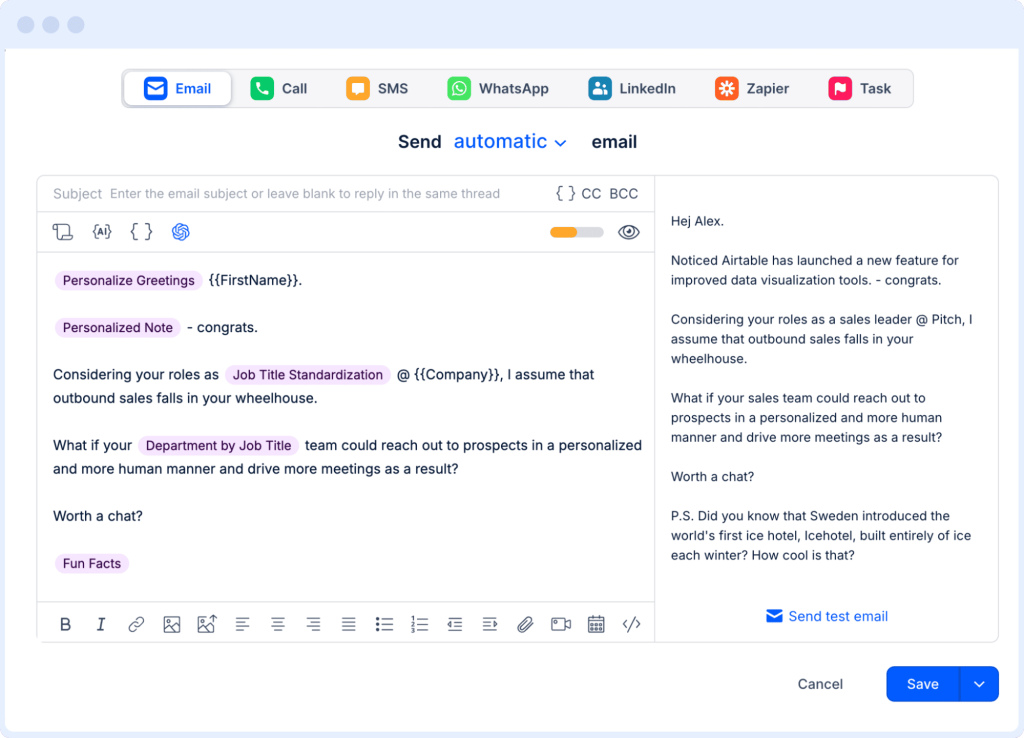
With its AI Variables feature, you can tailor closings based on role, stage, and engagement (cold prospect vs warm reply), then run it across multichannel sequences so the tone stays consistent whether the touchpoint is email or LinkedIn:
Each recipient will get a truly personalized email intro, main body, and ending, all based on AI-researched context from their LinkedIn, company websites, and more.
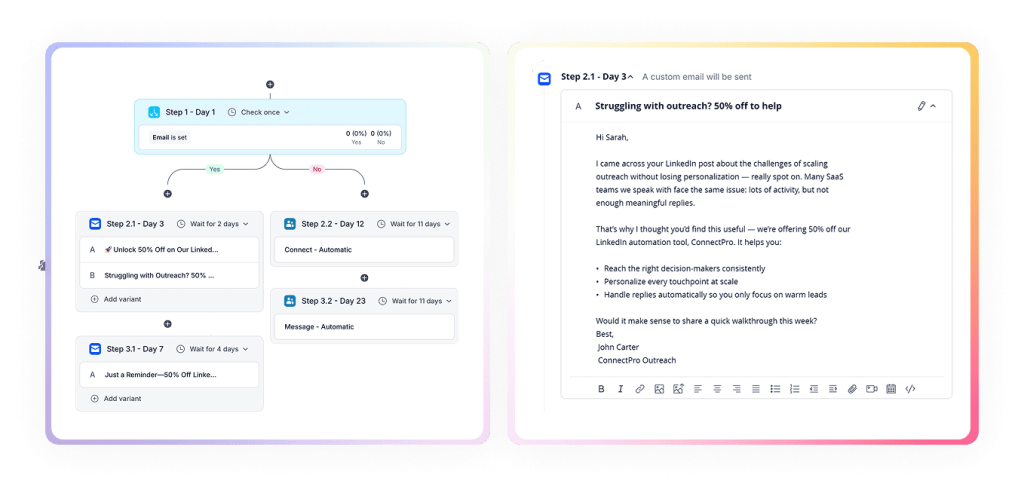
With its conditional logic, each sequence will adjust messaging, channel, and timing based on each recipient’s behavior in real time. So if your first email went unopened, Reply sends out an automated LinkedIn connection request; once accepted — Reply crafts a personalized LinkedIn message and cancels the scheduled email follow-up, and so on.
How to craft your own alternative phrases?
You don’t need a giant swipe file of sign-offs. What you need is a repeatable way to write a closing that feels specific, natural, and aligned with the rest of the email.
The mistake most people make is treating the sign-off as a generic polite ending. It shouldn’t be detached from the message. It should keep the conversation going.
Here’s a practical framework you can reuse:
1) Start with a warm, genuine greeting (yes, it matters)
If your opener is generic, your closer will feel generic too.
Use their name, and reference one real detail from the interaction:
the demo you just ran
a timeline they mentioned
their expansion/hiring plans
a shared goal you discussed
That one detail is what makes your final line feel earned, not copy-pasted.
2) Express anticipation, but make it concrete
“Looking forward to…” is fine when it points to something real.
Tie your anticipation to a milestone, decision, or outcome:
“Excited to see whether this fits your Q3 hiring plan.”
“Looking forward to aligning on rollout steps.”
“Keen to map this to your current pipeline goals.”
Vague enthusiasm reads like fluff, but specific anticipation reads like intent.
3) Invite collaboration instead of ending on a statement
Strong closings invite a response. They make it easy for the other person to engage without thinking too hard. Examples:
“Happy to adjust the scope based on your priorities.”
“Open to feedback if you want to tweak the approach.”
“If there’s a constraint on your side, tell me and I’ll adapt.”
This works especially well in procurement-heavy or stakeholder-heavy deals, where “yes” is rarely immediate.
4) Close with direction (a clear next step)
Your last line should either ask for confirmation, propose a time, or clarify what happens next. Examples:
“Want me to send two time options?”
“Does Thursday work for a quick follow-up?”
“If you’re aligned, I’ll share the next step doc.”
This is where sign-offs stop being simply polite and start being actually useful.
The reusable formula
If you want something you can repeat every time, use this:
Greeting + Context + Specific anticipation + Support/invite + Next step
Here’s what that looks like in a real email:
“Hi Sarah. Thanks again for taking the time to review the proposal. If this lines up with your Q3 expansion timeline, I’m excited to collaborate on a rollout that fits how your team works today. Would Tuesday or Wednesday be better for a quick 15-minute alignment call?”
Quick quality check before you hit send
Remove filler, keep it tight.
Avoid exaggerated enthusiasm (it rarely matches the buyer’s tone).
If the closing could fit any email in any industry, rewrite it.
Read the full message once so the ending matches the tone you used above.
That’s the difference between a sign-off that sounds like a template and one that feels like it belongs in the thread.
How to use alternatives effectively in different communication channels?
A good sign-off can still fall flat if it doesn’t match the channel. Email gives you space, chat and LinkedIn need tighter wording, while calls are mostly tone, then the follow-up email does the real work.
Email is where you can be the most intentional. Match the closing to the audience and level of formality.
More formal (execs, offers, external partners): “Looking forward to supporting your transition into the role. Let me know if anything is unclear before Monday.”
Internal / kickoff style: “Excited to get this rolling. Want to sync tomorrow to confirm next steps?”
Instant messaging and chat (Slack/Teams)
Keep it short and action-oriented. Long, polished closings feel weird in chat.
“Excited to move this forward. Does 2 PM work?”
“Sounds good — I’ll send a draft by Friday.”
LinkedIn (connection messages + follow-ups)
LinkedIn is casual, but still professional. Your closing should usually invite a reply, not imply a partnership.
Connection note: “Appreciate it — open to a quick chat if this is relevant.”
Post-engagement follow-up: “Thanks for connecting. Curious if you’re the right person to ask about this?”
Video calls and meeting wrap-ups
On the call, tone matters more than the exact phrase. Keep the verbal close simple, then use the follow-up email to anchor it to an action.
On the call: “Looking forward to collaborating on this. Next step is X.”
Follow-up email: “Great speaking today. Excited to move into the next phase we discussed — I’ll send the draft by Friday.”
Quick rules that save you time
Match the closing to the relationship stage (cold, warm, active deal).
Pair the sign-off with a next step when you want momentum.
Keep synchronous channels tighter (chat, LinkedIn DMs) and let email carry the nuance.
If you automate at scale, vary phrasing by stage so every step doesn’t end the same way.
If you’re running multichannel outreach, this is where tools like Reply.io help in a practical way: you can keep your tone consistent across email, LinkedIn, WhatsApp, SMS, and calls, all while using AI Variables to ensure the closing matches the exact recipient, previous communications, and reason for outreach, instead of repeating one generic line everywhere.
What tools and resources can support better email communication?
You can leverage technology to hone your “looking forward to working with you” reply phrasing. Still, you need to know which tools to pick and why.
Below is a rundown of the best tools and resources to help improve your email and workplace communication.
Category
Tools and resources
Primary purpose
AI writing assistants
Grammarly, Jasper AI, Writesonic
Refine tone, improve wording, and generate alternative phrasing.
AI-powered sales outreach platforms
Jason AI SDR
Personalize outreach, automate replies, and book meetings.
Email outreach platforms
ManyReach, Yesware, HubSpot Sales
Run campaigns and track engagement metrics.
Analytics tools
ManyReach, Yesware, HubSpot Sales
Measure performance and test messaging variations.
Tone analyzers and sentiment detection
Hemingway Editor, IBM Watson Tone Analyzer
Evaluate emotional tone and readability before sending.
Collaboration and feedback platforms
Workhuman Conversations, 15Five, Officevibe
Collect structured feedback and monitor engagement trends.
Workflow automation tools
Zapier, Make
Automate follow-ups, reminders, and triggered workflows.
Communication frameworks
AIDA, Psychological Safety Principles, SBAR
Structure persuasive emails and organize workplace communication.
Let’s unpack these tools and resources in more detail:
AI writing assistants
These are your last-mile polish tools. Useful when the email is fine, but the tone is slightly off, or the closing reads a bit stiff. They’re also good at catching repetitive phrasing when you’re writing a lot of outreach in the same week. Grammarly is the obvious one, while Jasper and Writesonic can also help generate variations if you’re stuck.
AI-driven sales outreach platforms
This category matters when you’re past “write one good email” and into “run this across hundreds of contacts without sounding like a robot.”
The real value is not just scale but context: different email closings for a cold prospect vs someone who replied vs someone who clicked.
Reply.io is a prime example here because its AI engine researches each recipient for additional context, and then uses that data to personalize each email, follow-up, and LinkedIn message, even when you’re dealing with thousands of contacts.
Tone analyzers and readability tools
These are “sanity check” tools. They won’t write the message for you, but they can catch when something reads colder than you intended, or when the email is just too dense.
Hemingway is great for readability, while IBM Watson’s Tone Analyzer can help if you’re writing across cultures or into formal industries.
Collaboration and feedback platforms
This one is more internal-facing — it’s about keeping communication consistent across onboarding, partner comms, and team workflows, so you’re not reinventing tone and standards every time.
15Five, Officevibe, Workhuman Conversations are all great examples in this category.
Workflow automation tools
These don’t improve the writing, but they keep your entire process running smoothly: find targeted leads, update CRM fields, trigger follow-ups, route tasks, set reminders, and so on.
Zapier and Make are the usual choices here.
Better sign-offs, better replies
Most people default to the same closing because it’s easy. The downside is it makes your email feel templated and generic, even when the rest of your message is solid and potentially interesting to the recipient.
A simple approach is to match the sign-off to the situation — cold outreach should invite a reply, warm threads can be more upbeat, while enterprise conversations usually need a cleaner, more process-aware closing.
Once you start doing that consistently, your emails read more intentional, your tone lands better, and replies tend to follow.
Don’t overthink it, pick a few alternatives you like, test them in real conversations, and keep the ones that fit your audience and channel.
If you want to scale this without rewriting every variation manually, Reply.io can help you personalize messaging (including sign-offs) across automated sequences and channels. Start a free trial and see it in action right away.
Subscribe to our blog to receive the latest updates
from
the world
of sales and marketing. Stay up to date.
We use cookies to enhance your browsing experience, serve personalised ads or content, and analyse our traffic. By clicking "Accept All", you consent to our use of cookies.