How to Find B2B Contacts in Recently Funded Startups in 2026
Vlad Oleksiienko02 Mar 2026
Recently funded startups are one of the cleanest “timing plays” in B2B. They’ve got new budgets, a real growth mandate, and a short window where they’re actively evaluating tools, services, and partners — before priorities shift and inboxes get flooded.
The catch is execution: you need the right signals, the right people, and a fast outreach loop that doesn’t feel generic.
In this guide, we’ll cover how to spot post-funding buying signals, find verified contacts inside funded startups, choose the right decision-makers (founder vs GTM vs ops), and avoid the common outreach mistakes that kill replies.
What makes recently funded startups good leads?
Recently funded startups are “high intent” for one simple reason: they just got a mandate to move fast.
New capital usually triggers a short burst of activity:
hiring ramps up
tools get evaluated (and replaced)
processes get formalized
growth experiments get funded
That creates a window where they’re actually willing to take calls — not because they love salespeople, but because they’re trying to hit milestones before the next board/investor checkpoint.
A few practical signals that a funded startup is in buying mode:
hiring spikes (especially GTM, RevOps, CS, data)
new leadership hires (new VP = new stack review)
stack changes (new CRM, data tooling, outbound tooling, etc.)
new launches / expansion moves (new segment, new region, new product line)
Funding stage changes the “why” behind the buying:
Pre-seed / Seed: speed, MVP building, early traction, lightweight tools
Series A: pipeline + repeatability, hiring, outbound/inbound systems
Series B+: scale, compliance, reporting, efficiency, operational maturity
And yes — timing is crucial. The best outreach usually happens early, before the inbox gets flooded and the shortlist is already set.
Jason AI helps here by tracking funded startups and surfacing these intent signals that explain why now (hiring spikes, stack changes, growth moves), so you can prioritize the right accounts and reach out with context instead of guessing.
Where to find data on recently funded startups?
If you can’t reliably spot who just raised, you’re basically doing outbound blind. The goal is simple: get fresh funding signals fast, then enrich them with real contacts you can actually reach.
Here are the sources that matter (and how to use them without drowning in tabs):
Outbound data platforms
If you want speed + verified contact data in one place, start here.
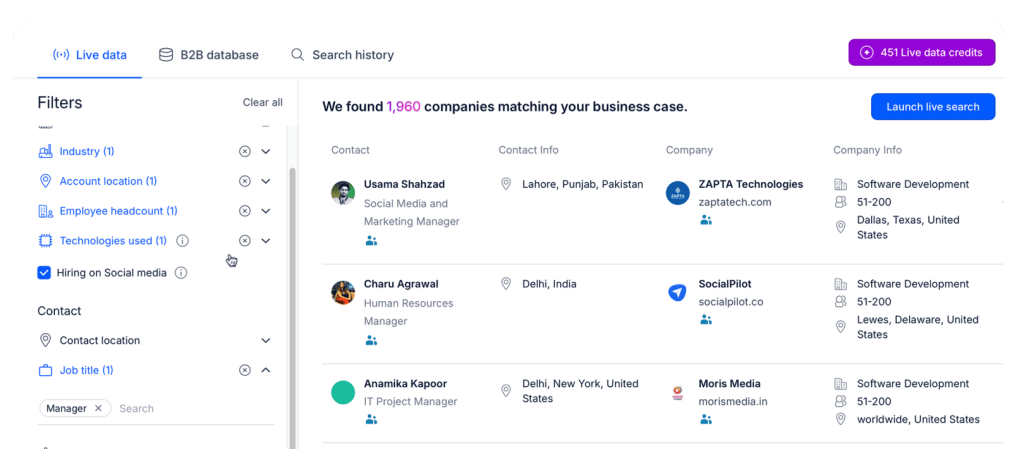
Reply Data is the prime example: find decision-makers at funded startups with verified contact info, then move straight into outreach without stitching together five different tools.
Curated “recently funded” lists (good for speed)
If you prefer curated drops with added context, these can be useful inputs:
Fundraise Insider (curated startup lists with funding context + extras like tech stack insights)
Revli (weekly updates with hiring/context signals and contact freshness)
Think of these as “signal feeds” you can layer into your core prospecting workflow — helpful for coverage, not something you want to manually live inside.
Startup funding databases
These are still solid for confirming rounds, investors, and company basics:
Crunchbase
PitchBook
Dealroom
CB Insights
Freshness and enrichment vary, so they’re best as a “funding truth layer,” then you enrich contacts elsewhere.
Social + press signals (often first)
Funding news often hits social and press before databases fully update:
LinkedIn (founder/VC posts + company updates)
Google News / alerts
VC newsletters + firm blogs
X/Twitter for real-time announcements
Great for timing, weaker for usable contact data.
Vertical lists and niche trackers
If your ICP is specific, niche trackers can beat broad databases on relevance and speed (fintech, biotech, devtools, etc.). Less volume, but more signal.
VC portfolio pages and syndicates
Following the money still works:
VC portfolio / “latest investments” pages
syndicates and angel platforms (early-stage signals before they spread)
Make it scalable (without manual checking)
Once you know your sources, automation is the difference between “nice idea” and repeatable pipeline:
Google Alerts for funding keywords + vertical terms
Feedly/RSS to track VC blogs + funding news
Zapier to push signals into your CRM and outreach tool like Reply.io
And if you’re using Jason AI, a lot of this gets centralized — live funding signals, hiring/stack context, and prioritization — so you’re not rebuilding the same list manually every week.
How to narrow down and segment startups for your outreach?
Recently funded doesn’t automatically mean good account-fit for your unique business. You want funded startups that match your ICP and show signs they’re actively buying.
Here’s a clean way to segment without overthinking it:
Segment by funding round
The funding stage tells you what they’re optimizing for right now:
Pre-seed / Seed: building, testing, trying to get traction fast
Series A: hiring, pipeline, repeatable GTM, tooling for execution
Series B+: scale, infrastructure, compliance, efficiency, multi-team ops
Same company, different stage = different priorities, different messaging, different buyer.
Filter by industry + geography
Pick a few verticals where you actually win (SaaS, fintech, healthcare, AI, etc.), then narrow by region if it impacts your motion (pricing, language, compliance, timezone).
Also, don’t get stuck in US-only thinking. Berlin, London, Singapore… there’s plenty of funded momentum outside the usual hubs, and often less inbox competition.
Add company-level signals (the “are they actually moving?” layer)
Funding stage and industry are table stakes. What matters is what they’re doing after they raised:
Framework names (BANT/CHAMP) are fine, but don’t turn this into an academic exercise — you’re just trying to rank accounts so your best outreach goes first.
Jason AI can remove all this manual work by auto-scoring accounts using funding + hiring + stack + intent signals, then producing a ranked list you can actually execute on, or simply let Jason do the heavy lifting of building multichannel sequences and personalizing messages based on those uncovered signals.
How to gather and verify B2B contact details?
Once you’ve picked the right startups, the next bottleneck is obvious: getting clean contact data.
Bad emails don’t just give you poor results, but they also cost you spam rates, business domain reputation, and deliverability, and slow down momentum.
Here’s the workflow that actually holds up.
1) Start with discovery (names + roles)
Use LinkedIn/Sales Navigator to lock in the right people and titles (founder, CEO, head of growth, RevOps, etc.). At this stage, you’re focusing on targeting, not the actual emails yet.
2) Pull verified contact data (don’t Frankenstein it)
Then bring in a data source that gives you usable emails/phones with context.
Curated sources like Fundraise Insider and Revli can also help, especially for “recently funded” lists with freshness/context baked in.
Tools like Apollo/Lusha/Hunter are fine too, depending on your workflow and region coverage.
3) Verify before outreach (non-negotiable)
Even “verified” data needs a quick check — especially with startups where people change roles fast.
Run email verification (NeverBounce / ZeroBounce / BriteVerify / Hunter verifier), flag catch-all domains, and keep anything risky out of your first send.
Also, verify any phone numbers if you’re going to call, otherwise, you’re just burning dials.
4) Cross-check the basics
Quick sanity checks that prevent avoidable mistakes:
name + title match LinkedIn
company/domain match reality (startups love changing domains)
location/region makes sense (especially post-funding org reshuffles)
5) Keep the list fresh
Funded startups move fast, so set a simple refresh cycle (monthly is ideal if you’re actively prospecting, quarterly if you’re not). Titles change, organization charts shift, and last month’s “Head of Growth” is this month’s “Advisor.”
How to time and personalize your outreach?
This is where most teams fumble. They either reach out the same day funding is announced (too early, zero context), or they wait a month and show up after the shortlist is already forming.
You want a window where priorities are being set and tools are being evaluated.
Aim for the 1–3 week window
In most cases, week 1 to week 3 after funding is the sweet spot.
That’s when the team is translating a recent funding raise into execution: hiring plans, tooling decisions, pipeline targets, and internal KPIs. You’re early enough to matter, but respectfully late enough that they’ve got real problems on the table.
Lead with a real trigger, not a generic congrats
Reference something concrete and timely:
the round (and what it implies)
a hiring push (GTM, RevOps, CS, data)
a launch or expansion move
a leadership hire
One line is enough — the point is to show you’re not guessing.
Match the message to what that stage usually needs
Your outreach should map to their current reality:
Pre-seed / Seed: speed, traction, shipping, doing more with less
Series A: pipeline, outbound/inbound motion, hiring, repeatability
Series B+: scale, reporting, efficiency, compliance, multi-team coordination
Keep it outcome-first, for example, “We help teams cut reporting time by 60%” lands better than “powerful analytics platform,” because it’s instantly clear and to the point.
Use AI personalization tools
When you’re targeting recently-funded startups, “personalization” can’t be generic fluff. It has to come from live signals: the round, what they’re hiring for, what stack they’re running, what role you’re emailing, and what that stage usually breaks.
This is where software matters — not for sending volume, but for keeping context accurate across every email, follow-up, and LinkedIn message, especially at scale.
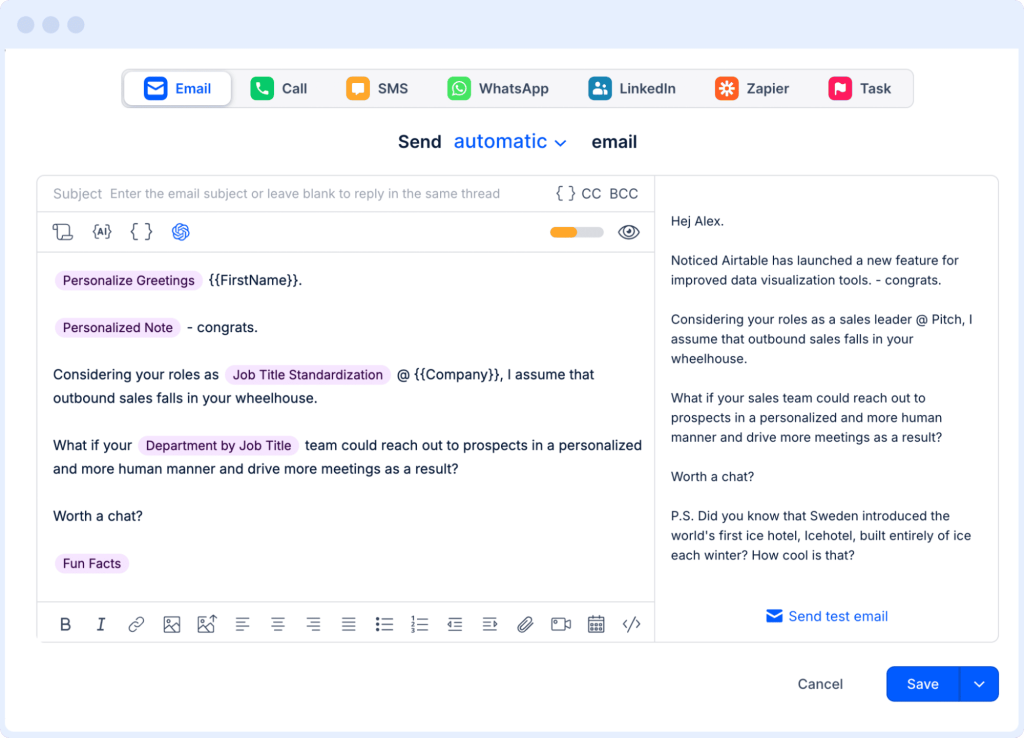
With an AI outreach tool like Reply.io, you can make this run on autopilot. Whether it’s external data you found on LinkedIn, funding news sources, etc., or directly within Reply’s native database — once it has the data, personalization becomes meaningful and tailored.
With its AI variables feature, you can create custom personalization elements within your message templates, and Reply will then, on its own, take the right info and fill those gaps.
It will personalize each opening line and body with whichever information is most relevant to you, from funding rounds, hiring roles, relevant team signals, LinkedIn posts, etc., so every email reads like it was written for that startup — without you rewriting the same thing 200 times (and spending hours on research).
Even better, when those variables are paired with research/enrichment, you’re not guessing. You’re personalizing off facts, and that’s what tends to drive replies in these post-funding windows.
Then the timing piece becomes easy too: when a new trigger hits (funding, hiring spike, leadership hire), you update the context once and your outreach stays aligned — instead of sending “Congrats on the round” two months too late.
Keep watching for new triggers
Funding is the starting gun, not the whole story. The best follow-ups often come from a second trigger:
job posts that confirm execution has started
a new GTM hire
a launch or partnership
a stack change
Those moments give you a clean reason to re-enter the conversation without sounding persistent for the sake of it.
Test, then tighten
Don’t run A/B tests for fun — test the few levers that actually move replies:
opener: trigger-led vs outcome-led
CTA: “open to 10–15 min?” vs “should I speak to [role]?”
proof: one-line example vs none
follow-up style: new insight vs quick bump
Reply.io makes this easier because you can run controlled tests inside sequences and see what’s driving replies and meetings (not just opens), then roll the winner into the rest of your funded-startup plays.
And that’s the whole game: hit the right timing window, anchor on a real trigger, speak to what they care about at that stage, and run a sequence that stays relevant with every step.
How to automate and scale your outreach effectively?
Scaling funded-startup outreach without automation is how good leads slip through the cracks. The goal isn’t to simply scale volume but to actually react fast to key signals, keeping follow-ups consistent, and making sure the right message hits the right account at the right time.
Segment your list once, then let the system route
In your CRM or outreach platform, segment by:
funding stage (Seed / A / B+)
industry
region
ICP fit
That way, the messaging and cadence match budget, urgency, and what the startup is likely dealing with post-round.
Turn funding signals into triggers
Set alerts so new funding events automatically:
tag the account (round, amount, date)
push it into the right segment
assign an owner
kick off the correct outreach motion
You can wire this through Zapier, for instance, by connecting funding sources to your CRM. In any case, the point is zero manual “refresh and copy-paste” work.
Build stage-based playbooks (keep it lean)
You only need a few to make it work:
Seed / early: speed, traction, shipping, doing more with less
Series A: pipeline, hiring, repeatability, process
Series B+: scale, reporting, efficiency, security/compliance (when relevant)
Add light role variants (Founder vs GTM vs Ops) and you’re covered without rewriting campaigns weekly.
Run multichannel outreach
Funded startup outreach is high-speed — people reply on different channels, timelines vary, and signals change mid-sequence. A static “email 1 → email 2 → email 3” flow is usually too ineffective for that.
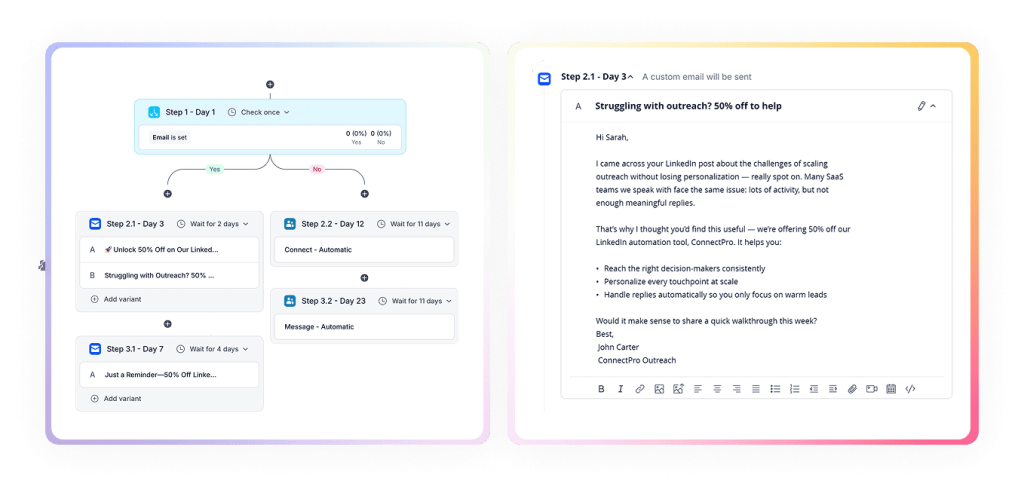
With Reply.io, you can launch automated multichannel sequences (email + LinkedIn, and more if needed) and add conditional logic so the messaging, channel, and timing adapt in real time based on each account’s behavior.
Examples that matter in this exact use case:
if they reply, stop everything and route it correctly (no awkward extra touches)
if they open/click but don’t reply, switch to a different follow-up angle (more context, different CTA)
if they accept a LinkedIn connection, send a short LinkedIn message instead of forcing another email
if they don’t engage, slow the cadence or move them to a lighter nurture track
if a new trigger appears (hiring spike / leadership hire), pivot the messaging to match the new reality
That’s how you scale without spamming — the system adjusts, instead of running the same script no matter what.
Keep data fresh and workflows connected
If funding data, contact data, and activity data aren’t synced, you’ll end up doing the right thing at the wrong time.
Make sure:
funding updates flow into CRM fields
contacts are enriched and kept current
lifecycle stages update based on real engagement (reply, meeting booked, etc.)
Track what matters and tighten fast
Ignore vanity metrics. For funded startups, track:
replies
meetings booked
pipeline created
time-to-first-touch after funding
Then iterate playbooks based on what’s converting by stage/industry/region.
What common mistakes should you avoid?
You can have the right list and the right tools, and still get nothing if you mess up the basics. These are the mistakes that kill funded-startup outreach (and what to do instead):
Reaching out too late → the post-funding window moves fast. If you wait until the noise settles, decisions are already in motion.
Sending “congrats” with no substance → a generic raise mention doesn’t earn a reply — tie the raise to a likely priority and a specific outcome.
Treating every funded startup like a buyer → funding is a signal, not qualification. Look for execution signals (hiring spikes, stack changes, launches, new leadership).
Ignoring stage context → seed and Series B aren’t the same universe — your message should match what that stage is optimizing for right now.
Over-automating and sounding robotic → automation is fine; generic automation isn’t. Every touch needs at least one real, company-specific anchor.
Using stale or unverified contact data → bounces and misroutes hurt deliverability and trust — verify, and keep records fresh.
Being sloppy on compliance → track opt-outs, respect regional rules (GDPR/CCPA), and keep suppression lists clean.
Relying on one channel → email-only or LinkedIn-only limits your surface area; multichannel wins when it’s coordinated and not spammy.
Never iterating → if you’re not testing openers, CTAs, and follow-up angles, you’re guessing, so make sure to track replies and meetings, then tighten what works.
With Reply.io, teams can reduce a lot of these failure modes by keeping data verified, personalizing off live signals, handling consent/compliance, and coordinating multichannel outreach so you can move fast while keeping every message and touchpoint relevant and effective.
The funded-startup outreach playbook for 2026
If you want more B2B wins in 2026, recently funded startups are one of the best places to focus — fresh budget, clear urgency, and a short window where new tools and vendors are actually being evaluated.
The workflow is simple:
track funding signals and move fast
pull clean contacts from funding news websites and lead databases
segment by stage + ICP so your message matches what they care about
personalize off real context (round, hiring, stack, priorities)
keep your CRM updated and iterate based on replies + meetings
Don’t overbuild it — start with one play, run it consistently, then tighten based on what actually converts.
If you want the easiest way to execute this without juggling tools, run it through Reply.io — a native lead database to find targeted accounts, multichannel outreach, AI personalization at scale, and analytics — everything you need to keep the whole engine moving.
Subscribe to our blog to receive the latest updates
from
the world
of sales and marketing. Stay up to date.
We use cookies to enhance your browsing experience, serve personalised ads or content, and analyse our traffic. By clicking "Accept All", you consent to our use of cookies.