
How to Use Reply.io + Jason for B2B SaaS Lead Gen in 2026

How to Use Reply.io + Jason for B2B SaaS Lead Gen in 2026

B2B SaaS lead generation in 2026 is tricky. On the one hand, it has become increasingly complex given the increased competition and expectation for a more personalized buyer journey, shifting away from the traditional quantity-over-quality sales approach. 

On the other hand, the leading lead gen software has adapted to this shift, now offering consolidated features that help businesses find truly interested buyers, and then engage them with truly meaningful and relevant messaging — with the right channel, at the right time. 

Teams generating consistent pipeline run on a much tighter system: accurate prospect data, strong email deliverability, multichannel outreach, and AI-driven personalization that can scale without turning a single message generic (which most of us can see right through by now). 

That’s exactly where Reply.io and Jason AI come in. Used together, they give SaaS teams a powerful AI lead generation engine that helps them find the right contacts, launch coordinated outreach, and turn replies into booked meetings, like clockwork.

What successful B2B SaaS lead generation looks like in 2026

Successful B2B SaaS lead generation now comes down to how well a team connects strategy, data, infrastructure, and execution. A big contact list on its own won’t do much, manual personalization alone won’t carry the whole process either, and even strong messaging starts to fall apart when inbox placement is weak, or you’re only trying to reach them on one channel. 

The teams getting the best results work from a more connected model — they start by defining a clear ideal customer profile (ICP), identifying decision-makers within relevant accounts, prioritizing contacts using intent signals and other fit indicators, and running multichannel outreach across email and LinkedIn with room to swiftly adjust each outreach campaign based on lead behavior. 

AI lead generation supports that process even further by significantly cutting down the time spent on research, message drafting, AI personalization, sequence building, and even reply handling. 

This matters especially in SaaS, where buying cycles usually involve multiple stakeholders, a fair bit of education, and timing that can change fast. Good lead generation software helps teams move from defining ideal customers to building targeted prospect lists to personalization to meetings in one connected flow. 

The main goal is simple: better-fit leads, better timing, and a cleaner path from the first touch to a qualified conversation.

Example of an effective B2B SaaS lead generation workflow

Think of an effective B2B SaaS lead generation workflow as a system, not a one-off campaign. Every step should make the next one easier, feeding it with relevant data, while automation reduces manual work without making targeting or messaging sloppy or generic.

A typical B2B lead generation workflow may look like this:

  • Define the ideal customer profile, including industry, company size, market, job titles, pain points, and buying triggers.

  • Build target account and contact criteria so outreach is based on fit rather than volume.

  • Use intent signals and firmographic filters to prioritize accounts that are more likely to be interested in your offer.

  • Enrich lead and company data with role context, social profiles, and business details.

  • Set up email and LinkedIn infrastructure before launching campaigns (crucial).

  • Build a multichannel sequence that adapts to prospect behavior.

  • Use AI personalization to tailor messaging at scale.

  • Handle replies, objections, and qualification quickly.

  • Move interested prospects toward booked meetings.

  • Review analytics to improve targeting, channel mix, deliverability, and message performance over time.

The value of automation here is pretty straightforward — it makes the workflow faster, easier to repeat, and much easier to improve over time.

Building Outbound from Scratch [2026 Playbook]

This playbook shows you how to build outbound from zero, step by step.

No theory. No BS. Just clear guidance you can use right away.

You’ll learn how to:

– Choose the right companies and people to contact
– Write outbound messages that get replies
– Use simple email templates that actually work
– Set up a lean outbound stack without wasting money
– Avoid common mistakes that kill response rates

What is Reply.io, and what is Jason AI?

Reply.io is an all-in-one AI lead generation software and sales engagement platform built for teams that need more than basic email automation. It combines B2B prospect data, multichannel outreach, email infrastructure support, AI-powered workflows, and analytics in one system. 

That makes it especially useful for SaaS sales teams, founders, agencies, and lean go-to-market teams that want to scale outbound without stitching together a fragmented stack.

Jason AI, an autonomous AI sales agent, sits on top of that same core engine, but plays a different role. While Reply gives your team an AI lead generation system, Jason joins your team and then handles a huge chunk of the entire lead gen process on its own. 

It learns your business in detail, understands the target audience, continuously finds leads, enriches them with context, launches multichannel outreach, personalizes every email and LinkedIn message, and even manages replies based on your custom playbooks.

In practice, Reply.io gives teams direct control over each stage of outbound execution, while Jason AI can take over a lot of the actual work inside that same environment. Together, they support a modern B2B SaaS lead generation workflow that is faster, more effective, and scalable.

How to use Reply.io and Jason AI for B2B SaaS lead generation

The process below shows how to build a practical lead generation engine for a B2B SaaS team using Reply.io, and optionally, adding Jason AI as the final layer to then run that engine for you. 

Step 1: Define your ICP, offer, and lead generation strategy

Before any lead generation software can produce meaningful results, your team needs a very clear idea of who it wants to reach and why those accounts should care. For B2B SaaS teams, that usually means building an ICP around industry, company size, geography, business model, technology stack, job titles, pain points, and buying triggers. 

It also means deciding what outcome the campaign is supposed to deliver, whether that’s booked demos, trials, qualified discovery calls, expansion into a new market, and so on.

This step is crucial because it sets the foundation for all the next steps, while weak targeting usually creates problems that teams later unfairly blame on messaging or channel choice. If the offer is too broad or the audience definition is loose, even strong outreach is going to struggle.

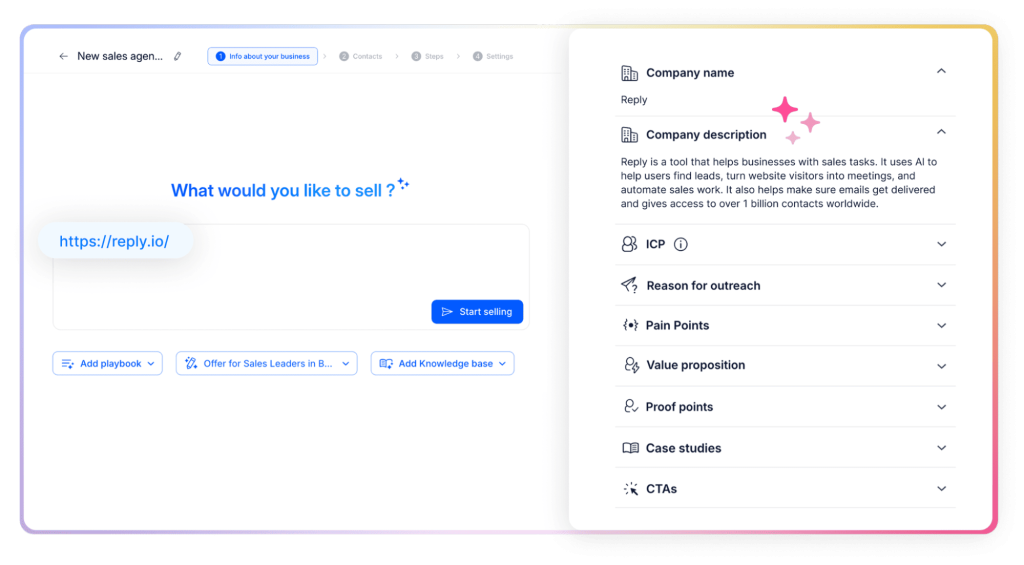
Jason AI starts its journey here too. Before it starts looking for potential buyers or running any outreach, it first learns about your business, product, positioning, and sales strategy so it can fully align prospecting and messaging in the future. 

This gives the automation layer a much stronger foundation and keeps the rest of your sales workflow focused on fit instead of pure volume.

Step 2: Find targeted leads with Reply Data

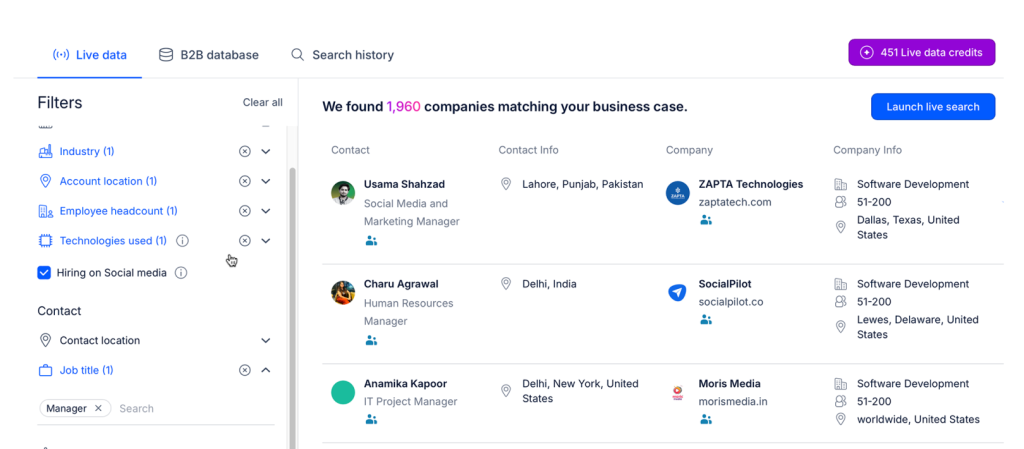
Once the ICP is clear, the next step is finding targeted leads that actually match it. This is where Reply Data becomes a core part of the process. This is Reply’s native B2B lead database, built around real-time prospect data, and removing a huge point of friction for SaaS teams that would otherwise jump between separate databases, scrapers, spreadsheets, LinkedIn, and lead enrichment tools.

Reply Data offers access to more than 1 billion B2B prospects and accounts across 150+ countries, along with company-level search, social profiles, built-in email verification, and precise targeting filters. 

In practice, that means teams can search for companies and decision-makers based on the exact criteria they have already defined in their ICP, and then move straight from search to outreach with just a few clicks.

The quality of this step affects everything that comes after it — successful B2B lead generation starts with precise lead selection and relevant additional context. 

But if the data layer is weak, personalization gets weaker, deliverability becomes harder to protect, and the sequence has far less chance of creating relevant conversations in the long run.

Intent signals matter a lot here, helping teams prioritize their efforts on accounts that are showing signs of potential interest, rather than treating every account like it’s equally ready. For SaaS teams, that could mean focusing on companies showing signs of active growth, tech adoption, hiring activity, or other buying triggers that make outreach more timely. 

The final layer here is Reply’s native lead enrichment feature, which automatically finds out more data about each lead in your list with info from LinkedIn, company websites, and more, all of which will be crucial for segmentation and AI personalization in the next steps. 

Step 3: Set up your outreach infrastructure the right way

Lead quality matters, no doubt, but even strong targeted leads can underperform when your outreach setup is weak. In B2B SaaS lead generation, outreach infrastructure is what protects your ability to consistently reach inboxes over time, especially once you start scaling. 

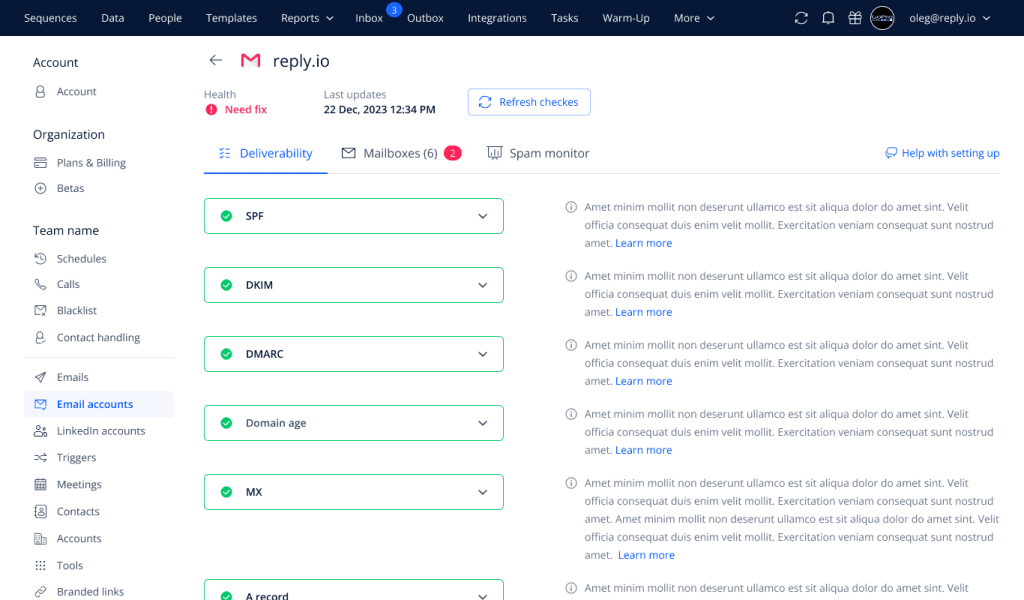
That starts with email authentication — SPF, DKIM, and DMARC need to be configured correctly so your recipients’ mailbox providers can trust the messages coming from your domain, and Reply handles this completely on its own. 

On top of that, Reply.io comes with built-in email warm-up for all your connected mailboxes, gradually ramping up volume instead of creating risky spikes. This is crucial because your company’s sender reputation is shaped by consistency, engagement, and technical trust signals over time, not just the context of your emails.

Given its multichannel outreach engine, Reply also ensures all your connected LinkedIn accounts stay within the platform’s messaging limits. 

Step 4: Build a multichannel outreach sequence

The previous steps took care of the infrastructure and data foundation. Now, this is where lead generation starts turning into real lead generation with Reply’s automated multichannel outreach. 

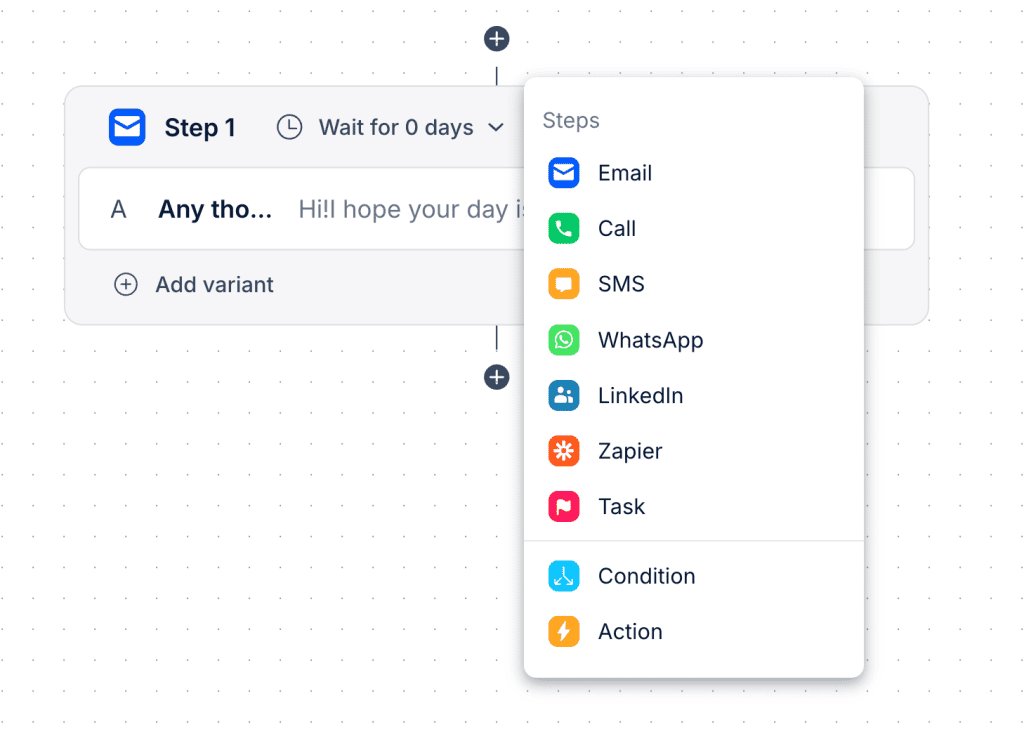
Rather than relying on static emails, Reply builds coordinated sequences across email, LinkedIn, calls, SMS, WhatsApp, and additional workflow steps. This is a game-changer for B2B teams where buyers’ attention is scattered. A prospect may ignore the first email, notice a LinkedIn touch later, and only reply once the pattern starts to feel familiar and relevant over time.

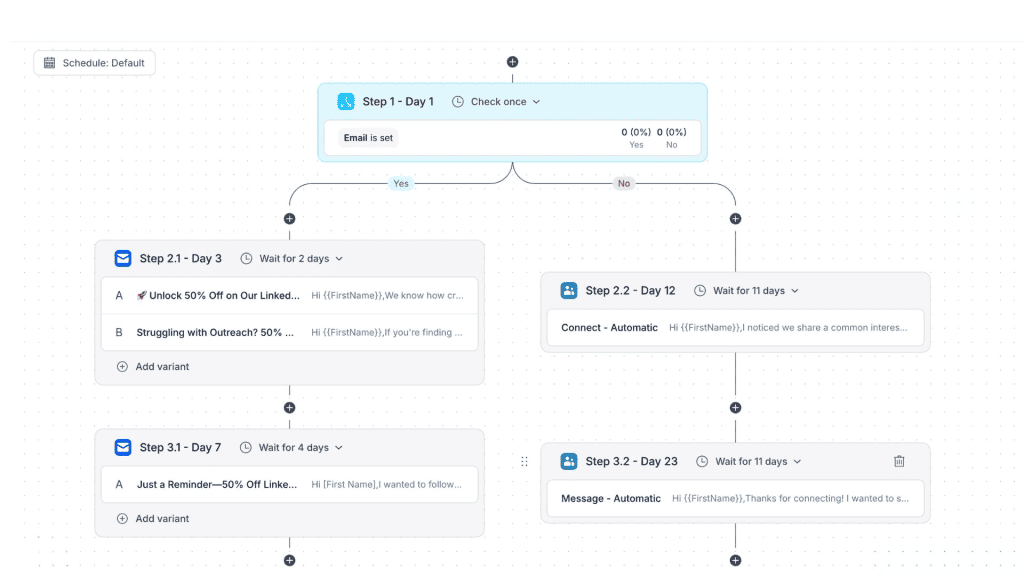
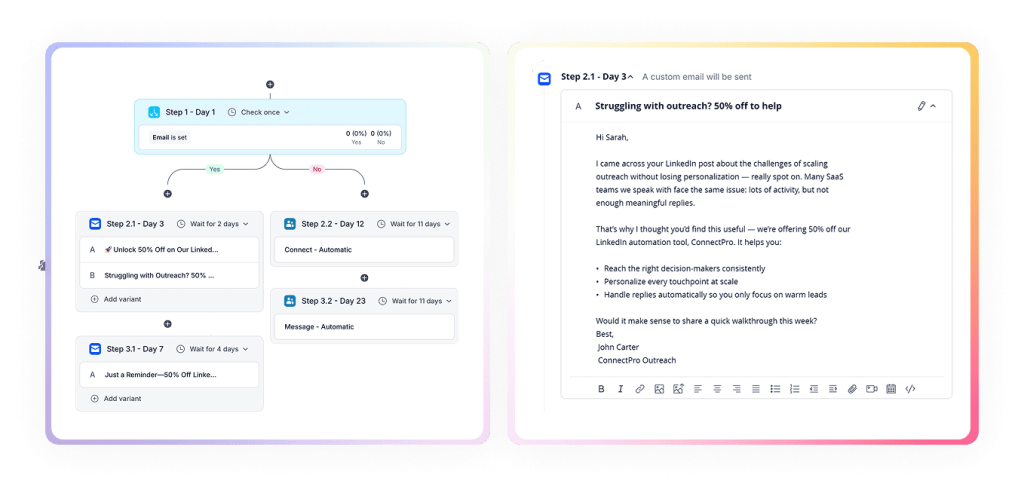
Instead of pushing every prospect through the same buyer journey, Reply.io builds cohesive multi-touch campaigns for each unique lead, designed with conditional logic. This means that every sequence is updated in real time, adjusting the messaging, channel, and timing based on prospect behavior and intent signals picked up from the previous steps.


To put this into perspective, if a prospect doesn’t reply to your initial email in 3 days, Reply sends out an automated LinkedIn connection request. If your prospect accepts it, Reply’s AI engine writes up a short personalized connection message and cancels the scheduled email follow-up, and so on. 

That flexibility can be a deal-breaker for B2B teams because lead generation is rarely linear. Some prospects reply fast, while others may need warmer social engagement first, like profile views or post likes, before a direct message makes sense. 

At the same time, some leads simply prefer to be reached through email, while others are more open to talking on LinkedIn. Reply’s conditional logic makes those paths manageable without forcing reps to rebuild sequences from scratch for every new lead. 

For SaaS teams trying to scale outbound, this is one of the clearest advantages of a real sales engagement platform over a basic sequencing tool. It keeps the process structured while still adapting to prospect behavior, which leads to more relevant outreach and more booked meetings.

Step 5: Use AI personalization to scale relevance

Personalization still matters, that part hasn’t changed. What has changed is that the old way of doing it just doesn’t scale, nor does it produce any meaningful results. Manually researching every prospect, writing every opener from scratch, and customizing every LinkedIn message and follow-up puts a hard cap on what a SaaS team can actually get done. 

Reply’s AI personalization engine solves that by making tailored outreach fast, effective, and scalable. Once you’ve built your prospect lists with Reply Data, LinkedIn, and any other sources you may be working with, Reply automatically enriches their profiles with additional data picked up from LinkedIn, company websites, and more. 

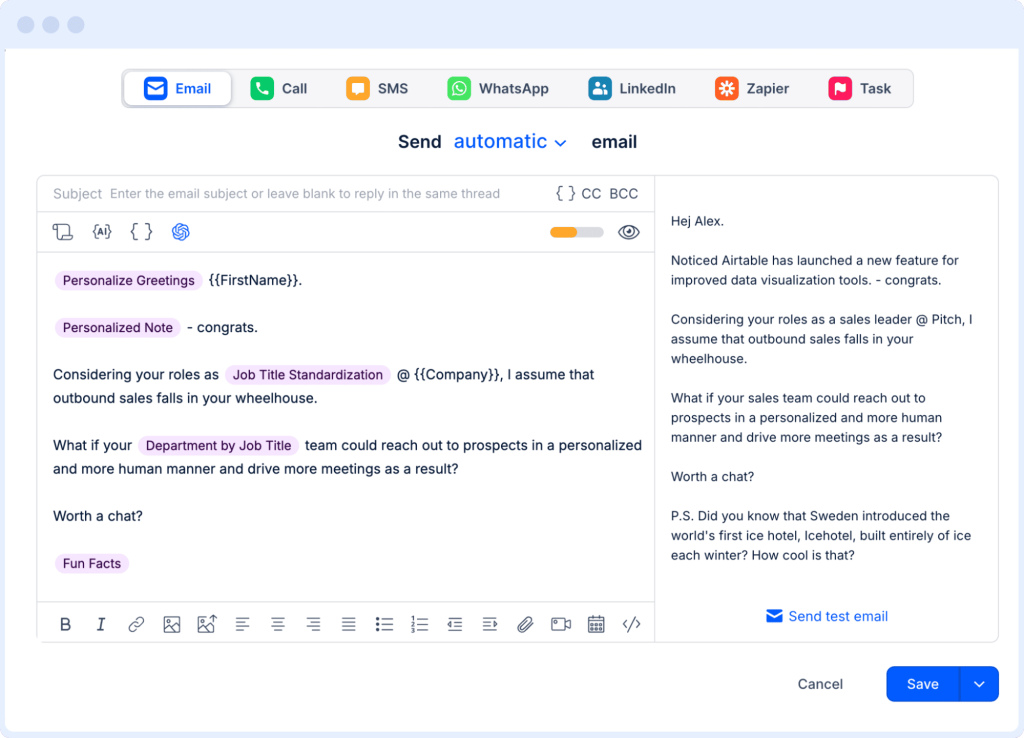
That’s when Reply’s AI engine takes all that data to create hyper-personalized and highly relevant emails, follow-ups, and LinkedIn messages for each unique lead. The AI variables feature allows you to create email templates with custom personalization variables, so the overall structure stays the same, but each email is now truly tailored for every lead:

This becomes much stronger when paired with enriched prospect data. If the system knows the prospect’s role, company context (recent funding, new hiring, etc.), industry, LinkedIn signals, and likely pain points, personalization can become specific enough to feel like a human rep spent hours researching and writing it.  

In B2B SaaS, generic outreach gets ignored fast, while messaging tied to actual market context, use case, or growth stage has a much better shot. All in all, AI personalization drastically  improves open rates and reply quality, speeds up qualification, and increases the chances of moving a conversation toward booked meetings.

Step 6: Let Jason AI run the lead generation engine

At this point, Reply.io already gives any SaaS team a full AI-powered lead generation with lead data, outreach infrastructure, multichannel outreach, AI personalization, and analytics. 

Jason AI is Reply’s AI sales agent that takes that same system, and runs the show for you.

After learning about your business, offer, lead generation strategy, and ideal customer profile, Jason begins continuously searching for targeted leads and target accounts that match your team’s criteria. 

It then finds decision-makers within those companies, enriches them with contextual prospect data from LinkedIn, company websites, and other sources, and launches tailored multichannel outreach using the same core engine that powers Reply.io.

Jason also personalizes each email, LinkedIn message, and follow-up, adapting messaging to each lead’s unique context, while keeping every sequence coordinated. 

On top of that, Jason AI handles incoming replies based on your team’s custom sales playbooks. That includes answering common questions, working through objections, and even moving qualified leads toward meetings with integrated calendar scheduling.

That’s what makes Jason AI meaningfully different from lighter lead generation tools that simply help your team write personalized messages. 

Jason completely takes over a larger share of the entire B2B lead generation workflow, from finding potential buyers to launching outreach, handing over qualified, ready-to-buy leads to your sales team. 

For teams that want control, “approval mode” adds oversight before campaigns or messages go live, whereas teams that want more automation can use “autopilot mode,” which lets Jason operate more independently. 

Multilingual support across 50+ languages also makes it practical for SaaS companies expanding into new regions without building a separate outbound motion for every market.

How to make B2B SaaS lead generation more efficient over time

Automation improves speed, but efficiency only improves when the team keeps refining the system over time. That means looking beyond campaign volume and paying attention to the underlying performance drivers: ICP fit, deliverability health, channel efficiency, AI personalization quality, reply quality, and meeting conversion.

If open rates are weak, the issue may be infrastructure rather than messaging. If replies are low but deliverability is healthy, the problem may be targeting, offer relevance, or personalization depth. If replies are coming in but booked meetings are not, the team may need better qualification logic, reply handling, or nurturing sequences. 

This is where analytics truly matter, which is why Reply.io’s robust reporting and performance visibility help teams understand what’s happening at the channel, team, and sequence level in real time, making it easier to make the right, precise tweaks instead of guessing. Over time, that’s what turns lead generation software from a simple prospecting and outreach tool into an actual operating system for pipeline creation.

Build a smarter B2B SaaS lead generation engine

B2B SaaS lead generation in 2026 works best when accurate data, solid email infrastructure, multichannel outreach, and AI personalization all work together in one unified system. 

Reply.io helps teams build, control, and scale that engine, while Jason AI takes over a big chunk of execution, from finding the right leads and launching outreach to handling replies and creating a steady flow of qualified leads for your team. 

For SaaS teams that want a more scalable way to generate pipeline, the next step isn’t just adding another lead generation software tool. The real strategy should be building a smarter lead generation engine and letting AI do more of the heavy lifting.

Subscribe to our blog to receive the latest updates from the world of sales and marketing.
Stay up to date.

Related Articles

How to Use Reply.io + Jason for Lead Generation for Software Companies in 2026

How to Use Reply.io + Jason for Lead Generation for Software Companies in 2026

How to Use Reply.io + Jason for Lead Generation for Software Companies in 2026
Top 12 GTM Outbound Sales Platforms to Try in 2026

Top 12 GTM Outbound Sales Platforms to Try in 2026

Top 12 GTM Outbound Sales Platforms to Try in 2026
How to Use Reply.io + Jason for B2B Demand Generation in 2026

How to Use Reply.io + Jason for B2B Demand Generation in 2026

How to Use Reply.io + Jason for B2B Demand Generation in 2026