
Best Firmographic APIs in 2026 for Data and Compliance Teams

Best Firmographic APIs in 2026 for Data and Compliance Teams

Key takeaways:

  • Firmographic APIs split into two markets that rarely overlap. GTM providers optimize for coverage and speed; KYC providers optimize for provenance and audit trails, and only one of those will satisfy a compliance review.
  • Check the source before the field list. Registry-derived data can be cited to a filing, inferred data cannot, and that distinction is the whole purchase for regulated use.
  • Published prices are unusually clear at the low end and absent at the high end. OpenCorporates starts at GBP1 per 100 credits, BuiltWith at $295 a month, while HG Insights and Dun & Bradstreet publish nothing.
  • Technographics are a separate field set sold by separate vendors. Nothing here returns firmographics and a full technology stack from one call.

Firmographics are the boring fields that decide everything downstream: industry, employee count, revenue band, location, legal entity, incorporation status. Every scoring model, routing rule and territory assignment runs on them, and every one of those breaks quietly when the fields are wrong.

The complication is that two different industries buy a firmographic api for opposite reasons. A growth team wants breadth and freshness to size a market. A compliance team wants a verifiable chain back to a government filing. This guide covers both, because the same search term serves both and the wrong choice fails expensively.

Nine providers are compared below, with pricing read off each vendor’s own page and quote-only vendors named as such rather than filled in with a guess.

What Is a Firmographic API?

A firmographic API returns descriptive attributes about a company rather than about a person. The core fields are consistent across vendors: legal and trading name, industry classification, employee count, revenue estimate, headquarters and other locations, founding date, and corporate structure.

Where providers diverge is provenance, and it is the only thing that matters for regulated work. Registry-derived data comes from official filings, so a record can be traced to a document with a date on it. Inferred data is assembled from web crawling, job postings and models, which produces much broader coverage and no citable source.

Resolving a domain to a canonical company record is a distinct job from describing one, and our roundup of company enrichment APIs covers that side of it.

Neither is better in the abstract. A market-sizing exercise wants the inferred provider’s coverage. A customer onboarding check wants the registry provider’s paper trail, because “our vendor estimated it” is not an answer a regulator accepts.

The compliance framing is not optional in the US. FinCEN’s Customer Due Diligence rule requires covered financial institutions to identify and verify the beneficial owners of legal entity customers, which means firmographic data used in onboarding has to be defensible rather than merely accurate.

The Best Firmographic APIs

The second column decides which half of this market a vendor belongs to, and it is the first thing to check against your use case.

Tool Data source Best for Main limitation Pricing (from) Rating
Reply.io Inferred, GTM-oriented Finding and contacting matching companies No domain-to-firmographics endpoint $49/month ★★★★☆
OpenCorporates Official company registries Traceable legal entity data Coverage is entity-level, not commercial GBP1 per 100 credits ★★★★★
Middesk Registries plus verification workflow Onboarding and KYB checks No published pricing Quote only ★★★★★
Enigma Registries plus transaction signals Small business revenue evidence Complex per-call pricing $0.01 per call ★★★★☆
Dun & Bradstreet Proprietary D-U-N-S database Enterprise-wide entity resolution Publishes no pricing at all Quote only ★★★★☆
TheirStack Job-posting inference Firmographics with hiring signal Inferred, not registry-backed $59/month ★★★★☆
BuiltWith Website crawling Firmographics tied to web technology Per-call API pricing is quoted separately $295/month ★★★★☆
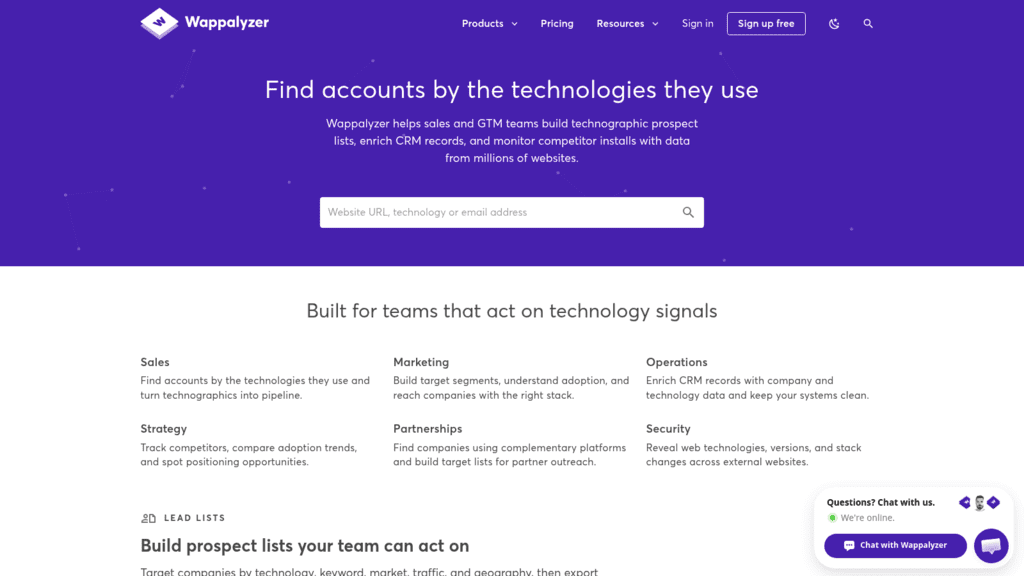
Wappalyzer Website fingerprinting Cheap technology-plus-company lookups Included API credits expire in 60 days $250/month ★★★☆☆
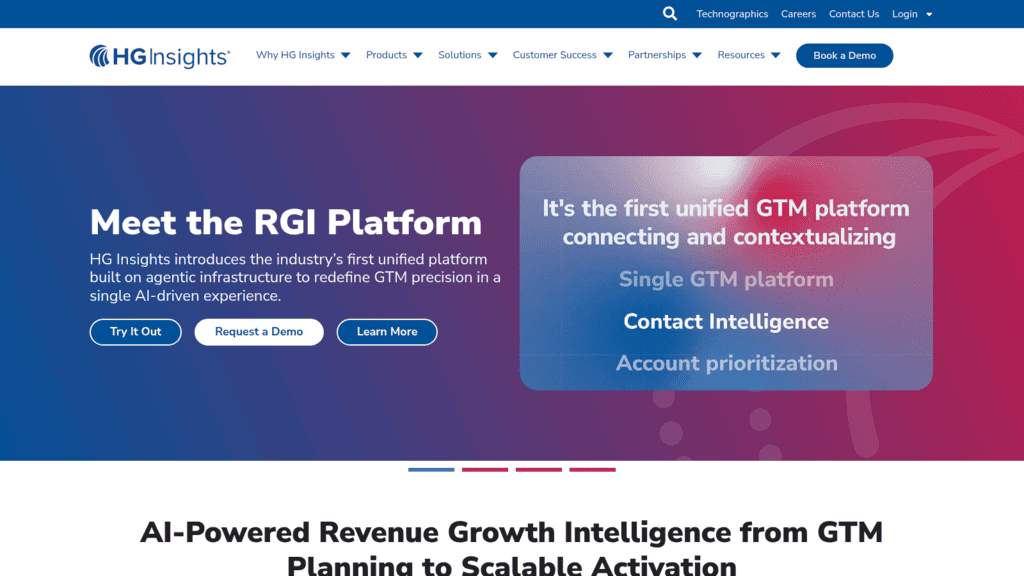
HG Insights Proprietary IT spend research IT budget and spend estimates Quote only, enterprise-oriented Quote only ★★★★☆

Read that table against your compliance obligations first and your coverage needs second, because a provider that cannot cite a source will not survive an audit no matter how complete its records are.

Reply.io
Reply.io as one of the best firmographic apis

Best for: Acting on firmographic filters, not resolving them

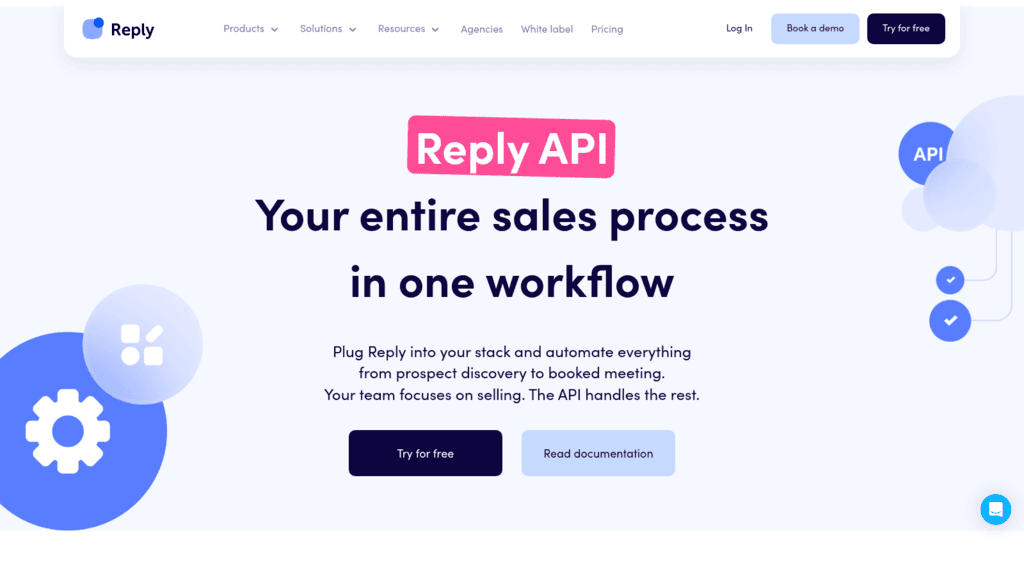
Overview: Our place in this list is narrow and worth stating before anything else. We have no endpoint that accepts a domain and returns a firmographic record. If that is the call you need to make, several providers below sell exactly it and we do not.

What we do have is firmographic filtering across a large company footprint. Our contact database covers more than 60 million company profiles across 150-plus countries, and industry, location and headcount work as search filters rather than as a retrievable record.

That makes us useful at the other end of the workflow. Once a firmographic definition exists, we find the people inside those companies and run the outreach, on one credential.

The honest limits: the Live Data search endpoints carrying those filters are all marked Beta, and the five contact enrichment endpoints remain Coming soon in our developer docs as of August 2026.

Key features:

  • Industry, location, seniority and headcount available as ICP search filters
  • Typeahead endpoints that resolve firmographic filter values to valid IDs
  • People search returning contacts at companies matching the definition
  • Sequence endpoints that contact those people without an export step
  • Native CRM syncs writing results back to HubSpot, Salesforce and Pipedrive
  • Throughput capped at 100 requests a minute and 3,000 an hour, documented

Pricing: The entry point is $49 a month billed annually against 1,000 active contacts, with cost scaling on database size rather than seats. The base plan includes only 50 live data credits a month, so real volume needs a package from $20 a month. A 14-day trial is available and no plan is free.

Pros: large company footprint behind the filters, filtering and outreach on one contract, published throughput, CRM write-back, live validation endpoints

Cons: there is no domain-in, firmographics-out endpoint, so company attributes exist only as filters inside a beta people search, and the base plan’s 50 monthly credits will not support real volume

How to start using it:

  1. Sign up for the trial and create a v3 token under Settings, then API Key.
  2. Map each firmographic criterion onto a filter ID with the lookup calls.
  3. Submit a Live Data search carrying those filters and poll for completion.
  4. Put the returned addresses through validation before trusting them.
  5. Load the remainder into a sequence and subscribe to the reply event.

Why it’s a good firmographic API companion: It turns a firmographic definition into contacted people, which is the step that firmographic data usually exists to enable.

Final verdict: Right when you already have a company definition and need to act on it. Wrong if you need to resolve a domain into a company record, which we do not offer.
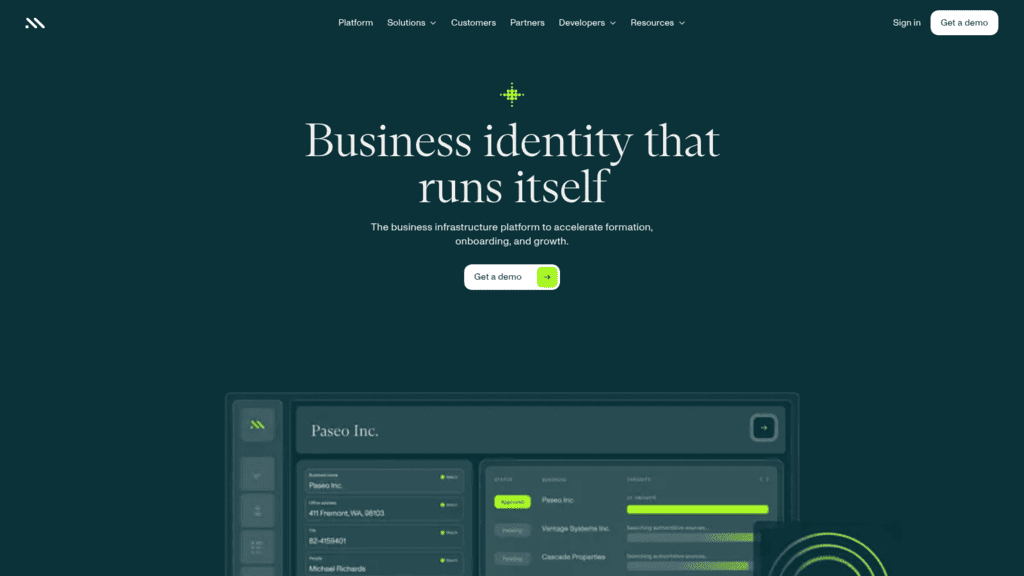
OpenCorporates

OpenCorporates as one of the best firmographic apis

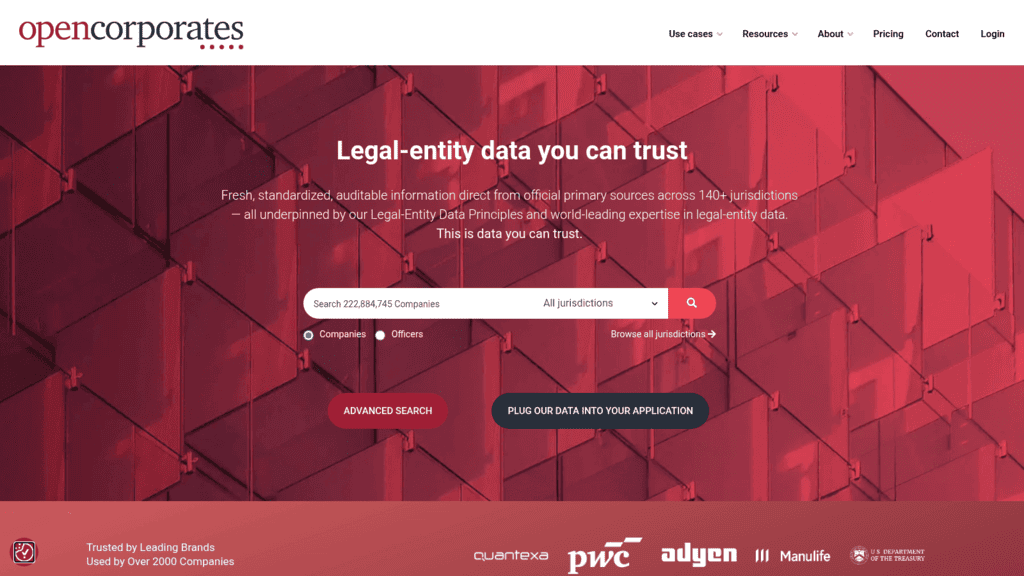
Overview: OpenCorporates aggregates official company registers rather than inferring anything, which makes it the most traceable source here and the natural starting point for any use that has to withstand scrutiny.

Key features:

  • Records sourced from official government registries with links to filings
  • Corporate structure, officers and filing history rather than marketing attributes
  • Bulk data access alongside the REST API for warehouse use

Pricing: API credits start at GBP1 per 100, rising through GBP2, GBP6 and GBP12 tiers, with larger commitments at GBP225 and GBP660. Pricing is in pounds sterling rather than dollars.

Pros: every record traces to an official filing, transparent low-cost entry, genuine international registry coverage

Cons: entity data rather than commercial attributes, no revenue estimates or technographics, priced in GBP

Why it’s a good firmographic API: It is the only provider here where a record can be cited to a document, which is what compliance work actually requires.

Final verdict: The default for legal entity data, and deliberately not a marketing database.

Middesk

Middesk as one of the best firmographic apis

Overview: Middesk wraps registry data in a verification workflow built for business onboarding, returning not just what a company is but whether its details reconcile with official records.

Key features:

  • Business verification against Secretary of State and IRS records
  • Watchlist and adverse media screening alongside entity data
  • Structured decisioning output designed for onboarding flows

Pricing: Not published. Access is quoted after a conversation, positioned for platforms onboarding business customers.

Pros: built for KYB rather than adapted to it, verification output is decision-ready, strong US registry coverage

Cons: no published pricing, US-centric, unnecessary for pure GTM work

Where it fits: Fintechs, marketplaces and lenders onboarding businesses, where a verification decision must be defensible.

Final verdict: The specialist choice for KYB, and overkill for market sizing.

Enigma

Enigma as one of the best firmographic apis

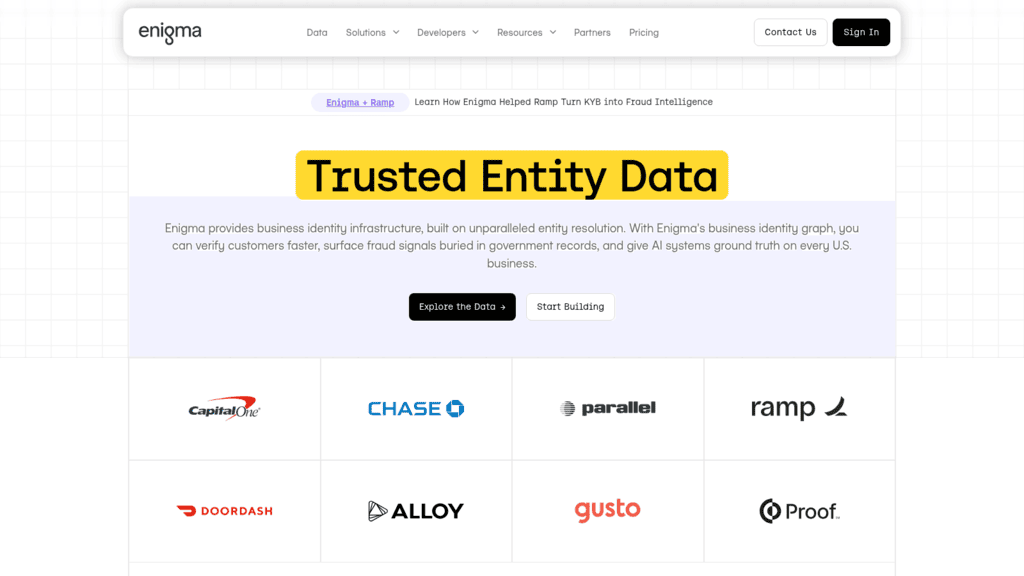
Overview: Enigma combines registry records with card-transaction signals to estimate small business revenue and activity, which fills the gap where conventional firmographic providers are weakest.

Key features:

  • Revenue and activity estimates derived from transaction data
  • Registry-based identity resolution underneath the estimates
  • Usage-based pricing rather than seat or platform licensing

Pricing: Usage-based, with per-call rates published from around $0.01 and rising by data product into the dollars, alongside larger committed tiers.

Pros: genuine small business revenue signal, usage-based billing suits variable volume, registry-backed identity

Cons: pricing structure is complex to model, US-focused, narrower attribute set than general providers

Its real strength: Estimating whether a small business is actually trading, which crawled data consistently gets wrong.

Final verdict: Excellent for lending, insurance and SMB risk work, less relevant for enterprise targeting.

Dun & Bradstreet

Dun and Bradstreet as one of the best firmographic apis

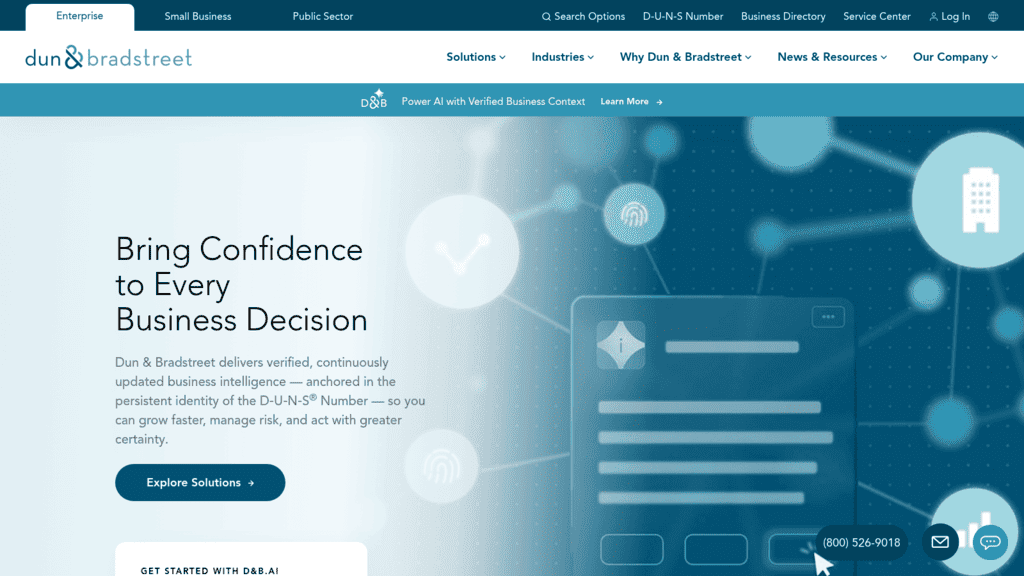
Overview: D&B is the incumbent, and the D-U-N-S number remains the closest thing to a universal company identifier in enterprise systems, which is why it persists regardless of newer competition.

Key features:

  • D-U-N-S numbering that many enterprise systems already key on
  • Corporate family trees resolving parents, subsidiaries and branches
  • Credit and risk scoring alongside descriptive firmographics

Pricing: Nothing published anywhere on its site. Every route is a sales contact, on enterprise terms.

Pros: unmatched entity resolution at enterprise scale, corporate hierarchy data, an identifier other systems recognize

Cons: publishes no pricing at all, procurement is slow, data freshness varies by market

Why buyers still choose it: Compatibility. If your ERP, your credit team and your suppliers all key on D-U-N-S, the alternatives create a mapping problem.

Final verdict: The interoperability choice, bought through procurement rather than a signup form.

TheirStack

TheirStack as one of the best firmographic apis

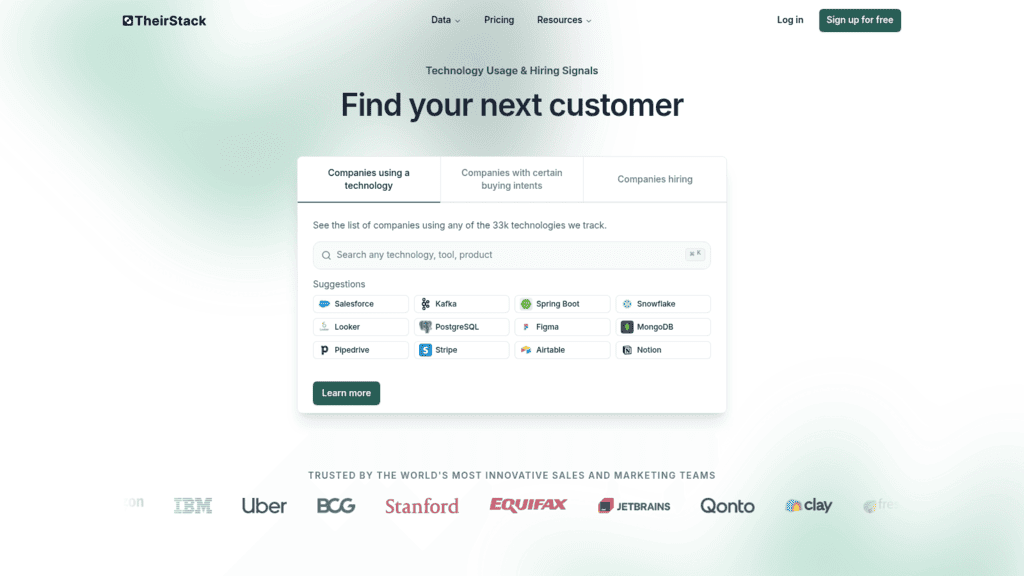
Overview: TheirStack infers both firmographics and technology use from job postings, which produces a hiring-signal view of a company that crawl-based vendors cannot see.

Key features:

  • Firmographic and technographic inference drawn from job-posting data
  • Credits valid for twelve months rather than expiring monthly
  • Published per-credit rates at every volume step

Pricing: A free tier includes 200 API credits a month. Paid tiers run $59 for 1,500 credits, $100 for 5,000, $169 for 10,000, $400 for 50,000 and $1,500 for a million. One credit covers a job, three cover a company.

Pros: transparent per-credit pricing at every tier, credits last twelve months, hiring signal is genuinely distinct

Cons: inference from postings rather than registry-backed, coverage skews to companies that hire publicly, not suitable for compliance

Why buyers shortlist it: A company hiring six Kubernetes engineers tells you something no firmographic record does.

Final verdict: The best-priced inference provider here, and unsuitable for anything requiring provenance.

BuiltWith

BuiltWith as one of the best firmographic apis

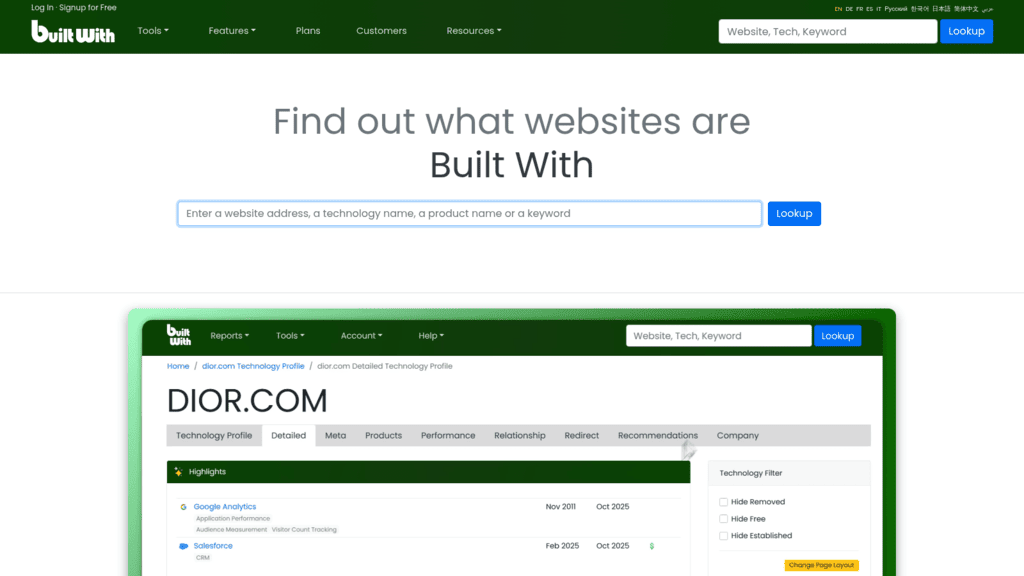
Overview: BuiltWith crawls the web and reports what runs on a site, pairing technology detection with basic company attributes across a very large domain index.

Key features:

  • Detection across a large index of domains and tracked technologies
  • Technology change history showing adoptions and removals over time
  • A separate API surface including natural-language query and an MCP endpoint

Pricing: Basic is $295 a month, Pro $495 and Team $995, with annual equivalents at $2,950, $4,950 and $9,950. Individual site lookups are free on the website, and per-call API pricing is quoted separately from the published plan prices.

Pros: very large domain coverage, long technology history, MCP endpoint for agent access

Cons: API pricing is not on the plans page, expensive relative to inference competitors, firmographics are secondary to technology

Where it beats the alternatives: Historical depth. Knowing when a company adopted or dropped something is a different question from what it runs today.

Final verdict: Strong for technology-led targeting, and priced as a technographic tool that happens to carry firmographics.

Wappalyzer

Wappalyzer as one of the best firmographic apis

Overview: Wappalyzer fingerprints websites to identify technologies and attaches company attributes to the result, at a lower price point than the larger crawl-based providers.

Key features:

  • Technology fingerprinting with company attributes attached
  • Free account tier for low-volume lookups
  • Lead lists built from technology criteria

Pricing: A free account allows 50 technology lookups a month. Pro is $250 a month with 5,000 API credits, Business $450 with 20,000, and Enterprise from $850 with 200,000 or more. Annual billing saves 17%.

Pros: cheapest entry among crawl-based providers, usable free tier, straightforward credit model

Cons: included API credits expire after 60 days, shallower firmographics than dedicated providers, detection is point-in-time

Why it earns a place here: The credit expiry is the catch to plan around, but at $250 a month it is the cheapest way to combine technology and company attributes.

Final verdict: Good value for technology-filtered prospecting, provided you consume credits inside the window.

HG Insights

HG Insights as one of the best firmographic apis

Overview: HG Insights sells IT spend intelligence rather than simple detection, estimating what companies actually spend on technology categories, which is a different and more commercially useful question.

Key features:

  • IT spend estimates by technology category rather than presence or absence
  • Firmographic context wrapped around the spend data
  • Enterprise delivery into CRM and data warehouses

Pricing: Quote only, with no public pricing of any kind.

Pros: spend estimates are genuinely differentiated, enterprise-grade delivery, deep technology taxonomy

Cons: publishes nothing on price, enterprise sales cycle, disproportionate for small teams

What it is genuinely good at: Sizing an opportunity rather than merely identifying one, which matters when deal size varies widely.

Final verdict: The enterprise choice when budget signal justifies an enterprise contract.

How We Chose These Firmographic APIs

Four criteria applied. Each provider needed a documented API rather than a file drop, a current product, a distinct data source, and a clear position on provenance. We did not require published pricing, since that would have removed the incumbents, but every entry states whether pricing exists.

Provenance did most of the sorting. Splitting the list into registry-derived and inferred providers is not an academic distinction, it is the difference between a source that survives an audit and one that does not, and vendors on both sides sell into the same search results.

Pure prospecting-data vendors without a firmographic focus were left out and sit instead in our B2B data APIs comparison.

We opened a capture of every homepage instead of taking the marketing copy on trust, and any self-published figure is marked as the vendor’s own inside its entry.

Firmographic Data for KYC and Compliance

If your use case is onboarding rather than prospecting, most of this market is unsuitable, and the reason is worth being precise about.

FinCEN’s Customer Due Diligence rule requires covered financial institutions to identify and verify beneficial owners of legal entity customers at account opening. That is a verification obligation, not a data-quality preference. A firmographic record assembled by crawling cannot satisfy it, however accurate it happens to be, because there is nothing to point at when someone asks where the answer came from.

Registry-derived providers exist for exactly this. OpenCorporates links records to filings, Middesk reconciles details against Secretary of State and IRS records, and Enigma anchors its estimates to registry identity. Dun & Bradstreet’s D-U-N-S serves a related purpose as a stable identifier across systems.

Identifier strategy deserves attention too. The Global Legal Entity Identifier Foundation maintains the LEI system, a 20-character code issued to legal entities and used in financial reporting worldwide, with a public reference dataset. Where an LEI exists it is the cleanest key to join on, because it is issued rather than inferred.

The practical rule is simple. If a regulator, auditor or underwriter might ask where a field came from, buy from the registry side of this list and accept the narrower attribute set that comes with it.

How Much Do Firmographic APIs Cost?

Pricing transparency in this category tracks the split almost perfectly: the newer inference providers publish, and the incumbents do not.

Tool Published pricing Entry price Billed on
OpenCorporates Yes GBP1 per 100 credits Credits
Enigma Yes From $0.01 per call Per call, by product
Reply.io Yes $49/month Active contact count
TheirStack Yes $59/month Credits, 12-month validity
Wappalyzer Yes $250/month Credits, 60-day expiry
BuiltWith Partly $295/month Plan tier, API quoted separately
Middesk No Quote only Negotiated
HG Insights No Quote only Negotiated
Dun & Bradstreet No Quote only Negotiated

Our own API sits on a different axis again, billed against stored contacts rather than per lookup, which only makes sense if outreach is the destination.

The gap between GBP1 for 100 registry lookups and an unquoted enterprise contract is not a discount ladder, it is two different products. A market-sizing exercise runs happily on the cheap end; an onboarding flow with regulatory exposure usually does not.

Model the credit rules rather than the headline. Wappalyzer’s 60-day expiry and TheirStack’s twelve-month validity move effective cost more than the monthly figure does, and BuiltWith quotes API access separately from the plan price shown on its site. Teams comparing the technology fields specifically should read our roundup of technographic data APIs, which treats that half of the question properly.

How to Build a Firmographic Enrichment Pipeline

Firmographic pipelines fail in predictable ways. This order avoids most of them.

Pick Your Join Key First

Decide whether you key on domain, registry number, LEI or an internal ID before you buy anything. Domains break on rebrands and subsidiaries; registry numbers do not travel across jurisdictions. Choosing late means remapping everything later.

Resolve the Entity Before You Enrich It

Enrich the wrong company and every downstream field is confidently wrong. Resolve first, confirm the match, then request attributes. This is the step teams most often skip.

Decide How Subsidiaries Should Behave

A record for a local subsidiary and a record for its global parent produce very different headcounts and revenues. Write down which one your scoring model expects, because the vendor default may not match it.

Store the Source and the Timestamp

Keep which provider returned each field and when. Without that, you cannot tell a stale field from a wrong one, and you cannot answer a compliance question at all.

Re-enrich on a Cycle, Not on Every Read

Firmographics change slowly, so re-enriching on every lookup wastes credits. A quarterly refresh, with an event-driven exception for records flagged by a signal, is usually the right cadence and fits neatly alongside the wider lead enrichment stack.

Built that way, the data stays defensible and the credit spend stays predictable.

Matching a Provider to Your Actual Obligation

Start with the question you have to answer, not the field list.

If a regulator or auditor might ask where a value came from, buy registry-derived: OpenCorporates for traceable entity data at very low cost, Middesk for a decision-ready KYB workflow, Enigma where small business revenue evidence matters. Accept a narrower attribute set as the price of provenance.

If the work is market sizing, scoring or territory design, inference wins on coverage and cost. TheirStack is the best-priced option and adds a hiring signal, BuiltWith and Wappalyzer attach technology detection, and HG Insights estimates spend when deal size varies enough to justify enterprise pricing.

If you already have the company definition and need to reach people inside those accounts, that is our end of the workflow, with the boundary stated plainly: we filter on firmographics, we do not return them from a domain lookup. Teams that need exactly that call will find our comparison of company lookup APIs more directly useful than this one.

Whatever you choose, test against a sample of companies you know well, including at least one subsidiary and one recent rebrand. Those two cases expose more about a provider than any coverage statistic.

Frequently asked questions

What is the difference between firmographic and technographic data?

Firmographics describe the company: industry, headcount, revenue, location, legal structure. Technographics describe what it runs: the software, infrastructure and services detectable on its website or inferred from hiring. They answer different questions and are usually sold by different vendors. TheirStack, BuiltWith and Wappalyzer carry both to some degree, but no provider here returns a complete firmographic record and a full technology stack from a single call.

Can I use a firmographic API for KYC or KYB?

Only if it is registry-derived. FinCEN’s Customer Due Diligence rule requires covered institutions to verify beneficial owners of legal entity customers, which means the data must trace to an official source rather than an estimate. OpenCorporates, Middesk and Enigma anchor to registries; crawl-based and inference-based providers do not, no matter how accurate their records happen to be. Buying the wrong type here fails at audit rather than at integration.

How fresh is firmographic data?

It varies by source and by field. Registry data updates when a filing is made, which can lag reality by months but is precisely dated. Crawled and inferred data updates on the vendor’s crawl cycle, typically weekly, and captures change faster without being citable. Headcount and revenue are the least reliable fields across every provider, since both are usually estimated rather than reported.

What does a firmographic API cost?

Published entry prices here run from GBP1 per 100 credits at OpenCorporates to $295 a month at BuiltWith, while Middesk, HG Insights and Dun & Bradstreet publish nothing at all. Credit rules matter as much as the rate: Wappalyzer’s included credits expire after 60 days, TheirStack’s last twelve months, and BuiltWith quotes API pricing separately from its plan prices.

Which firmographic API has the best coverage?

It depends on what you count. Dun & Bradstreet and the crawl-based providers cover the most commercial entities; OpenCorporates covers the most registered legal entities across jurisdictions. They are not the same population, since many registered entities never trade and many trading businesses have thin registry footprints. Test both against your own list rather than comparing headline record counts, which are measured differently by each vendor.

Subscribe to our blog to receive the latest updates from the world of sales and marketing.
Stay up to date.

Related Articles

How to Build and Use an Automated Follow Up System in 2026

How to Build and Use an Automated Follow Up System in 2026

How to Build and Use an Automated Follow Up System in 2026
How to Build a B2B Marketing Automation Strategy for 2026 and Beyond

How to Build a B2B Marketing Automation Strategy for 2026 and Beyond

How to Build a B2B Marketing Automation Strategy for 2026 and Beyond
Best AI GTM Agent Tools for Future-proof B2B Teams in 2026

Best AI GTM Agent Tools for Future-proof B2B Teams in 2026

Best AI GTM Agent Tools for Future-proof B2B Teams in 2026