How to Use Reply.io + Jason for Enterprise Lead Generation in 2026
Vlad Oleksiienko21 Mar 2026
Enterprise lead generation in 2026 is a whole different ball game. Not just because the stakes are higher, though they definitely are, but because enterprise deals come with more people involved, more scrutiny, longer sales cycles, and a lot less patience for generic outreach.
To build truly effective and scalable enterprise pipelines, teams simply can’t lean on one contact, one sequence, or one channel anymore. Instead, they need account-level targeting, strong email deliverability, multichannel outreach, and AI personalization that can actually scale across a buying committee.
That’s exactly where Reply.io and its AI sales agent Jason AI come into play. Now, let’s explore how they can help your team build an effective, enterprise-oriented lead generation engine.
What successful enterprise lead generation looks like in 2026
Successful enterprise lead generation now comes down to how well a team connects targeting, data, infrastructure, and execution at the account level. A huge list of contacts is not enough, nor is a decent but one-size-fits-all outreach sequence.
In fact, even strong messaging starts falling apart when it reaches the wrong stakeholder, ignores the buying committee, or never reaches the inbox at all.
Modern teams have to precisely define what a qualified enterprise account looks like, identify the decision-makers and influencers within that firm, prioritize target accounts using intent signals and fit, and coordinate multichannel outreach across email, LinkedIn, calls, and follow-ups that adjust based on engagement.
Enterprise buying journeys are rarely clean or linear. One person may show interest early, but that doesn’t mean the account is ready — you could still have an executive sponsor, an end-user champion, as well as procurement, finance, and operations evaluators in the mix before anything moves forward.
That’s exactly why enterprise lead generation software is crucial, helping teams organize account-based outreach, stay consistent across multiple stakeholders, and scale without turning enterprise outbound into manual chaos.
Building Outbound from Scratch [2026 Playbook]
This playbook shows you how to build outbound from zero, step by step.
What’s inside:
→ How to define your ICP and micro-segments → Proven outbound message frameworks → Copy-paste cold email templates → A practical outbound tool stack → 30 quick outbound shortcuts used by top sellers
If outbound feels confusing or isn’t working for you, this playbook will help you fix it fast.
How enterprise lead generation differs from general lead generation
Traditional lead generation usually focuses on finding as many relevant contacts as possible and getting them straight into outreach. Enterprise lead generation, on the other hand, is narrower and much more account-centered. The focus shifts away from isolated prospects and toward enterprise accounts, buying committees, and coordinated stakeholder engagement.
The few differences include:
outreach usually needs to target several people inside the same account
messaging often needs to reflect different role-specific priorities
follow-up cycles are longer and require more channels and more patience
qualification matters even more because enterprise pipeline is lower-volume but much higher-value
timing signals and account context are often more important than raw volume
That’s why enterprise sales outreach needs a stronger system behind it. Basic cold email automation will not carry the load when the process depends on account-level structure, multichannel orchestration, and tighter operational control.
Example of an effective enterprise lead generation workflow
A strong enterprise lead generation workflow should be treated like an operating system, not a one-off play:
define the criteria for a qualified enterprise account
prioritize target accounts using firmographic fit and intent signals
map decision-makers, champions, and other stakeholders within each account
enrich account and contact data with company, role, and buying-context details
set up email and LinkedIn infrastructure before launching campaigns (crucial)
build multichannel sequences tailored to roles and account context
use AI personalization to tailor outreach for each stakeholder
track engagement across accounts, not just individual contacts
The value of lead generation software here is pretty straightforward — it makes such a complex workflow faster, and easier to scale and optimize.
What is Reply.io, and what is Jason AI?
Reply.io is an all-in-one AI lead generation and sales engagement platform for teams that are looking for more than simple email automation. It combines a native B2B lead database containing individual and company data, multichannel outreach, AI-powered workflows, email deliverability tools, lead enrichment, and analytics inside one system.
Jason AI works on top of that same foundation, but it plays a different role. While Reply helps your team build and control your lead generation system, Jason is an AI sales agent that joins your team, learns your business, understands the enterprise accounts you want to go after, and then autonomously finds leads, enriches them with context, launches personalized outreach, and even handles replies and books meetings on your behalf.
In practice, Reply.io gives enterprise teams direct control over each stage of execution, while Jason AI can then take over much of the actual work within that system.
Together, they create a powerful and much more scalable enterprise lead generation workflow built around account-based outreach, stakeholder-level personalization, and multichannel execution.
How to use Reply.io and Jason for enterprise lead generation
The process below shows how to build a practical enterprise lead generation engine with Reply.io, and then optionally add Jason AI to run most of the actual execution.
Build your enterprise account universe before outreach starts
Enterprise lead generation starts with precise account selection. Before your team launches a single message, it needs to define what a qualified enterprise account actually looks like, in detail. That usually means looking at company size, industry, geography, revenue range, operational complexity, likely buying triggers, and overall strategic fit.
Unlike general outbound, the goal here isn’t to find as many potential prospects but to identify the target accounts that are actually worth pursuing, then understand which stakeholders within those accounts are actually the right people to influence the buying process.
That also means thinking ahead about the buying committee. In a lot of enterprise deals, you are not selling to one person. You are selling to a group with different priorities: executive buyers, operational stakeholders, technical evaluators, and internal champions. Ignore that in the early stages, and your outreach simply will not produce the results you expect.
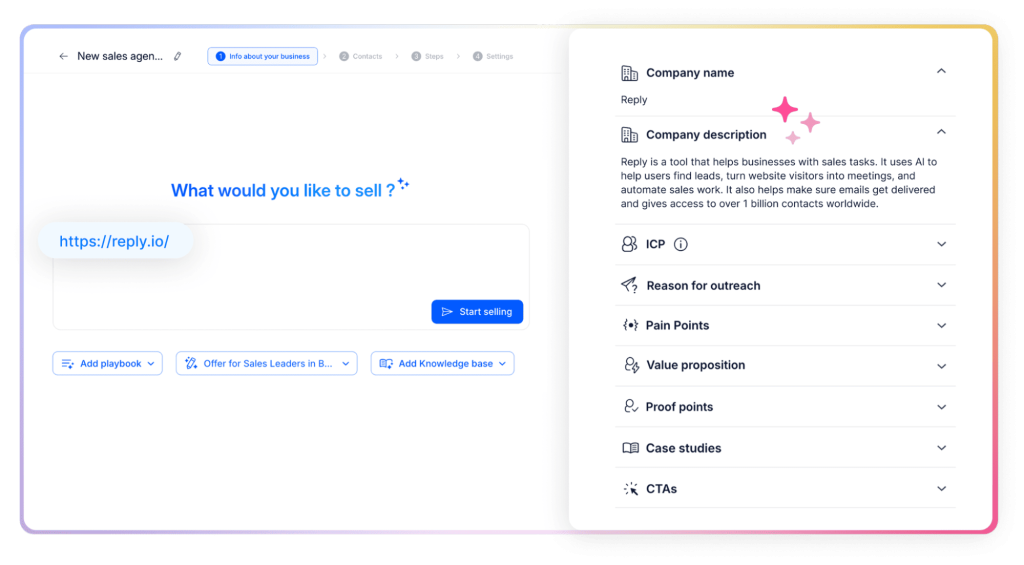
Jason AI starts working here as well. After joining your team, Jason learns everything about your business, offer, product, positioning, and audience so it can clearly define the enterprise accounts to target. This is also the foundation of future alignment when it comes to launching effective outreach from day one.
Use Reply Data to find target accounts and the right stakeholders
Once the account criteria are clear, the next move is finding the right accounts and the right decision-makers inside them. This is where Reply Data becomes central to your lead gen engine.
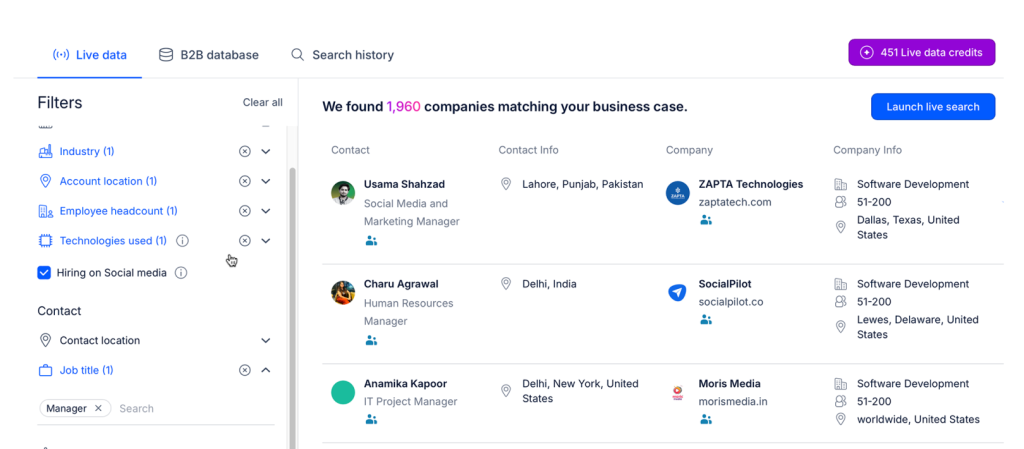
Reply’s native B2B lead database gives teams access to more than 1 billion real-time B2B contacts across industries and regions, with countless search filters to narrow down precise companies and prospects.
This already removes a massive amount of friction for teams that would otherwise bounce between separate databases, spreadsheets, LinkedIn, and enrichment tools.
For enterprise lead generation, this is even more valuable because it helps build account-level visibility. Teams can identify decision-makers, likely champions, and other relevant stakeholders within one company, along with enriched individual and company data for additional context.
In short, Reply Data offers precise account-level search, built-in email verification, and enriched data from LinkedIn, company websites, and other related sources.
On top of that, it now comes with real-time intent signals that matter even more in enterprise pipeline building because timing is rarely obvious. These signals help teams focus on accounts that are actively hiring, expanding, adopting new tools, or showing some other sign of active change.
The quality of this step shapes everything that follows — if the data layer is weak, AI personalization gets weaker, email deliverability becomes harder to protect, and the sequence has far less chance of generating meaningful conversations across the account.
Prepare enterprise outreach infrastructure for scale and consistency
Even with the perfect accounts uncovered, enterprise lead generation will still underperform if the setup behind your outreach engine is weak. Once multiple target accounts, multiple stakeholders, and multiple mailboxes are involved, operational discipline matters even more.
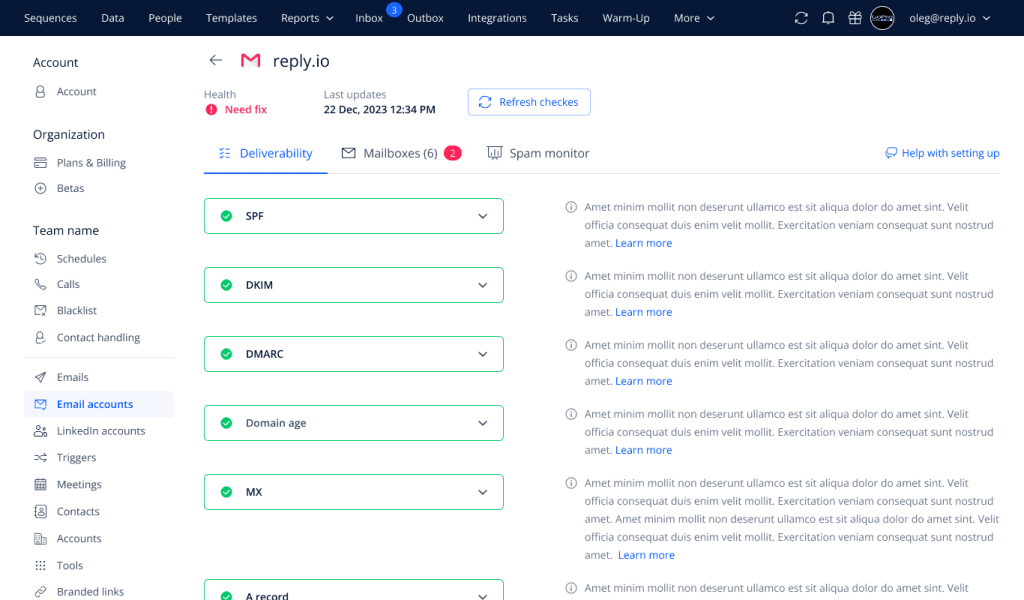
It starts with proper authentication — SPF, DKIM, and DMARC need to be configured so email providers trust the messages coming from your business domain. Reply.io offers all the key deliverability tools required to set up and monitor your entire email and LinkedIn infrastructure, protecting your business domain in the long run even as outreach scales.
Built-in email warm-up for all your connected mailboxes helps gradually ramp up sending volume instead of creating any risky spikes, native Google Postmaster integration monitors spam rates in real time, and Reply will also ensure all your team doesn’t go overboard on any email or LinkedIn sending limits.
Reply.io’s unified inbox helps keep email, LinkedIn messages, and follow-ups in one place, which becomes quite useful once multiple stakeholders from the same account start engaging at different times.
For enterprise sales outreach, this is not just some technical checklist item but the foundation that keeps the whole system consistent, compliant, and scalable.
Orchestrate multichannel outreach across the buying committee
This is where your enterprise lead generation starts turning into real pipeline. Once the account structure, stakeholder data, and infrastructure are ready, the next step is building a multichannel outreach strategy that can effectively engage multiple people within the same account.
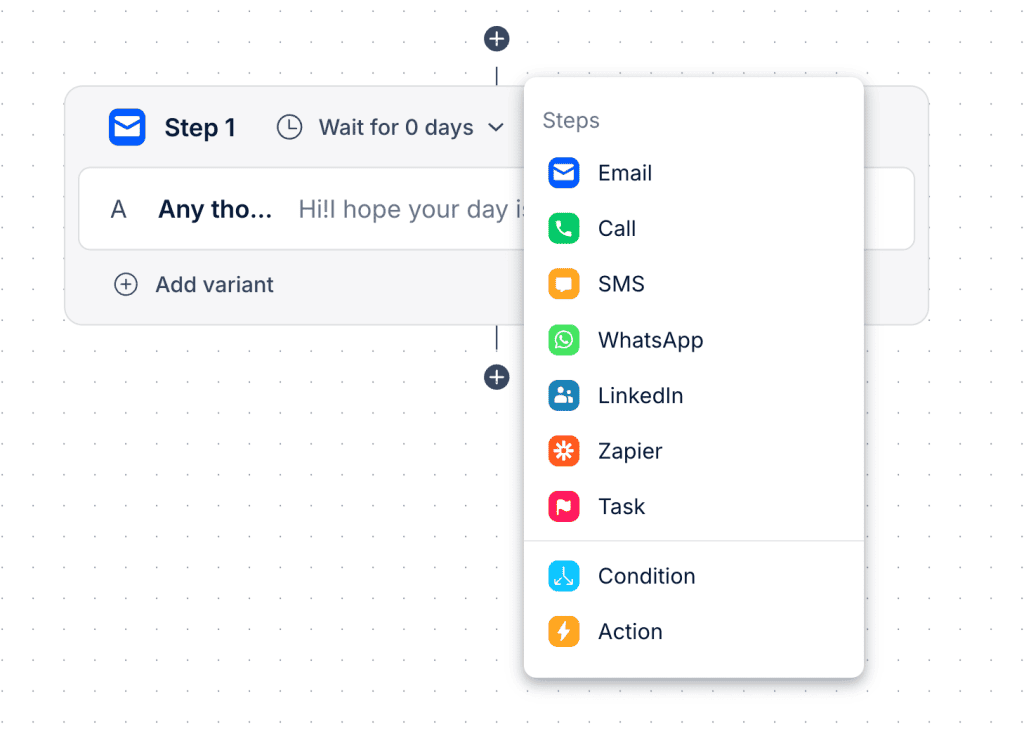
With Reply.io’s multichannel outreach, this becomes very easy. You can launch coordinated campaigns across email, LinkedIn, calls, SMS, WhatsApp, and other workflow steps.
Enterprise attention is fragmented — one stakeholder may engage through email, another may respond more easily after a LinkedIn touch, while a third may need a slower cadence with lower-friction follow-ups before anything meaningful conversations occur.
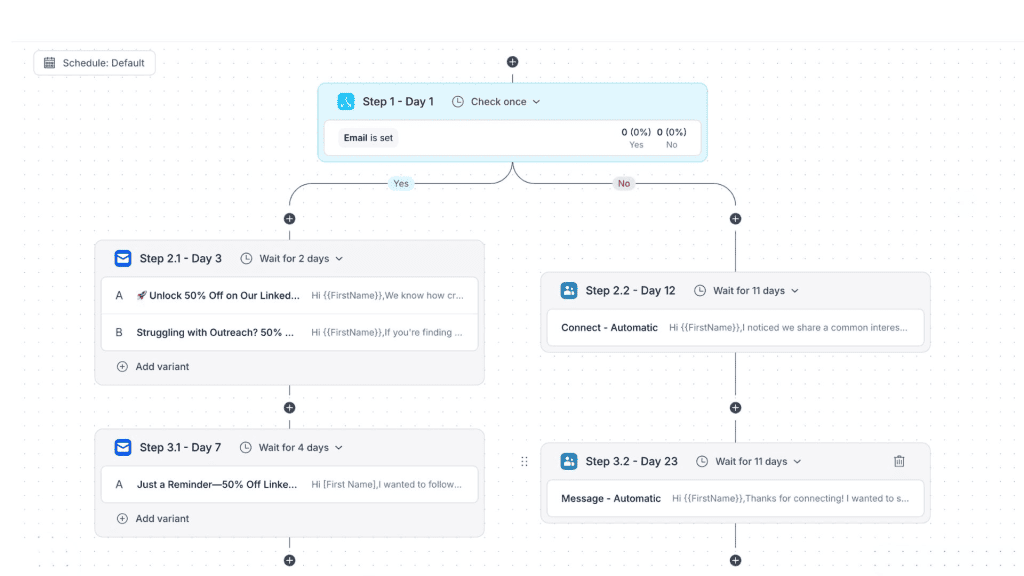
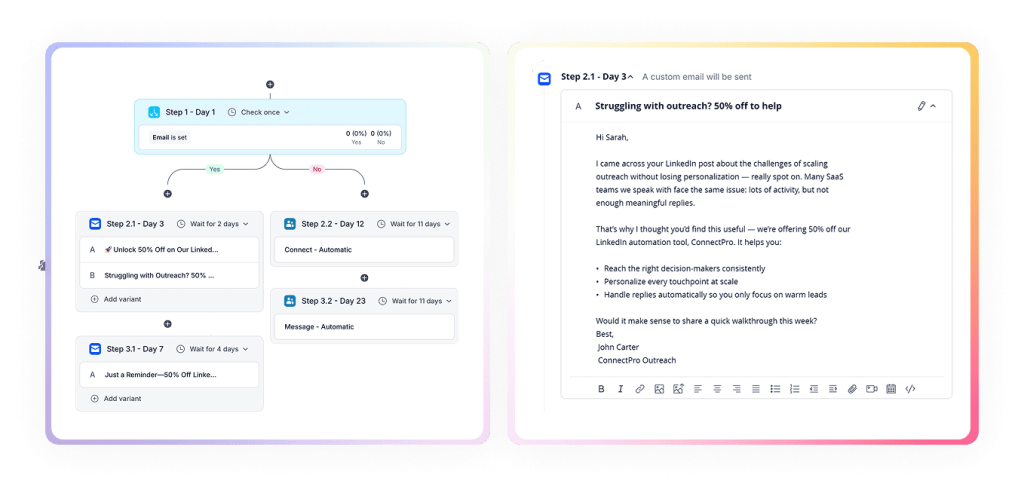
This is where Reply’s multichannel conditional sequences become especially useful. Rather than forcing every stakeholder and account through the same campaign, the system can in adapt real time, adjusting the messaging, channel, and timing based on prospect behavior and intent signals picked up from the previous steps.
For instance, if a key decision-maker hasn’t replied to your initial email in 3 days, Reply sends out an automated LinkedIn connection request. If they accept it, Reply’s AI engine writes up a short personalized connection message and cancels the scheduled email follow-up, and so on.
The result is a much stronger form of account-based outreach: structured enough to scale, but flexible enough to match how enterprise buying committees actually behave in real life.
Use AI personalization to speak to enterprise priorities
Enterprise buyers are much harder to win with generic messaging because the decision criteria are broader, the stakes are higher, and every stakeholder tends to look at the purchase from a different angle. A finance leader is not interested in the same thing an operations stakeholder or team lead is. Pretty obvious, but some teams still miss it.
At the same time, crafting tailored emails and/or LinkedIn messages to each stakeholder for multiple accounts can quite literally take up your reps’ entire workday.
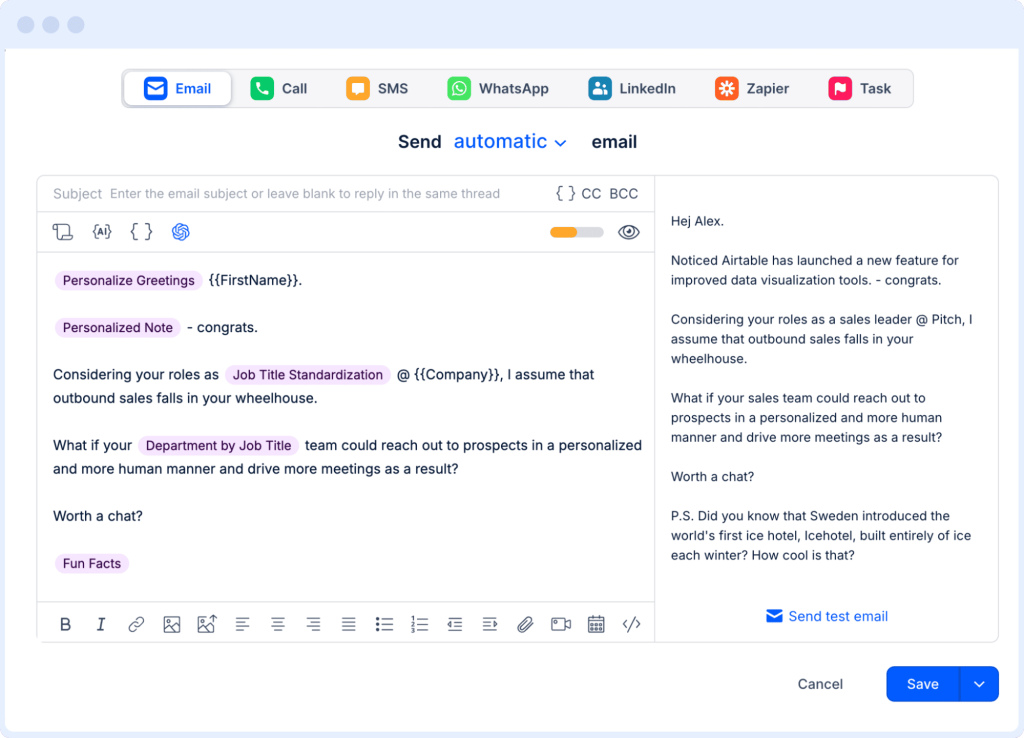
With Reply.io, however, you get an AI engine that takes all the prospect and company data uncovered in the previous steps and uses it to personalize each and every email, follow-up, and LinkedIn message. It also understands the intricacies of each distinct stakeholder and which ‘angle’ to use for each one.
It also has an AI variables feature, which allows teams to create their own template and include completely custom variables. Reply’s AI will simply fill in those variables with the right context, giving the perfect balance of brand structure and true personalization at scale:
The real value isn’t just that AI can write faster but that it can use relevant company context, role context, timing signals, and other enriched data points to power stakeholder-level personalization without forcing reps to spend hours on research and writing.
In enterprise lead generation, the strongest personalized outreach usually reflects a few things at once:
the company’s likely priorities or current growth context
the stakeholder’s role in the buying committee
likely objections or decision criteria
the level of urgency suggested by account signals
That is what makes AI personalization so useful in an enterprise setting — it helps teams scale personalized outreach across a large set of accounts and stakeholders without making the messaging feel flat or templated.
Let Jason AI run the enterprise lead generation engine
At this point, Reply.io already gives your team a full enterprise lead generation system built around data, infrastructure, multichannel outreach, AI personalization, and analytics.
Jason AI is Reply’s AI SDR that joins your team as a full-time rep and executes most of this entire workflow on your behalf.
After learning about your business, offer, strategy, and enterprise account criteria, Jason begins continuously looking for target accounts and relevant stakeholders that match your priorities.
It then enriches them with additional context from LinkedIn, company websites, and other sources, and then launches tailored multichannel outreach using the same core engine that powers Reply.io.
Jason personalizes every email and LinkedIn message, adapts outreach to the account and stakeholder context, and what’s more — it handles incoming replies, whether it’s answering questions, working around objections, or even booking meetings, all based on your custom sales playbooks and business rules.
This way, Jason will create a steady flow of handing off qualified enterprise stakeholders to your human reps for meetings, negotiations, and other more high-level conversations.
Depending on your comfort level of delegation, Jason AI comes with “approval mode”, where you still get oversight before outreach goes live, or “autopilot mode”, where the AI agent autonomously executes the workflow.
Jason also speaks 50+ languages, so you can confidently reach enterprise accounts across numerous regions.
How to improve enterprise lead generation performance over time
Automation improves speed, but long-term performance can only improve when the team keeps continuously fine-tuning the system. In enterprise lead generation, that means looking beyond activity volume and tracking the performance drivers that actually shape pipeline:
account quality
stakeholder engagement
deliverability health
channel efficiency
reply quality
meeting conversion
If open rates are weak, the issue may be infrastructure rather than messaging. If replies are low but deliverability is healthy, the problem may be account fit, timing, or stakeholder relevance. And if multiple people engage but meetings never happen, the team may need stronger qualification logic or tighter message coordination.
With a reliable AI sales platform like Reply.io, you’ll get built-in reporting and analytics regarding campaign performance across channels, accounts, and sequences, making it much easier to adjust the right variable instead of guessing.
Over time, that’s exactly what turns a static lead generation workflow into an operating system for enterprise pipeline growth.
Build a smarter enterprise lead generation engine
Enterprise lead generation in 2026 works best when precise targeting, multichannel orchestration, and AI personalization all work together inside one coordinated system.
Reply.io helps teams build such a system with little-to-no setup, and then find relevant companies, identify key decision-makers, research more about those accounts, and turn that into AI-powered, multichannel outreach, all under one roof. And if you’re looking to take it a step further, Jason AI can join your team as a full-time AI sales rep and do the heavy lifting for you.
Subscribe to our blog to receive the latest updates
from
the world
of sales and marketing. Stay up to date.
We use cookies to enhance your browsing experience, serve personalised ads or content, and analyse our traffic. By clicking "Accept All", you consent to our use of cookies.