
Any startup’s biggest challenge is that initial growth that eventually compounds over time. At Reply.io, we’ve been there, done that, completely bootstrapped.
In this article, we’ll share some of the best proven growth hacking techniques you can use to scale with limited resources.
Growth hacking is the art of driving fast, scalable growth through rapid experimentation and minimal cost. Coined by Sean Ellis, it’s a mindset rooted in speed, data, creativity, and tight feedback loops.
Does it work? Yes. In fact, that’s the playbook that many of the leading brands such as Dropbox, Hotmail, and Airbnb used to scale.
The blueprint is simple on paper — test ideas fast, double down on what works, and drop what doesn’t.
Before we dive in, here’s what we’ll cover in 7 growth-focused steps:
- Measuring growth and metrics
- Data and experimentation
- Onboarding and activation
- Funnel conversion improvement
- Community and referrals
- Content and storytelling
- Email automation and paid psychology
Read on.
How do you measure growth, and what metrics matter most?
Growth hacking without measurement is just, well, … guesswork.
You must therefore establish a tracking system to determine if your growth-hacking techniques are generating a positive ROI. It’s the absolutely critical first step to ensure you get the results you want.
Monitoring performance allows you to understand how users move through your sales and product funnels. Here’s what you need to do:
Use AARRR to map growth
The AARRR model breaks growth into five simple stages as explained below:
- Acquisition: Allows you to track how new users find you. Think ad clicks, outbound replies, demo requests, content signups, or referral traffic.
- Activation: Enables you to identify when users take a meaningful first step. This could be completing onboarding, sending a first message, or booking a meeting.
- Retention: Helps you understand whether users return and remain active over time, whether through repeat logins, weekly usage, or continued engagement.
- Revenue: Allows you to track when users convert into paying customers through subscriptions, purchases, or closed deals.
- Referral: Gives you insight into how and when users share your product, invite others, or promote it through word of mouth.
These five metrics give your startup a solid baseline to measure what’s working and where users are dropping off.
Set SMART goals
Numbers are good. However, you must have goals to turn metrics into action.
That’s where SMART (specific, measurable, achievable, relevant, and time-bound) goals come in.
So, instead of “get more signups,” say: “increase onboarding completion by 15% in 30 days.” When combined with AARRR and SMART, you have a clear roadmap on what to test, when to scale, and when to stop.
Dig deeper with cohorts and retention curves
Averages can be misleading.
Therefore, use cohort analysis to group users by sign-up date and behavior. That way, it’s easier to monitor trends such as churn or re-engagement. Meanwhile, customer retention curves allow you to determine engagement decay over time.
These insights are essential for improving onboarding, timing outreach, or fixing friction in the user journey.
Use the right growth hacking tools
Accurate measurement depends on software and data hygiene. Some good solutions for startups include:
- Google Analytics to track funnels and conversions.
- Mixpanel to map event flows and user paths.
- Kissmetrics to analyze lifecycle cohorts.
- Amplitude to monitor customer journeys through various touchpoints
- AI software for startups, from AI outreach platforms to CRMs and beyond
But none of this works if you’re only looking at surface-level metrics. You must track funnel conversions to understand how these metrics impact growth. Some key metrics to track include:
- Visitor-to-lead rate to measure acquisition quality
- Lead-to-meeting rate to assess message relevance
- Meeting-to-customer rate to evaluate qualification
- Time to first value to gauge onboarding speed
- Churn and referral rates to reveal product gaps and advocacy
Pro tip: These metrics won’t mean anything if your definitions keep changing. Stick to consistent event names, shared definitions, and documented tracking rules. That way, everyone is working based on the same numbers, also enabling data-backed decisions.
How can data and experimentation drive your growth?
Startups don’t have time or budget to waste on gut feelings.
Growth comes from running fast, data-backed experiments. Therefore, every test should help answer one question: what’s worth doing again?
Let’s unpack that.
What makes a growth experiment?
A growth hacking experiment has three parts: a clear hypothesis, a measurable outcome, and a set timeline.
For example: “If we personalize our email subject lines by job title, we expect a 20% increase in reply rate over the next 10 days.”
The process is structured, easy to understand, and implement.
With the experiment, you’re testing a small change and analyzing the results. Then, decide what to do next based on evidence.
At the heart of this strategy is the Lean Startup methodology, introduced by Eric Ries.
It encourages startups to move fast without losing focus. The Build-Measure-Learn loop works as follows:
- Build a simple version of your idea or campaign
- Measure how it performs using first-hand data
- Learn from the outcome and adjust quickly
Over time, this rhythm compounds results. Teams running SaaS growth hacking techniques can apply this loop to onboarding flows, pricing pages, and messaging.
Apply A/B and multivariate testing
For starters, A/B testing compares two versions of one element. Multivariate testing, on the other hand, compares multiple variables at once.
Tests can include landing page headlines, call-to-action buttons, feature placement, and email copy.
Startups can use tools like:
- Optimizely for A/B and multivariate tests on websites and features
- VWO for optimizing landing pages and conversion paths
- Google Optimize for simple, free testing options
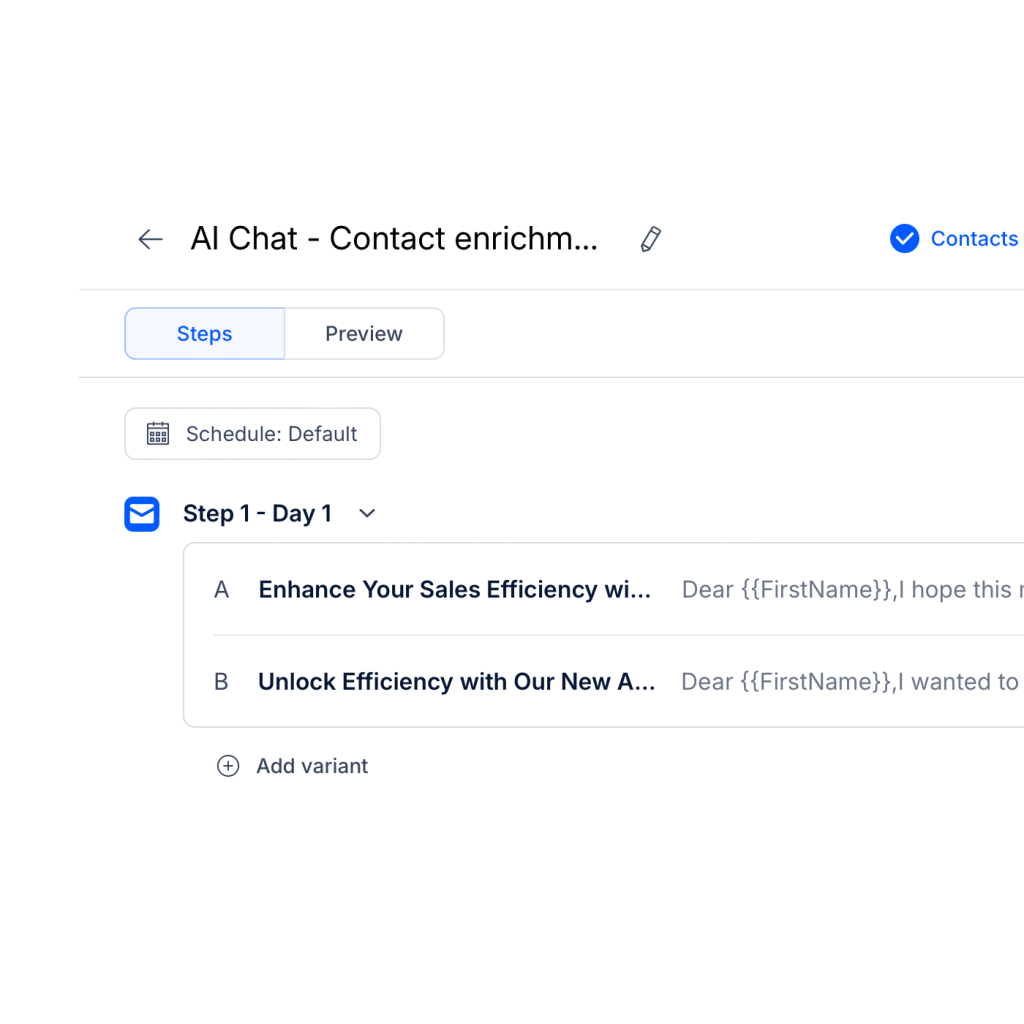
- Reply.io to A/B test outreach across email, LinkedIn, and more
How to optimize user onboarding and activation?
Acquisition gets prospects to your door, but onboarding convinces them to stay. It’s the critical bridge between initial interest and long-term usage.
A well-designed onboarding flow helps users reach their “aha moment” when they see the value of your product.
Here’s how to build an onboarding flow that works:
Personalize onboarding by user segment
One-size-fits-all onboarding isn’t effective.
And that’s because leads who come through different acquisition channels or have different job roles don’t need the same intro flow.
Therefore, segment users by source, industry, or behavior. That way, you can tailor content to a specific audience and, more importantly, reduce drop-offs.
After all, the more relevant the first experience, the faster users see value.