A GTM plan can look sharp on paper and still fail in execution, and there are a number of reasons why that would happen.
The ICP is too broad, sales and marketing aren’t aligned on targeting, outreach goes live before messaging is tested, leads move through the funnel without clear qualification, and nobody catches the problem until revenue targets are missed.
That’s the real work (and challenge) of GTM management — turning strategy into an automated operating system that keeps teams aligned, campaigns focused, and revenue moving.
What is GTM management?
GTM management is the day-to-day execution of your go-to-market strategy.
A GTM strategy defines what you sell, who you sell to, how you position the offer, and which channels you use. GTM management turns those decisions into action across sales, marketing, RevOps, customer success, and leadership.
In practice, that means:
pointing teams at the right accounts
running campaigns that generate qualified replies
qualifying leads before they reach sales
tracking what works and cutting what doesn’t
keeping sales and marketing aligned around the same data
The strategy sets the direction, and management keeps the system moving.
A SaaS company may have a clear plan: target HR leaders at 200-person companies, use email and LinkedIn, and close within 30 days. But if reps contact the wrong roles, follow-ups slip, messaging stays uncoordinated across channels, and nobody monitors reply quality, the plan won’t turn into revenue.
Good GTM management closes that gap by connecting the plan on the whiteboard to the daily actions that create pipeline, meetings, and closed deals.
Building Outbound from Scratch: 2026 Playbook
We broke down what actually works in outbound. No fluff. No theory. Just real steps you can use right away.
Inside this playbook, you’ll learn how to find the right companies, reach out with messages that get replies, and build a simple outbound system from zero.
What’s inside:
→ How to define your ideal customers (and avoid wasting time on the wrong ones) → A simple way to write messages that actually get replies → Real examples of cold emails you can reuse → A basic outbound system you can set up in a few days → The exact tools you need (and what to skip) → Benchmarks so you know if you’re doing it right
Grab your copy and start booking more meetings.
Step 1: Define your ideal customer profile (ICP) and positioning
Who you sell to determines every GTM decision that follows, from positioning and messaging to qualification and reporting. If your ICP is too broad, the rest of the system will look active but produce weak leads.
An ideal customer profile describes the type of company most likely to buy, renew, expand, and see clear value from your product. It should be specific enough for sales and marketing to use in daily execution, not a vague label like “growing SaaS companies.”
A strong ICP usually includes:
company size and revenue range
industry and sub-niche
buyer role and seniority
current tools or tech stack
trigger events that create urgency
deal-breakers that mark a poor fit
The best way to build it is to work backwards from your existing customers. Pull your last 20 closed-won deals and look for patterns — who bought fastest, had the shortest sales cycle, paid the most, expanded later, and stayed the longest. Then compare those accounts against lost deals and stalled opportunities to find the attributes that actually predict revenue.
That level of detail gives your team something actionable. Sales teams know who to prospect, marketing know what pain points to write about, and RevOps understand which accounts should be prioritized.
It also helps with timing, which is crucial in modern B2B. A company that just raised funding, hired a new revenue leader, opened sales roles, changed tools, or expanded into a new region often has a fresh operational problem to solve. Reaching out around that trigger gives your message more context than any generic pitch ever will.
With Reply.io, teams can turn their ICP into prospect lists using Reply Data — its native lead database offering access to over 1 billion live contacts and accounts, along with advanced search filters, built-in enrichment, and even intent signals (more on that shortly).
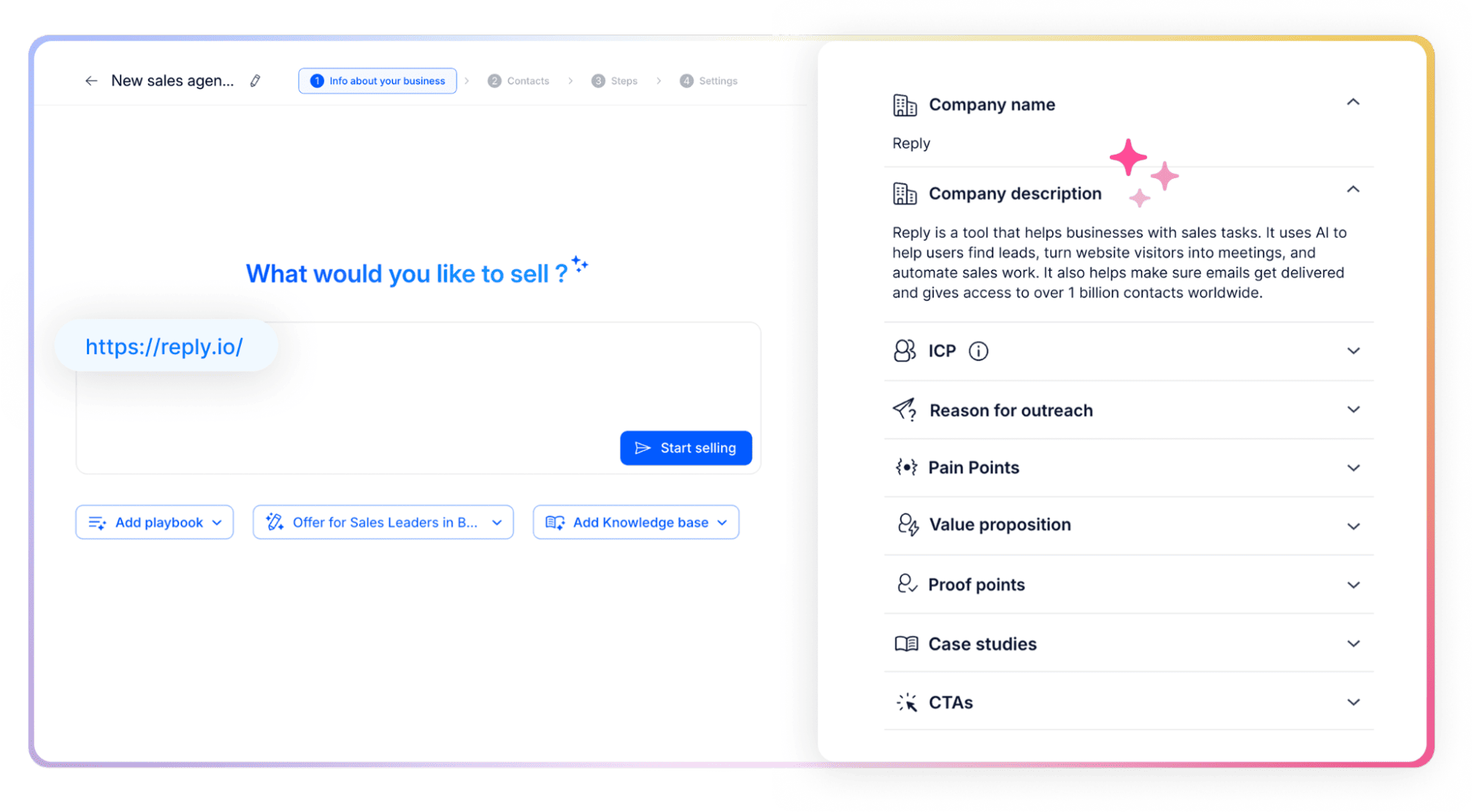
Jason AI is Reply’s AI sales agent that joins your team as a full-time rep, helps you build your ICP, and learns everything about your business, audience, and strategy before getting down to business.
Positioning and messaging should come directly after the ICP, since the ICP defines who you’re speaking to and messaging defines what you say to them. Once you know the buyer, focus the message on one clear pain point, one outcome, and one proof point instead of leading with a feature list.
The same positioning should adapt across multichannel outreach. A LinkedIn message needs to be shorter than a cold email, while a call opener should lead with a brief question, not a rehearsed speech. The core message stays consistent, but the format changes based on how the buyer reads it.
Step 2: Choose your go-to-market motion
Your GTM motion defines how buyers discover, evaluate, and buy your product. The right motion depends on your deal size, buyer behavior, product complexity, and sales cycle.
Most companies use one of three core motions, or a combination of them:
Sales-led growth puts reps at the center of the process. They prospect, qualify, run demos, handle objections, and close deals. This works best when the product is complex, deal sizes are high enough to support rep involvement, and buyers need a conversation before making a decision.
Marketing-led growth creates demand through SEO, content, paid campaigns, webinars, communities, and events. It works well when buyers research heavily before speaking to sales and when your category has enough search demand or market awareness to support inbound acquisition.
Product-led growth lets buyers experience value before talking to a rep. Free trials, freemium plans, templates, and self-serve onboarding can reduce friction, especially when the product is easy to understand and the buyer can evaluate it without a long approval process.
In practice, many GTM teams combine all three. A SaaS company might use outbound to reach target accounts, content to educate the market, and a free trial to shorten the buying decision once interest is created.
The key is to match the motion to the buyer — a six-figure enterprise deal needs sales involvement, a low-cost self-serve tool needs fast product value, a category with strong search demand should not ignore content and SEO.
Step 3: Pick your outreach channels
Once the message is clear, the next decision is where to deliver it.
Most B2B buyers split attention across several channels, which makes single-channel outreach fragile. One email can get missed, one LinkedIn request can be ignored, and a call with no prior context can feel too cold. The channel mix should reflect where your buyer pays attention and how much context the deal requires.
Use each channel for a clear role:
Email works well for structured outbound because it gives you room to explain the problem, value proposition, proof, and CTA.
LinkedIn works well for warming up buyers, adding context, and engaging prospects who are active in professional conversations.
Calls are useful for high-value accounts where direct conversation can shorten the path to qualification.
SMS or WhatsApp can support reminders and short follow-ups when the prospect already knows who you are.
This only works if all these channels stay coordinated across the entire buying journey for each lead. A prospect who gets an email on Monday, a LinkedIn touch on Wednesday, and a call on Friday should hear one connected message, not three disconnected pitches.
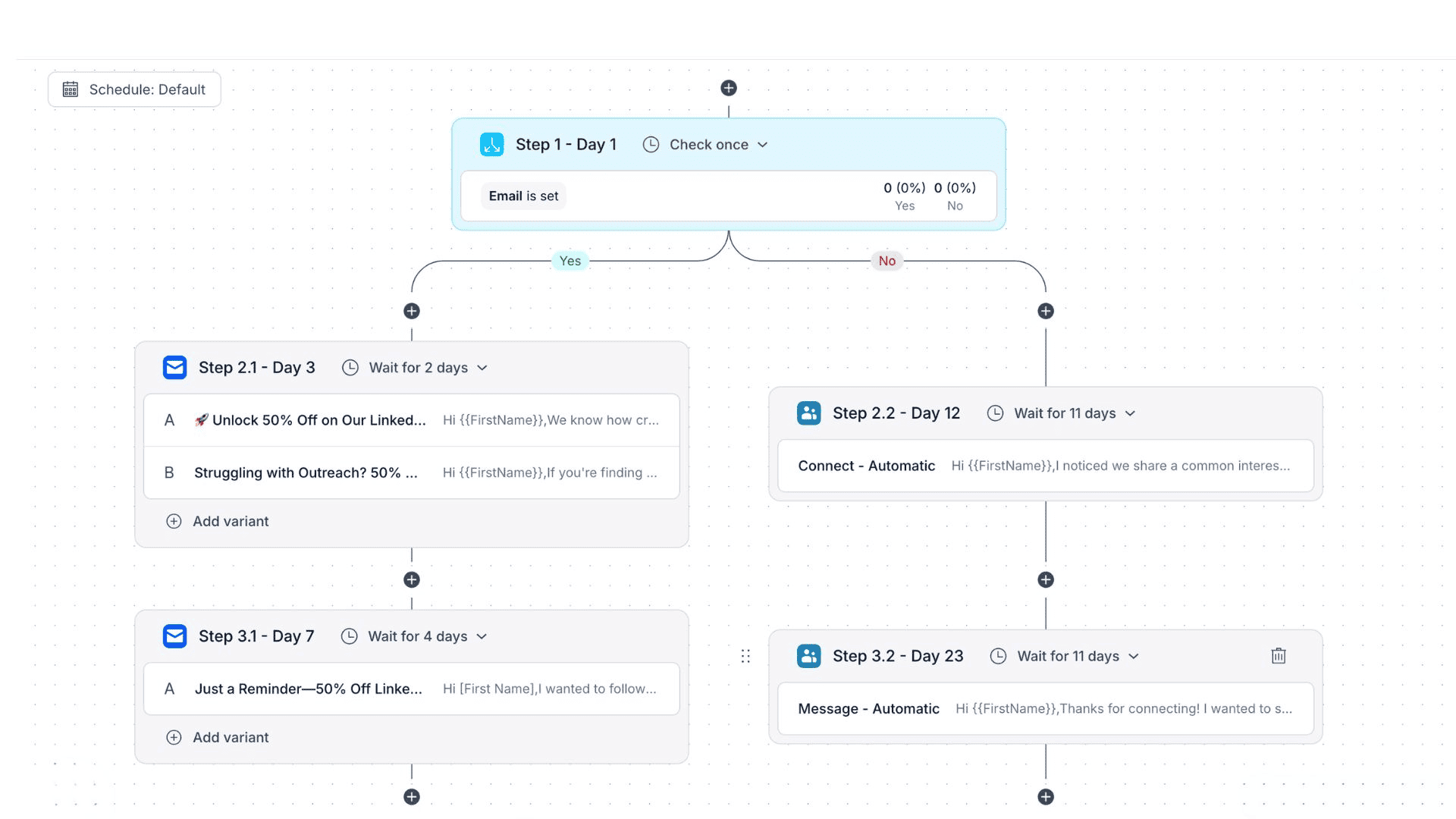
This is where AI outreach platforms like Reply.io truly shine. Reply helps GTM teams build coordinated multichannel sequences across email, LinkedIn, calls, SMS, WhatsApp, and other workflow steps. These sequences are conditional, which means they adapt the messaging, timing, and channel choice in real-time based on lead behavior:
For instance, if your initial cold email doesn’t spark a response in 3 days, Reply will launch an automated LinkedIn connection request. Once accepted, Reply writes up a personalized LinkedIn message and cancels the scheduled email follow-up, and so on.
The value isn’t just having more channels, but having them inside one sequence with timing rules, reply detection, and follow-up logic that keeps your outreach consistent.
Step 4: Build your sales engagement engine
Once the ICP, message, and channels are in place, you need a system that runs outreach consistently.
A sales engagement engine is the combination of tools, sequences, data, rules, and workflows your reps use to contact prospects, follow up, manage replies, and move conversations forward. Without it, pipeline depends too much on individual rep discipline.
Start with a sequence that matches the buying motion. A simple outbound sequence for a cold prospect could look like this:
Day 1: personalized email tied to a specific pain point
Day 3: LinkedIn connection request with a short note
Day 5: follow-up email with proof or a relevant use case
Day 8: call task for high-fit prospects
Day 10: final email with a low-friction CTA
The exact cadence will depend on your audience, but the principle stays the same, which is that every prospect should move through a planned path instead of relying on reps to remember the next touch manually.
Personalization should also be a key part of the entire outbound system, but of course, doing that manually across hundreds or even thousands of leads is challenging, to say the least.
Reply’s AI engine fully takes care of this by using all the enriched data and intent signals to personalize every email, follow-up, and LinkedIn message with the most relevant context.
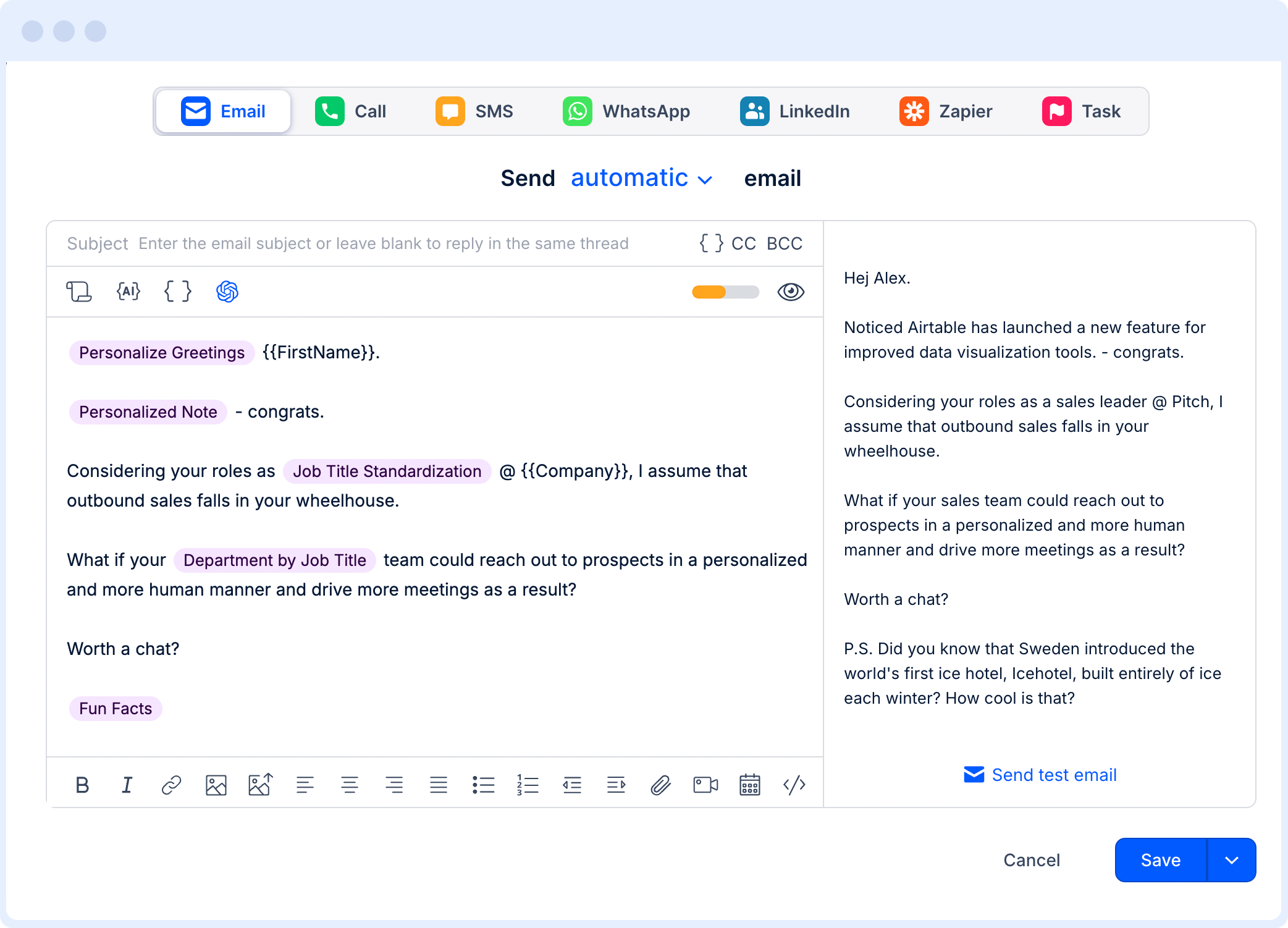
It also comes with an AI Variables feature that helps teams create their own templates with custom variables for openers, value props, CTAs, and more, and Reply then researches each lead/company to fill in those gaps:
This way, every lead in your pipeline will always get the most relevant, personalized, and timely outreach, while all your outreach campaigns stay coordinated and running like clockwork.
Step 5: Automate lead qualification with an AI sales agent
Not every reply deserves a sales call, and not every interested prospect is ready to buy.
Lead qualification decides which prospects should move to sales, which ones need nurturing, and which ones should exit the process. Without clear qualification, reps waste time on poor-fit conversations and the pipeline fills with opportunities that were never likely to close.
A qualified lead usually meets three conditions:
they match your ICP
they have a problem your product can solve
they show some level of buying intent
A prospect who matches the ICP, owns the problem, has urgency, and can influence the decision is worth a call, whereas a prospect who lacks fit or timing may still be valuable, but they need nurture before sales involvement.
The challenge is volume. When replies come in from email, LinkedIn, forms, and other channels, reps can spend hours sorting responses, answering basic questions, and deciding who deserves follow-up.
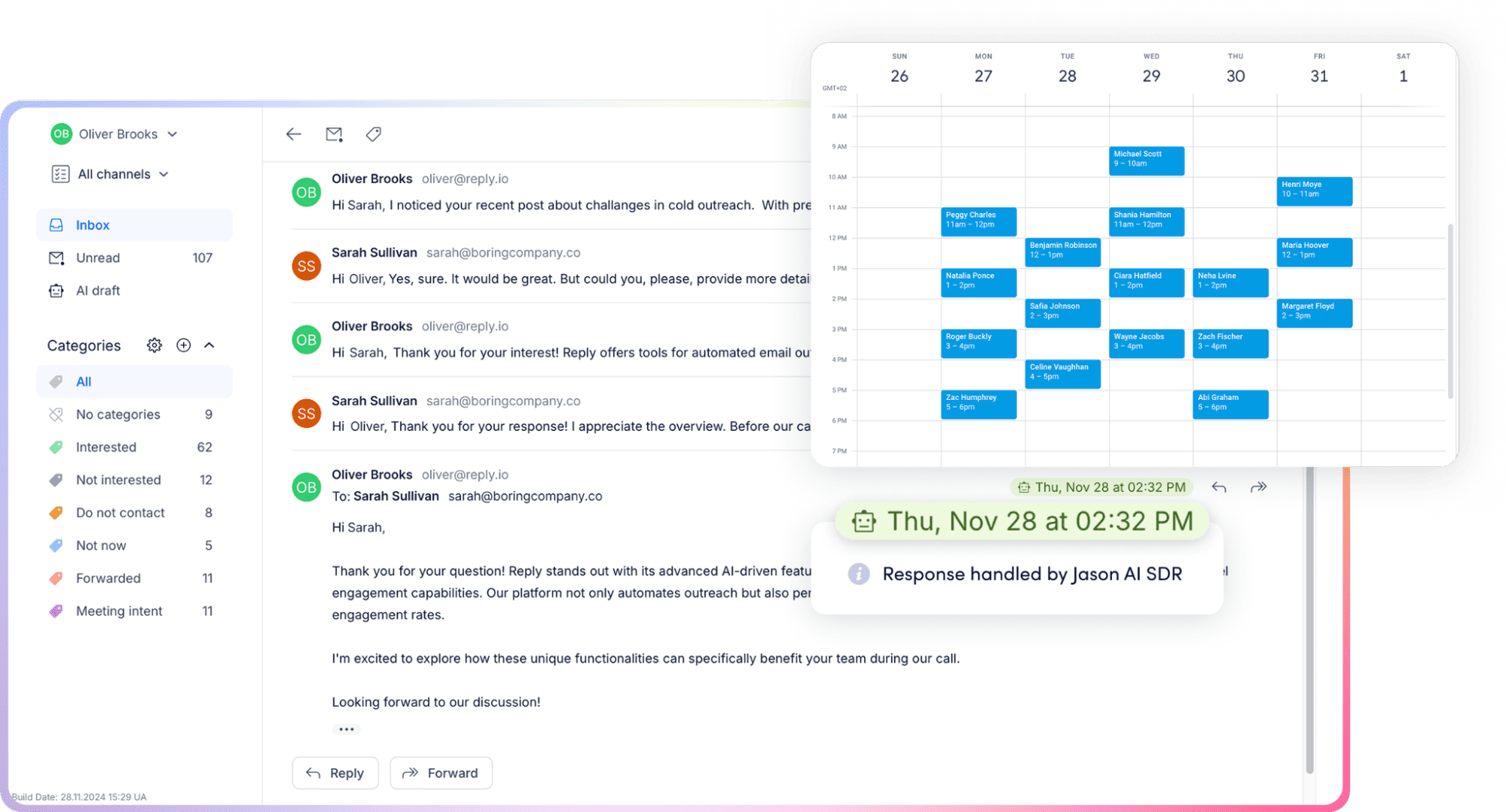
Jason AI helps fully automate that front line. After finding targeted leads and launching outreach, it can handle replies by answering questions and working with objections based on your custom sales playbooks, continue conversations, qualify interest, and even book meetings on your behalf.
For GTM teams, this creates a much smoother handoff. Reps spend more time on qualified conversations, while AI handles the early reply management that often slows down pipeline.
Step 6: Protect your email deliverability
You can have a detailed ICP, strong positioning, and a well-built sequence, but none of it creates meetings or revenue if your emails land in spam. Email deliverability is now another key part of GTM execution, especially for teams running outbound at scale.
sending too much volume from one inbox or LinkedIn account
using poor-quality or unverified contact data
adding too many links, images, or spam-heavy phrases
ignoring bounce rates, spam complaints, and sender reputation
The first layer is the technical setup → SPF, DKIM, and DMARC help mailbox providers verify that your emails are legitimate.
The second layer is sending behavior → gradual warm-up, controlled volume, inbox rotation, and clean sending patterns.
The third layer is list quality → since invalid addresses and risky contacts can damage sender reputation fast.
Reply.io’s email deliverability infrastructure supports all 3, with built-in email authentication, spam monitoring, mailbox rotation, and email validation, warm-up, and sending limits running in the background to help you run those higher-volume campaigns with full safety.
Step 7: Measure, report, and improve
GTM management only works if the system gets reviewed and improved regularly.
Activity alone doesn’t prove progress, because a team can send more emails, add more contacts, and run more sequences while pipeline quality still gets worse. The right reporting connects outreach activity to qualified replies, booked meetings, pipeline, and revenue.
Track the metrics that show whether the GTM motion is working:
Reply rate: shows whether targeting and messaging are strong enough to start conversations
Positive response rate: shows whether replies are coming from buyers with real interest
Meetings booked: shows whether outreach is creating sales conversations.
Pipeline created: shows the revenue value of opportunities added
Win rate: shows whether qualification and targeting are producing deals that can close.
Channel performance: shows where your buyer is most likely to engage
Sequence step performance: shows which messages move prospects forward and which ones need work
Build a weekly review rhythm around those numbers. Look for weak sequence steps, low-quality reply patterns, channel drop-offs, deliverability issues, and ICP segments that underperform. If a message fails for two weeks in a row, rewrite it. If a segment produces strong positive replies, expand it. If a channel creates activity but no meetings, reduce its weight in the sequence.
Reply.io’s analytics help teams review sequence performance, replies, meetings, channel activity, and campaign results in one place. That makes GTM management easier to run as an optimization loop rather than a monthly reporting exercise.
Turn GTM management into a repeatable revenue system
GTM management works when the strategy is clear, and the execution stays consistent. That means tight targeting, sharp positioning, coordinated channels, structured outreach, qualified handoffs, healthy deliverability, and weekly performance reviews.
Reply.io helps run that execution layer with prospect data, multichannel sequences, AI personalization, deliverability tools, analytics, and Jason AI for prospecting, reply handling, and meeting booking.
Start your free 14-day Reply.io trial and start transforming your GTM strategy into an AI revenue engine right away.
FAQ
What is GTM management?
GTM management is the daily execution of your go-to-market plan. It covers how teams target accounts, run campaigns, qualify leads, manage outreach, measure performance, and adjust the system based on what creates pipeline.
How is GTM management different from GTM strategy?
GTM strategy defines the plan: who you sell to, what you sell, how you position it, and which channels you use. GTM management turns that plan into operating routines, campaigns, handoffs, reviews, and improvements.
What does a GTM manager do?
A GTM manager keeps sales, marketing, RevOps, and leadership aligned around the same revenue motion. They manage targeting, messaging, channel execution, funnel metrics, campaign performance, and the changes needed when results fall short.
What tools do you need for GTM management?
Most teams need a CRM, prospecting database, sales engagement platform, analytics tool, and enrichment or qualification layer. Reply.io covers several of those needs by combining prospect data, multichannel outreach, AI personalization, deliverability, and reporting.
How does AI fit into GTM management?
AI helps with the repetitive parts of execution, including prospecting, enrichment, personalization, reply handling, and lead qualification. An AI sales agent like Jason AI can also help move qualified prospects toward booked meetings, so reps spend more time on live sales conversations.
How do you measure GTM management success?
Track reply rate, positive response rate, meetings booked, pipeline created, win rate, and channel performance. Together, these metrics show whether your GTM motion is reaching the right buyers and turning outreach into revenue.
Subscribe to our blog to receive the latest updates
from
the world
of sales and marketing. Stay up to date.
We use cookies to enhance your browsing experience, serve personalised ads or content, and analyse our traffic. By clicking "Accept All", you consent to our use of cookies.