
Lead Generation Optimization in 2026 for Better Results

Lead Generation Optimization in 2026 for Better Results

The fastest way to waste time on lead generation in 2026 is by optimizing for volume alone. More contacts, more emails, more tools…sounds productive on paper. In reality, it usually creates the exact opposite: worse data, weaker personalization, harmed deliverability, and a lot more noise for buyers who already ignore generic outreach.

Lead generation optimization today is about building a much sharper and more precise system. Better-fit accounts, cleaner data, stronger buying signals, smarter outreach, and most importantly nowadays — faster movement from interest to booked meetings.

What effective B2B lead generation looks like in 2026

For quite some time now, effective lead generation is no longer some clean, linear process where marketing captures leads, sales engages them, and deals get booked at the end. 

Buyers go through much of the buyer journey on their own now. They research, compare vendors, and often wait to talk to sales until they already understand the problem and have a shortlist in mind. That changes the whole game, and modern B2B lead generation has to be a lot more precise. 

The goal is now to be proactive, finding accounts that match your ideal customer profile, understanding why they may be in-market right now, and engaging them with relevant messaging across the right channels at the most optimal time. 

A strong lead generation process usually includes:

  1. ICP definition → industry, company size, geography, tech stack, growth stage, pain points, and buying triggers

  2. Account sourcing → finding companies through databases, CRM records, website visitor data, LinkedIn, intent signals, funding news, hiring activity, and market movement

  3. Contact discovery → identifying decision-makers, influencers, champions, technical evaluators, and users within the shortlisted accounts

  4. Lead enrichment → adding verified emails, job titles, LinkedIn profiles, company data, technologies used, and other relevant signals for more context

  5. Lead scoring → ranking and prioritizing accounts by fit, urgency, engagement, and likelihood to convert
  6. Multichannel outreach → using coordinated outreach across email, LinkedIn, calls, while AI personalizes each message with all the uncovered data (from previous steps)

  7. Reply handling and meeting booking → qualifying interest, answering questions, handling objections, and routing sales-qualified leads

  8. Performance feedback → using data on replies, meetings, and closed deals to improve future targeting

While every team has certain “steps” that they’ve nailed, and some that they need the most improvement on, lead generation optimization is really about improving that entire system. 

Done right, it increases lead quality, cuts wasted effort, and helps teams spend more time on qualified leads that actually have a shot at becoming real opportunities.
Convert Competitors` Fans Into Hot Leads

Stop chasing cold leads.
Start talking to people who already want what you sell.

Your competitors’ followers?
They know the problem. They’re paying attention.
Some are even looking for something better, right now.

This playbook shows you exactly how to turn them into hot leads.

The biggest lead generation challenges in 2026

Let’s be honest, there’s no shortage of software out there. Many teams already have more tools than they realistically need to effectively generate leads and close deals. 

In most cases, the main issue is that their data, channels, signals, and workflows are  disconnected.

  • Challenge #1: lead volume. 

A huge list might look great in a dashboard, but it means very little if the contacts are poor-fit, outdated, unverified, or simply not in a position to buy. In most cases, a smaller list of well-matched, high-intent accounts will lead to more revenue than any giant static list because the timing is better and the messaging can actually be specific.

  • Challenge #2: data quality. 

Bad data quietly breaks the entire lead generation process. Invalid emails drive up bounce rates, old job titles send reps to the wrong people, and duplicate records make the CRM messy. Weak enrichment further kills personalization, while poor segmentation forces teams to send the same message to prospects with completely different needs and pain points.

  • Challenge #3: scattered buyer intent. 

A prospect might visit your pricing page, start actively hiring, expand into a new market, swap out part of their tech stack, engage with competitor content, or interact with your LinkedIn posts. All of those are clear signs of intent, but the problem is that many teams still fail to connect those signals to outreach fast enough.

  • Challenge #4: generic AI lead generation. 

AI has made it easier to write sales emails, sure. But it has also made buyers much better at spotting lazy personalization. “I noticed your company is growing” does not cut it anymore. Good personalization has to now connect a real signal to a real business problem. 

  • Challenge #5: deliverability. 

Email authentication, bounce rates, spam complaints, sending patterns, unsubscribe handling, and list quality all shape whether your outreach lands in the inbox or disappears (and harms your brand domain in the process). 

  • Challenge #6: self-inflicted complexity. 

A lot of teams stitch together too many tools for lead databases, enrichment, validation, LinkedIn automation, sequencing, website visitor identification, and analytics. For small and mid-sized teams, that gets messy (and expensive) really fast. 

A consolidated platform like Reply.io becomes the more practical option for combining lead generation, contact data, intent signals, and AI-powered outreach under one roof. 

The platform offers a native lead database with over 1 billion prospects and accounts, along with built-in enrichment, email validation, buyer signals, and website visitor identification. And once you’ve found the right leads, Reply launches tailored multichannel sequences while personalizing every email, follow-up, and LinkedIn message with the uncovered data. 

How to optimize lead generation in 2026

If you want to optimize lead generation, do not simply start by sending more messages. That will rarely amount to anything meaningful in terms of booked meetings or revenue. 

Start by finding the weakest part of your existing system. Are you targeting the wrong accounts? Working with stale data? Missing buying signals? Sending generic outreach? Losing momentum because follow-up is weak or deliverability is off?

The lead generation optimization strategies below focus on fixing the full path, from prospect discovery to qualified meetings.

Tighten your ICP before you even begin generating leads 

A weak ICP makes every B2B lead generation strategy less effective down the line. If your ideal customer profile is too broad, your lists get messy, your messaging gets generic, and your reps spend more time filtering out bad-fit prospects than actually selling.

A strong ICP in 2026 has to go beyond basic firmographics like company size, industry, location, and revenue range. Those still matter, of course, but it’s no longer enough. You also need to understand buying triggers, operational pain points, intent signals, and the so-called buying committee, as in the right point of contact within each account. 

For example, “B2B SaaS companies” is way too broad for any meaningful lead gen. A much stronger version would be: “Series A to C B2B SaaS companies with 30–300 employees, actively hiring sales reps, expanding into the US or EU, and using HubSpot or Salesforce.”

That level of detail makes a huge difference, as it helps you build better lead lists, write sharper messages, and avoid wasting budget on contacts that look good on paper but have no real reason to engage with you, let alone make a purchase.

For lead generation optimization, these are the ICP layers to consider, depending on your unique business and audience: 

  • Best-fit company profile
  • Common pain points
  • Buying triggers
  • Technologies used
  • Decision-makers and influencers
  • Disqualifying factors
  • Most relevant use cases
  • Proof points by segment

Prioritize leads with intent signals, not static lists

Static lists answer one question: “Does this company match our filters?” Intent-based B2B lead generation answers a much better one: “Is this company likely to care right now?”

That distinction matters more than ever, as a company can fit your ICP perfectly yet still have zero urgency for a number of reasons. At the same time, another firm may be showing multiple signals that point to a potential near-term opportunity, be it visiting your website, expanding their team, entering a new market, adopting a related technology, or even simply engaging with your product-related LinkedIn content.

Some of the most useful buyer intent signals include:

  • Repeat visits to pricing, comparison, product, or integration pages
  • Actively hiring for roles that your product/service is relevant to
  • Funding announcements
  • New market expansion
  • Technology changes
  • LinkedIn engagement
  • Webinar attendance or content downloads
  • Website visitor activity

The real opportunity is combining fit and intent. A high-fit account with no signal might go into a nurture sequence, whereas a high-fit account showing strong intent should move into faster, more personalized outreach. And by focusing your emails and LinkedIn messages on these signals, your value proposition and engagement angle become much more relevant. 

Platforms like 6sense and Demandbase can support enterprises with much deeper, hard-to-source intent signals. 

For smaller and mid-sized teams, an all-in-one lead gen and outreach platform like Reply.io is the better choice, as it covers the main intent signal identification, like hiring activity, website visits, company growth, LinkedIn engagement, and technology usage to identify better opportunities and personalize outreach at scale.

Build multichannel outreach around buyer behavior

Single-channel lead generation is getting less effective by the day. Email alone is way too crowded, LinkedIn alone is hard to scale consistently, and calls only work in a few situations when there’s enough context to justify the interruption. 

That’s why multichannel outreach is key. The real goal is to match the right channel to the level of intent, urgency, and relationship.

A simple multichannel sequence might look like this:

  • Day 1: Personalized email based on a relevant trigger
  • Day 2: LinkedIn profile view or connection request
  • Day 4: Follow-up email with a specific use case or proof point
  • Day 6: LinkedIn message that continues the same conversation
  • Day 8: Call task for high-fit or high-intent accounts
  • Day 12: Final follow-up with a clear, low-friction CTA
  • Later: Re-engagement when a new signal appears

The mistake a lot of teams make is repeating the exact same message across every channel. Instead, each touchpoint should add context — emails can explain the value prop, LinkedIn can build familiarity, and a call can be saved for accounts showing stronger positive engagement. 

This is where automation becomes absolutely crucial. An outreach tool like Reply.io has an AI engine that launches tailored multichannel outreach campaigns across email, LinkedIn, SMS, calls, and WhatsApp. It takes all the uncovered data and intent signals to craft personalized emails, follow-ups, and LinkedIn messages, and decides on the most optimal time for each touchpoint.

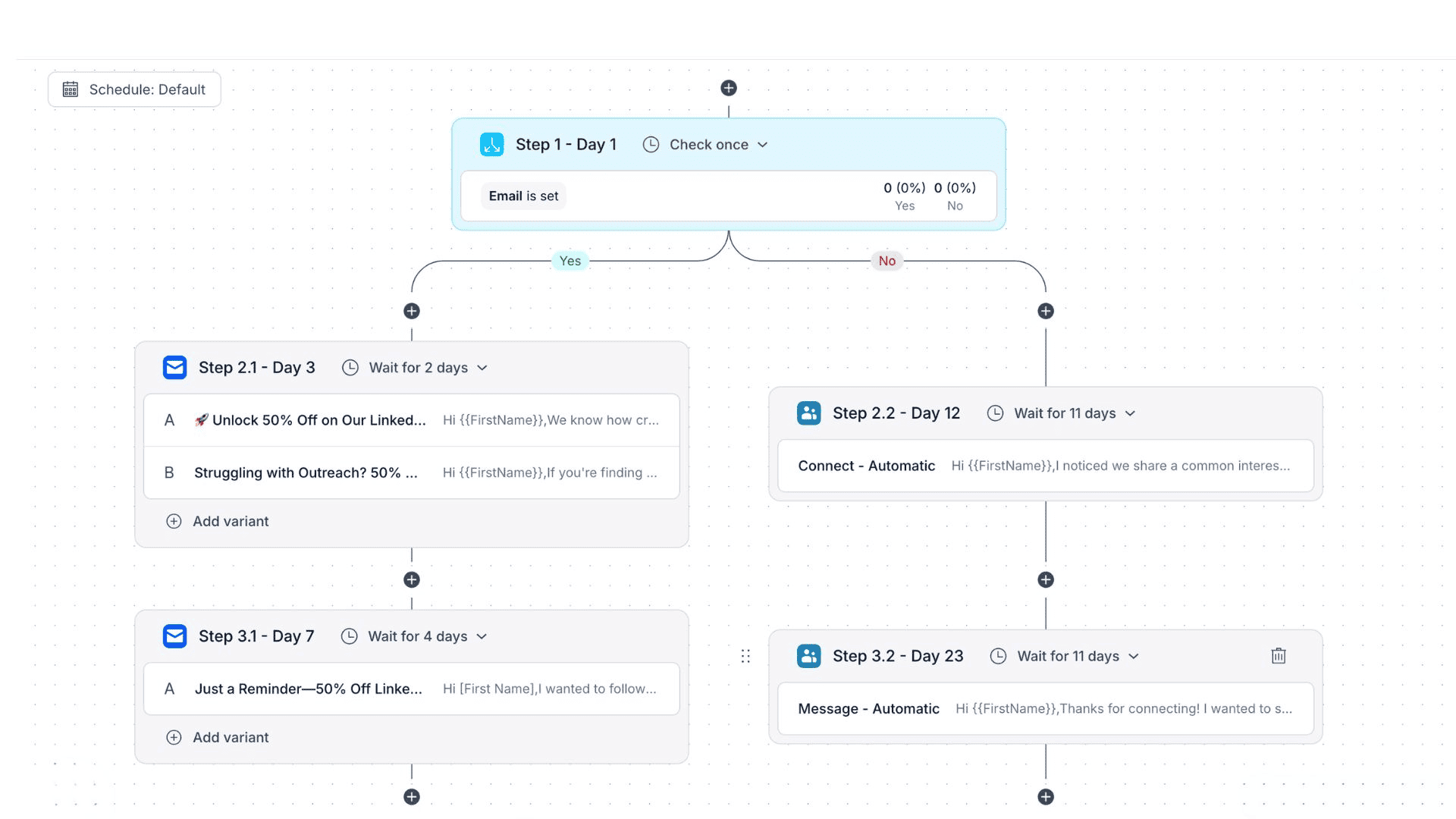
It also comes with conditional logic, where each sequence adjusts based on lead behavior. For instance, 4 days after the initial email Reply can launch an automated LinkedIn connection request. Once accepted, it launches a personalized LinkedIn message and cancels the scheduled email follow-up, and so on. 

how to auto send emails to a folder in gmail with conditional sequences

Improve personalization with sales intelligence

Personalization is not just the first name, company name, and a generic compliment. Buyers have seen that a thousand times, and they can see right through it. In 2026, useful personalization means connecting a real business signal to a relevant problem and giving the prospect a clear reason to respond.

A simple formula to keep in mind here: signal + business implication + relevant offer

For example:

“Noticed your team is hiring SDRs across EMEA. Teams expanding outbound usually hit two bottlenecks at once: finding clean lead data and keeping follow-up personalized across regions. Are you already solving that internally?”

It starts with a visible signal, ties it to a reasonable business implication, and opens the door to a relevant conversation. It’s specific, but not weirdly overfamiliar.

AI can help a lot here, but only when used right. If you’re simply using ChatGPT or Claude to craft emails and LinkedIn messages, you’d need to write them up one by one, while feeding the available data for each lead. And that’s not scalable at all.  

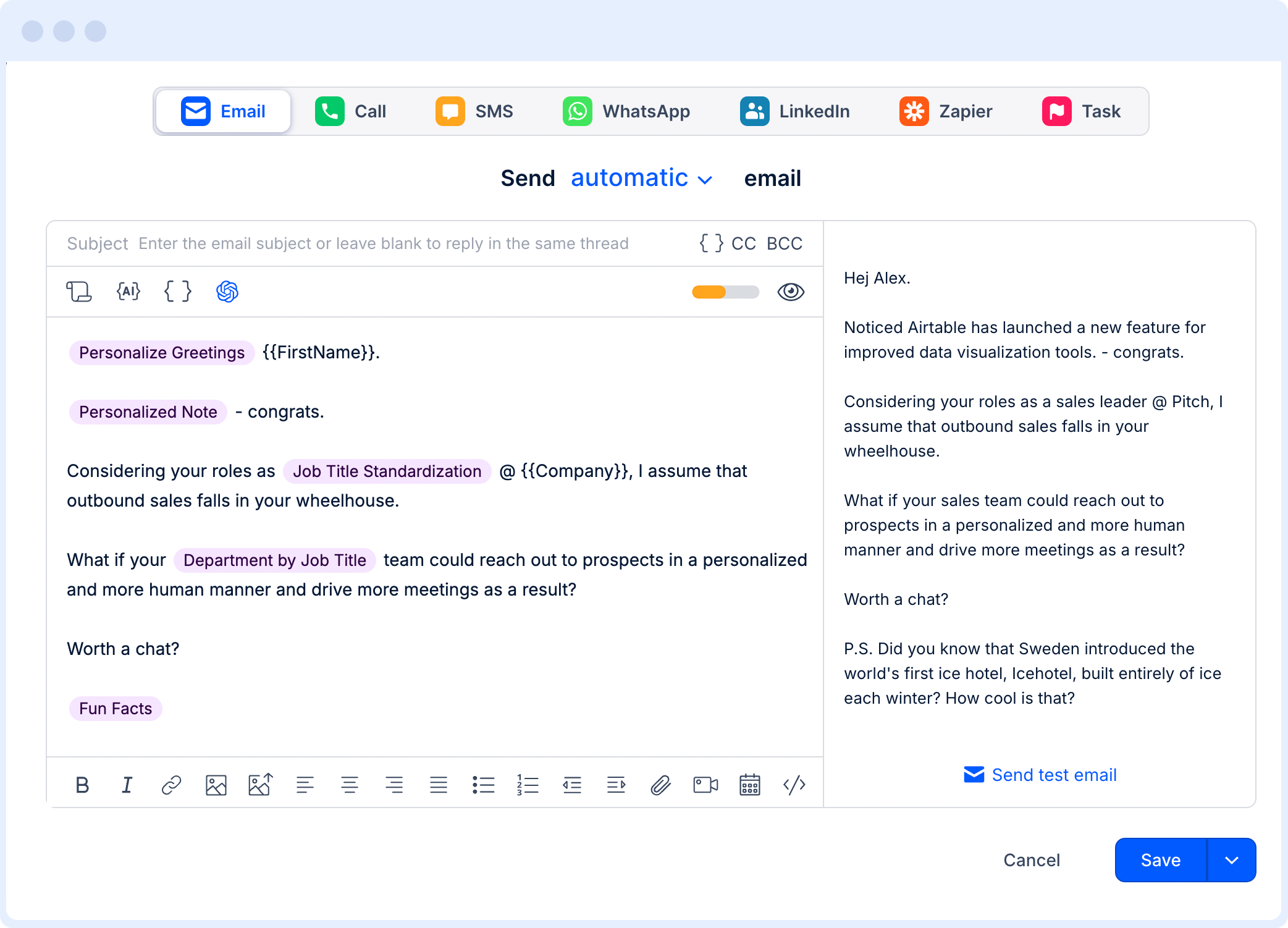
If you’re using Reply.io to generate leads and launch multichannel outreach, you get AI personalization built into your workflow, where the data and intent signals are leveraged to personalize each email, follow-up, and LinkedIn message on autopilot. 

You can also use the AI variables to create your own brand templates with custom variables, in which case Reply will simply research/enrich each lead to fill in those gaps with verified, real-time information. 

AI personalization

Treat deliverability and revenue metrics as one optimization loop

A lead generation campaign cannot convert if your emails never reach the recipients’ inboxes, and this is where email deliverability comes into play. But getting into the inbox is not the end goal either. The real goal is qualified conversations that turn into meetings, opportunities, and revenue.

That’s why both deliverability and performance have to be correctly tracked and managed together, as they affect one another. 

Poor-fit leads usually create weak engagement, and weak engagement leads to more ignores, unsubscribes, and spam complaints. Bad lists increase bounce rates, generic messaging lowers replies, and over time, all of that hurts both deliverability and pipeline.

Start with the technical foundation:

  • Set up SPF, DKIM, and DMARC
  • Validate emails before launching campaigns
  • Monitor bounce rates and spam complaints
  • Control sending volume (especially on LinkedIn) 
  • Warm up domains and mailboxes responsibly
  • Make it easy for your recipients to unsubscribe
  • Remove unengaged contacts from active sequences

Once the foundation is set in place and there’s a system to make sure it runs correctly, move on to the revenue metrics. Opens and clicks can still be useful signals, but they’re not enough on their own. Better metrics include:

  • Positive reply rate
  • Meeting booking rate
  • Opportunity creation rate
  • Cost per qualified meeting
  • Conversion by ICP segment
  • Conversion by channel
  • Conversion by intent signal

That gives you a real optimization loop to tweak your lead gen strategy over time. 

So if one ICP segment drives high bounce rates and low replies, the problem may be targeting or data quality. If another segment gets fewer replies but books more meetings, it may deserve more budget. If website-triggered outreach converts better than cold lists, then speed-to-lead may be the bigger lever.

The Joker card: Delegate lead generation to an AI sales agent

AI sales agents have completely transformed lead generation, allowing lean sales teams to grow their operations without increasing overhead or paying for enterprise tools. The best ones join your team like new reps that work around the clock with the precision and knowledge of a sales-focused AI model. 

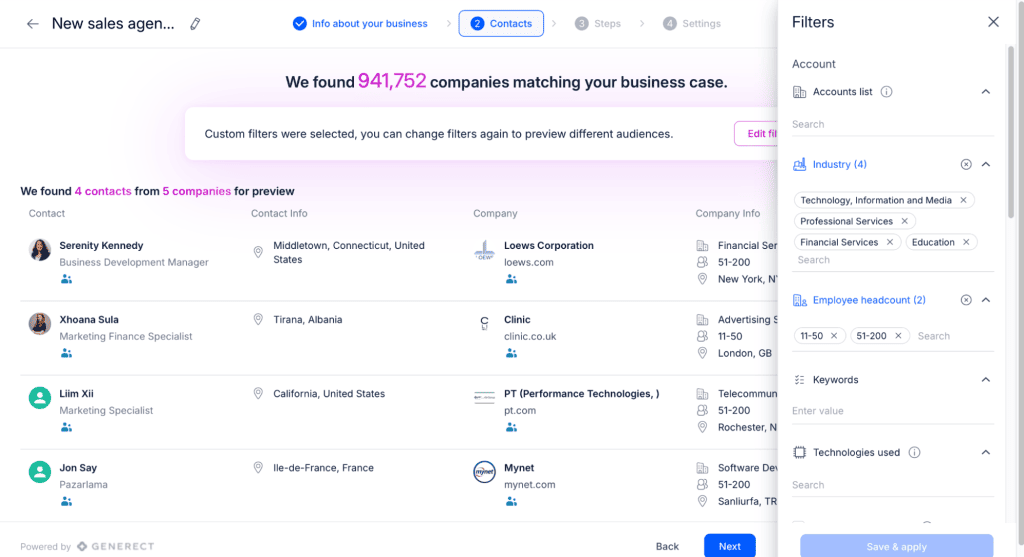
Jason AI is built for exactly this. It first learns everything about your business, ICP, product, sales strategy, tone, and playbooks. From there, it starts finding relevant accounts and contacts within those companies, validating email addresses, enriching leads with additional context from LinkedIn, company websites, and more, and picking up buying signals. 

live data

Next, Jason creates personalized outreach sequences for each lead with conditional logic, which means they adjust in real-time based on lead behavior. For instance, say the initial email goes unopened for 3 days, Jason then launches an automated LinkedIn connection request. Once accepted, it crafts a personalized LinkedIn message and cancels the scheduled email follow-up, and so on. 

how to send a second follow up email after no response with conditional sequences

Finally, once replies start coming in, Jason answers questions, handles objections, and books meetings on your behalf. Just like that, most of your lead generation is delegated to an AI sales agent, while you get a steady flow of qualified and interested leads, ready to talk further. 

The value here isn’t just automation. It’s controlled scale. Jason AI turns sales intelligence into actual outbound execution. It also supports outreach in 50+ languages, which is a big deal for teams expanding into multiple markets without building separate local sales teams from scratch.

Building a smarter lead generation system

Lead generation in 2026 has lots of moving pieces, so optimizing it is really about building a connected system where everything runs like clockwork. Clear ICP, clean data, buyer intent signals, coordinated email + LinkedIn outreach, deliverability, personalization, and revenue-focused measurement.

The teams that will win those deals are the ones that will identify better-fit buyers earlier, act on stronger signals, and follow up with more relevance.

Reply.io and Jason AI help fully automate that system and keep it running under one roof, from discovering targeted accounts to booking meetings. And once you automate all that, lead generation optimization stops feeling like a bunch of disconnected tactics and starts working like an actual growth engine.

FAQ: Lead generation optimization in 2026

What is lead generation optimization?

Lead generation optimization is the process of improving how your team finds the right accounts, reaches out to them, and turns their interest into real sales opportunities. In B2B, that usually comes down to more precise targeting, cleaner and more enriched lead data, better personalization, timely follow-ups, and a smoother path from discovery to meeting.

How do you improve lead quality in B2B lead generation?

If your ICP is too broad, everything downstream gets worse. Weak contact lists, generic messaging, and wasted touches. So first, narrow the targeting and create separate buyer segments if needed. Then clean and enrich the data, remove bad-fit accounts, and use lead scoring and intent signals to prioritize accounts most likely to convert at this very moment.

What are the best lead generation strategies in 2026?

The ones that rely on relevance, not volume. In practice, this refers to tight ICP targeting, intent signals, website visitor tracking, multichannel outreach, personalized cold emails, LinkedIn touches, lead scoring, and AI lead generation workflows. Different tactics, but the same general idea — reach the right accounts, at the right time, with a relevant message.

How does AI help with lead generation?

AI helps by taking a lot of the manual work completely off the table. It can speed up prospect research, lead discovery, enrichment, segmentation, personalization, outreach, and even reply handling if you’re using an AI sales agent. But in reality, it only works well when the foundation is solid, which means a clear ICP and clean data.

What is an AI sales agent?

An AI sales agent is software that handles a big chunk of sales development work for you, including finding leads, researching accounts, launching outreach, sending follow-ups, responding to replies, and booking meetings. Jason AI is one of the top AI sales agents on the market, purpose-built for B2B lead generation and outreach.

Subscribe to our blog to receive the latest updates from the world of sales and marketing.
Stay up to date.

Related Articles

Top 12 GTM Outbound Sales Platforms to Try in 2026

Top 12 GTM Outbound Sales Platforms to Try in 2026

Top 12 GTM Outbound Sales Platforms to Try in 2026
What’s New in Reply: New API, AI Custom Fields, LinkedIn Enrichment, and More

What’s New in Reply: New API, AI Custom Fields, LinkedIn Enrichment, and More

What’s New in Reply: New API, AI Custom Fields, LinkedIn Enrichment, and More
Best 12 CRM for Marketing Agencies in 2026

Best 12 CRM for Marketing Agencies in 2026

Best 12 CRM for Marketing Agencies in 2026