Step-by-Step Guide to SaaS Demand Generation for Your Team

Step-by-Step Guide to SaaS Demand Generation for Your Team

Build a useful product, price it competitively, acquire customers — that’s the SaaS playbook, right? Yes, but to a certain point.

However, today’s SaaS market demands more than finding business leads. You need sustained demand. 

That means you have to educate buyers, earn trust, and remain relevant throughout the tedious and increasingly complex B2B buying cycle.

Welcome to SaaS demand generation, a strategic, multi‑channel strategy rooted in awareness, engagement, and building ongoing interest and brand authority.

Demand gen is a significant paradigm shift, especially for SaaS companies, where success depends on recurring revenue, retention, and upsell opportunities. 

In this guide, you’ll learn a step-by-step framework on how to build a scalable SaaS demand generation strategy to ensure your business gets a long-term, steady flow of customers and revenue.

Who is your perfect customer (and what’s their journey like?)

Your SaaS demand generation strategy starts here. You need to know who you’re targeting and what they care about to the smallest details. 

Otherwise, you’ll most likely miss the mark even with the best inbound and outbound strategies in place.

But when personas and customer journeys reflect real buyer behavior, each touchpoint aligns better with your leads. Here’s what you need to do.

Define your Ideal Customer Profile (ICP) with precision

First, build personas that transcend job titles. Surface-level details rarely explain why buyers act the way they do. A complete buyer persona includes the following:

  • Demographics: Role, seniority, location, education
  • Firmographics: Industry, company size, revenue range, growth phase
  • Psychographics: Priorities, daily pain points, risk tolerance, decision style

You can gather these insights from sales calls, customer interviews, analytics tools, and support conversations.

To streamline this process, use tools such as HubSpot’s “Make My Persona,” Google Analytics audience insights, and dedicated free ICP templates.

This groundwork ensures your SaaS demand generation campaign resonates with the right audiences, increasing relevance and conversion rates.

Even so, building personas manually can be time-consuming, let alone leveraging them to generate leads. That’s where dedicated software like Jason AI, a powerful AI sales agent, comes into play. 

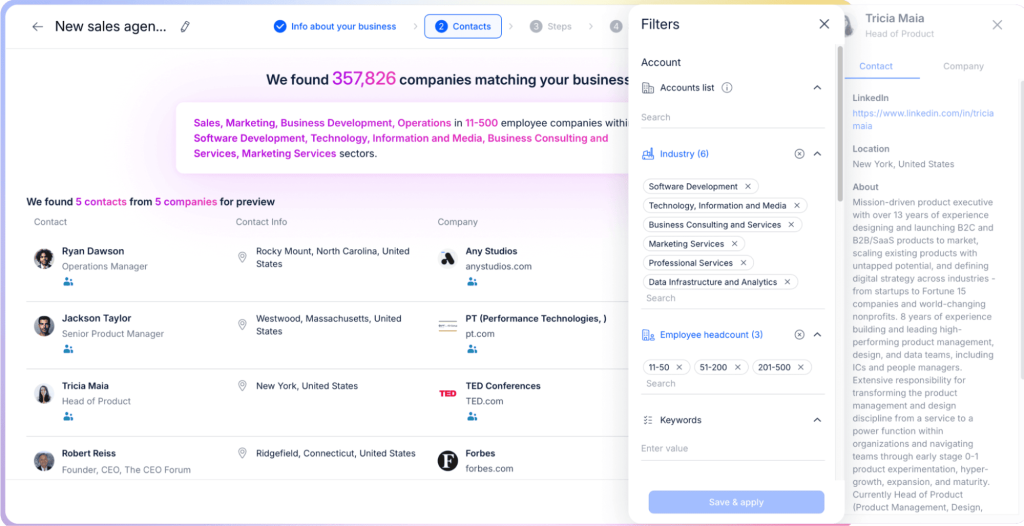
After just a few minutes of learning about your company, product, and value proposition, it then creates the most relevant buyer personas, and then scans its native lead database with over 1 billion live contacts to build you entire lists of targeted potential buyers.

Then, it researches each lead and company from LinkedIn, company pages, and more, and keeps an eye out for any intent signals that show when somebody is on the market right this moment. 

2. Map the customer journey with intent-first precision

With that out of the way, the next step of building a high-performing demand generation strategy for B2B SaaS is to align your campaign with how buyers make purchase decisions. 

Typically, most B2B SaaS journeys follow four stages as follows:

  • Awareness: The buyer realizes a challenge or opportunity
  • Consideration: They explore solutions and compare vendors
  • Decision: They evaluate your offer, pricing, and results
  • Retention and expansion: They become loyal users or upgrade accounts

Use frameworks like AIDA (Awareness, Interest, Desire, Action) to guide your messaging. 

You can, for instance, use blog posts to build awareness and case studies to spark interest. Meanwhile, leverage product demos to create desire, and personalized offers to prompt action.

3. Validate personas through feedback loops

Finally, regularly validate personas using onboarding surveys, behavior analytics, and A/B testing. 

In addition, be sure to use feedback from your marketing and sales teams to refine assumptions and improve accuracy over time. 

In the end, the stronger your buyer personas, the better your B2B SaaS demand generation outcomes will be.

What content will grab your prospects’ interest?

Content is the engine that powers SaaS demand generation.

And, to move prospects through each stage of the funnel, you need the right format, tone, and timing.

The idea is to create content that matches buyer intent and, by extension, boost conversions. Let’s unpack that.

Match content to funnel stages

Effective demand generation for SaaS companies begins with creating value at every stage of the buyer’s journey. Here’s how to structure your content accordingly:

Educational content

Use educational content to generate awareness and attract top-of-funnel traffic. At the awareness stage, your content should focus on educating your audience.

The best content to create here includes SEO-optimized blog posts, ungated whitepapers, explainer videos, and podcasts. 

You can also host webinars that speak to broad pain points. This type of content helps you establish credibility and attract top-of-funnel traffic.

Use tools like SEMrush and Ahrefs for keyword and topic research.

Evaluative content

Evaluative content helps buyers compare solutions and build trust in your offering at the consideration stage.

Offer detailed case studies that show ROI and calculators that quantify potential gains. You can also create product comparison guides and strategic retargeting ads.

Use tools like the HubSpot ROI calculator or Salesforce’s ROI models to develop high-impact assets. The goal is to show how your product solves problems and stacks up against other options.

Decision-driven content

Decision-driven content addresses last-minute objections and accelerates conversion. At the decision stage of the funnel, buyers now want proof and assurance before committing.

Provide free trials with onboarding support and demo scripts tailored to pain points. Include objection-handling guides and video testimonials for your reps. 

Also, consider hosting live Q&A sessions or webinars to address objections and build trust.  

Post-purchase content

You shouldn’t overlook post-sale content. After you’ve closed the deal, keep users engaged with onboarding tutorials, customer success stories, and product-related newsletter updates (which is also a great way to cross-sell offers as well). 

Pro tip: Timing is crucial here, so trigger promotions based on user behavior and segment using CRM data.

Use proven messaging frameworks

Two frameworks work well here. These are:

  • Problem–Agitate–Solve (PAS): Frame the pain point, intensify it, then offer your product as the solution.
  • StoryBrand: Position the customer as the hero, and your product as the guide.

Also, stick to SEO best practices, including structured headers, internal links, and metadata. Meanwhile, plugins like Yoast or RankMath can help streamline publishing via WordPress.

Plan, manage, and repurpose content

You must have a robust content management and repurposing plan to increase your messaging impact.

Use tools like Asana for managing content calendars and Canva for visuals. Grammarly can help you polish the content, while Google Keyword Planner is great for ideation.

While at it, repurpose high-performing pieces into newsletters, short videos, social snippets, or infographics to expand reach.

Which marketing channels should you use?

The best demand generation for SaaS growth is multi-faceted. It uses several touchpoints to guide buyers through the funnel.

Each channel plays a different role, depending on where your prospect is in their journey.

That said, you need to know when and how to use each one. Also, how to sync the channels into a cohesive, multi-touch experience.

Below is a rundown of the best marketing channels for B2B SaaS demand generation.

SEO → Use SEO to capture demand early in the funnel. Target top-ranking keywords in your niche to grow organic traffic to your blog. Build links through guest posts, and don’t forget to optimize page speed, URL structure, and schema markup for your website.

Paid advertising → run PPC for SaaS for intent-driven search queries, LinkedIn Ads for sponsored posts and InMail campaigns, and Facebook Ads for early-stage brand awareness or retargeting. Budget-wise, start small in top-of-funnel (TOFU) and scale in middle-of-funnel (MOFU). Then, optimize Cost-Per-Click (CPC) in the bottom-of-funnel (BOFU).

Social media → leverage LinkedIn for B2B thought leadership. Here, you’ll want to share polls, case studies, or insights on a fixed weekly schedule. X (formerly Twitter) is great for quick company updates and news, while Instagram and TikTok are good for SaaS brand storytelling. You can also use paid social media to boost high-performing posts.

Unlock the Power of LinkedIn Social Selling

Ready to level up on LinkedIn? This guide is perfect for small business owners, sales pros, and marketers looking for ways to build their brands, generate leads, and close more sales.

Email marketing

When it comes to email marketing, it’s crucial to break down your ICP (from step 1) into smaller customer segments, based on firmographics or behavioral triggers.

In addition, build funnel-stage drip campaigns using merge tags and dynamic blocks for personalization.

Time emails based on engagement patterns, and always A/B test subject lines and CTAs to see what works best.

Account-Based Marketing (ABM)

Account-based marketing is critical for SaaS companies. Start by selecting high-value accounts within your target companies, in other words, find the right decision-makers who would be the best point of contact for your offering. 

Then, create tailored sequences that include email, LinkedIn InMail, direct mail, and event invites. Finally, ensure your messaging aligns with the sales and marketing teams for consistency.

How do you capture and nurture leads effectively?

You may have the best content and an effective outreach campaign, but these won’t move the needle if you don’t have an efficient system to capture and nurture leads.

Demand generation for SaaS requires aligning your landing pages, data collection, scoring models, and follow-up workflows with buyer behavior.

That way, you can create a frictionless, timely, and relevant experience for your prospects, irrespective of where they are in the buyer’s journey. Here’s what you need to implement:

Optimize landing pages and CTAs → start with landing pages tailored to your ideal customers. Pages should feature value-focused messaging, form fields to capture emails, as well as trust signals like testimonials, partner logos, and security badges.

Get compliance and data hygiene right → your lead capture must be clean and compliant. Align your forms and tracking with GDPR and CCPA standards by implementing measures such as cookie consent banners, opt-in checkboxes, and privacy notices. Also, make sure to verify emails to keep your company domain healthy and avoid spam filters. 

Prioritize leads with scoring models → to ensure your sales team focuses on the right opportunities, implement a lead scoring system that considers:

  • Demographic fit, such as job title and company size
  • Firmographic signals, including industry, revenue, and tech stack
  • Behavioral data, such as pages visited, content downloaded, and email engagement

Nurture leads with personalized, behavior-triggered workflows → set up automated conditional sequences that ensure each lead gets the most relevant message, in the most relevant channel, at the most optimal time.

With Jason AI, this becomes incredibly painless as it creates custom, multichannel sequences for each unique lead based on their potential interest, online behavior, and more, even in the context of thousands of leads. 

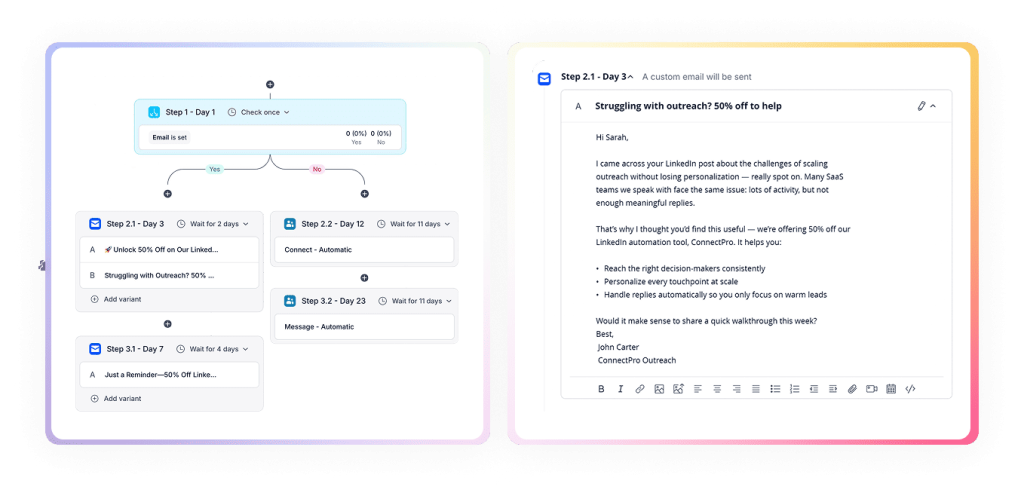
For instance, it will launch a personalized email, and after 3 days if there is no reply, Jason will send an automated LinkedIn connection request with a short personal note. Once accepted, it will then write up a friendly introductory message on LinkedIn, and so on.

How do you build and optimize your demand generation funnel?

A scalable demand generation funnel should move buyers from first contact to purchase and then keep them engaged after the sale. 

However, getting a lead to sign up or buy is only part of the job. For SaaS companies, next-level growth also depends on what happens after conversion.

That’s why creating a well-defined demand generation funnel gives structure to your growth efforts, clarifying what prospects need at every step of their journey. Here’s why that’s important: 

It aligns marketing and sales: When each stage of the funnel is clearly defined, both teams know when to engage, what qualifies a lead, and how to measure success. 

It makes your campaigns more intentional: Without funnel stages, you risk treating all leads the same. However, defining the journey allows you to tailor outreach, content, and CTAs to match buyer readiness. By extension, this helps improve conversion rates.

It sharpens your targeting: Understanding where a lead sits in the funnel lets you serve more relevant messaging. For example, someone browsing a blog post shouldn’t get a pricing-focused email. Instead, they should get an educational ebook to foster trust.

It reveals where revenue leaks: When you know your funnel stages, you can track performance by segment, such as awareness to consideration, or MQL to SQL. And if there’s a drop-off, you know exactly where to focus your optimization.

It supports better automation and personalization: Tools like HubSpot, Salesforce, and Jason AI rely on funnel logic to trigger workflows. Without defined stages, automation, even with the most powerful AI engine, becomes chaotic and ineffective.

It ensures post-sale growth isn’t an afterthought: Many SaaS companies stop at conversion. A mapped funnel reminds you that onboarding, product adoption, and expansion are equally important for recurring revenue and customer lifetime value.

Think of your funnel as the blueprint for both strategy and execution. Without it, your team is flying blind. With it, you can test, improve, and scale from a point of information.

Measure, test, and improve

Some of the tools you can use to measure and test performance include:

  • Google Analytics to track behavior and traffic sources
  • Salesforce dashboards to monitor pipeline movement
  • Tableau to visualize trends and funnel drop-offs
  • Optimizely or VWO to A/B test landing pages, emails, and offers

Regular testing and data-driven adjustments are crucial to keep your funnel effective.

How can you leverage AI, automation, and data for smarter demand gen?

AI-powered automation makes SaaS demand generation significantly easier. 

Behavioral data allows you to implement well-informed decisions, optimize touchpoints, and personalize experiences at scale. When combined with AI, the results are faster sales cycles, better targeting, and greater ROI across your funnel.

Here’s how to turn your tech stack into a growth engine: 

Use AI and machine learning (ML) to predict lead behavior

AI-powered tools are now playing a critical role in identifying high-intent buyers.

Platforms like 6sense and Bombora, for instance, use ML models to detect buying signals and predict intent based on firmographic and behavioral data.

You can also use platforms like HubSpot or Salesforce to implement predictive lead scoring

With these tools, you can surface your best-fit opportunities while reducing time wasted on low-quality leads.

Optimize ad spend with machine learning

SaaS marketers can use Google Ads and Facebook Campaign Budget Optimization to reallocate budgets in real time to the best-performing campaigns. This enables them to minimize waste, double down on what’s working, and shift budget instantly between funnel stages. 

Use conversational AI for real-time engagement

Buyers want quick answers once they land on your website.

AI-powered chatbots such as Drift and Intercom can help you with that. They guide site visitors, qualify leads, and schedule demos in real time through personalized conversation flows. These systems give your team 24/7 coverage and accelerate lead capture.

Automate personalization in content and email

AI tools can dynamically match the right message to the right user, and that’s not only a huge time saver, but also the only way to actually get your emails or LinkedIn messages opened and replied to. 

Besides building your ICP and continuously finding targeted leads for your business, Jason AI also leverages enriched researched data and online behavioral signals to hyper-personalize each and every message. 

For instance, if one of your target accounts just announced a new funding round on their LinkedIn, Jason will use that reference as the email/message opener to build rapport:

This way, businesses can rest assured that they have a powerful AI agent working 24/7 to find potential buyers, research them, craft personalized emails and messages, and launch tailored multichannel campaigns. Oh, and it also handles incoming replies on your behalf!

What common mistakes should you avoid?

Avoidable mistakes will almost always creep in, even when working with a demand generation agency for B2B SaaS companies. But it doesn’t have to be that way.

Below are some mistakes that silently kill performance and how to avoid them.

Focusing only on lead capture → A common misstep is investing heavily in top-of-funnel campaigns and neglecting long-term engagement. Without a strategy to educate, nurture, and guide leads through the funnel, you’ll end up with inflated lead numbers but little revenue impact.

Underinvesting in post-acquisition nurturing → Many SaaS companies stop the momentum after the sale. Lack of onboarding support, product education, or retention workflows leads to two fundamental problems. It increases churn and the customer’s lifetime value. 

Ignoring data and iterative testing → Without tracking performance, you’re flying blind. You must, therefore, analyze email open rates, landing page conversions, and ad performance. Then, use that data to run experiments and make improvements.

Overcomplicating the buyer journey → Too many steps, unclear messaging, or long forms create friction, which in turn causes leads to drop off. So keep it simple, and make sure each page, email, or ad has one clear next step that moves the lead forward.

Miscommunication between marketing and sales → You lose leads when teams don’t communicate or work in silos. A classic scenario is when the sales department doesn’t follow up or when marketing doesn’t know which channel is working best.

Neglecting personalization → If your emails or landing pages speak to everyone, they convert no one. To avoid this, use behavioral and firmographic data to tailor outreach. After all, relevance is what drives engagement.

Relying on manual outreach → Manual emails slow you down and create inconsistent follow-up. Luckily, you can use Jason AI to automate personalized outreach across email, LinkedIn, and more. It also responds to leads in real-time by handling objections and booking meetings on autopilot.

How do you effectively scale your SaaS demand generation?

The unwritten rule of scaling a SaaS business is simple: zero in on what works and double down on it.

Once you’ve built a functioning demand gen engine, your next job is to expand its impact without reinventing the wheel. Here’s how to do it:  

Systematize repeatable motions

Find the parts of your demand generation that already convert. Standardize those workflows, then automate them using tools like:

  • HubSpot for lifecycle sequences and form-based triggers
  • Salesforce for deal tracking and lead handoffs
  • Jason AI for multichannel outreach and reply handling across email and LinkedIn

Standardizing and automating frees up your team to focus on optimization and strategy.

Repurpose and scale high-performing content

Identify the content that consistently drives engagement and conversions. Then repurpose it as follows:

  • Turn blog posts into short videos or LinkedIn carousels
  • Repurpose webinars into nurture sequences or email courses
  • Use social snippets to drive traffic back to your top-funnel content

Repurposing high-converting content allows you to expand reach without creating new content from scratch every time.

Optimize channels using real-time data

Use machine learning and real-time analytics to help manage marketing spend and prioritize what’s working.

  • Use Google Smart Bidding and Facebook Campaign Budget Optimization to prioritize top-performing placements
  • Monitor engagement and drop-offs using Tableau or Google Analytics

The goal is to allocate resources where they’ll move the needle fastest.

Expand outreach without expanding team size

It’s hard to scale manual sales and marketing outreach without hiring more people, but with an AI agent like Jason AI, it becomes very easy and effective. 

And as your database grows, Jason ensures your outbound campaigns scale with it without leaving a hole in your budget, and all that’s left for your sales team is to focus on demo meetings and closing deals.

Build feedback loops into your system

Continuous improvement is the only way to scale sustainably. Therefore:

  • Collect insights from sales calls
  • Track content engagement
  • Run A/B tests on messaging

Then, update sequences, retargeting ads, and onboarding flows accordingly. With all these steps, that’s how your SaaS demand generation becomes less of a hustle with a scalable engine in place.

Closing thoughts

Getting demand generation right means thinking beyond isolated campaigns.

Focus on the full buyer lifecycle, from first touch to long-term customer value. 

For SaaS teams, the best strategy is to start small — choose one or two channels and invest in deep persona research. Next, create targeted content that speaks directly to buyer problems before scaling.

Leverage data to guide your strategy by tracking performance, testing processes, and refining continuously.

Most importantly, leverage reliable software like Jason AI to help you in your journey of building sustainable, long-term demand — your future self will thank you for it!

Subscribe to our blog to receive the latest updates from the world of sales and marketing.
Stay up to date.

Related Articles

What’s New in Reply: New API, AI Custom Fields, LinkedIn Enrichment, and More

What’s New in Reply: New API, AI Custom Fields, LinkedIn Enrichment, and More

What’s New in Reply: New API, AI Custom Fields, LinkedIn Enrichment, and More
Top 12 Cognism Alternatives for Finding Leads in 2026

Top 12 Cognism Alternatives for Finding Leads in 2026

Top 12 Cognism Alternatives for Finding Leads in 2026
Mailtrap Review 2026: Is This Email API the Right Fit for Your Team?

Mailtrap Review 2026: Is This Email API the Right Fit for Your Team?

Mailtrap Review 2026: Is This Email API the Right Fit for Your Team?